
Small and medium-sized businesses considering a switch to electric vans could face significantly different operating costs depending on their access to private charging facilities, according to new economic research. The study, conducted by the Centre for Economics and Business Research (Cebr), highlights how charging infrastructure, vehicle finance and lost working time can influence the financial case for electrification.
Commissioned by the Open Road Partnership, which includes United Rental Group, Zenith, Enterprise Mobility and Vertu Motors, the research examines the costs facing businesses replacing diesel vans with electric alternatives. Its findings suggest that while electric vans could deliver substantial savings for businesses with access to private charging, operators relying on public charging networks could face considerably higher costs.
For businesses operating smaller fleets, the findings raise important questions about the affordability of electrification, particularly where installing workplace charging infrastructure is not practical.
Electric Van Charging Could Create A £150,000 Cost Difference
The Cebr research examined a modelled construction business operating a fleet of 10 vans over five years. It found that the financial outcome of switching to electric vehicles varied considerably depending on where the vehicles were charged.
A business with access to private charging facilities could potentially save £42,000 over five years compared with continuing to operate diesel vans.
However, the same business relying on public charging could be £110,000 worse off once the cost of lost working hours is included. The difference between the two charging arrangements could therefore reach £150,000 over the five-year period.
The findings demonstrate that the purchase price of an electric van is only one part of the financial calculation. Businesses must also consider electricity prices, charging availability, vehicle utilisation and the amount of productive time employees spend away from their normal work.
For construction companies, tradespeople and other businesses whose employees travel between jobs throughout the working day, additional charging stops could create operational difficulties. Time spent travelling to charging locations and waiting for vehicles to recharge can affect the number of jobs completed and the overall productivity of a business.
This makes it important to consider the total cost of ownership of business vehicles, rather than comparing monthly vehicle payments or fuel costs in isolation.
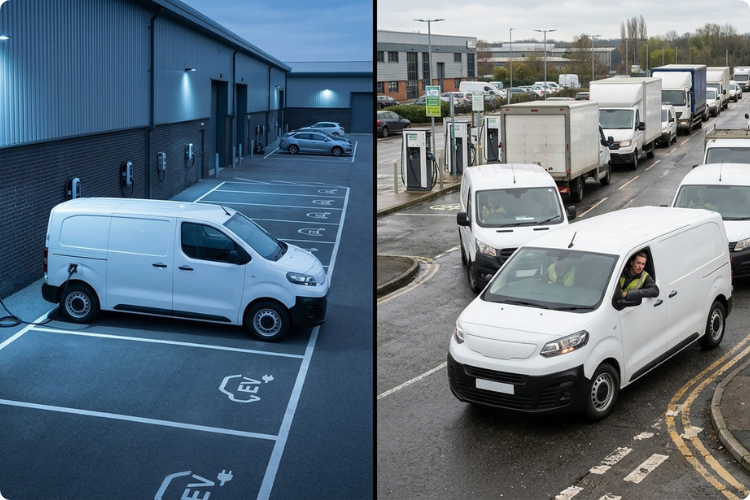
Private Charging Makes A Significant Difference
Access to private charging infrastructure appears to be one of the biggest factors influencing the financial viability of electric vans.
Businesses with suitable premises can potentially install workplace charging equipment and recharge vehicles while they are parked overnight or during periods when they are not required. This can reduce reliance on public charging networks and make it easier to plan vehicle availability.
The research suggests that the modelled 10-van business with private charging could see its annual costs fall below those of diesel from 2027, reaching break-even by 2028.
However, not every business has access to a depot, dedicated parking facilities or sufficient electrical capacity to support multiple charging points.
Smaller operators may work from shared premises, residential addresses or locations where installing charging equipment is not possible. Others may have employees taking vehicles home, making it difficult to establish a centralised charging arrangement. Where employees charge company vans at home, businesses also need to consider how electricity costs will be recorded and reimbursed. CVC’s guide to home EV charging reimbursement for fleets explains some of the practical and administrative considerations.
Businesses without dedicated charging facilities may need to rely on public rapid chargers or alternative workplace arrangements. These can introduce additional costs and require more planning around daily vehicle movements.
Our guide to how electric vehicle charging works for businesses explains the different charging arrangements available to companies and the considerations involved when introducing electric vehicles into a working fleet.
Public Charging Costs Extend Beyond Electricity Prices
The financial comparison between electric and diesel vans is not simply a question of how much it costs to recharge a battery compared with filling a diesel tank.
The Cebr research estimates that relying on public charging could result in more than £23,800 of lost productive output every year for the modelled 10-van business. Businesses can also use CVC’s EV charging time calculator to estimate how long different charging arrangements could take, helping them assess the potential impact on vehicle availability and working schedules.
This figure highlights the potential impact of charging-related downtime, particularly for businesses whose vehicles need to remain operational throughout the working day.
A tradesperson travelling between several customer appointments, for example, may have limited opportunities to stop and recharge. A delivery business operating to strict schedules could also find that charging requirements affect route planning and vehicle availability.
Public charging prices can also vary depending on the charging provider, location, charger speed and payment arrangement. Rapid charging may offer greater convenience but can be more expensive than charging overnight using a suitable private electricity supply.
Businesses should therefore consider their typical mileage, daily routes, parking arrangements and charging opportunities before deciding whether an electric van is suitable.
For companies comparing electric and diesel running costs, CVC’s electric van versus diesel van comparison provides a useful starting point.
Upfront Electric Van Costs Remain A Barrier For SMEs
Although electric vans can offer lower running costs in certain circumstances, the initial investment required to introduce them can be difficult for smaller businesses to absorb.
According to the Cebr research, a medium-sized business replacing its diesel fleet with 10 new electric vans could face approximately £15,500 in additional costs during the year of purchase.
These costs are primarily associated with the initial vehicle investment and the infrastructure needed to support charging.
For an SME operating with limited cash reserves, committing to several new vehicles and installing charging equipment at the same time can place pressure on working capital. Smaller operators make up a substantial part of the UK commercial vehicle market. CVC’s report on how small fleets account for 63% of UK commercial vehicles highlights the importance of smaller businesses, many of which may have fewer financial resources and less flexibility when investing in electric vehicles and charging infrastructure.
Larger fleet operators may have greater financial flexibility, established depot facilities and dedicated fleet management resources. Smaller businesses may have fewer opportunities to spread the investment or benefit from economies of scale.
This is particularly relevant for sole traders and companies operating only a handful of commercial vehicles, where the cost of installing charging infrastructure could represent a significant proportion of the overall investment.
Businesses should also consider the availability of government support, including the Plug-in Van Grant and eligible workplace charging schemes, when assessing the initial cost of electrification.

Can Leasing Make Electric Vans More Affordable?
Vehicle leasing could help businesses manage the initial financial commitment involved in introducing electric vans.
Rather than purchasing vehicles outright, companies can spread the cost through fixed monthly payments over an agreed contract period. This can help preserve working capital and make vehicle replacement costs easier to budget for.
However, the Cebr research also highlights that financing does not automatically make the transition cheaper.
Its model suggests that financing could erode the longer-term savings available from switching to electric vehicles, leaving a modelled sole trader approximately £100 worse off after five years than purchasing a diesel van outright.
This demonstrates why businesses need to assess the complete financial picture rather than assuming that lower monthly payments will necessarily translate into lower overall costs.
Leasing providers can also play an important advisory role beyond arranging vehicle finance. CVC’s article on how leasing providers are helping fleets electrify examines how leasing companies can support businesses with vehicle selection, charging infrastructure and the wider transition to electric vehicles.
Contract length, initial rentals, annual mileage, maintenance arrangements and the expected vehicle replacement cycle can all influence the outcome.
Businesses considering this approach can explore the different business vehicle leasing and finance options available, including how contract hire and other finance arrangements work.
The right arrangement will depend on the company’s financial position, vehicle requirements and how frequently its commercial vehicles are used.

Electric Van Registrations Remain Below Government Targets
The financial challenges identified by the research come as electric van registrations continue to fall short of the Government’s Zero Emission Vehicle (ZEV) mandate targets.
According to the Society of Motor Manufacturers and Traders (SMMT), battery electric vans accounted for 11% of new light commercial vehicle registrations in the UK during the first 10 months of 2026.
However, that figure includes certain electric commercial vehicles weighing more than 3.5 tonnes. For vans up to 3.5 tonnes, the comparable year-to-date market share was 9.7%, against a 24% ZEV mandate target for 2026. SMMT+1
Although electric van registrations increased during October, the figures highlight the continuing gap between actual demand and the targets manufacturers are expected to meet.
The Government’s ZEV mandate review is therefore particularly important for the commercial vehicle sector. The consultation closed on 23 October 2026, with the Department for Transport confirming that it aims to publish its response by the end of the year. Any changes are expected to take effect from the 2027 compliance year, although no policy decisions have yet been made. UK Parliament+1
The findings from Cebr add to the wider discussion about whether businesses have sufficient financial and practical support to transition their fleets.
Wider concerns have also been raised about whether the current targets reflect the practical challenges facing commercial operators. CVC’s report on how electric vans remain behind ZEV targets as fleets call for a more realistic transition examines the issues surrounding vehicle costs, charging infrastructure and the support needed to make electric vans a viable option for more businesses.
CVC has previously examined the challenges surrounding the UK’s ZEV mandate and electric vehicle targets, including the pressures facing manufacturers and commercial vehicle operators.
What Should Businesses Consider Before Switching To Electric Vans?
The research highlights why businesses should assess their individual operating requirements before deciding whether to replace diesel vans with electric alternatives.
For businesses operating several commercial vehicles, reviewing the wider fleet can also help identify where electric vans are financially and operationally suitable. CVC’s fleet management solutions include fleet audits, whole-life cost analysis, vehicle utilisation reviews and support with planning the transition to electric vehicles.
Businesses planning a wider change to their vehicles can also refer to CVC’s guide to transitioning a business van fleet from diesel to electric, which covers charging infrastructure, total cost of ownership, vehicle trials and phased fleet replacement.
The potential savings will depend on several factors, including annual mileage, electricity prices, charging access and how vehicles are used throughout the working day.
Businesses should consider:
- Daily mileage: Establish how far each van typically travels and whether its usable driving range is sufficient for normal operations.
- Charging availability: Assess whether vehicles can be charged at business premises, at employees’ homes or through suitable public charging facilities.
- Installation costs: Establish whether workplace charging equipment is required and whether the existing electrical supply can support it.
- Vehicle utilisation: Consider how much time vehicles spend parked and whether charging can take place outside normal working hours.
- Finance arrangements: Compare outright purchase, contract hire and other finance options, taking account of initial payments and total contract costs.
- Running costs: Compare electricity, diesel, maintenance and other operating expenses over the expected period of ownership or use.
- Government support: Check which grants or financial incentives are available and whether the business and vehicles meet the eligibility requirements.
Businesses can use CVC’s electric vehicle running cost calculator to estimate electricity expenditure, alongside its fuel cost calculator to compare potential diesel running costs.
For a broader assessment, the total cost of ownership guide explains the different expenses businesses should consider when choosing and operating commercial vehicles.
The research does not suggest that electric vans are unsuitable for SMEs. Instead, it demonstrates that the financial case can vary significantly between businesses, depending on their infrastructure, vehicle usage and financing arrangements.
For businesses that cannot install private charging facilities, the decision may be more complicated. CVC’s guide to charging an electric vehicle without a driveway also explores some of the practical challenges facing drivers without dedicated charging facilities.

 Call our expert team on