
Personal Contract Hire (PCH) is a popular way for UK motorists to access a new car or van without buying it outright.
Instead of taking ownership of the vehicle, you agree to use it for a fixed period and an agreed mileage. You then make an initial rental payment followed by regular monthly payments. At the end of the agreement, the vehicle is normally returned to the leasing company.
For drivers who want predictable monthly costs, access to newer vehicles and the flexibility to change cars every few years, Personal Contract Hire can be an attractive alternative to buying a car or using an ownership-based finance agreement.
But how does Personal Contract Hire work, what does it cost, and is it the right option for you?
What Is Personal Contract Hire?
Personal Contract Hire is a form of vehicle leasing designed for private individuals.
You do not normally own the vehicle. Instead, you pay to use the car for an agreed contract period and mileage.
A Personal Contract Hire agreement will usually specify:
- The vehicle being leased
- The contract length
- The agreed annual mileage
- The initial rental
- The monthly rental
- Whether maintenance is included
- Any additional services included in the agreement
At the end of the contract, the vehicle is normally returned to the leasing company, subject to the agreed mileage and fair wear and tear requirements.
One of the main attractions of Personal Contract Hire is that you do not normally have to sell the vehicle when the agreement ends.
Personal Contract Hire can be available on a wide range of cars, including:
- Small cars
- Hatchbacks
- Saloon cars
- Estate cars
- SUVs
- Crossovers
- Electric cars
- Hybrid cars
- Plug-in hybrid cars
- Premium cars
The availability of specific vehicles and finance structures will depend on the finance provider and individual agreement.
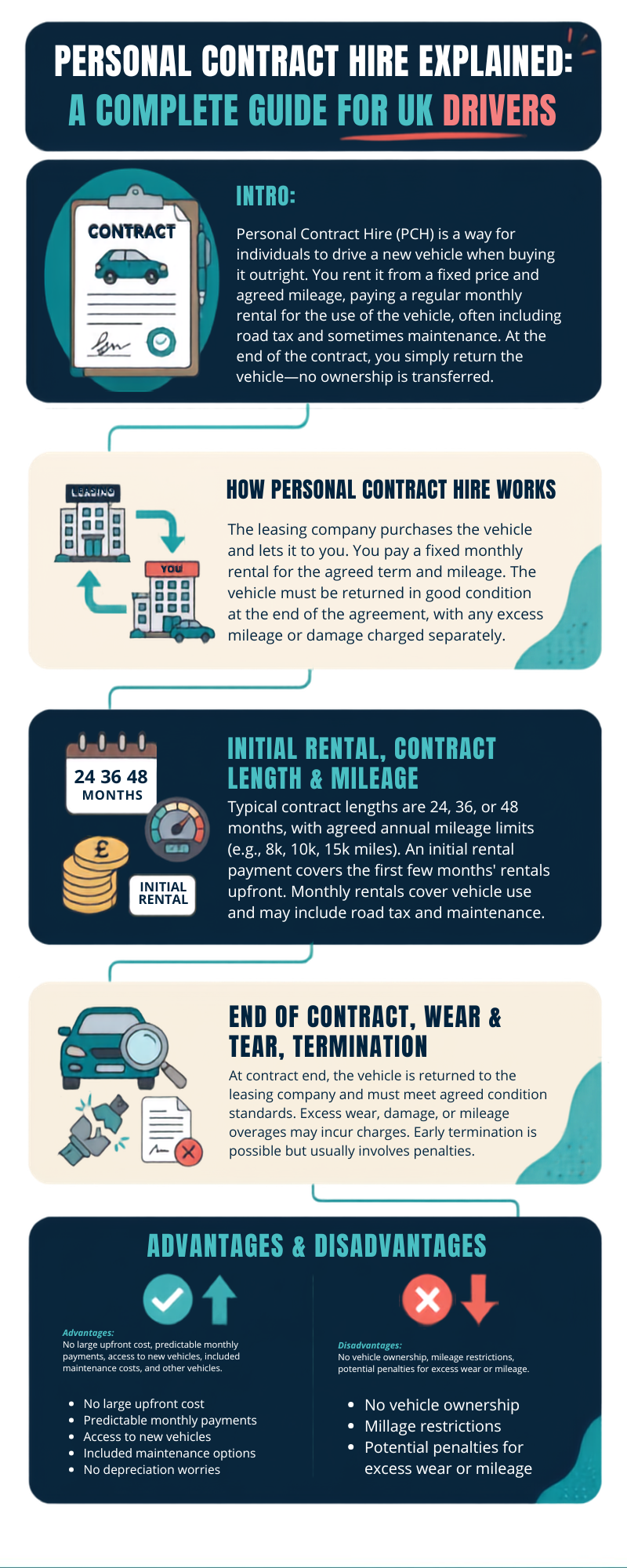
How Does Personal Contract Hire Work?
Personal Contract Hire is based around an agreed vehicle, contract term, mileage and rental structure. Our vehicle leasing FAQs provide further information about how leasing agreements work, including payments, mileage and contract terms.
First, you choose a suitable vehicle and estimate how many miles you expect to cover each year. For more information, see our Guide to Van and Car Lease Mileage Allowance.
The leasing provider then calculates the rental based on factors including:
- Vehicle value
- Expected depreciation
- Contract length
- Annual mileage
- Initial rental
- Funding costs
- Optional maintenance
- Other services included in the agreement
You pay the agreed initial rental, followed by the remaining monthly rentals throughout the contract.
Once the agreement reaches its end, the vehicle is normally handed back to the leasing company.
This makes Personal Contract Hire particularly attractive to people who want a straightforward way to change cars regularly without having to sell their existing vehicle.
Can You Use Personal Contract Hire For A Van?
Yes, Personal Contract Hire can be used to lease a van, but it is designed for private individuals rather than businesses. If you are using the van for business purposes, Business Contract Hire or another business finance option may be more appropriate, depending on your circumstances.
If you are looking for finance for a van that will be used by a business, our Van Finance For Businesses guide explains the main business finance options available.
What Is An Initial Rental?
The initial rental is the first payment made at the beginning of a Personal Contract Hire agreement.
It is sometimes referred to as a deposit, but it is important to understand that it is not normally a refundable deposit.
Initial rentals are commonly expressed as a number of monthly payments, such as:
- 1 month
- 3 months
- 6 months
- 9 months
- 12 months
For example, if the monthly rental is £300 and the agreement has a six-month initial rental, the first payment would be £1,800.
A larger initial rental can reduce the subsequent monthly payments, while a smaller initial rental generally results in higher monthly rentals.
When comparing Personal Contract Hire offers, it is therefore important to consider the total cost of the agreement rather than looking at the monthly rental alone.
How Long Does Personal Contract Hire Last?
Personal Contract Hire agreements are available over a range of contract periods.
Common contract lengths include:
- 24 months
- 36 months
- 48 months
- 60 months
The most suitable term will depend on your circumstances, the vehicle and how frequently you want to replace your car.
A shorter agreement may allow you to change vehicles more regularly, while a longer agreement can spread the cost over a greater period.
How Does Mileage Work With Personal Contract Hire?
Mileage is an important part of a Personal Contract Hire agreement.
When the contract is arranged, you agree on an annual mileage allowance. This is used to calculate the monthly rental.
For example, you could choose an allowance of:
- 5,000 miles per year
- 8,000 miles per year
- 10,000 miles per year
- 12,000 miles per year
- 15,000 miles per year
- 20,000 miles per year
Available mileage allowances will vary depending on the vehicle and leasing provider.
It is important to provide as accurate an estimate as possible.
If the vehicle travels significantly more miles than agreed, an excess mileage charge may apply when the vehicle is returned.
What Happens If You Exceed Your Mileage?
If you exceed the agreed mileage, an excess mileage charge may be applied when the vehicle is handed back. You can find out more about how these charges work in our guide to Excess Mileage Charges.
The charge is normally calculated using the excess mileage rate specified in your agreement.
For example, if a three-year agreement allows a total of 30,000 miles and the vehicle is returned with 36,000 miles, the additional 6,000 miles could be subject to an excess mileage charge.
This is why it is important to think carefully about how you expect to use the vehicle before agreeing to the mileage.
If your circumstances change and you expect to travel significantly more miles than originally planned, it is worth speaking to your leasing provider as early as possible.
What Happens At The End Of A Personal Contract Hire Agreement?
At the end of a Personal Contract Hire agreement, the vehicle is normally returned to the leasing company.
The vehicle will be assessed against the agreed mileage and fair wear and tear standards.
If the vehicle has been maintained correctly, is within the agreed mileage and is in an acceptable condition, the hand-back process should be straightforward.
You do not normally have to sell the vehicle or find a buyer yourself.
This is one of the key differences between Personal Contract Hire and finance products designed to lead towards vehicle ownership.
| Personal Contract Hire Feature | How It Works |
|---|---|
| Vehicle ownership | The leasing company normally remains the legal owner throughout the agreement. |
| Initial rental | An initial rental is paid at the beginning of the agreement and is normally calculated as a number of monthly rentals. |
| Monthly payments | You make regular monthly rentals throughout the agreed contract period. |
| Contract length | Personal Contract Hire can typically be arranged over a range of terms, depending on the vehicle and leasing provider. |
| Annual mileage | An agreed annual mileage is set at the beginning of the agreement and forms part of the rental calculation. |
| Excess mileage | Additional charges may apply if the vehicle exceeds the agreed mileage when it is returned. |
| Maintenance | A maintenance package may be available to cover certain servicing and running costs. |
| Vehicle depreciation | The leasing company generally takes responsibility for the vehicle’s future residual value. |
| End of agreement | The vehicle is normally returned to the leasing company, subject to mileage and fair wear and tear requirements. |
| Main benefit | Predictable vehicle costs and a straightforward vehicle replacement process. |
| Main consideration | You do not normally own the vehicle and must stay within the agreed mileage and condition requirements. |
What Is Fair Wear And Tear?
Fair wear and tear refers to reasonable deterioration that occurs during the normal use of a vehicle.
A vehicle is not expected to be returned in exactly the same condition as when it was delivered.
However, damage that goes beyond what would reasonably be expected for the vehicle’s age and mileage may result in charges.
This can include significant dents, scratches, damaged wheels, damaged interior trim or other damage that falls outside the relevant fair wear and tear standards.
Drivers should therefore take reasonable care of their vehicles throughout the agreement and repair significant damage where appropriate.
Can Maintenance Be Included With Personal Contract Hire?
Yes, vehicle maintenance can often be added to a Personal Contract Hire agreement.
A maintained agreement can cover certain routine vehicle costs, potentially including:
- Scheduled servicing
- Routine maintenance
- Replacement tyres
- MOT requirements where applicable
- Breakdown assistance
- Certain wear-and-tear items
The exact cover will depend on the maintenance package selected and the terms of the agreement.
Adding maintenance can make budgeting for your vehicle easier because more of the ongoing running costs are incorporated into a regular payment.
Whether maintenance is worthwhile will depend on the vehicle, contract length and your individual circumstances.
You can also read our guide to Maintenance vs Warranty to understand the difference between the two.
What About Road Tax?
Vehicle Excise Duty, commonly known as road tax, is generally dealt with by the leasing company during a Personal Contract Hire agreement.
The exact arrangements will depend on the agreement and should be confirmed when the vehicle is ordered.
Is VAT Included In Personal Contract Hire?
Unlike business leasing, private customers do not generally have the same VAT recovery considerations associated with a business vehicle lease.
The advertised Personal Contract Hire rental will normally include VAT where applicable, meaning the price you see for a private lease is generally the amount you pay rather than a business price that needs VAT added separately.
Always check the quotation and finance agreement carefully to confirm exactly what is included in the advertised rental.
What Are The Advantages Of Personal Contract Hire?
Personal Contract Hire offers several potential benefits for private motorists.
Predictable Monthly Costs
Personal Contract Hire provides an agreed payment structure, making it easier to budget for your vehicle.
Rather than buying a car outright and having to consider its future resale value, you know the rental you have agreed to pay throughout the contract.
No Need To Sell The Vehicle
One of the biggest practical benefits is that you normally return the vehicle at the end of the agreement.
There is no need to advertise the car, negotiate with potential buyers or arrange its sale.
Reduced Exposure To Depreciation
Cars lose value over time, with depreciation being one of the largest costs associated with vehicle ownership.
With Personal Contract Hire, the leasing company generally takes responsibility for the vehicle’s future residual value.
You are therefore not normally responsible for selling the car when the agreement ends.
Access To Newer Cars
Personal Contract Hire can make it easier to change cars regularly.
This can provide access to newer technology, improved fuel efficiency, modern safety equipment and the latest electric and hybrid vehicles.
Easier Vehicle Replacement
Personal Contract Hire can provide a straightforward vehicle replacement cycle.
Once the agreement ends, you normally hand the vehicle back and can arrange another vehicle if you want to continue leasing.
This can appeal to drivers who prefer changing their car every few years rather than keeping the same vehicle for a long period.
Are There Any Disadvantages To Personal Contract Hire?
Personal Contract Hire is not right for everyone.
There are several factors to consider before entering into an agreement.
You Do Not Normally Own The Vehicle
You normally return the vehicle at the end of the agreement.
If your priority is to own your car, Hire Purchase or another ownership-based finance option may be more appropriate.
Mileage Restrictions Apply
Your rental is calculated using an agreed mileage.
Exceeding the agreed mileage can result in additional charges.
The Vehicle Must Be Returned In An Acceptable Condition
Damage beyond fair wear and tear can result in charges when the vehicle is returned.
You should therefore take reasonable care of the vehicle throughout the agreement.
Early Termination Can Be Expensive
Personal Contract Hire agreements are designed around a specific contract period and mileage.
Ending an agreement early can therefore result in additional costs.
You should make sure you are comfortable with the contract term and expected mileage before entering into an agreement.
Personal Contract Hire vs Finance Lease
Personal Contract Hire and Finance Lease work differently and are generally aimed at different types of customers.
Personal Contract Hire is designed around using a vehicle for an agreed period and mileage before normally returning it to the leasing company.
Finance Lease is structured differently and can provide alternative end-of-term arrangements.
For most private motorists looking for a straightforward way to lease a car and hand it back at the end, Personal Contract Hire is the more directly relevant option.
Personal Contract Hire vs Lease Purchase
Personal Contract Hire and Lease Purchase have very different objectives.
With Personal Contract Hire, you normally return the vehicle at the end of the agreement.
With Lease Purchase, the agreement is structured with eventual ownership as the objective, normally following payment of a final balloon payment.
Personal Contract Hire can therefore be more suitable if you do not want to own the vehicle, while Lease Purchase may appeal to customers who want to retain the vehicle once the agreement has been completed and the applicable final payment requirements have been met.
Personal Contract Hire vs Hire Purchase
Hire Purchase provides a route towards ownership.
You make regular repayments towards the vehicle and, subject to the agreement being completed and any applicable final purchase fee being paid, ownership transfers to you.
Personal Contract Hire works differently. You pay for use of the vehicle and normally hand it back at the end of the agreement.
Hire Purchase may therefore be more appropriate where long-term ownership is important, while Personal Contract Hire can be attractive if you prefer to change vehicles regularly.
Personal Vehicle Finance Options At A Glance
| Finance Option | Vehicle Ownership | Initial Payment | Mileage Structure | What Happens At The End? | Best Suited To |
|---|---|---|---|---|---|
| Personal Contract Hire | Leasing company | Initial rental | Agreed annual mileage | Vehicle is normally returned to the leasing company | Drivers wanting predictable costs and regular vehicle replacement |
| Hire Purchase | Finance provider until agreement is completed | Deposit may apply | No standard Contract Hire mileage allowance | Ownership transfers once the agreement and applicable final payment requirements are completed | Drivers looking for a route to ownership |
| Lease Purchase | Finance provider until agreement is completed | Deposit or initial payment may apply | No standard Contract Hire mileage allowance | Ownership passes after the agreement is completed and the final payment and any applicable fees have been paid, subject to the terms of the agreement. | Drivers intending to own the vehicle |
| Outright Purchase | Customer | Full vehicle cost upfront | No contractual mileage limit | Customer keeps the vehicle | Drivers with sufficient funds to purchase outright |
Is Personal Contract Hire Suitable For Private Individuals?
Personal Contract Hire can be suitable for a wide range of private motorists, subject to finance approval and the terms of the agreement.
For drivers who want to keep their monthly vehicle costs predictable, leasing can provide an alternative to purchasing a car outright.
It can also provide access to newer cars without having to find a buyer for the vehicle at the end of the agreement.
However, you should consider your expected mileage, contract length, budget and whether ownership is important before deciding which finance option is most appropriate.
Who Is Personal Contract Hire Best Suited To?
Personal Contract Hire may be suitable for drivers who:
- Want predictable monthly vehicle costs
- Prefer not to own their vehicle
- Want to replace their car regularly
- Have a reasonably predictable annual mileage
- Want to avoid selling their vehicle at the end of the agreement
- Want reduced exposure to vehicle depreciation
- Prefer driving a newer vehicle
- Want the option of adding a maintenance package
It may be less suitable for drivers who expect to keep a vehicle for many years, cover unpredictable mileage or want to own their car outright.
| If Your Priority Is… | Finance Option To Consider | Why? |
|---|---|---|
| Predictable monthly costs and returning the vehicle | Personal Contract Hire | You use the vehicle for an agreed term and mileage and normally return it at the end. |
| Owning the vehicle after making regular repayments | Hire Purchase | Provides a route towards ownership once the agreement and applicable final payment requirements have been completed. |
| Spreading the cost while planning to own the vehicle | Lease Purchase | Structured around eventual ownership, subject to the agreement and final payment. |
| Buying the vehicle outright | Outright Purchase | You pay for the vehicle upfront and own it. |
How Much Does Personal Contract Hire Cost?
The cost of Personal Contract Hire depends on the vehicle, contract length, agreed mileage and payment structure.
The monthly rental can be influenced by factors including:
- Vehicle purchase price
- Expected depreciation
- Contract length
- Agreed annual mileage
- Initial rental
- Interest and funding costs
- Maintenance
- Additional services included in the agreement
A higher initial rental will generally reduce the subsequent monthly payments, while a lower initial rental will usually result in higher monthly rentals.
Mileage is also particularly important with Personal Contract Hire. A higher annual mileage can increase the rental because the vehicle is expected to have a lower value when it is returned.
You should therefore compare the overall cost of an agreement rather than choosing a Personal Contract Hire offer based solely on the advertised monthly rental. Our FAQs also explain some of the factors that can affect leasing costs.
It is also important to consider any maintenance costs, excess mileage charges and potential end-of-contract charges when calculating the overall cost of leasing a vehicle.
The best way to establish the cost of Personal Contract Hire is to obtain a quotation based on the specific vehicle, contract term, mileage and payment structure you require.
| Contract Hire Cost | What It Means | What You Should Consider |
|---|---|---|
| Initial Rental | The upfront payment made at the beginning of the agreement. | A higher initial rental can reduce the subsequent monthly payments, but increases the amount paid at the start. |
| Monthly Rentals | Regular payments made throughout the Personal Contract Hire agreement. | Compare the number and amount of rentals rather than focusing only on the advertised monthly figure. |
| Contract Length | The period for which the vehicle is leased. | A longer or shorter term can affect the monthly rental and how often you replace your vehicle. |
| Annual Mileage | The agreed number of miles the vehicle is expected to cover each year. | Estimate mileage carefully because exceeding the agreed allowance can result in excess mileage charges. |
| Maintenance | Optional servicing and maintenance cover that can be added to some agreements. | Consider whether including maintenance makes vehicle costs easier to budget. |
| Insurance | You are normally responsible for arranging appropriate insurance. | Check the insurance requirements before taking delivery of the vehicle. |
| Road Tax | Vehicle Excise Duty is generally dealt with by the leasing company during the agreement. | Confirm what is included within your specific Personal Contract Hire agreement. |
| Excess Mileage | A charge that may apply if the vehicle exceeds the agreed mileage when returned. | Make sure your agreed mileage accurately reflects your expected use. |
| Fair Wear And Tear | Reasonable deterioration expected during normal vehicle use. | Damage beyond acceptable fair wear and tear may result in charges when the vehicle is returned. |
| End-Of-Contract Costs | Charges may apply for excess mileage or damage beyond fair wear and tear. | Understand the hand-back requirements before entering the agreement. |
What Should You Consider Before Taking Personal Contract Hire?
Before entering into a Personal Contract Hire agreement, you should consider more than just the advertised monthly rental.
Think about:
Your Expected Mileage
Estimate how many miles you are realistically likely to cover each year.
Consider your commute, weekend driving, holidays and any other regular journeys before choosing your mileage allowance.
Contract Length
Consider how long you realistically want to keep the vehicle.
If you prefer changing cars regularly, a shorter agreement may be more appealing. If you want to keep the same vehicle for longer, a longer contract could be worth considering.
Initial Rental
Compare different initial rental structures and look at the overall cost of the agreement.
A low monthly rental can sometimes be achieved by paying a larger initial rental, so it is important to compare like-for-like offers.
Maintenance
Decide whether including maintenance would make managing your vehicle costs easier.
A non-maintained agreement may have a lower monthly rental, but you will need to budget separately for servicing, tyres and other eligible maintenance costs.
Vehicle Usage
Consider how you will use the vehicle and whether the chosen car is suitable for your lifestyle.
Think about passenger space, boot capacity, fuel or charging requirements and the type of journeys you regularly make.
End-of-Contract Requirements
Make sure you understand the rules around mileage, vehicle condition and returning the car.
Knowing what is expected before taking delivery can help you avoid unexpected charges later.
Ownership
Most importantly, decide whether you want to own the vehicle at the end of the agreement.
If ownership is important to you, another finance product may be more suitable.
You should also be aware of the common pitfalls associated with vehicle leasing, which we cover in 5 Mistakes People Make When Leasing A Vehicle (And How To Avoid Them).
 Call our expert team on