
Finance Lease is a popular way for UK businesses to fund cars, vans and commercial vehicles without paying for the vehicle outright at the beginning of the agreement.
Finance Lease is one of several vehicle finance options available to UK businesses, alongside Business Contract Hire, Hire Purchase, Lease Purchase and Outright Purchase.
Finance Lease can be particularly attractive to businesses that want to spread the cost of acquiring a vehicle while retaining greater control over what happens to the vehicle at the end of the finance period.
Rather than purchasing the vehicle with a large upfront payment, the business makes regular payments over an agreed period. At the end of the main finance period, there are different options available depending on the type of Finance Lease agreement and the arrangements with the finance provider.
But how does Finance Lease work, what is a Finance Lease, who owns the vehicle, what final payments may apply and what happens when the agreement ends?
This guide explains everything UK businesses need to know about Finance Lease.
What Is Finance Lease?
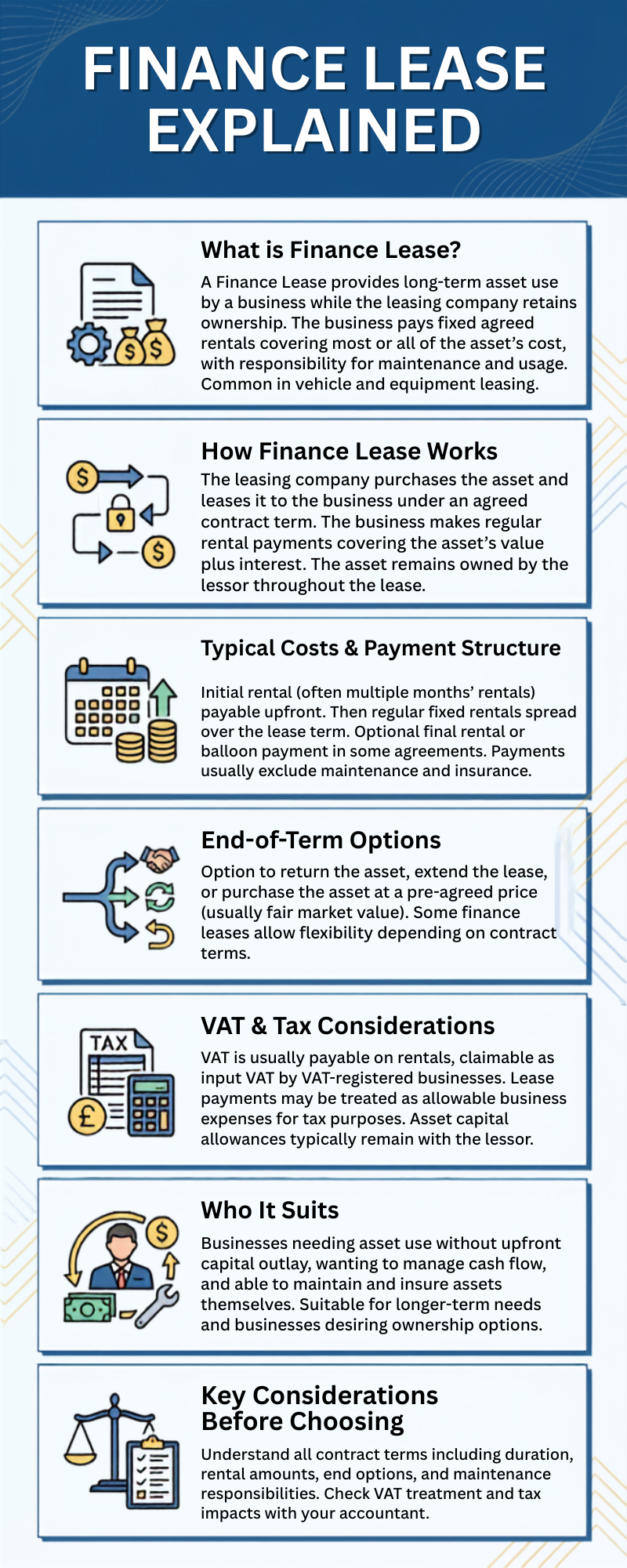
Finance Lease is a form of vehicle finance that allows a business to fund a vehicle through regular payments rather than purchasing it outright.
The finance company purchases the vehicle, and the business then makes agreed payments over the finance period.
Unlike Business Contract Hire, where the vehicle is normally returned to the leasing company at the end of the agreement, Finance Lease provides different options for dealing with the vehicle once the main payment period has finished.
The business does not normally become the legal owner of the vehicle during the agreement.
Instead, the finance provider retains ownership while the business has possession and use of the vehicle in accordance with the finance agreement.
Finance Lease is one of several van finance options available to UK businesses.
Finance Lease can be used for a wide range of vehicles, including:
- Small vans
- Medium vans
- Large vans
- Electric vans
- Pick-up trucks
- Crew vans
- Dropside vans
- Tippers
- Luton vans
- Minibuses
- Specialist commercial vehicles
The availability of specific vehicles and finance structures will depend on the finance provider and the individual agreement.
How Does Finance Lease Work?
The business first chooses the vehicle it wants to finance.
The finance provider then purchases the vehicle and leases it to the business for an agreed period.
The business makes regular payments throughout the agreement.
The amount paid each month will depend on factors such as:
- Vehicle price
- Initial rental
- Contract length
- Agreed payment structure
- Any final payment or balloon rental
- Interest and finance costs
- VAT treatment
At the end of the main finance period, the business normally has options for continuing with or disposing of the vehicle, depending on the agreement.
This gives Finance Lease a different structure from Contract Hire.
What Is An Initial Rental?
An initial rental is the first payment made at the start of a Finance Lease agreement.
The initial rental is normally calculated as a number of monthly payments.
For example, an agreement could be structured around a 3-month, 6-month or 9-month initial rental.
A larger initial rental generally reduces the subsequent monthly payments, while a smaller initial rental usually means higher monthly payments.
Businesses should consider the total cost of the agreement rather than choosing an offer based solely on the advertised monthly rental.
Can A Finance Lease Include A Final Payment?
Some Finance Lease agreements include a final payment, sometimes referred to as a balloon or balloon rental. This is agreed at the beginning of the finance agreement and can reduce the regular monthly payments by deferring part of the cost until the end of the main finance period.
It is important to understand that a balloon payment is not simply a payment that can be ignored at the end of the contract. The business needs to understand how the final payment works and what options are available when the finance period ends.
How Long Does A Finance Lease Agreement Last?
Finance Lease agreements can be arranged over different periods depending on the vehicle and finance provider.
Common contract terms include:
- 24 months
- 36 months
- 48 months
- 60 months
The most appropriate term depends on how long the business intends to use the vehicle and how it wants to structure its monthly costs.
A longer agreement can reduce the regular payment by spreading the cost over a greater period, although it can also mean the business is committed to the vehicle for longer.
Does Finance Lease Have A Mileage Limit?
Mileage is treated differently under Finance Lease compared with Contract Hire.
Contract Hire rentals are closely linked to an agreed mileage because the leasing company is taking the vehicle back at the end of the contract and calculating its expected future value.
With Finance Lease, the structure is different because the business may continue to use or dispose of the vehicle through the options available at the end of the agreement.
However, mileage can still be relevant to the finance arrangement and the vehicle’s future value.
Businesses should therefore discuss their expected usage and mileage allowance with the finance provider before entering into an agreement.
What Happens At The End Of A Finance Lease?
The end of a Finance Lease agreement is one of the most important areas to understand before signing a contract.
Depending on the agreement, there can be different options for dealing with the vehicle.
These can include continuing to use the vehicle under a secondary rental period or arranging for the vehicle to be sold to a third party.
The exact options and conditions vary between finance providers.
Finance Lease should therefore not be viewed simply as another name for Contract Hire. The end-of-term arrangements are fundamentally different.
Businesses should always check the specific terms of their agreement so they understand exactly what happens when the main finance period ends.
Can I Own The Vehicle With Finance Lease?
Finance Lease is not normally structured as a straightforward route to ownership in the same way as Hire Purchase.
The finance company retains legal ownership of the vehicle during the agreement.
Depending on the finance structure, there may be arrangements at the end of the agreement that allow the vehicle to be sold to a third party, with the proceeds used to settle the outstanding finance.
Because the precise arrangements vary, businesses should not assume that a Finance Lease agreement automatically gives them ownership of the vehicle.
If your primary objective is to own the vehicle once all payments have been made, Hire Purchase or Lease Purchase may be more appropriate options.
What Is A Secondary Rental Period?
Some Finance Lease agreements can continue beyond the initial finance period through a secondary rental period.
After the main finance payments have been completed, the business may continue using the vehicle while paying a smaller rental.
This can allow a business to keep the vehicle for longer without having to replace it immediately.
The length and cost of any secondary rental period will depend on the finance provider and agreement.
Can Maintenance Be Included With Finance Lease?
A maintenance package may be available alongside a Finance Lease agreement, depending on the vehicle and finance provider.
Maintenance packages can potentially include:
- Scheduled servicing
- Routine maintenance
- Replacement tyres
- Breakdown assistance
- MOT-related servicing where applicable
- Certain wear-and-tear items
If you are unsure how maintenance differs from warranty cover, see our guide to Maintenance vs Warranty.
The exact cover will vary between providers and packages.
Adding maintenance can make it easier for businesses to forecast their vehicle running costs and can be particularly useful for companies operating several commercial vehicles.
What About Road Tax?
Road tax arrangements depend on the finance agreement and provider.
Businesses should check how Vehicle Excise Duty is handled before taking a vehicle on Finance Lease and understand which costs are included within the agreement.
Can Businesses Reclaim VAT on a Finance Lease?
VAT treatment is an important consideration for VAT-registered businesses.
The amount of VAT a business can recover depends on the vehicle, how it is used and the circumstances of the business.
The VAT treatment of cars can differ from commercial vehicles, and private use can affect the amount that can be reclaimed.
Businesses should obtain appropriate professional tax advice regarding their own circumstances rather than assuming that all VAT can automatically be recovered.
For more information, see our guide to reclaiming VAT on a business van or car lease.
What Are The Advantages Of Finance Lease?
Finance Lease can offer several benefits for businesses.
Spread The Cost Of The Vehicle
Rather than paying for a vehicle outright, Finance Lease allows the cost to be spread through regular payments.
This can help businesses manage cash flow and retain working capital for other areas of the business.
Flexible Payment Structures
Finance Lease can offer different payment structures, including agreements where part of the cost is deferred through a final payment or balloon rental.
This can allow businesses to tailor their regular payments to their budget.
Potentially Lower Monthly Payments
Where part of the cost is deferred through a final payment or balloon rental, the regular monthly payments can be lower than they would otherwise be.
However, businesses should consider the total amount payable rather than focusing solely on the monthly rental.
Greater Control Over The Vehicle
Finance Lease can provide businesses with greater flexibility over what happens to the vehicle at the end of the main finance period compared with Contract Hire.
Suitable For Commercial Vehicles
Finance Lease can be used for a wide range of commercial vehicles, making it an option worth considering for businesses that need specialist vans, pickups or other working vehicles.
Retain Working Capital
Businesses can avoid committing a large amount of cash to buying a vehicle outright.
This can be useful for companies that would rather keep funds available for stock, equipment, employees, expansion or other business expenses.
Are There Any Disadvantages To Finance Lease?
Finance Lease also has some important considerations.
You Do Not Normally Own The Vehicle
The finance provider remains the legal owner during the agreement.
Businesses should not assume that making all the regular payments automatically transfers ownership.
The End-Of-Term Structure Can Be More Complicated
Finance Lease can involve different end-of-term arrangements, including secondary rental periods and vehicle disposal.
Businesses should understand these arrangements before entering into the agreement.
A Final Payment May Apply
Some Finance Lease agreements include a final payment or balloon rental. Businesses should understand the amount involved, when it is due, and what happens when the main finance period ends before entering into the agreement.
The Business Remains Responsible For The Vehicle
Depending on the agreement, the business can have responsibility for maintaining and insuring the vehicle throughout the finance period.
The Vehicle’s Future Value Matters
The end-of-term arrangements can involve the vehicle being sold to a third party.
Businesses therefore need to understand how the vehicle’s future value and any outstanding finance are dealt with under the agreement.
| Finance Lease Feature | How It Works |
|---|---|
| Vehicle ownership | The finance provider remains the legal owner during the agreement. |
| Initial rental | An initial rental is normally paid at the start of the agreement, with the amount depending on the finance structure chosen. |
| Monthly payments | The business makes regular payments over an agreed finance period. |
| Contract length | Finance Lease can typically be arranged over a range of terms, depending on the vehicle and finance provider. |
| Final payment | A final payment or balloon rental may apply, depending on the finance structure and provider. |
| Mileage | Mileage can be more flexible than Contract Hire, although expected usage remains relevant to the agreement. |
| Maintenance | A maintenance package may be available, depending on the vehicle and finance provider. |
| End of agreement | Depending on the agreement, the vehicle may be sold to a third party or the business may continue using it under a secondary rental arrangement. |
| Main benefit | Greater flexibility over the vehicle and the end of the finance period. |
| Main consideration | The business does not normally own the vehicle and must understand the end-of-term arrangements and any applicable final payment. |
Finance Lease vs Contract Hire
Finance Lease and Contract Hire are often compared because both allow businesses to use vehicles without purchasing them outright.
However, the agreements work differently.
With Contract Hire, the business agrees to a term and mileage and normally returns the vehicle at the end of the agreement.
With Finance Lease, the business finances the vehicle and can have different options available after the main finance period.
Contract Hire is often attractive to businesses that want a straightforward vehicle replacement cycle and predictable rental structure.
Finance Lease can be more appropriate for businesses that want greater flexibility around the vehicle at the end of the finance period.
Finance Lease vs Lease Purchase
Finance Lease and Lease Purchase can look similar because both involve spreading the cost of a vehicle through regular payments.
However, the intended outcome is different.
Lease Purchase is structured with the intention of eventually owning the vehicle, subject to the agreement being completed and any final payment being made.
Finance Lease does not normally provide straightforward ownership in the same way.
If owning the vehicle is the main objective, Lease Purchase or Hire Purchase may therefore be more appropriate.
Finance Lease vs Hire Purchase
Hire Purchase is designed to provide a route towards ownership.
The business makes regular payments and, once the agreement has been completed and any applicable final payment has been made, ownership transfers to the customer.
Finance Lease works differently.
The finance provider remains the legal owner and the business uses the vehicle under the terms of the lease.
Finance Lease can therefore suit businesses that want to finance vehicle use without committing to outright ownership.
Finance Options At A Glance
| Finance Option | Who Owns The Vehicle? | Initial Payment | Monthly Payments | Balloon/Final Payment | What Happens At The End? | Best Suited To |
|---|---|---|---|---|---|---|
| Finance Lease | Finance provider | Initial rental may apply | Regular lease payments | A final payment or balloon rental may apply, depending on the agreement | Secondary rental or vehicle sale arrangement, depending on agreement | Businesses wanting flexibility without straightforward ownership |
| Contract Hire | Leasing company | Initial rental | Fixed monthly rentals | Usually no balloon/final payment for the customer | Vehicle is normally returned to the leasing company | Businesses wanting predictable costs and straightforward vehicle replacement |
| Lease Purchase | Finance provider until agreement is completed | Deposit or initial payment may apply | Regular finance payments | Usually applies | Vehicle can become the customer’s once the agreement and final payment are completed | Businesses intending to own the vehicle |
| Hire Purchase | Finance provider until agreement is completed | Deposit may apply | Regular payments | May apply depending on agreement | Ownership transfers once the agreement and applicable final payment are completed | Businesses looking for a route to vehicle ownership |
| Outright Purchase | Business | Full vehicle cost upfront | None | None | Business keeps the vehicle | Businesses with sufficient funds to purchase the vehicle outright |
Is Finance Lease Suitable For Small Businesses?
Finance Lease can be suitable for businesses of different sizes, subject to finance approval.
For smaller businesses, one of the main attractions can be the ability to spread the cost of a vehicle rather than paying for it outright.
It can also provide access to commercial vehicles that may otherwise require a significant upfront investment.
If you operate through a limited company, our guide to the benefits of leasing through a limited company explains some of the key considerations.
However, smaller businesses should consider their cash flow, expected vehicle usage and long-term plans before choosing Finance Lease.
Is Finance Lease Suitable For Fleets?
Finance Lease can be used by businesses operating multiple commercial vehicles and may be particularly useful where vehicles are expected to remain in service for longer periods.
The ability to structure payments and potentially continue using vehicles beyond the main finance period can provide businesses with greater flexibility when managing a fleet.
However, fleet operators should consider the total cost of ownership, maintenance requirements, vehicle replacement cycles and end-of-term arrangements before deciding whether Finance Lease is the best option.
Who Is Finance Lease Best Suited To?
Finance Lease may be suitable for businesses that:
- Want to spread the cost of a vehicle
- Do not want to purchase the vehicle outright
- Want flexibility around the end of the finance period
- Want to retain working capital
- Need a commercial vehicle for longer-term business use
- Want to consider a balloon/final payment to reduce regular payments
- Do not necessarily need straightforward ownership at the end
- Want an alternative to Contract Hire
It may be less suitable for businesses that want a simple hand-back arrangement or specifically want to own the vehicle at the end of the agreement.
| If Your Priority Is… | Finance Option To Consider | Why? |
|---|---|---|
| Keeping monthly costs predictable and returning the vehicle | Contract Hire | You use the vehicle for an agreed term and normally return it at the end |
| Flexibility at the end of the finance period | Finance Lease | Offers different end-of-term arrangements depending on the agreement |
| Owning the vehicle eventually | Hire Purchase | Designed to provide a route towards ownership |
| Owning the vehicle while spreading the cost | Lease Purchase | Structured around eventual ownership, subject to the agreement and final payment |
| Buying the vehicle outright | Outright Purchase | The business pays for the vehicle upfront and owns it |
How Much Does Finance Lease Cost?
There is no standard cost for a Finance Lease because the amount a business pays depends on the vehicle, finance agreement and individual circumstances.
The monthly rental can be influenced by several factors, including:
- Vehicle purchase price
- Initial rental
- Length of the finance agreement
- Interest and finance charges
- Any agreed balloon/final payment
- VAT treatment
- Credit profile and finance approval
A higher initial rental can reduce the subsequent monthly payments, while including a balloon/final payment can also reduce the regular rental by deferring part of the vehicle’s cost until the end of the main finance period.
However, businesses should not judge a Finance Lease agreement solely by its advertised monthly payment. A lower monthly rental may involve a larger initial rental or balloon/final payment, so it is important to consider the overall structure and total amount payable.
The best way to establish the cost of Finance Lease is to obtain a quotation based on the specific vehicle, contract term and payment structure required by your business.
If you are comparing Finance Lease with other forms of van finance, it is also worth considering the overall cost, ownership position and end-of-term arrangements rather than simply comparing monthly payments.
What Should You Consider Before Taking Finance Lease?
Before entering into a Finance Lease agreement, businesses should consider the complete structure rather than focusing only on the monthly payment.
Initial Rental
Understand how much you will need to pay at the beginning of the agreement.
Monthly Payments
Check the amount of each payment and how many payments are required.
Balloon/ Final Payment
If applicable, understand the size of the final balloon and how it affects the overall cost.
Contract Length
Consider how long you expect to use the vehicle.
End-Of-Term Options
Make sure you understand what happens when the main finance period ends.
Maintenance
Decide whether a maintenance package would be beneficial.
Ownership
If you specifically want to own the vehicle, make sure Finance Lease is actually appropriate for your requirements before proceeding.
Total Cost
Compare the total amount payable rather than choosing a finance agreement based solely on the lowest advertised monthly payment.
| Cost / Payment | What It Means | What Businesses Should Consider |
|---|---|---|
| Initial Rental | The upfront payment made at the beginning of the agreement | A larger initial rental can reduce subsequent monthly payments |
| Monthly Rentals | Regular payments made throughout the main finance period | Compare the number and amount of payments, not just the advertised monthly figure |
| Balloon/ Final Payment | A larger final payment that may be included in the agreement | Check the amount and understand how it is dealt with at the end of the finance period |
| Interest / Finance Charges | The cost of financing the vehicle | Consider the overall cost of the agreement |
| VAT | VAT may be charged on rentals and other applicable costs | VAT recovery depends on the vehicle and business circumstances |
| Maintenance | Optional servicing and maintenance costs, where available | Check whether adding maintenance provides better cost predictability |
| Insurance | The business will generally need to arrange appropriate insurance | Confirm the insurance requirements before taking delivery |
| Road Tax | Vehicle Excise Duty may apply depending on the vehicle and agreement | Check whether this is included or needs to be paid separately |
| End-Of-Term Costs | Costs can arise depending on how the vehicle is dealt with at the end of the agreement | Understand the provider’s specific end-of-term arrangements |
Finance Lease FAQs
No. Finance Lease and Contract Hire are different types of vehicle finance.
With Contract Hire, you agree to a contract term and mileage and normally return the vehicle to the leasing company at the end. Finance Lease gives the business different end-of-term options, which can include continuing to use the vehicle under a secondary rental or arranging for it to be sold to a third party, depending on the agreement.
Finance Lease is not normally designed as a straightforward route to ownership.
The finance provider remains the legal owner of the vehicle during the agreement. Depending on the agreement, the vehicle may be sold to a third party at the end of the finance period, with the proceeds used in accordance with the finance arrangement.
If your main objective is to own the vehicle, Hire Purchase or Lease Purchase may be more appropriate.
Finance Lease does not generally operate with a mileage allowance in the same way as Contract Hire.
However, expected vehicle usage and mileage can still be relevant to the agreement and the vehicle’s future value. You should discuss your anticipated mileage with the finance provider before taking out a Finance Lease.
A balloon/final payment is a larger final payment included in some Finance Lease agreements.
By deferring part of the vehicle’s cost until the end of the main finance period, a balloon can reduce the regular monthly payments.
The exact amount and how it is dealt with at the end of the agreement will depend on the finance provider and the terms of the Finance Lease.
A balloon/final payment may be available with some Finance Lease agreements, depending on the vehicle, finance provider and agreement structure.
A balloon can reduce the monthly rental, but businesses should consider the overall cost and understand exactly what happens when the main finance period ends.
The options available at the end of a Finance Lease depend on the agreement.
These can include continuing to use the vehicle under a secondary rental period or arranging for the vehicle to be sold to a third party.
The exact process varies between finance providers, so businesses should check the specific terms before entering into an agreement.
You may be able to continue using the vehicle after the main finance period through a secondary rental arrangement, depending on the agreement.
This is different from simply owning the vehicle. The finance provider normally retains legal ownership, so you should not assume that completing the primary rental period automatically transfers ownership to your business.
A maintenance package may be available with a Finance Lease, depending on the vehicle and finance provider.
It can potentially cover items such as scheduled servicing, routine maintenance, tyres and other specified costs.
The exact cover varies, so always check what is included before adding a maintenance package.
Yes. Finance Lease can be suitable for businesses of different sizes, subject to finance approval.
It can allow a small business to spread the cost of a commercial vehicle rather than paying the full purchase price upfront. However, businesses should consider their cash flow, vehicle usage, contract structure and end-of-term requirements before choosing Finance Lease.
Yes. Electric vans can be financed through Finance Lease, subject to the vehicle and finance provider’s requirements.
Businesses should consider the electric van’s range, payload, charging requirements and expected mileage alongside the finance agreement.
Neither option is automatically better. They are designed for different requirements.
Finance Lease can suit businesses that want to use a vehicle without straightforward ownership and want flexibility around the end of the finance period.
Hire Purchase is designed as a route towards ownership once the agreement and applicable final payment requirements have been completed.
The right option depends on whether ownership is important to your business.
It depends on what you want from the agreement.
Contract Hire can be suitable if you want predictable rentals, an agreed mileage and a straightforward vehicle hand-back at the end.
Finance Lease can be more suitable if you want greater flexibility around what happens to the vehicle after the main finance period.
You should not assume that a Finance Lease can simply be cancelled early without additional costs.
Finance agreements are normally structured around an agreed term, and ending an agreement early can involve financial implications. Speak to your finance provider before making any decision to terminate the agreement early.
Finance Lease can help a business avoid paying the full cost of a vehicle upfront by spreading payments over an agreed period.
This can allow businesses to retain working capital for other expenses. However, the business should consider the initial rental, monthly payments, any balloon payment and other costs when assessing the overall impact on cash flow.
Finance Lease can be suitable for businesses that need commercial vehicles and want to spread the cost without purchasing the vehicle outright.
It can be particularly worth considering for businesses using specialist vans, pickups or converted commercial vehicles where a Finance Lease structure may provide an alternative to Contract Hire.
 Call our expert team on