If you’re exploring vehicle finance for the first time—or looking to review your current funding approach—you’re in the right place. This guide is designed to clearly explain the different finance options available, helping you understand how each one works and which solution best suits your personal or business needs.
From simple, hassle-free leasing to structured ownership plans, there is a finance solution to match every driving requirement, cash flow strategy, and long-term goal.
Whether you are a private driver, sole trader, SME, or larger fleet operator, understanding the differences between Personal Contract Hire (PCH), Business Contract Hire (BCH), Hire Purchase (HP), Finance Lease (FL), and Lease Purchase (LP) will help you make a confident and informed decision.
What Are Vehicle Finance Options?
Vehicle finance allows you to access a new vehicle without paying the full purchase price up front. Instead, you spread the cost over an agreed period through fixed monthly payments, making vehicle ownership or usage more accessible, flexible, and cash-flow friendly.
Depending on the option you choose, you may:
- Simply use the vehicle and return it at the end
- Work towards full ownership over time
- Or combine lower monthly payments with a structured end payment
Each finance solution is designed with different priorities in mind—whether that’s simplicity, tax efficiency, ownership, or cash flow control.
Choosing the Right Option
The key difference between each finance type is what happens at the end of the agreement and how the vehicle is treated financially during the contract.
- If you want simplicity and no ownership responsibility, leasing options like PCH and BCH are ideal
- If you want to own the vehicle outright, options like HP and LP provide a clear route to ownership
- If you want flexibility in how you manage vehicles at the end of the term, Finance Lease offers adaptable exit options
Each structure offers a different balance of monthly cost, control, and long-term commitment.
Your Finance Options at a Glance
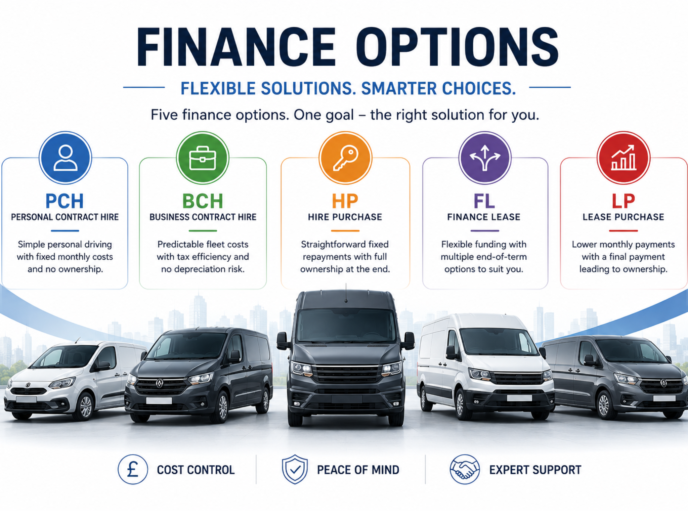
Below is a simple breakdown of the five core finance solutions covered in this guide:
- Personal Contract Hire (PCH) – simple personal leasing with fixed monthly costs and no ownership
- Business Contract Hire (BCH) – fleet-friendly leasing with tax efficiency and no depreciation risk
- Hire Purchase (HP) – straightforward route to full ownership through fixed repayments
- Finance Lease (FL) – flexible business funding with multiple end-of-term options
- Lease Purchase (LP) – lower monthly payments with a planned final payment leading to ownership
The Goal of This Guide
This guide is designed to remove complexity and give you a clear understanding of how each finance option works, what it costs, and what it delivers.
By the end, you’ll be able to confidently identify the most suitable funding method for your driving needs, budget requirements, and long-term plans.
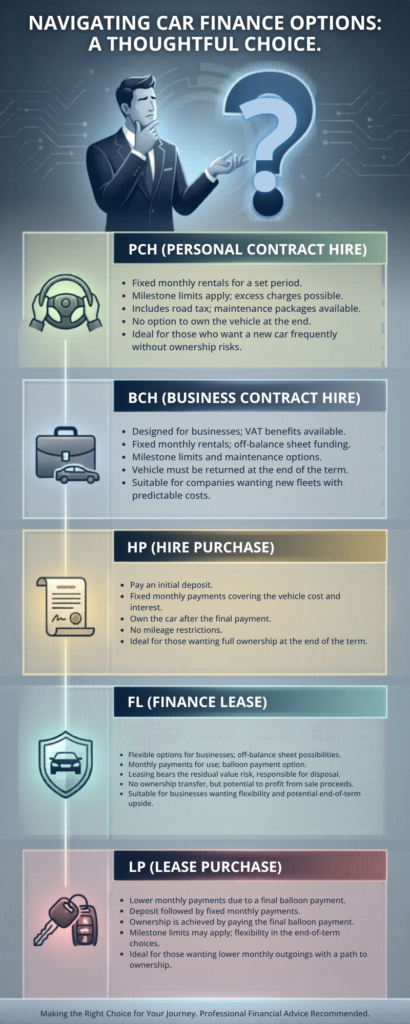
Personal Contract Hire (PCH)
Simple personal driving with zero ownership stress
💷 COST & PAYMENTS
| 💰 Monthly Cost | Fixed monthly rentals |
| 🏁 Upfront Cost | Low initial rental |
| 📊 VAT | Not applicable |
🚗 VEHICLE USE
| 📅 Term | 24–60 months |
| 🛣️ Mileage | Pre-agreed allowance |
| 🔧 Usage | Personal use within contract terms |
🔄 END OF CONTRACT
| 🔁 Ownership | No ownership |
| 🚚 Outcome | Return vehicle |
| 📦 Process | Simple hand-back |
🧠 RISK & BENEFITS
| 📉 Depreciation | No risk |
| 🧾 Admin | Minimal |
| 🚘 Benefit | Drive new cars regularly |
🎯 Ideal For
Private individuals want simple, predictable driving with no ownership responsibility.
Business Contract Hire (BCH)
Fleet simplicity with total cost control
💷 COST & PAYMENTS
| 💰 Monthly Cost | Fixed rentals |
| 🏁 Upfront Cost | Low initial rental |
| 📊 VAT | Potentially reclaimable* |
🚗 VEHICLE USE
| 📅 Term | 24–60 months |
| 🛣️ Mileage | Pre-agreed allowance |
| 🧭 Use | Business fleet operation |
🔄 END OF CONTRACT
| 🔁 Ownership | No ownership |
| 🚚 Outcome | Return vehicle |
| 📦 Process | No disposal required |
🧠 RISK & BENEFITS
| 📉 Depreciation | No risk |
| 🧾 Admin | Low fleet admin |
| 📊 Benefit | Predictable operating costs |
🎯 Ideal For
Businesses want predictable fleet costs, tax efficiency, and no asset risk.
Hire Purchase (HP)
Straightforward route to full ownership
💷 COST & PAYMENTS
| 💰 Monthly Cost | Fixed repayments |
| 🏁 Upfront Cost | Deposit required |
| 📊 VAT | No VAT on monthly payments |
🚗 VEHICLE USE
| 📅 Term | 24–60 months |
| 🛣️ Mileage | No restrictions |
| 🔧 Usage | Full control |
🔄 END OF CONTRACT
| 🔁 Ownership | Full ownership |
| 🚚 Outcome | Keep vehicle |
| 📦 Process | Option-to-purchase fee |
🧠 RISK & BENEFITS
| 📉 Depreciation | Customer risk |
| 🧾 Admin | Low |
| 🚘 Benefit | Long-term asset ownership |
🎯 Ideal For
Businesses want long-term ownership and unrestricted vehicle use.
📉 Finance Lease (FL)
Flexible funding without ownership commitment
💷 COST & PAYMENTS
| 💰 Monthly Cost | Fixed rentals |
| 🏁 Upfront Cost | Low initial rental |
| 📊 VAT | VAT applies to rentals |
🚗 VEHICLE USE
| 📅 Term | 24–60 months |
| 🛣️ Mileage | Flexible options |
| 🔧 Usage | Business operational use |
🔄 END OF CONTRACT
| 🔁 Ownership | No ownership |
| 🚚 Outcome | Sell/extend /re-lease |
| 📦 Process | Flexible exit options |
🧠 RISK & BENEFITS
| 📉 Depreciation | Shared exposure |
| 🧾 Admin | Moderate |
| 🔁 Benefit | Maximum flexibility |
🎯 Ideal For
Businesses want flexibility and control without ownership commitment.
📊 Lease Purchase (LP)
Lower monthly payments with planned ownership
💷 COST & PAYMENTS
| 💰 Monthly Cost | Lower fixed payments |
| 🏁 Upfront Cost | Deposit required |
| 📊 VAT | No VAT on monthly payments |
🚗 VEHICLE USE
| 📅 Term | 24–60 months |
| 🛣️ Mileage | No restrictions |
| 🔧 Usage | Full business use |
🔄 END OF CONTRACT
| 🔁 Ownership | After a balloon payment |
| 🚚 Outcome | Keep vehicle |
| 📦 Process | Final balloon payment |
🧠 RISK & BENEFITS
| 📉 Depreciation | Customer risk |
| 🧾 Admin | Low |
| 💡 Benefit | Lower monthly cost + ownership goal |
🎯 Ideal For
Businesses want ownership but prioritise lower monthly payments.
For our VAT-registered customers, we prepared a guide on How to reclaim VAT on a van lease. It should answer all your VAT-related questions.
Optional Maintenance Packages
To further simplify fleet management, optional maintenance packages can be added to your BCH agreement. These can include servicing, routine maintenance, tyres, and breakdown assistance.
This provides:
- Reduced unexpected repair costs
- Less downtime and disruption
- Greater control over total vehicle running costs
- A fully managed, worry-free driving experience
Do I need Maintenance if I have a Manufacturer’s Warranty cover?
If you buy or lease a brand-new van, it will usually come with a manufacturer’s warranty. The exact warranty can vary depending on the manufacturer and sometimes even the specific model. Each warranty covers different components and has its own terms and conditions, so it’s important to check what is included — and what you must do to keep the warranty valid.
What’s the difference between a Maintained Agreement and a Manufacturer’s Warranty?
Understanding these two types of cover is essential when choosing the right lease for your business. A maintained agreement looks after your vehicle’s routine servicing, tyres, MOTs and wear-and-tear repairs, while a manufacturer’s warranty covers faults caused by defects in materials or workmanship. If you’d like a clear, detailed breakdown of how they compare — and what each one includes — you can read our blog titled: ‘Maintenance vs Warranty: What’s the difference?’.
| Finance Option | Ownership | Monthly Payments | Cash Flow Impact | End of Agreement | Key Benefit |
|---|---|---|---|---|---|
| Personal Contract Hire (PCH) | No | Fixed | Low upfront cost | Return vehicle | Simple personal driving with no ownership hassle |
| Business Contract Hire (BCH) | No | Fixed | Highly efficient | Return vehicle | Predictable fleet costs with no depreciation risk |
| Hire Purchase (HP) | Yes (end of term) | Fixed | Medium upfront commitment | Ownership transferred | Straightforward route to owning the vehicle |
| Lease Purchase | Yes (after balloon) | Lower monthly payments | Improved short-term cash flow | Balloon payment then ownership | Reduced monthly cost with planned ownership |
| Finance Lease | No (flexible options) | Fixed | Flexible structure | Sell/extend /continue leasing | Maximum end-of-term flexibility |
When it comes to leasing a van for business, you might also want to consider the pros and cons of leasing versus buying. We cover this topic in another article: Buying vs leasing a business van.
Please do not hesitate to contact us if you need any help with leasing a van. You’ll be in good hands with our experts.
 Call our expert team on