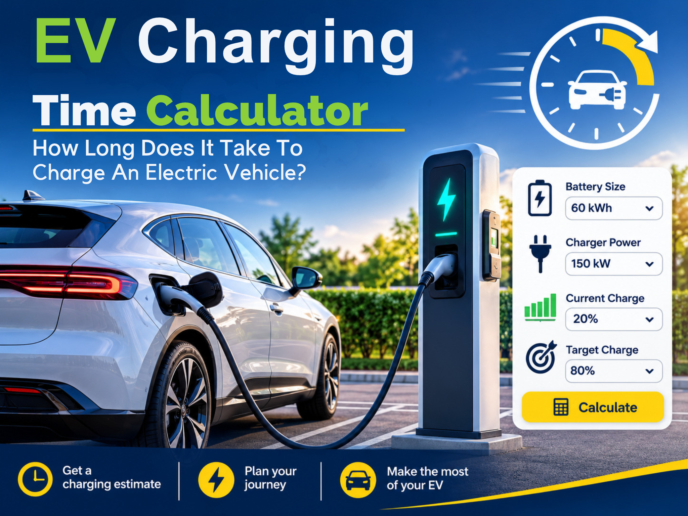
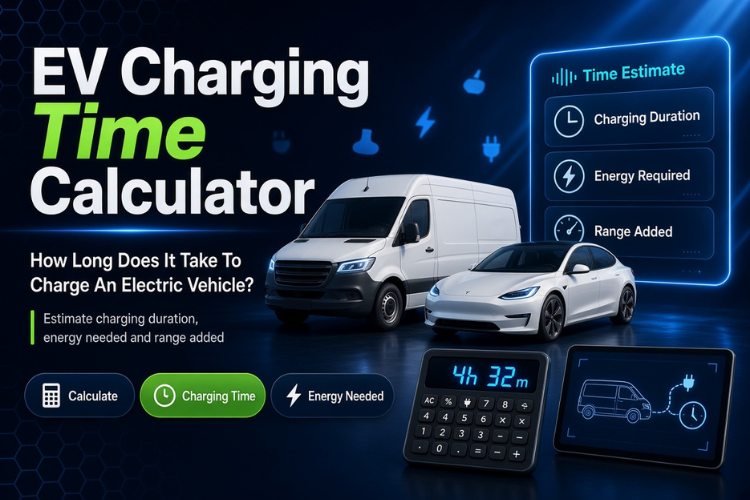
How long does it take to charge an electric vehicle? The answer depends on several factors, including the size of the battery, its current charge level, the vehicle’s maximum charging rate and the power output of the charging point.
Our free EV Charging Time Calculator helps estimate how long it could take to charge an electric car or van at home, at work or using a public charging point. Enter your vehicle’s usable battery capacity, current battery percentage, desired charge level and charger power to calculate an estimated charging time.
Whether you are planning an overnight home charge, topping up during a working day or using a rapid charger on a longer journey, the calculator provides a useful indication of how long you may need to allow.
EV Charging Time Calculator
Estimate how long it could take to charge an electric vehicle at home, at work or using a public charging point.
Your Estimated Charging Time
Enter your vehicle and charger details, then select Calculate Charging Time to see your estimate.
This calculator provides an estimate, not a guaranteed charging time. Actual results depend on the vehicle, battery temperature and condition, charger capability, electrical supply, battery management system and charging curve. The estimate uses a simplified average-power calculation and does not model every vehicle’s individual charging profile.
How To Use The EV Charging Time Calculator
The calculator uses your vehicle’s battery capacity and charging specifications to estimate the time required to reach your chosen battery level.
You will need to enter:
- Usable Battery Capacity: The amount of energy available in the vehicle’s battery, measured in kilowatt-hours (kWh).
- Vehicle Efficiency: The approximate number of miles the vehicle travels per kWh. This is used to estimate the additional driving range provided by the charge.
- Current Battery Level: The vehicle’s existing state of charge, expressed as a percentage.
- Target Battery Level: The percentage you want the battery to reach.
- Charging Type: Select AC charging, typically used at home and workplaces, or DC rapid charging, commonly found at public charging stations.
- Charger Power: The charging point’s rated output in kilowatts (kW).
- Vehicle Maximum Charging Rate: The maximum AC or DC charging power the vehicle can accept.
For DC rapid charging, you can also adjust the average charging power factor to account for the reduction in charging speed that commonly occurs as the battery approaches a higher state of charge.
Once you have entered the information, select Calculate Charging Time to see the estimated duration, energy required, average charging power, and approximate driving range added.
What Factors Affect Electric Vehicle Charging Time?
Charging times can vary considerably between electric vehicles, even when they are connected to the same charging point. The main factors include battery capacity, charger output, vehicle charging limits and the battery’s current state of charge.
Battery Capacity
Battery capacity is measured in kilowatt-hours (kWh). In general, a larger battery requires more energy to charge than a smaller one when both are being charged through the same percentage range.
For example, charging a 100kWh battery from 20% to 80% requires more electricity than charging a 60kWh battery through the same percentage range.
The calculator uses usable battery capacity, rather than gross battery capacity, to estimate the energy needed.
Charging Point Power
Charging point power is measured in kilowatts (kW). A higher-powered charger can potentially deliver electricity more quickly, but the vehicle must also be capable of accepting that level of power.
A vehicle connected to a 150kW rapid charger will not necessarily charge at 150kW. Its maximum charging rate may be lower, meaning the vehicle itself becomes the limiting factor.
Vehicle Charging Capability
Electric vehicles have their own maximum AC and DC charging rates.
For AC charging, the onboard charger in the vehicle determines how much power can be converted and supplied to the battery. For DC rapid charging, the vehicle’s battery management system controls the amount of power it can accept.
This means two vehicles connected to the same charger can have noticeably different charging times.
Current Battery Level
The amount of charge already in the battery affects how much additional energy is required.
Charging from 20% to 80% will generally take less time than charging from 10% to 100%, although the relationship is not always directly proportional.
This is particularly important when using rapid chargers, as charging speeds commonly reduce as the battery approaches a higher state of charge.
Battery Temperature And Conditions
Battery temperature can influence charging performance. Very cold or hot battery conditions may cause the vehicle to restrict charging power to protect the battery.
Some electric vehicles can precondition their batteries before reaching a rapid charging station, helping to prepare them for faster charging.
How Long Does It Take To Charge An Electric Vehicle?
There is no single charging time that applies to every electric vehicle. The time required depends on the battery size, charging equipment and the vehicle’s own charging capabilities.
The following are broad examples of charger ratings rather than guaranteed charging speeds:
| Charging Equipment | Typical Power Rating | Common Use |
|---|---|---|
| Standard domestic socket | Around 2.3kW | Occasional or emergency charging |
| Lower-power AC charger | Around 3.6kW | Home or workplace charging |
| Home wallbox | Around 7.4kW | Overnight domestic charging |
| Three-phase AC charger | 11kW–22kW | Compatible workplace and public charging |
| Rapid DC charger | Around 50kW | Public rapid charging |
| High-power DC charger | 100kW–150kW+ | Public rapid and ultra-rapid charging |
These figures describe the rated power of the equipment. Actual charging speeds may be lower because of vehicle limitations, battery temperature, battery state of charge and other factors.
AC Charging Vs DC Rapid Charging
Electric vehicle charging is generally divided into two types: AC and DC.
AC charging is commonly used at home, at workplaces and at many public destination chargers. The vehicle converts the alternating current into direct current using its onboard charger before storing the energy in the battery.
Home wallboxes commonly provide charging power of up to around 7.4kW on a single-phase domestic supply, although other configurations are available.
DC rapid charging supplies direct current to the vehicle’s battery, bypassing the onboard AC charger. This allows compatible vehicles to accept substantially higher charging power, making DC charging particularly useful when travelling longer distances or when vehicles need to return to work quickly.
However, the advertised output of a rapid charger does not guarantee that the vehicle will charge at that rate throughout the session.
Why Does Rapid Charging Slow Down Above 80%?
Electric vehicle charging is not always delivered at a constant speed.
When a battery has a lower state of charge, it can generally accept higher charging power. As the battery fills, the vehicle’s battery management system may reduce the charging rate to manage temperature, battery health and charging safety.
This is known as the charging curve.
For this reason, charging from 10% to 80% can often be considerably quicker than charging from 80% to 100%, even though both represent a 70-percentage-point increase.
For drivers on longer journeys, it can sometimes be more time-efficient to make shorter rapid-charging stops rather than waiting for the battery to reach 100%.
The exact charging curve varies between vehicles, so drivers should consult the manufacturer’s specifications for model-specific information.
Charging Electric Vehicles At Home And At Work
Home and workplace charging can make electric vehicles easier to manage, particularly for businesses operating cars and vans on regular daily routes.
Charging vehicles overnight can help ensure they are ready for use at the start of the working day, while workplace charging can provide an opportunity to replenish batteries during operating hours.
Businesses considering electric vehicles should assess the availability of charging infrastructure, the number of vehicles requiring charging, their daily mileage and the time each vehicle spends parked.
Our guide to how EV charging works for businesses explains some of the considerations involved in planning charging provision.
For businesses looking at home charging arrangements for employees, our guide to home EV charging reimbursement for fleets provides further information.
Charging Time And Electric Vehicle Running Costs
Charging time is only one consideration when assessing whether an electric vehicle is suitable for business or personal use.
Electricity prices, vehicle efficiency, annual mileage and charging location all influence the overall cost of running an electric vehicle.
Our EV Journey Cost Calculator can help estimate the electricity required and the cost of charging for a particular journey.
You can also use our Electric Vehicle Running Cost Calculator to estimate electricity expenditure, while the AER Reimbursement Calculator can help businesses work out electric vehicle mileage reimbursement.
 Call our expert team on