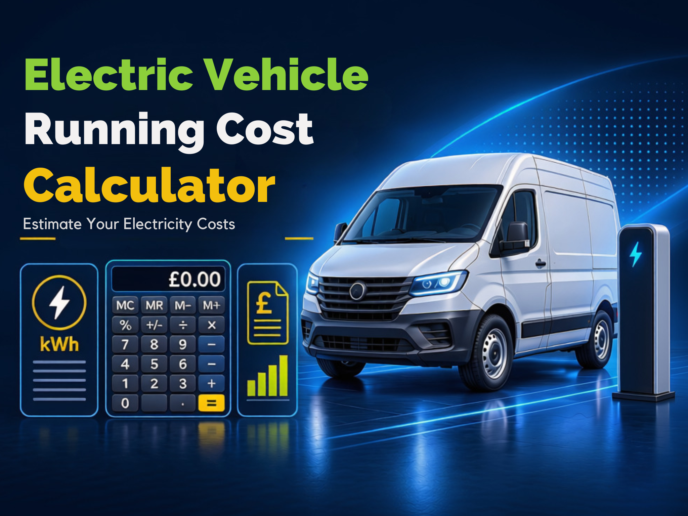
Calculate how much it costs to run an electric van or car based on your annual mileage, vehicle efficiency and the price you pay for electricity. Use our electric vehicle running cost calculator to estimate your weekly, monthly and annual electricity costs and compare different vehicles to help make informed decisions about your business fleet.
Electric Vehicle Running Cost Calculator
Estimate how much it costs to run an electric van or car based on your mileage, efficiency and electricity price.
Typical values: 3.0 – 4.5 miles/kWh for vans, 3.5 – 5.0 for cars
Home overnight rates are often 15–25p. Public charging can be 40–80p+
Estimated annual electricity cost
Estimates only. Real-world costs vary with driving style, weather, load, and exact charging rates. Efficiency is measured in miles per kWh.
How to Calculate Your Electric Vehicle Running Costs
Understanding the electricity costs of an electric vehicle can help you plan your budget more accurately and compare different models. The main factors are your annual mileage, the vehicle’s efficiency (measured in miles per kWh) and the price you pay for electricity.
To estimate your annual electricity spend, divide your annual mileage by the vehicle’s miles per kWh to find out how many kilowatt-hours (kWh) you will use. Multiply that figure by the average price you pay per kWh. If you charge at different rates (for example, home overnight rates versus public rapid chargers), you can apply a weighted average based on the percentage of charging you do at each location.
For example, a vehicle travelling 15,000 miles per year and returning 3.5 miles per kWh will use approximately 4,286 kWh of electricity. If 80% of charging is done at home at 28p per kWh and 20% is done at public chargers at 55p per kWh, the estimated annual electricity cost would be around £1,450.
Your actual expenditure may be higher or lower depending on driving style, weather, vehicle load, journey type and the exact charging rates available to you. Vans used for deliveries or carrying heavy equipment may achieve different real-world efficiency from the figures quoted by the manufacturer.
What Affects Electric Vehicle Running Costs?
Several factors influence how much a business spends on electricity for its electric vehicles. Annual mileage is particularly important because vehicles covering more miles will generally use more electricity. Vehicle efficiency also makes a significant difference — a van or car that returns more miles per kWh will typically cost less to run over the same distance.
Electricity prices vary widely. Home charging (especially on an overnight or EV-specific tariff) is usually the cheapest option, while public rapid chargers are considerably more expensive. The mix of home versus public charging therefore has a major impact on overall costs. Driving style, payload, cold weather and the use of heating or air conditioning can also affect real-world efficiency.
Businesses operating multiple electric vehicles may benefit from reviewing mileage records, actual electricity expenditure and charging patterns to identify opportunities to improve efficiency and reduce costs.
If you're considering replacing your current vehicle, comparing efficiency figures can help you identify ways to reduce running costs. When comparing replacement vehicles, consider more than electricity costs alone. Leasing costs, maintenance, downtime and the suitability of each vehicle for your business should also inform your decision.
Managing Your Electric Vehicle Costs
Electricity is just one part of the overall cost of running a business electric vehicle. Maintenance, servicing, insurance, vehicle finance and downtime can also affect your budget. Our fleet management solutions can help businesses manage their vehicles and day-to-day fleet requirements.
If you're considering switching to an electric vehicle, electric van leasing offers businesses a way to access a vehicle through an agreed contract rather than purchasing it outright. Understanding the vehicle leasing process can help you assess your options and plan for your next vehicle.
You may also find it useful to compare the running costs of electric vehicles with conventional petrol or diesel alternatives using our other calculators.
 Call our expert team on