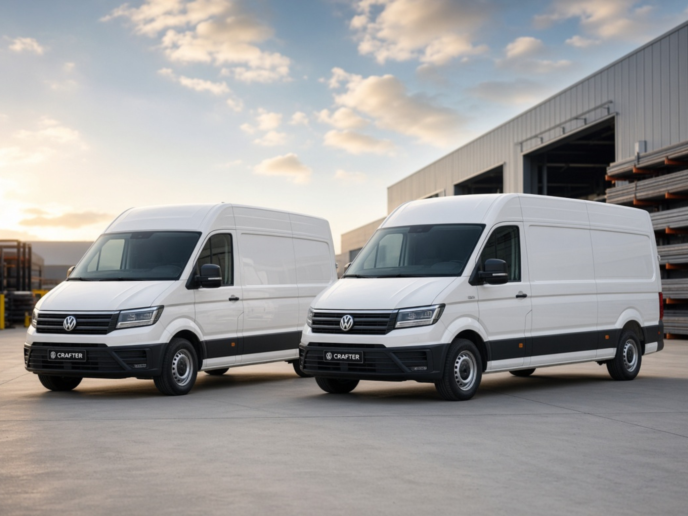
Choosing a large panel van isn’t simply a case of finding the biggest load area and assuming more space is always better.
For some businesses, the additional length of a long-wheelbase van can make an enormous difference to productivity. For others, a shorter body can provide all the load space required while making the vehicle easier to manage around towns, customer premises, construction sites and tighter access roads.
That is particularly relevant with the Volkswagen Crafter.
For businesses considering the Volkswagen Crafter CR35 2.0 TDI 140PS Commerce Plus High Roof FWD, one of the most important decisions is whether to choose the medium-wheelbase (MWB) or long-wheelbase (LWB) version.
At Commercial Vehicle Contracts, both configurations are available to lease, giving businesses the opportunity to choose the van around the way they actually work rather than trying to make their business fit the vehicle.
The important question isn’t necessarily which Volkswagen Crafter is better.
It’s which Crafter gives your business the right combination of load space, payload, dimensions and day-to-day usability.
Why Van Size Matters More Than You Might Think
When businesses choose a new commercial vehicle, it is tempting to concentrate on the headline figures.
- Payload
- Load volume
- Load length
- Price
- Fuel economy
All of those figures matter, but they don’t tell the whole story.
A van is ultimately a working environment on wheels.
The way that environment is used can be completely different from one business to another.
A mobile engineer might need extensive racking, tools and parts but rarely carry particularly long items.
A construction company might regularly carry long materials alongside heavy equipment.
A delivery business could prioritise maximum usable volume.
A fleet operator might be looking for a standardised vehicle that works across multiple roles. For larger businesses, vehicle choice also forms part of wider Fleet Management Solutions for UK Businesses, particularly when vehicles need to be standardised across different teams or locations.
That means the largest van isn’t automatically the most suitable van.
Instead, the right approach is to work backwards from the job.
The First Question: What Are You Actually Carrying?
Before comparing the MWB and LWB Crafter, think about the contents of the van.
There are four particularly important considerations:
- Weight – How heavy is a typical working load?
- Length – What is the longest item you regularly carry?
- Volume – How much physical space do your tools, equipment, stock or materials occupy?
- Organisation – Will the van contain shelving, racking, drawers, storage boxes or a workbench?
That last point is particularly important.
A van that looks enormous when completely empty can feel considerably smaller once it has been properly converted for professional use.
This is why businesses should consider their finished working vehicle, rather than simply looking at the manufacturer’s dimensions.
For more information on the options available, see CVC’s Complete Guide to Commercial Vehicle Conversions for UK Businesses explains how racking, shelving, lining, storage and other modifications can change the way a van is used.
Volkswagen Crafter MWB: When The Shorter Van Makes Sense
The Volkswagen Crafter MWB CR35 2.0 TDI 140PS Commerce Plus High Roof FWD is still a substantial large panel van.
The “medium-wheelbase” description shouldn’t be confused with the dimensions of a medium-sized van.
The CVC-listed specification provides approximately 3,450mm of load length, giving businesses considerable room for equipment, tools, materials and stock. The high-roof configuration also provides significant vertical space, with a listed load height of around 1,861mm.
The listed payload is approximately 836kg, although businesses should always consider the specific vehicle specification and the weight of any racking, lining, shelving or other conversions when calculating their usable payload.
For many businesses, 3.45 metres of load length is already more than enough.
The key is understanding how that space is used.
The MWB Crafter For Tradespeople
The MWB configuration can be particularly interesting for trades and service businesses.
An electrician, for example, might carry:
- Cable
- Conduit
- Electrical equipment
- Ladders
- Power tools
- Test equipment
- Consumables
- Spare parts
That doesn’t necessarily mean they need the longest possible van.
With a well-designed racking and storage system, much of the available space can be used vertically and efficiently.
The same principle applies to plumbers, heating engineers, HVAC engineers, mobile mechanics and many other service-based businesses.
CVC has dedicated guides covering the requirements of individual trades, including our guides to the best vans for electricians, the best vans for plumbers, the best vans for heating engineers and the best vans for mobile mechanics.
The Crafter can therefore be considered alongside a much wider range of options in CVC’s Best Vans for Tradespeople in 2026 guide.
The MWB Advantage Isn’t Just About Size
There is another consideration that can easily be overlooked.
Every extra metre of vehicle length has to go somewhere.
The van might spend its working life:
- In residential streets
- On urban roads
- At customer premises
- On construction sites
- In car parks
- At depots
- On narrow access roads
- Around loading bays
If the business doesn’t regularly use the additional load length of an LWB van, there is a reasonable argument for keeping the overall vehicle as compact as the job allows.
That doesn’t mean the MWB is inherently more manoeuvrable than every LWB configuration in every situation. It means that body length is one of the variables businesses should consider alongside their actual operating environment.
For businesses that spend much of the day travelling between individual customers, that can be an important part of the decision.
Volkswagen Crafter LWB: When You Need More Room
The Volkswagen Crafter LWB CR35 2.0 TDI 140PS Commerce Plus High Roof FWD takes the same basic formula and provides a longer load area.
That additional length can make a significant difference when the business regularly carries:
- Long materials
- Bulky equipment
- Multiple items for different jobs
- Large quantities of stock
- Specialist equipment
- A combination of tools and materials
This is where the LWB version starts to make particular sense.
If a business is routinely running out of load space in an MWB van, adding another shorter vehicle isn’t necessarily the answer.
Sometimes the more efficient solution is simply to put the additional capacity into the vehicle being used.
When Does Extra Load Length Really Matter?
Imagine a contractor carrying materials that are difficult to stack.
Or a joiner transporting longer components.
Or a furniture delivery business carrying large items.
Or a construction company transporting equipment alongside materials.
In those situations, load length can be more important than headline payload.
You can have enough payload capacity but still be unable to physically fit the item you need to transport.
That’s one of the biggest mistakes businesses can make when choosing a commercial vehicle.
Don’t Choose A Crafter On Payload Alone
Payload is critically important.
But it is only one part of the equation.
A van has to accommodate the physical dimensions of the load as well as its weight.
Consider two completely different loads.
Load A
800kg of relatively compact equipment.
Load B
400kg of long, bulky materials.
The first load creates a payload challenge.
The second could create a space challenge.
That is why businesses should consider:
Payload + load length + load height + load volume + storage configuration.
All five can influence whether a van works effectively.
For a deeper look at the subject, see CVC’s guide to Navigating Van Payload: Safely Carrying Cargo and Passengers.
MWB vs LWB: What Changes In The Real World?
The differences between the two versions become much easier to understand when you stop looking at them as specification sheets.
Think about the working day.
A Mobile Engineer
The van needs to carry tools, parts, consumables and specialist equipment.
Storage efficiency is likely to be extremely important.
An MWB may provide sufficient space, particularly when the van is professionally racked.
A Builder
The vehicle could carry power tools, building materials, fixings, protective equipment and other site equipment.
The answer depends heavily on the materials being transported.
Either configuration could work, depending on the typical load.
See CVC’s guide to the best vans for builders for more information on choosing a vehicle around construction work.
A Joiner
Longer components and finished items can create a very different requirement.
An LWB can become considerably more attractive when load length regularly becomes the limiting factor.
See our guide to the best vans for joiners and carpenters for more on the requirements of woodworking businesses.
A Courier
Volume and the ability to organise multiple consignments can be important.
An LWB may provide additional flexibility where the business regularly carries large volumes.
A Property Maintenance Business
The van might carry everything from power tools and ladders to replacement materials.
Here, organisation can be just as important as overall dimensions.
Our guide to the best vans for property maintenance companies looks at this type of working requirement in more detail.
The High-Roof Advantage
There is another reason both of these Crafter configurations deserve attention.
They’re high-roof vans.
That means businesses aren’t limited to thinking about floor space.
Think vertically.
This can be particularly valuable when the vehicle is equipped with professional shelving and racking.
Instead of placing every item on the floor, a well-designed interior can create different storage zones for:
- Hand tools
- Power tools
- Consumables
- Spare parts
- Boxes
- Fixings
- Safety equipment
- Longer equipment
This can transform how much usable storage a van provides.
CVC also offers Shelving and Racking as part of its commercial vehicle conversion and customisation services, allowing businesses to make better use of the available load area.
The Conversion Question: How Will You Build Your Crafter?
This is something businesses should consider before choosing the body length.
A completely empty van and a finished working vehicle are two very different things.
You could add:
Shelving And Racking
For organised storage of tools, parts and equipment.
Ply Lining
Ply lining can help protect the load area from everyday wear while creating a more durable working environment. CVC also offers Ply Lining as part of its commercial vehicle conversion services.
Ladder Storage
Particularly useful for trades where ladders and long equipment need to be transported safely.
Security Systems
Useful where expensive tools and equipment are left in the vehicle.
Storage Boxes
For keeping smaller equipment and consumables organised.
Workbenches
Potentially transforming part of the load area into a mobile workspace.
CVC’s Commercial Vehicle Conversions Guide covers the wider range of conversion possibilities available to UK businesses.
Don’t Forget Security
The more equipment you carry, the more important vehicle security becomes.
A large commercial van could contain thousands of pounds’ worth of tools and equipment.
That makes security another consideration when designing the finished vehicle.
Businesses can consider solutions such as:
- Security gates
- Secure storage boxes
- Internal locking systems
- Specialist tool storage
- Alarm and security upgrades
CVC provides Van Storage Systems and Secure Storage Boxes for businesses looking to make better use of their load space while improving organisation and security. Depending on the equipment being carried, businesses can also consider solutions such as security gates, secure storage boxes and specialist internal storage.
MWB vs LWB: At A Glance
| Volkswagen Crafter MWB | Volkswagen Crafter LWB | |
|---|---|---|
| Model | CR35 Commerce Plus High Roof | CR35 Commerce Plus High Roof |
| Engine | 2.0 TDI | 2.0 TDI |
| Power | 140PS | 140PS |
| Drive | Front-wheel drive | Front-wheel drive |
| Roof | High Roof | High Roof |
| Load length | Approx. 3,450mm | Longer than MWB |
| Typical priority | Balance of space and overall dimensions | Maximum load length and volume |
| Suitable for | Trades, engineers, contractors and general business use | Businesses carrying longer or bulkier loads |
| Conversion potential | Excellent | Excellent |
| CVC lease listing | Available | Available |
Specifications can vary according to vehicle configuration, optional equipment and conversion. Always check the individual vehicle specification before ordering.
CVC currently has both configurations available, allowing businesses to compare the Volkswagen Crafter MWB CR35 2.0 TDI 140PS Commerce Plus High Roof FWD and Volkswagen Crafter LWB CR35 2.0 TDI 140PS Commerce Plus High Roof FWD based on their own business requirements.
The Price Difference Can Be Worth Considering
There is also an interesting point when looking at these two vehicles from a leasing perspective.
CVC’s displayed examples currently put the Volkswagen Crafter MWB CR35 2.0 TDI 140PS Commerce Plus High Roof FWD at £409.92 + VAT per month, while the Volkswagen Crafter LWB CR35 2.0 TDI 140PS Commerce Plus High Roof FWD is displayed at £416.97 + VAT per month.
That’s a difference of just £7.05 + VAT per month on those particular examples.
However, leasing prices can change and are dependent on factors including contract length, annual mileage, initial rental, funder, credit status and availability.
So the important point isn’t that one particular monthly price will always apply.
It’s that businesses should compare the cost of additional capacity against the cost of not having enough space.
If the longer van prevents additional journeys, reduces the need for a second vehicle or simply allows the driver to complete the job in one trip, the additional capacity can have a business value that isn’t visible on the specification sheet.
Businesses considering their wider finance options can also read CVC’s Van Finance For Businesses: A Complete Guide To Your Options.
The Cost Of Choosing Too Little Van
This is perhaps the most important question to ask.
What happens if you choose the MWB and discover six months later that you really needed the LWB?
You could end up:
- Making additional journeys
- Leaving equipment behind
- Carrying fewer jobs
- Reorganising loads repeatedly
- Removing equipment to make space
- Using another vehicle
- Turning down work because you cannot transport everything required
The cheapest vehicle on the day isn’t necessarily the cheapest vehicle over the life of the contract.
At the same time, choosing an unnecessarily large van has its own implications.
You could be paying for capacity that is rarely used.
That’s why the decision needs to be based on actual business usage.
The 10-Question Crafter Test
Before choosing between the MWB and LWB, ask yourself these questions.
1. What Is The Longest Item You Regularly Carry?
Measure it.
Don’t guess.
2. How Heavy Is A Typical Full Load?
Understanding your normal payload requirement is essential.
3. Do You Use Shelving Or Racking?
If so, allow for the space those systems will occupy.
4. Are Your Loads Mainly Heavy Or Bulky?
These create very different requirements.
5. How Often Do You Carry Multiple Jobs At Once?
If you’re carrying equipment for several jobs, additional load volume could become valuable.
6. Do You Regularly Work In Urban Areas?
Consider where the van will actually operate.
7. Do You Regularly Visit Construction Sites?
Think about access, parking and the type of terrain you encounter.
8. Do You Regularly Make Additional Trips Because Of Lack Of Space?
If the answer is yes, your current vehicle may simply be too small.
9. Will The Van Be Converted?
Plan the conversion before choosing the body length.
10. Is This A Single Vehicle Or Part Of A Larger Fleet?
A fleet may benefit from standardising vehicle specifications where the operational requirements are similar.
One Engine, Two Different Working Philosophies
The interesting thing about these two Crafter configurations is that the fundamental powertrain remains familiar.
Both the CVC-listed MWB and LWB models use the 2.0 TDI 140PS engine, front-wheel drive and a high-roof body, with both versions available in the Commerce Plus specification.
We’ve already looked in detail at why the Volkswagen Crafter Commerce Plus has become the gold standard for Britain’s large van fleets, so rather than repeating that information here, the focus is on a different question: which Crafter body configuration makes the most sense for your business?
The MWB gives businesses a substantial working van without going all the way to the longest Crafter body configuration.
The LWB puts greater emphasis on available load length and carrying volume.
In other words:
The MWB is about making the space you need work efficiently.
The LWB is about having more space available when the job demands it.
Neither approach is automatically right for every business.
Which Volkswagen Crafter Should You Lease?
There is no universal answer.
Instead, think about the type of work your business actually does.
The MWB Could Make Sense If:
- You need a large high-roof van but don’t regularly carry extremely long items.
- You rely heavily on racking and organised storage.
- You work extensively in towns and built-up areas.
- You want substantial load space without moving to the longest Crafter body.
- Your typical loads are relatively compact but equipment-heavy.
The LWB Could Make Sense If:
- You regularly transport long materials.
- You carry large or bulky loads.
- You frequently run out of load space.
- You carry equipment for multiple jobs.
- You need additional flexibility for future business growth.
- Your work benefits from maximising the usable load area.
The key word is regularly.
Don’t choose the LWB because you might need the additional space once a year.
But don’t choose the MWB if you’re already regularly struggling to fit everything into your current van. Once you’ve decided which Volkswagen Crafter configuration best suits your business, you can find out more about the next steps in CVC’s vehicle leasing process, from selecting your vehicle through to delivery.
Volkswagen Crafter MWB: View The CVC Vehicle
For businesses looking for a large panel van that combines substantial load space with the slightly shorter MWB body, the Volkswagen Crafter MWB CR35 2.0 TDI 140PS Commerce Plus High Roof FWD is available through CVC.
It combines the 140PS 2.0 TDI engine with front-wheel drive, a high-roof body and a load length of approximately 3,450mm.
View the Volkswagen Crafter MWB CR35 2.0 TDI 140PS Commerce Plus High Roof FWD *
* STOCK OFFER: Rear Camera, Extra Fleet Keys & Ply Lining included at no extra cost – available while stocks last.
Volkswagen Crafter LWB: View The CVC Vehicle
For businesses where additional load length is more important, the Volkswagen Crafter LWB CR35 2.0 TDI 140PS Commerce Plus High Roof FWD provides the longer load area while retaining the same 140PS diesel powertrain and front-wheel-drive configuration.
View the Volkswagen Crafter LWB CR35 2.0 TDI 140PS Commerce Plus High Roof FWD *
* STOCK OFFER: Rear Camera, Extra Fleet Keys & Ply Lining included at no extra cost – available while stocks last.
Choosing The Right Crafter Starts With The Job
Choosing a commercial vehicle shouldn’t start with the badge, the monthly payment or even the maximum load capacity.
It should start with the work.
What do you carry?
How heavy is it?
How long is it?
How often do you need it?
How will the van be converted?
And where will you drive it?
For one business, the Volkswagen Crafter MWB could provide the right balance of substantial load space and manageable dimensions.
For another, the additional capacity of the Volkswagen Crafter LWB could make the difference between a van that simply transports equipment and a vehicle that genuinely improves the way the business operates.
The right choice isn’t necessarily the van with the most space.
It’s the van with the right space.
 Call our expert team on
  Drop us a message