
Company Car BiK & P11D Tax Calculator
Calculate your estimated company car tax with our Company Car BiK & P11D Tax Calculator. Enter your vehicle’s P11D value, CO₂ emissions, fuel type and your income tax rate to estimate your annual and monthly Benefit-in-Kind (BiK) tax liability.
Whether you’re considering an electric car, petrol, hybrid, plug-in hybrid or diesel vehicle, the calculator provides an estimate of the company car tax you could pay based on the information you enter.
Please note: This calculator is for guidance only. Your actual tax liability may vary depending on your individual circumstances, the vehicle’s registration date and the latest HMRC rules.
Use our Company Car BiK & P11D Tax Calculator to estimate how much company car tax you could pay based on your vehicle’s P11D value, CO₂ emissions, fuel type and your personal income tax rate.
Enter your vehicle details below to calculate an estimated annual and monthly Benefit-in-Kind (BiK) tax liability.
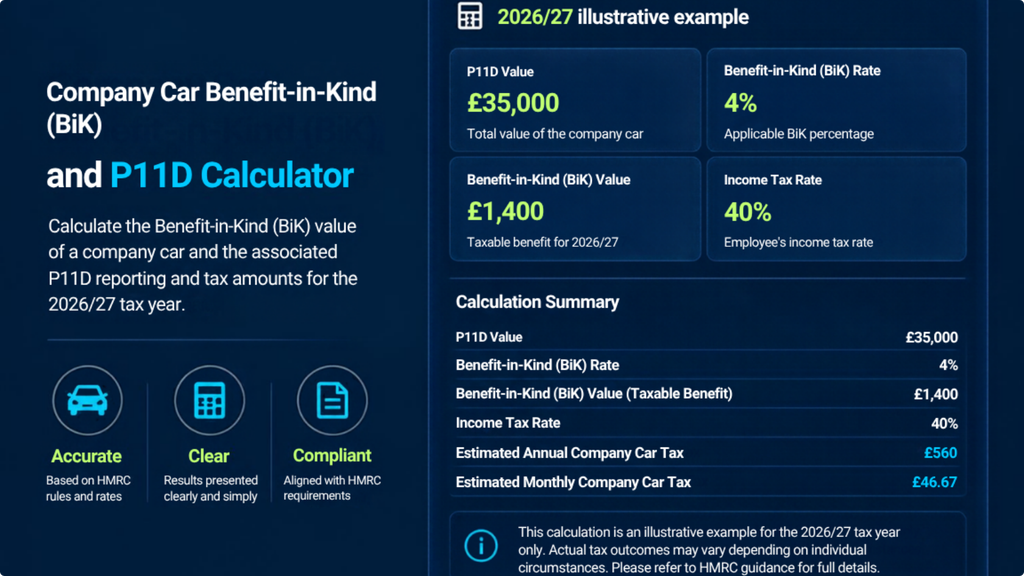
Company Car BiK & P11D Tax Calculator
Estimate your annual and monthly company car tax based on the vehicle’s P11D value, CO₂ emissions, fuel type and your income tax rate.
1. Enter Your Vehicle Details
Your Estimated Company Car Tax
Important Information
This calculator is provided for guidance purposes only and is not tax, financial or accounting advice. Tax rules and company car BiK rates can change, and individual circumstances may affect the amount of tax payable.
For the most accurate and up-to-date information, check the latest guidance published by HM Revenue & Customs or speak to a qualified tax adviser.
How Much Company Car Tax Will I Pay?
The amount you pay depends on three main factors:
1. The vehicle’s P11D value
A more expensive vehicle will generally have a higher taxable benefit when the same BiK percentage is applied.
2. The vehicle’s BiK percentage
The BiK percentage is determined by factors including CO₂ emissions, fuel type and, for some plug-in hybrids, electric-only range.
3. Your income tax rate
Your personal income tax rate is then applied to the taxable benefit. The same company car can therefore result in different tax bills for employees paying income tax at different rates.
Company car tax remains a significant part of the UK tax system, with HMRC data showing that hundreds of thousands of employees receive company car benefits. Our HMRC company car tax statistics provide a more detailed look at the number of company car drivers, taxable benefits and regional differences across the UK.
How Is Company Car Tax Calculated?
Company car tax is based on the vehicle’s P11D value and its applicable Benefit-in-Kind (BiK) percentage.
The P11D value is broadly based on the vehicle’s list price, including VAT and certain options, but excluding the first registration fee and Vehicle Excise Duty.
The applicable Benefit-in-Kind (BIK) Tax percentage is determined primarily by the vehicle’s CO₂ emissions.. Different rates apply to electric cars, petrol and hybrid vehicles, plug-in hybrids and diesel cars.
Once the taxable benefit has been calculated, your personal income tax rate is applied to determine the estimated amount of company car tax you may pay.
Estimated company car tax = P11D value × BiK percentage × income tax rate
For example, a company car with a P11D value of £30,000 and a BiK rate of 10% would have a taxable benefit of £3,000. A 20% taxpayer would therefore pay an estimated £600 in company car tax for the year.
What Is P11D Value?
The P11D value is used to calculate the taxable benefit you receive from a company car.
It is not necessarily the same as the amount you actually paid for the vehicle. The P11D value generally takes into account the vehicle’s list price, VAT and factory-fitted accessories, subject to HMRC rules.
For an accurate calculation, you should use the manufacturer’s published P11D value where available.
Company Car BiK Tax Rates
The percentage used to calculate company car tax varies according to the vehicle’s CO₂ emissions and powertrain.
Electric cars currently benefit from significantly lower BiK percentages than most petrol and diesel vehicles. However, BiK rates can change between tax years, so it is important to use the correct tax year when calculating your potential liability.
Plug-in hybrid vehicles can also qualify for lower BiK rates depending on their official CO₂ emissions and electric-only range.
Diesel vehicles may also be subject to a diesel supplement where the vehicle does not meet the relevant RDE2 emissions standard.
Company Car Tax For Electric Vehicles
Fully electric company cars currently have some of the lowest BiK percentages available. Electric cars are also widely used within workplace salary sacrifice schemes. Our guide to EV Salary Sacrifice explains how these schemes work and how they differ from traditional company car arrangements.
This can make an electric vehicle particularly attractive from a company car tax perspective, although the overall cost of running an electric vehicle will depend on factors such as charging, mileage, insurance and the vehicle’s purchase or lease cost. For businesses providing electric company cars, our Electric Vehicle Charging Explained: Home, Workplace & Employee Solutions for UK Businesses guide covers the main charging options available to employees and fleets.
Businesses considering an electric company car should also consider factors such as charging availability, annual mileage and the vehicle’s overall running costs.
If you’re comparing electric cars for company use, our guide to the Top 10 Electric Cars to Lease in 2026 looks at a selection of models available to private drivers, company car users and salary sacrifice customers.
The difference in BiK between electric and plug-in hybrid vehicles can be particularly significant for higher-value company cars. For a real-world example, see our analysis of the Range Rover Electric’s BiK position compared with the PHEV.
Company Car Tax For Plug-In Hybrids
Plug-in hybrid vehicles are treated differently from conventional hybrids for company car tax purposes. If you’re unsure how the different powertrains compare, our guide to BEV, PHEV, HEV and ICE explains the differences between fully electric, plug-in hybrid, hybrid and conventional petrol and diesel vehicles.
The applicable BiK percentage can depend on the vehicle’s official CO₂ emissions and its electric-only range. Our guide to PHEVs and BIK in 2026/27 explains how the current tax bands work and why electric-only range is particularly important for plug-in hybrid company cars. This means two plug-in hybrid vehicles with similar list prices can have different company car tax liabilities.
The calculator above provides an estimate based on the information entered, but you should check the vehicle’s official figures before making a final decision.
Can I Reduce My Company Car Tax By Making A Contribution?
An employee may sometimes make a capital contribution towards the cost of a company car.
Where applicable, this can reduce the taxable value used for Benefit-in-Kind purposes, subject to HMRC rules and the applicable limits.
Enter any qualifying employee capital contribution into the calculator to see how it could affect the estimated taxable value.
Is Company Car Tax The Same As P11D?
No. P11D value and company car tax are not the same thing.
The P11D value is one of the figures used to calculate the taxable benefit.
The taxable benefit is calculated by applying the appropriate BiK percentage to the P11D value. Your income tax rate is then applied to that taxable benefit to estimate the tax you pay.
For example:
P11D value: £35,000
BiK percentage: 10%
Taxable benefit: £3,500
Income tax rate: 20%
Estimated annual company car tax: £700
Company Car BiK Calculator FAQs
BiK stands for Benefit-in-Kind. A company car provided for private use is generally treated as a taxable benefit and can result in an income tax charge.
The P11D value is the figure used when calculating the taxable benefit provided by a company car. It is generally based on the vehicle’s list price, including VAT and certain accessories, subject to HMRC rules.
Electric cars currently have lower BiK percentages than many petrol and diesel vehicles. However, the actual tax saving depends on the vehicle’s P11D value, the applicable BiK percentage and the employee’s income tax rate.
Some plug-in hybrids qualify for lower BiK percentages depending on their official CO₂ emissions and electric-only range.
Yes. Your income tax rate is applied to the taxable benefit. This means an employee paying tax at 20% and an employee paying tax at 40% can pay different amounts of company car tax on the same vehicle.
The calculator is designed to provide an estimate for common company car scenarios, including electric, petrol, hybrid, plug-in hybrid and diesel vehicles.
However, it should not be treated as a definitive tax calculation. Always check the vehicle’s official figures and the latest HMRC guidance before making a financial decision.
 Call our expert team on