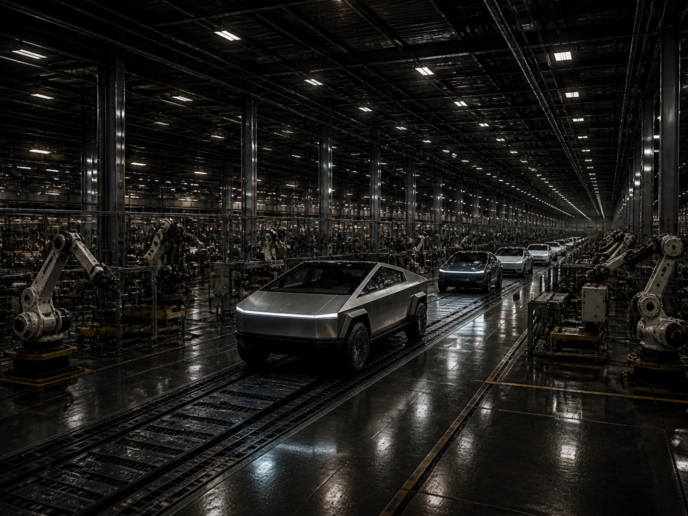
Tesla is preparing to wind down production of its controversial Cybertruck at its Texas factory around mid-2027, marking a significant change of direction for one of the electric vehicle industry’s most talked-about projects. The decision raises questions about the challenges facing electric pickups, international vehicle regulations and the future of zero-emission commercial vehicles.
Tesla Confirms Cybertruck Production Wind-Down
Tesla CEO Elon Musk announced on 6 November 2026 that the company intends to wind down Cybertruck production at its Gigafactory Texas facility around the middle of 2027. Tesla’s wider vehicle line-up and its future product plans are covered in our guide to Tesla’s current and upcoming vehicle models.
The move is intended to free up manufacturing capacity for increased production of Tesla’s Cybercab autonomous taxi, reflecting the manufacturer’s growing focus on artificial intelligence, robotics and autonomous mobility.
Unveiled in 2019, the Cybertruck attracted worldwide attention with its distinctive angular design, stainless-steel exterior and ambitious performance claims. However, bringing the vehicle into production proved more complicated than initially anticipated, with manufacturing delays, recalls and difficulties expanding into international markets.
The truck also struggled to achieve the sales volumes originally anticipated. Reuters reported that US Cybertruck sales fell by 48% in 2025 to 20,237 vehicles, considerably below Tesla’s earlier ambition of producing up to 250,000 annually.
Musk has disputed the suggestion that the decision reflects an inability to sell the vehicle, instead highlighting the opportunity to use manufacturing capacity for other projects.
Importantly, the announcement concerns production at the Texas factory. Tesla has not provided a definitive explanation of whether the Cybertruck could be manufactured elsewhere in the future.
Why Has The Cybertruck Struggled To Reach International Markets?
Although the Cybertruck became one of the most recognisable electric pickups in the world, its unconventional design has created challenges beyond manufacturing.
One significant obstacle has been meeting European vehicle safety requirements. The Cybertruck’s angular stainless-steel bodywork, rigid construction and external design have raised questions around pedestrian protection and the safety of other road users. European vehicle approval requirements place particular emphasis on protecting vulnerable road users, making the vehicle’s original design difficult to accommodate.
The challenges surrounding vehicle approval are part of a wider regulatory framework, which is explored in our article on proposed changes to UK vehicle safety and type approval rules.
Tesla has also faced separate regulatory scrutiny over how it describes its driver-assistance technology in Europe. In October 2026, the company began replacing its Full Self-Driving branding with Tesla Assisted Driving after regulators raised concerns that the original name could give drivers a misleading impression of the system’s capabilities. The technology still requires active driver supervision and does not make the vehicle autonomous. Our article on Tesla’s Assisted Driving technology in the UK and Europe explains the rebranding and the regulatory questions surrounding it.
Consequently, Tesla has not officially launched the Cybertruck in the UK or the wider European market.
Plans to introduce a right-hand-drive version have also encountered difficulties. In October 2026, Tesla abandoned plans to bring the vehicle to Australia and New Zealand, further reducing the likelihood of an official UK launch.
For British businesses interested in electric pickups, this means the Cybertruck has remained an interesting development in the international automotive industry rather than a realistic vehicle acquisition option.
Electric Pickups Must Deliver More Than Eye-Catching Design
The Cybertruck’s production difficulties highlight a wider consideration for manufacturers developing electric commercial vehicles.
While design, technology and performance can attract attention, businesses ultimately need vehicles that perform reliably in demanding working environments.
For companies operating pickups across construction, agriculture, utilities, infrastructure and other industries, practical considerations remain essential.
These include:
- Payload: How much equipment, tools and materials can the vehicle safely carry?
- Towing capacity: Can it accommodate trailers, machinery and other business equipment?
- Driving range: Can it complete a typical working day without requiring additional charging stops?
- Charging requirements: Is there sufficient charging infrastructure at business premises and across regular operating routes?
- Operating costs: How do electricity costs, maintenance, insurance and vehicle leasing payments compare with alternative powertrains?
- Vehicle suitability: Can the pickup accommodate the demands of the business without compromising productivity?
Battery weight can also create challenges for electric pickups, particularly when manufacturers are trying to balance driving range with payload and towing capabilities.
For fleet operators, these considerations are often more important than headline performance figures or distinctive styling.
The UK Electric Pickup Market Is Moving In A Different Direction
Although the Tesla Cybertruck has not established a presence in the UK, electric pickup development is continuing through manufacturers taking a more conventional approach to commercial vehicle design.
Toyota has introduced an all-electric version of its ninth-generation Hilux, bringing battery-electric technology to one of the UK’s best-known pickup nameplates.
The Toyota Hilux BEV retains the familiar pickup format while introducing an electric powertrain and permanent all-wheel drive. Its arrival gives businesses an established commercial vehicle manufacturer to consider when assessing the transition towards electric pickups.
We have previously covered the Toyota Hilux BEV and its introduction to the UK electric pickup market.
The Hilux is not the first fully electric pickup to attract attention in the UK, with the Maxus T90EV electric pickup having previously offered businesses an alternative to conventional diesel models.
Isuzu has also introduced the D-Max EV, developed around the practical requirements of commercial users. With a claimed WLTP range of up to 163 miles, a payload exceeding one tonne and a maximum towing capacity of 3.5 tonnes, it demonstrates how manufacturers are attempting to retain traditional pickup capabilities while moving away from diesel power.
The model has also attracted attention for its potential fleet applications, including a factory-fitted solar charging option designed to support its auxiliary electrical systems. We explore this development in our article about the Isuzu D-Max EV’s solar charging technology.
For businesses considering whether an electric pickup is suitable for their operations, the decision involves more than comparing driving range and charging times. Payload, towing capacity, vehicle configuration and the type of work being undertaken all need to be considered. Our guide to pickup truck leasing for businesses explains the key considerations when choosing a pickup for commercial use.
However, the transition to electric pickups will not suit every business immediately. For operators who still need a conventional diesel workhorse, the KGM Musso is available in commercial two-seat configurations, including the KGM Musso Rebel Commercial 2-Seat and the more highly equipped KGM Musso Saracen Commercial 2-Seat Automatic. Both feature a dedicated load area, fixed mesh bulkhead and rear-window security mesh, providing a practical alternative for businesses that are not yet ready to move away from diesel.
Not every manufacturer is taking the fully electric route, either. The BYD Shark plug-in hybrid pickup provides an example of how manufacturers are exploring different approaches to electrifying the pickup segment.
These vehicles illustrate that the future of electric pickups is not necessarily dependent on radical designs. Established manufacturers are instead concentrating on combining familiar working capabilities with the benefits of electric power.
Payload And Tax Rules Remain Important For UK Businesses
Another consideration influencing the development of electric pickups in Britain is the way commercial vehicles are classified for tax purposes.
Under current HMRC VAT rules, double-cab pickups generally need to offer a payload of at least 1,000kg to qualify for commercial vehicle treatment. Electric powertrains can make this threshold more difficult to achieve because battery packs add considerable weight. The tax position for businesses has also changed in recent years, particularly following the April 2025 changes to double-cab pickup tax treatment.
This can affect the financial considerations for businesses looking to introduce electric pickups into their fleets.
The VAT treatment of double-cab pickups is also separate from the Benefit-in-Kind rules introduced in April 2025, meaning businesses need to consider the relevant tax treatment rather than assuming all pickups receive the same classification.
We examine the issue in more detail in our guide to HMRC’s review of electric pickup VAT rules.
For fleet decision-makers, understanding payload, vehicle classification and the financial implications of different powertrains is an important part of assessing whether an electric pickup is suitable for their operations.
 Call our expert team on