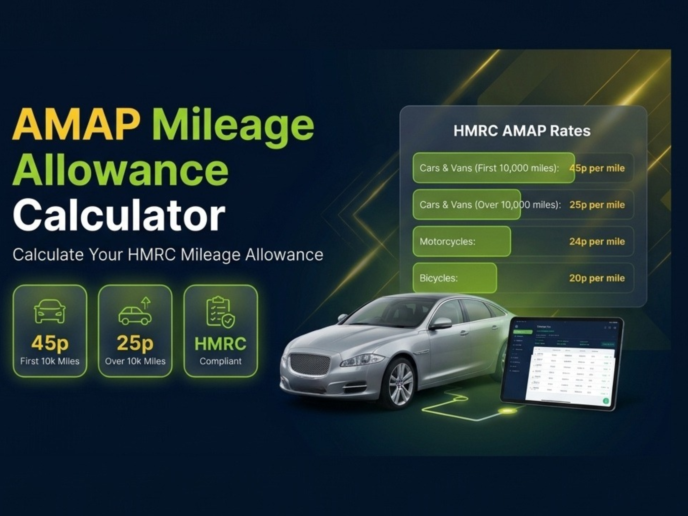
Use our AMAP Mileage Allowance Calculator to estimate your HMRC-approved mileage allowance for business journeys in your own vehicle. Enter your annual business mileage, vehicle type and the amount your employer has reimbursed to calculate the approved allowance and identify any potential Mileage Allowance Relief.
Whether you drive a petrol, diesel, hybrid or electric car or van, ride a motorcycle or use a bicycle for work-related journeys, understanding the HMRC mileage rates can help you calculate how much you may be entitled to receive or claim.
AMAP Mileage Allowance Calculator
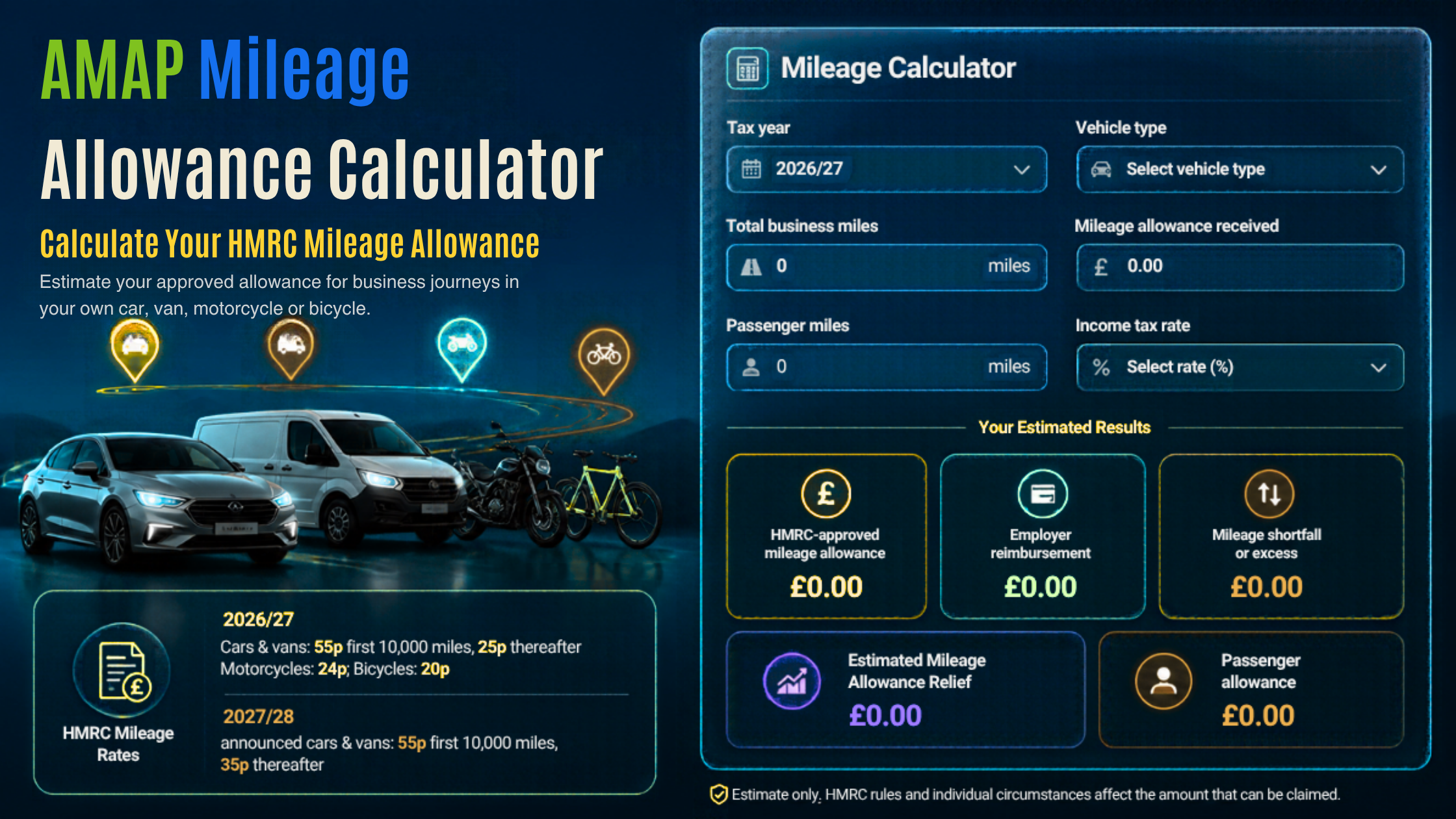
Enter your vehicle type, tax year and qualifying business mileage to calculate your estimated HMRC mileage allowance.
Calculator fields:
- Tax year: Select 2025/26, 2026/27 or 2027/28.
- Vehicle type: Car or van, motorcycle, or bicycle.
- Total business miles: Enter the qualifying business miles travelled during the tax year.
- Mileage allowance received: Enter the total amount your employer has reimbursed you for those journeys.
- Passenger miles: For eligible car and van journeys, enter the business miles travelled carrying fellow employees.
- Income tax rate: Select your applicable tax band if you want to estimate the potential tax relief on an eligible mileage shortfall.
The calculator should show:
- HMRC-approved mileage allowance: The calculated allowance based on the applicable rates and annual business mileage.
- Employer reimbursement: The amount already received.
- Mileage shortfall or excess: The difference between the approved amount and the reimbursement received.
- Estimated Mileage Allowance Relief: An indication of the potential tax relief available where an employer has reimbursed less than the approved amount.
- Passenger allowance: The additional amount that may be paid for eligible passenger journeys.
AMAP Mileage Allowance Calculator
Estimate your HMRC-approved mileage allowance, compare it with employer reimbursements and calculate any potential Mileage Allowance Relief.
1. Enter Your Details
Your Estimated Mileage Allowance
What Are Approved Mileage Allowance Payments (AMAPs)?
Approved Mileage Allowance Payments (AMAPs) are HMRC-approved rates used to calculate how much an employer can reimburse an employee for business journeys in their own vehicle without the payment normally becoming subject to Income Tax.
The rates are designed to cover the overall cost of using a privately owned vehicle for work, rather than simply the fuel consumed. This includes expenses such as petrol or diesel, electricity, insurance, servicing, repairs, vehicle tax and depreciation.
AMAP rates apply to qualifying business journeys in an employee's own car, van, motorcycle or bicycle. They provide a standardised way for employers to calculate mileage payments without having to assess the actual running costs of each individual vehicle.
For businesses where employees regularly use their own vehicles for work, mileage reimbursement should form part of a wider grey fleet management policy.
What Are the HMRC Mileage Allowance Rates for 2026/27?
HMRC increased the approved mileage rate for cars and vans from 45p to 55p per mile for the first 10,000 business miles, with the change taking effect retrospectively from 6 April 2026.
The rate for business mileage above 10,000 miles remains 25p per mile for the 2026/27 tax year.
Motorcycle and bicycle rates have not changed.
| Vehicle type | First 10,000 business miles | Above 10,000 miles |
|---|---|---|
| Cars and vans | 55p per mile | 25p per mile |
| Motorcycles | 24p per mile | 24p per mile |
| Bicycles | 20p per mile | 20p per mile |
The same car and van rates apply whether the vehicle uses petrol, diesel, hybrid technology or a fully electric powertrain.
What Are the Expected HMRC Mileage Rates for 2027/28?
The Government has announced a further increase to the car and van mileage rate for business journeys from 6 April 2027.
For the 2027/28 tax year, the rate for the first 10,000 business miles is expected to remain at 55p per mile, while the rate for additional mileage will increase from 25p to 35p per mile.
| Vehicle type | First 10,000 business miles | Above 10,000 miles |
|---|---|---|
| Cars and vans | 55p per mile | 35p per mile |
| Motorcycles | 24p per mile | 24p per mile |
| Bicycles | 20p per mile | 20p per mile |
The Government has announced that the revised rates will take effect from 6 April 2027, with legislation to be introduced to implement the changes.
These figures should therefore be treated as announced rates until the relevant legislation is in place.
How Is HMRC Mileage Allowance Calculated?
For cars and vans, HMRC uses two mileage bands. The first 10,000 qualifying business miles in the tax year are calculated at the higher rate, with any additional mileage calculated at the lower rate.
Motorcycle and bicycle mileage is calculated using a single rate, regardless of the number of business miles travelled.
For example, an employee driving 12,000 business miles in their own car during 2026/27 would calculate their approved mileage allowance as follows:
- First 10,000 miles: 10,000 × 55p = £5,500.
- Remaining 2,000 miles: 2,000 × 25p = £500.
- Total approved mileage allowance: £6,000.
The employee's approved mileage allowance for the year would therefore be £6,000.
For the same 12,000 miles in 2027/28, using the announced rates, the calculation would be:
- First 10,000 miles: 10,000 × 55p = £5,500.
- Remaining 2,000 miles: 2,000 × 35p = £700.
- Total approved mileage allowance: £6,200.
The calculation is based on cumulative qualifying business mileage during the tax year, rather than treating every journey separately.
What Is Mileage Allowance Relief (MAR)?
Mileage Allowance Relief (MAR) is tax relief that employees may be able to claim when their employer reimburses them at a rate below HMRC's approved mileage allowance.
For example, if an employee completes 8,000 qualifying business miles in their own car during 2026/27, their approved mileage allowance would be £4,400, based on 55p per mile.
If their employer pays 40p per mile, they receive £3,200.
The difference is £1,200, which represents the potential amount eligible for Mileage Allowance Relief.
The employee does not receive the full £1,200 back from HMRC. Instead, tax relief is calculated on the eligible shortfall at their applicable Income Tax rate.
For an employee paying Income Tax at 20%, the illustrative calculation would be:
- Approved mileage allowance: £4,400.
- Employer reimbursement: £3,200.
- Eligible mileage shortfall: £1,200.
- Potential tax relief at 20%: £240.
The actual amount will depend on the employee's circumstances and HMRC's rules. Employees must keep appropriate mileage records to support a claim.
What Happens If an Employer Pays More Than the HMRC Mileage Rate?
Employers can choose to reimburse employees at a rate higher than HMRC's approved mileage allowance. However, the amount above the approved threshold will normally be treated as taxable earnings and subject to the relevant reporting and payroll requirements.
For example, if an employer pays 60p per mile for qualifying car or van journeys during 2026/27, the first 55p per mile is within the approved rate for the first 10,000 miles. The additional 5p per mile is normally taxable.
The treatment can differ for Income Tax and National Insurance purposes, so employers should check the applicable payroll rules rather than assuming both use identical thresholds.
What Is the Additional Passenger Mileage Allowance?
HMRC allows employers to pay an additional 5p per mile for each fellow employee carried on qualifying business journeys in a car or van.
This is separate from the standard AMAP mileage rates and recognises the additional responsibility of carrying colleagues during work-related travel.
For example, an employee who travels 100 qualifying business miles with one fellow employee as a passenger may receive an additional £5 on top of their normal mileage allowance.
The passenger must also be travelling on a business journey. The additional payment does not apply to motorcycles or bicycles.
Importantly, employees cannot claim Mileage Allowance Relief if their employer pays less than 5p per passenger mile or makes no passenger payment.
Which Journeys Qualify for HMRC Mileage Allowance?
AMAP rates apply to qualifying business journeys undertaken in an employee's own vehicle. They do not normally apply to ordinary commuting between home and a permanent workplace.
Examples of journeys that may qualify include:
- Visiting customers or suppliers: Travelling from the normal workplace to attend a business meeting or appointment.
- Travelling between business locations: Moving between different offices, depots, sites or other workplaces as part of an employee's duties.
- Attending temporary workplaces: Travelling to a qualifying temporary workplace where the journey meets HMRC's rules.
- Work-related site visits: Travelling to locations where an employee needs to carry out business duties.
The distinction between business travel and ordinary commuting is important. Travelling from home to a permanent workplace is generally not eligible, even if an employee occasionally uses their own vehicle for work.
HMRC has specific rules for temporary workplaces and other types of business travel, so employees should check their circumstances before submitting a mileage claim.
Do AMAP Rates Apply to Electric and Hybrid Vehicles?
Yes. HMRC's approved mileage allowance rates for cars and vans apply regardless of whether the vehicle is petrol, diesel, hybrid, plug-in hybrid or fully electric.
This means an employee using their own electric car for qualifying business journeys can use the same AMAP rates as someone driving a petrol or diesel vehicle.
However, the AMAP system should not be confused with the Advisory Electricity Rate (AER), which applies to electricity reimbursement for business journeys in fully electric company cars.
The AER is a separate HMRC rate used by employers to reimburse electricity costs for qualifying business travel in company-owned or company-leased electric cars.
Two-Tier EV Mileage Reimbursement Guide: Learn how a two-tier Advisory Electricity Rate (AER) approach can be used to calculate business mileage reimbursement for electric company car drivers, depending on where the vehicle is charged.
For businesses managing electric company cars, the CVC AER Reimbursement Calculator can help estimate electricity reimbursement using the applicable advisory rates.
AMAP Mileage Allowance vs Mileage Allowance in Vehicle Leasing
AMAP mileage allowances and vehicle leasing mileage limits serve different purposes.
AMAP rates relate to the reimbursement of business journeys when an employee uses their own vehicle for work. Vehicle leasing mileage limits, by comparison, determine how many miles a leased vehicle is expected to cover during its contract.
A lease agreement will normally specify an annual mileage allowance. If the vehicle exceeds the agreed total mileage over the contract period, an excess mileage charge may apply, depending on the terms of the agreement.
Businesses should therefore consider both employee business mileage reimbursement and the contracted mileage requirements of any vehicles they provide.
Our guide to mileage allowance in vehicle leasing explains how mileage limits work when leasing a car or van.
How Should Businesses Manage Employee Mileage Claims?
For employers, accurate mileage records are important for controlling travel expenditure, processing employee expenses and applying the correct tax treatment.
A clear mileage policy should explain which journeys qualify, how employees should record their mileage, what reimbursement rate the business will pay and how claims are checked.
Businesses should consider the following:
- Record business journeys: Keep details of journey dates, destinations, purposes and mileage.
- Separate business and private travel: Do not include ordinary commuting or other non-qualifying journeys in business mileage claims.
- Apply the correct tax-year rates: Make sure reimbursement calculations reflect the rates applicable to the relevant tax year.
- Check passenger claims: Record eligible passenger journeys separately where the additional 5p allowance is paid.
- Review grey fleet arrangements: Consider the costs, safety responsibilities and administration associated with employees using their own vehicles.
Businesses with employees who regularly drive their own cars or vans should also review the wider costs and responsibilities involved in operating a grey fleet. Our grey fleet management guide explores the practical considerations for employers.
Explore Our Other Vehicle Calculators & Tools
Our range of vehicle calculators and tools can help businesses and drivers estimate vehicle costs, tax liabilities and other motoring expenses.
Other useful calculators include:
- Company Car BiK & P11D Tax Calculator: Estimate company car Benefit-in-Kind tax based on the vehicle's P11D value, CO₂ emissions and your Income Tax rate.
- Van BiK & Van Benefit Charge Calculator: Calculate the potential tax liability associated with having a company van available for private use.
- Business Fleet Fuel Cost Calculator: Estimate fuel expenditure based on vehicle efficiency, fuel prices and annual mileage.
- Electric Vehicle Running Cost Calculator: Estimate the electricity costs associated with running an electric vehicle.
- Total Cost of Ownership Calculator: Explore the wider costs involved in operating a business vehicle.
- AER Reimbursement Calculator: Calculate mileage reimbursement for business journeys in an electric company car using HMRC's Advisory Electricity Rate (AER).
- Van Payload Calculator: Calculate your van's available payload capacity to help determine how much weight it can carry, taking into account its gross vehicle weight and unladen weight.
 Call our expert team on