The Government’s £100 million commitment to reducing public electric vehicle (EV) charging costs could provide some welcome relief for motorists, but businesses operating electric cars and vans may see a more limited benefit.
Announced in the 2026 Autumn Budget, the funding is intended to make lower-powered public charging more affordable, particularly for drivers who cannot charge at home. The scheme is expected to begin in spring 2027 and run for two years, with estimated savings of around £150 annually for drivers who rely on the affected charging facilities.
However, businesses managing multiple vehicles face a different set of challenges. Public charging prices are only one part of the overall cost of operating an electric fleet. Vehicle utilisation, daily mileage, electricity tariffs, charging availability and the time vehicles spend off the road can all influence the financial case for switching.
The funding could help businesses with employees who regularly depend on public charging, but it does not remove the need to plan how an electric fleet will be charged. For many operators, understanding where vehicles are parked and how they are used could have a greater influence on long-term running costs than a reduction in public charging prices.
What Does The £100m EV Charging Fund Cover?
The Government’s funding package is designed to reduce the cost of using lower-powered public EV chargers, including those installed on residential streets.
These facilities are particularly important for drivers without private driveways or dedicated parking spaces, who cannot easily install a home charging point. Unlike rapid chargers at motorway services, lower-powered units are generally intended for vehicles that can remain connected for several hours.
The Government estimates that the targeted chargers account for approximately one-third of the public charging network. Drivers who regularly use these facilities could save around £150 a year, although the actual benefit will depend on their charging habits and the eventual implementation of the scheme.
The announcement also includes plans to investigate tariff portability, potentially allowing motorists to access their domestic electricity rates at selected public charging locations. A separate charge would still be needed to cover the operation and maintenance of the charging infrastructure.
These proposals could help address the difference between domestic and public charging costs, but the details are still being developed. The tax treatment of electricity can also influence the difference, with separate VAT rates applying to household electricity and public charging. Our article on the growing VAT gap between home and public EV charging explains the implications.
For businesses, it is important to recognise that the funding is aimed at reducing public charging costs rather than providing a general grant for installing workplace or depot chargers.
Our coverage of the Government’s £100m public EV charging fund examines the announcement and what it could mean for motorists and businesses.
Depot Charging Could Be More Suitable For Some Fleets
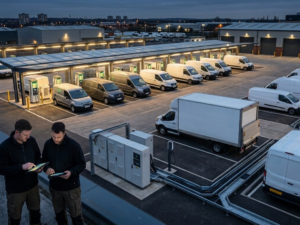
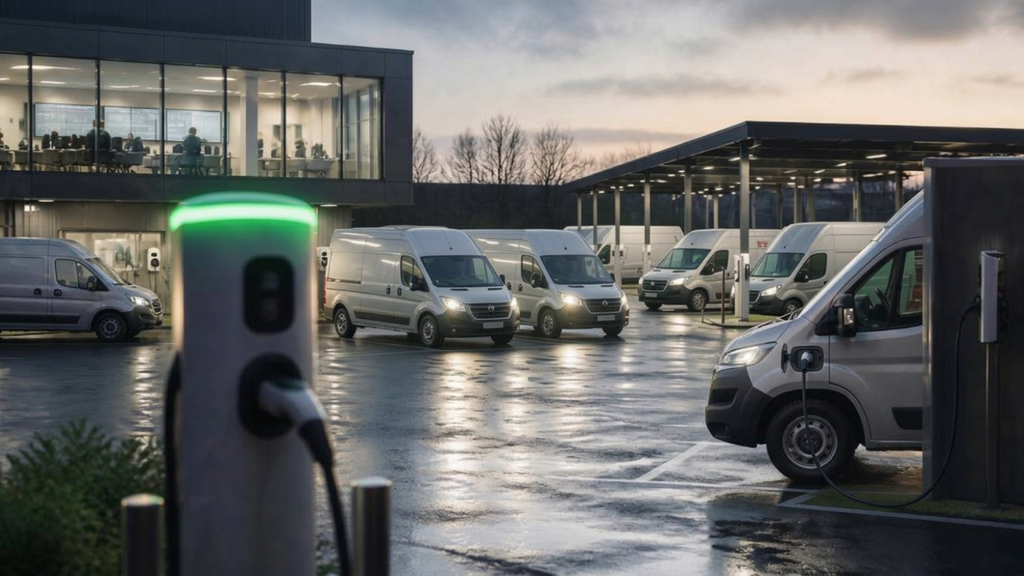
Businesses operating vehicles from a central depot or workplace may have opportunities to reduce their reliance on public charging.
Where vehicles return to the same premises at the end of each working day, they can potentially be connected to chargers overnight and prepared for their next journeys. This provides greater control over charging schedules and reduces the need to build additional charging stops into daily routes.
However, installing charging equipment requires careful planning. The number of vehicles in a fleet does not necessarily determine how many chargers a business needs.
For example, a business operating 20 vans that all return overnight may have different infrastructure requirements from one operating 20 vehicles across several shifts, with some returning throughout the day.
Before investing in workplace charging, businesses should consider:
- Vehicle operating schedules: When vehicles return to the premises, how long they remain parked and when they need to be available again.
- Daily mileage: How far individual vehicles travel and how much battery capacity they are likely to use.
- Parking arrangements: Whether vehicles have designated spaces where charging equipment can be installed and accessed.
- Electrical capacity: Whether the existing electricity supply can support the required charging equipment or needs upgrading.
- Simultaneous charging requirements: How many vehicles genuinely need to charge at the same time.
- Future fleet requirements: Whether the proposed installation will accommodate additional electric vehicles as the fleet changes.
A business should establish its actual charging requirements before deciding how many charging points to install or what equipment to purchase.
Intelligent charging systems can also help distribute available electrical capacity between vehicles, potentially reducing the need for every vehicle to charge at maximum power simultaneously.
Our guide to EV charging for businesses explains the different options available, including workplace, home and public charging.
Electricity Tariffs Are Just As Important As Charging Equipment
The cost of charging an electric vehicle is influenced by more than the equipment being used.
Electricity tariffs can vary considerably, and businesses should understand the rates available to them before deciding how and when vehicles should be charged.
Some electricity suppliers offer time-of-use tariffs, with lower prices available during particular periods. Where these arrangements are suitable, businesses may be able to schedule charging overnight or during other cheaper periods.
However, charging schedules must reflect operational requirements. Saving money on electricity is of limited benefit if vehicles are not sufficiently charged when employees need them.
Businesses should also consider whether their electricity arrangements need reviewing as more vehicles move towards electric power. An existing commercial electricity contract may not necessarily provide the most suitable arrangement for a growing fleet.
For businesses with employees who take company vehicles home, domestic charging creates another consideration. Employers need a reliable way to establish how much electricity has been used for business vehicles and reimburse employees appropriately.
The home EV charging reimbursement changes affecting fleets highlight how charging data, domestic electricity tariffs and reimbursement arrangements are becoming increasingly important to fleet managers. The introduction of separate home and public charging reimbursement rates has added another consideration, as explained in our article on the two-tier EV mileage reimbursement system.
It is also worth monitoring developments around UK electric vehicle tariffs for 2027, particularly as the Government examines whether domestic rates could be made available at selected public charging locations.
Public Charging Will Remain Important For Business Vehicles
Depot charging may be suitable for businesses with predictable operating patterns, but it will not meet every fleet’s requirements.
Vehicles travelling longer distances, visiting multiple customer locations or operating across different regions may need to use public charging facilities during the working day.
For these operators, the location and availability of charging points can be just as important as the price.
A delivery van completing local journeys might return to its depot with sufficient battery capacity remaining, whereas a vehicle travelling between cities could require one or more charging stops.
Businesses should therefore assess their regular routes and identify where charging opportunities are available. This includes considering whether suitable chargers are located near customer premises, along major routes or at locations where vehicles are likely to spend time parked.
Charging reliability is another important consideration. If a vehicle arrives at a charge point that is unavailable or out of service, the resulting delay could affect appointments, deliveries and other scheduled work. Research has also highlighted differences in public charger reliability across the UK, making availability an important consideration for businesses operating electric vans. Read more about EV charger reliability across UK regions.
A combination of depot, workplace, home and public charging may therefore be the most practical arrangement for some businesses.
The continued expansion of the UK EV charging network should provide additional options, but businesses still need to consider the facilities available in the areas where their vehicles operate.
Wider investment in charging infrastructure is also supporting the transition, as explored in our article on EV charging infrastructure growth.
Choosing The Right Electric Vehicles Matters Too
Charging arrangements should form part of the vehicle selection process rather than being considered after electric vehicles have already been introduced.
Different electric cars and vans have different battery capacities, driving ranges, energy consumption figures and charging capabilities. Selecting a vehicle that does not suit its intended duties could create unnecessary charging requirements or restrict how it can be used.
For commercial fleets, the decision involves more than comparing advertised driving ranges.
Businesses need to consider:
- Daily mileage: Whether the vehicle can complete its regular journeys without requiring additional charging.
- Payload requirements: Whether the vehicle can carry the necessary equipment, tools or goods without compromising operational suitability.
- Charging speed: How quickly the battery can be replenished when vehicles are parked or using public infrastructure.
- Vehicle availability: Whether the selected model is suitable for the type of work being undertaken.
- Overall running costs: How leasing, electricity, maintenance, insurance and other expenses compare with existing vehicles.
Overall running costs: How leasing, electricity, maintenance, insurance and other expenses compare with existing vehicles.
Businesses should also consider how changes to vehicle pricing and manufacturer incentives could affect the cost of switching to electric. Our guide to potential UK electric vehicle tariffs in 2027 explains the possible impact of upcoming UK–EU trade rules.
A larger battery is not automatically the most cost-effective option, particularly if the vehicle rarely needs its full available range.
Likewise, choosing a vehicle based solely on its advertised range may overlook practical considerations such as payload, operating conditions and the availability of suitable charging facilities.
Our guide to transitioning a business van fleet to electric explores some of the factors businesses should assess before replacing existing commercial vehicles.
Calculate The Total Cost Of Operating An Electric Fleet
The cost of electricity is an important part of the financial assessment, but businesses should avoid making decisions based on charging prices alone.
A meaningful comparison needs to consider the overall cost of operating a vehicle throughout the agreement or ownership period.
This includes the initial vehicle cost or monthly rental, electricity consumption, maintenance, insurance, taxation, mileage and any additional infrastructure expenditure.
Businesses should also account for the different ways vehicles are charged. A fleet relying heavily on public rapid charging could have a very different electricity bill from one that can make greater use of depot or domestic charging.
CVC’s electric vehicle running cost calculator can help estimate electricity expenditure, while the EV journey cost calculator provides another way to assess the potential cost of individual journeys.
Charging requirements can also be estimated using the EV charging time calculator, helping businesses understand how long vehicles may need to remain connected.
For a broader financial assessment, the total cost of ownership guide for business vehicles explains why comparing the complete cost of running a vehicle is more useful than focusing on one individual expense.
The Wider Challenge Is Managing An Electric Fleet Efficiently
As businesses introduce more electric cars and vans, fleet management becomes increasingly important.
Charging arrangements, electricity expenditure, vehicle availability and employee reimbursement all introduce considerations that may not have featured in the same way when operating a predominantly petrol or diesel fleet.
Businesses need reliable information about how vehicles are being used, how much they cost to operate and whether their charging arrangements are meeting operational requirements.
For larger fleets, centralising this information can help managers identify vehicles with higher running costs, monitor utilisation and make better-informed decisions about future replacements.
It is also important to review charging arrangements as the fleet changes. A system that works for five electric vans may need to be reassessed when the business introduces another 15 vehicles or expands into new operating areas.
Effective fleet management solutions can help businesses coordinate their vehicles and wider fleet requirements as electrification progresses.
The Government’s £100 million funding announcement may eventually help reduce one element of electric vehicle running costs, but businesses should not base their transition plans on savings that are not yet available.

 Call our expert team on