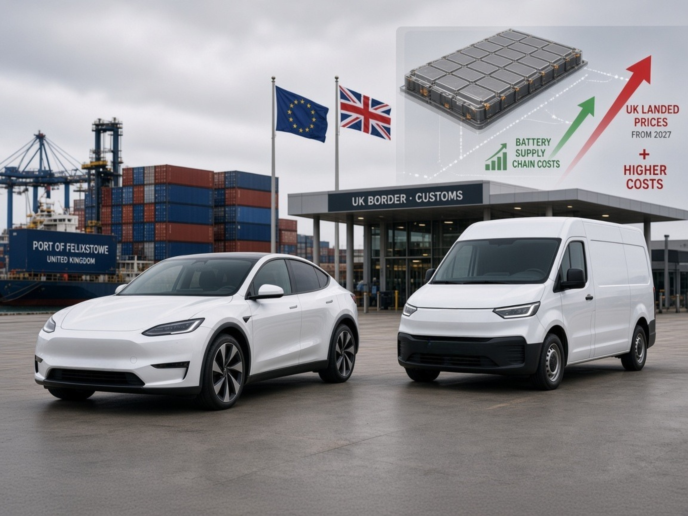
Electric cars and vans built in Europe could face additional costs when being exported to the UK from January 2027, as tighter battery sourcing requirements under the UK-EU trade agreement are set to come into force.
The European Automobile Manufacturers’ Association (ACEA) has warned that a significant proportion of electric vehicles exported from the European Union to the UK may not meet the rules of origin requirements due to take effect next year.
If the current rules remain unchanged, affected vehicles could be subject to a 10% customs tariff, potentially increasing costs for manufacturers and creating knock-on effects for vehicle prices, incentives and availability in the UK.
However, the situation is still developing, with ACEA calling for the rules to be temporarily adjusted to give manufacturers more time to establish European battery supply chains.
How Many Electric Vehicles Could Be Affected?
ACEA estimates that around 520,000 electric passenger cars and vans could be exported from the EU to the UK during 2027.
According to the organisation, approximately 82% of those vehicles could fail to meet the rules of origin requirements currently scheduled to apply from 1 January 2027.
That would potentially leave around 426,000 vehicles exposed to the 10% customs duty.
The vehicles affected are estimated to represent approximately €17.9 billion (£15.4bn) in exports, with ACEA calculating that the potential tariff bill could reach around €1.47bn (£1.2bn) during 2027.
These figures are ACEA estimates rather than a confirmed forecast of how many vehicles will ultimately attract the tariff, as manufacturers may alter their supply chains and the rules themselves could potentially be changed before they come into force.
Why Are New EV Tariffs Being Discussed?
The issue comes from the rules of origin contained within the UK-EU Trade and Cooperation Agreement (TCA).
Rules of origin are used to determine where a product is considered to originate for trade purposes. They can take into account where components are manufactured and the amount of qualifying content contained within the finished product, rather than simply where the vehicle is assembled.
For electric vehicles to benefit from tariff-free trade between the UK and EU, they must satisfy the relevant rules of origin.
The UK Government previously explained that these requirements were designed to encourage greater production of batteries and components within the UK and EU while ensuring preferential tariffs are applied to products that meet the agreed origin requirements.
Electric vehicles and their batteries have been subject to a phased approach under the TCA.
The UK and EU previously agreed to delay the next stage of the requirements until the end of 2026, giving manufacturers additional time to develop battery production and supply chains in the UK and Europe.
The next stage is currently scheduled to take effect from 1 January 2027.
What Are The New Rules?
The requirements become increasingly focused on the proportion of a vehicle and its battery that originates within the UK or EU.
The key requirements currently scheduled for 2027 can be summarised as follows:
| Requirement | From 1 January 2027 | Why It Matters |
|---|---|---|
| Electric vehicle originating content | 55% | The vehicle must contain sufficient qualifying UK or EU content to benefit from tariff-free trade |
| Battery pack originating content | 70% | A greater proportion of the battery pack must originate within the UK or EU |
| Battery cell originating content | 65% | Battery cells will also need to meet a higher regional-content threshold |
| Vehicles failing to qualify | 10% tariff | Vehicles that do not satisfy the rules could face the standard customs duty when exported between the UK and EU |
The important point is that the 10% tariff would not automatically apply to every electric vehicle built in Europe.
It would apply where an individual vehicle fails to meet the relevant rules of origin and therefore cannot qualify for the preferential tariff treatment available under the UK-EU Trade and Cooperation Agreement.
That means the eventual impact could vary significantly between manufacturers and individual models, depending on where their vehicles, batteries and components are produced. The European Parliament has previously outlined the same phased thresholds, with the 2027 requirements set at 55% for vehicle value, 70% for battery packs and 65% for battery cells.
Why Are Manufacturers Concerned?
The European automotive industry has invested heavily in developing domestic battery production, but ACEA argues that the necessary capacity is not coming online quickly enough to satisfy the next stage of the rules.
European manufacturers are increasingly using batteries and components sourced from outside the UK and EU, while domestic battery manufacturing capacity is still being developed.
ACEA says manufacturers have already committed substantial investment to European battery production and supports the longer-term objective of building a stronger regional supply chain.
Its concern is primarily about the timing.
The association argues that the industry will not have sufficient European battery capacity available by the beginning of 2027 to meet the requirements across the number of vehicles being exported to Britain.
Could UK Electric Vehicle Prices Increase?
There is potential for additional costs to feed through to the UK market, although it is too early to say exactly how manufacturers would respond.
A 10% customs tariff would increase the cost of importing an affected vehicle into the UK. Manufacturers could then choose to absorb some of the additional expense or pass some of it through the supply chain.
There are several possible responses.
Manufacturers could increase vehicle prices, reduce discounts, change finance incentives or adjust the number of vehicles allocated to the UK market.
For customers, the impact could therefore be felt through more than just the headline list price.
Changes to manufacturer contributions, promotional offers and vehicle availability could also influence the overall cost of leasing an electric vehicle.
This makes the issue particularly relevant to businesses considering their next company cars or electric vans.
CVC’s guide to Business Car Leasing explains how businesses can use vehicle leasing as part of their wider fleet strategy.
What Could It Mean For Electric Van Leasing?
The potential changes are also relevant to the rapidly expanding electric van market.
Electric vans are becoming an increasingly important part of the UK commercial vehicle sector, with businesses having more models to consider when replacing diesel vehicles or expanding their fleets.
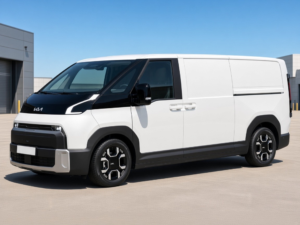
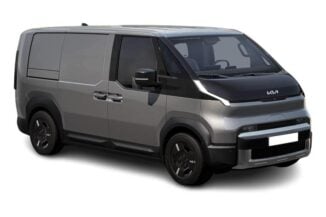
The Kia PV5, Volkswagen ID. Buzz Cargo and other newer electric commercial vehicles are adding further choice to the market.
CVC’s Volkswagen ID. Buzz vs Kia PV5 electric van comparison looks at two of the newer electric van options available to UK businesses.
For businesses considering the move to electric, the potential changes to UK-EU trade rules are therefore another factor worth keeping an eye on alongside charging requirements, range, payload, operating costs and vehicle availability.
CVC’s guide to Switching To An Electric Vehicle covers some of the practical considerations businesses should assess before making the move.
Manufacturers Could Absorb Some Of The Cost
A potential tariff does not automatically mean that the entire cost will be passed on to customers.
Vehicle manufacturers operate in a competitive market and could choose to absorb some of the additional expense in order to maintain pricing, sales volumes or market share.
They could also use a combination of measures.
For example, a manufacturer could maintain a vehicle’s list price while reducing a discount or finance contribution, meaning the change is reflected indirectly in the customer’s overall cost.
Alternatively, manufacturers could alter which vehicles are supplied to the UK, particularly where some models are easier to bring into compliance with the rules than others.
The impact could therefore vary considerably between manufacturers and individual models.
ACEA Calls For The Rules To Be Adjusted
ACEA is now calling for a temporary change to the battery rules of origin rather than abandoning the longer-term localisation requirements.
Its proposal would maintain a more flexible approach based around battery pack assembly until the end of 2029.
Stricter requirements covering battery cells would then be introduced from 2030, followed by requirements covering cathode material from 2032.
The association says this would give European manufacturers additional time for the battery supply chain to develop while retaining the longer-term objective of increasing European production.
Any change would require agreement between the relevant UK and EU authorities.
The rules are reciprocal, meaning the issue also affects UK-built electric vehicles being exported into the European Union.
The UK Has Already Delayed The Previous Stage
This is not the first time the automotive industry has raised concerns about the timing of the rules.
In December 2023, the UK and EU agreed to extend the existing electric vehicle rules of origin until the end of 2026.
The Government said the decision would prevent 10% tariffs from being introduced at that point and give manufacturers more time to develop battery supply chains.
The Government estimated that the agreement could avoid up to £4.3 billion in additional costs for manufacturers and consumers.
However, the 2023 agreement extended the transitional arrangements only until the end of 2026.
Under the current timetable, the stricter rules are scheduled to apply from 1 January 2027. The UK Government has also acknowledged industry concerns about the upcoming changes and said it is engaging with both the European Commission and the UK automotive sector.
What Does This Mean For People Leasing An EV?
For anyone considering an electric car or van, the potential changes are another reason to look beyond the headline vehicle price.
Leasing costs can be influenced by a range of factors, including the manufacturer’s list price, discounts, finance rates, residual values and the availability of manufacturer-supported offers.
If tariffs affect certain European-built models, manufacturers could respond differently depending on their production and battery supply chains.
Some models may be largely unaffected, while others could face additional costs if they cannot satisfy the new rules.
This means the impact of the 2027 changes is unlikely to be identical across the entire electric vehicle market.
Businesses considering an electric fleet can also compare different vehicle types and technologies rather than relying on a single model or manufacturer.
CVC’s Electric Vehicle Charging Explained guide covers the charging considerations businesses need to assess when operating electric cars and vans, while its Top 10 Electric Cars To Lease In 2026 guide provides an overview of some of the electric cars currently available to UK drivers.
More Electric Vehicles Are Entering The UK Market
The potential tariff changes come at a time when the number of electric vehicles available to UK drivers and businesses continues to increase.
The market now includes electric hatchbacks, SUVs, estates, premium cars and a growing selection of commercial vehicles.
For businesses, the expansion of electric vans is particularly significant.
The Kia PV5 is one example of the newer generation of electric commercial vehicles entering the UK market, while the Volkswagen ID. Buzz provides another option for businesses looking beyond traditional diesel vans.
CVC’s article More Choice, Greater Value: How The UK Vehicle Market Is Changing also looks at the wider changes taking place across the UK vehicle market.
The 2027 rules will therefore be introduced against a backdrop of increasing electric vehicle choice, rather than a market with only a small number of available EVs.
 Call our expert team on