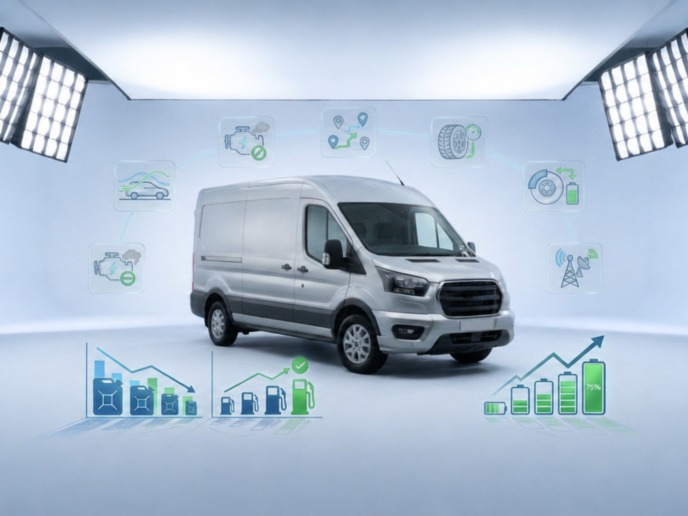
Fuel and electricity are two of the ongoing expenses businesses need to manage when operating commercial vehicles. While choosing the right vans, negotiating suitable leasing agreements and maintaining vehicles all influence running costs, driver behaviour is another important factor that can easily be overlooked.
How a van is driven every day can have a direct impact on fuel consumption, electricity use, tyre wear, brake condition and vehicle maintenance requirements. Repeated harsh acceleration, unnecessary braking, excessive idling and poor journey planning can all contribute to higher operating costs.
Eco-driving is the practice of using smoother, more efficient and more anticipatory driving techniques to reduce unnecessary energy consumption while maintaining safety and productivity.
For businesses operating diesel and petrol vans, the benefits can be measured through improved miles per gallon (MPG). For electric vans, the equivalent measure is miles per kilowatt-hour (miles/kWh). Although the techniques differ slightly between powertrains, the underlying principle is the same: getting more from every litre of fuel or unit of electricity.
With operating costs remaining an important consideration for UK businesses in 2026, introducing eco-driving practices can provide fleet managers with another way to improve efficiency without immediately needing to replace vehicles or invest in additional equipment.
What Is Eco-Driving?
Eco-driving is not simply about travelling more slowly or trying to achieve the highest possible fuel economy. It involves developing driving habits that minimise unnecessary acceleration, braking and energy consumption while allowing drivers to complete their journeys safely and efficiently.
Rather than reacting to traffic at the last moment, drivers are encouraged to anticipate what is happening further ahead and adjust their speed gradually.
The main principles include:
- Anticipating traffic conditions: Looking ahead to identify traffic lights, junctions, congestion and potential hazards before reaching them.
- Accelerating smoothly: Avoiding unnecessary bursts of acceleration that demand additional power from the engine or electric motor.
- Maintaining consistent speeds: Reducing unnecessary changes in speed where traffic and road conditions allow.
- Using appropriate gears: Selecting the highest suitable gear in a manual vehicle without labouring the engine, or using the vehicle’s available efficiency settings where appropriate.
- Reducing unnecessary weight: Removing equipment, tools and materials that are not required for the journey.
- Maintaining vehicles correctly: Ensuring tyres, brakes and other components remain in suitable condition.
- Planning journeys effectively: Reducing unnecessary mileage, avoiding avoidable congestion and making better use of vehicle capacity.
These techniques can help reduce energy consumption while also limiting unnecessary wear on components such as tyres and brakes.
For businesses looking at the wider benefits, eco-driving should form part of an overall approach to wider fleet management strategy rather than being treated as a one-off driver training exercise.
How Eco-Driving Can Reduce Fuel Costs for Diesel and Petrol Vans
Fuel remains a significant variable expense for many businesses operating commercial vehicles, particularly those covering substantial annual mileage.
Although manufacturers publish official fuel economy figures, real-world consumption can differ considerably depending on vehicle load, journey type, traffic conditions, maintenance and driving style.
Two drivers operating identical vans on similar routes may achieve noticeably different fuel consumption because of how they accelerate, brake and manage their speed.
Repeated hard acceleration, excessive idling and unnecessary braking can all increase fuel consumption.
For businesses operating several vehicles, relatively small differences in efficiency can become more significant when repeated across an entire fleet.
The Cost Of Poor Driving Habits
Consider a business operating a fleet of medium-sized vans covering thousands of miles each year.
If drivers regularly accelerate aggressively, maintain unnecessarily high speeds or leave engines running while stationary, the additional fuel consumption can accumulate over time.
Other common causes of avoidable fuel use include:
- Leaving engines idling during deliveries or while waiting at customer premises.
- Carrying tools, materials and equipment that are not needed for the job.
- Driving at higher speeds than necessary.
- Making repeated journeys that could have been combined.
- Ignoring tyre pressures and routine maintenance requirements.
- Failing to adjust driving behaviour to suit traffic and road conditions.
Improving these habits can help businesses reduce the amount of fuel required to complete their usual workloads.
The financial impact will depend on annual mileage, vehicle efficiency, fuel prices and the type of work being undertaken.
Businesses can use CVC’s fuel cost calculator to estimate their current expenditure and compare different fuel consumption figures.
Vehicle selection also remains important. Businesses considering replacement vans can refer to our guide to the best MPG vans in the UK when comparing models and their potential running costs.
Reducing Unnecessary Engine Idling
Engine idling is another area where businesses can improve fuel efficiency.
Leaving a diesel or petrol engine running while a driver waits at a delivery location, customer premises or roadside can consume fuel without moving the vehicle any closer to its destination.
Although some situations require an engine to remain running, unnecessary idling should be discouraged.
Drivers should understand when it is appropriate to switch off the engine, taking into account manufacturer guidance, safety requirements and operating conditions.
Reducing unnecessary idling can also help limit local exhaust emissions, particularly in urban areas where commercial vehicles frequently make short stops.
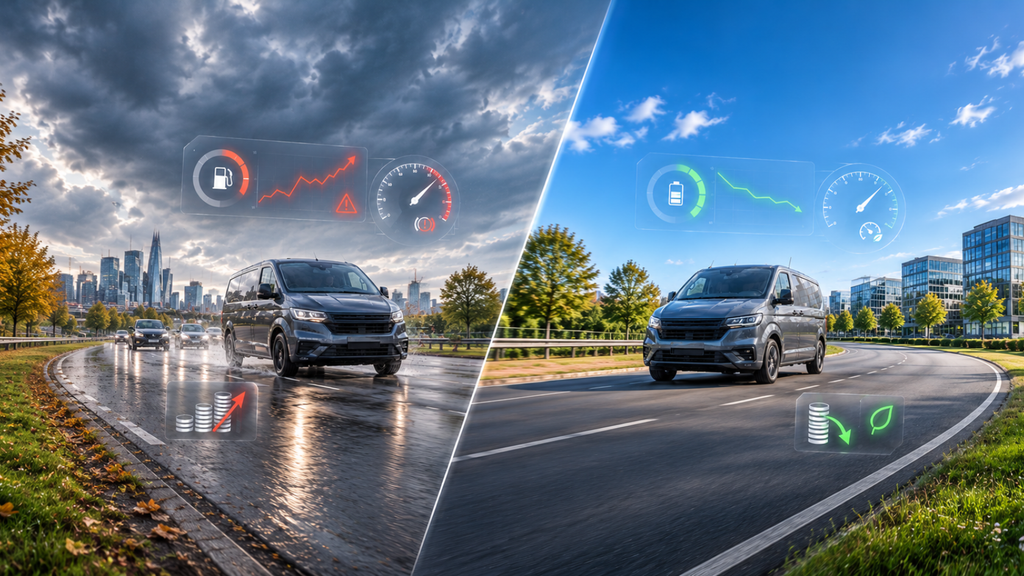
Improving Energy Efficiency When Driving Electric Vans
Electric vans introduce a different set of considerations because their efficiency is measured through electricity consumption rather than fuel economy.
For fleet managers, understanding how many miles a vehicle travels per kilowatt-hour provides a useful way to assess its real-world efficiency.
However, electric vehicle range can vary considerably depending on driving style, speed, temperature, payload and the use of heating or air conditioning.
A van that achieves an impressive range under favourable conditions may consume considerably more electricity when operating fully loaded, travelling at motorway speeds or working in colder weather.
Driver behaviour can therefore make an important difference to the efficiency of an electric fleet.
Smooth Acceleration And Regenerative Braking
Electric motors can deliver substantial torque immediately, making electric vans particularly responsive when accelerating.
However, repeatedly using strong acceleration demands more energy from the battery.
Drivers should therefore aim to accelerate progressively, using the available power when necessary rather than treating the immediate torque as an invitation to accelerate aggressively.
Regenerative braking is another important feature of electric vehicles.
When the driver slows down, the electric motor can operate as a generator, recovering some of the vehicle’s kinetic energy and returning it to the battery.
Drivers can make better use of this system by anticipating traffic conditions and easing off the accelerator earlier when approaching junctions, roundabouts and slower-moving traffic.
The precise approach will depend on the vehicle. Some electric vans offer adjustable regenerative braking, while others provide different driving modes or one-pedal driving.
Drivers should understand how their particular vehicle operates and use regenerative braking appropriately. It is not a substitute for using the conventional brakes when necessary.
Managing Speed And Driving Range
Speed has a particularly noticeable effect on electric vehicle efficiency.
At higher speeds, aerodynamic drag increases, requiring more energy to maintain momentum. This means that travelling faster on motorways can reduce an electric van’s available range.
For businesses operating electric commercial vehicles, maintaining appropriate and consistent speeds can help make journeys more energy-efficient.
Other useful habits include:
- Avoiding unnecessary rapid acceleration.
- Using the vehicle’s available efficiency mode where appropriate.
- Limiting unnecessary use of heating and air conditioning.
- Pre-conditioning the cabin while the vehicle is connected to a charger, where supported.
- Removing unnecessary equipment and additional weight.
- Monitoring actual electricity consumption rather than relying entirely on advertised WLTP range figures.
Winter conditions also need to be considered. Lower temperatures can affect battery performance and increase the amount of electricity required to heat the cabin.
Businesses can use CVC’s electric vehicle running cost calculator to estimate charging expenditure, while the EV journey cost calculator can help compare the cost of electricity for individual journeys.
For businesses reimbursing employees who charge electric vehicles at home, the AER reimbursement calculator can also help calculate applicable electricity reimbursement.
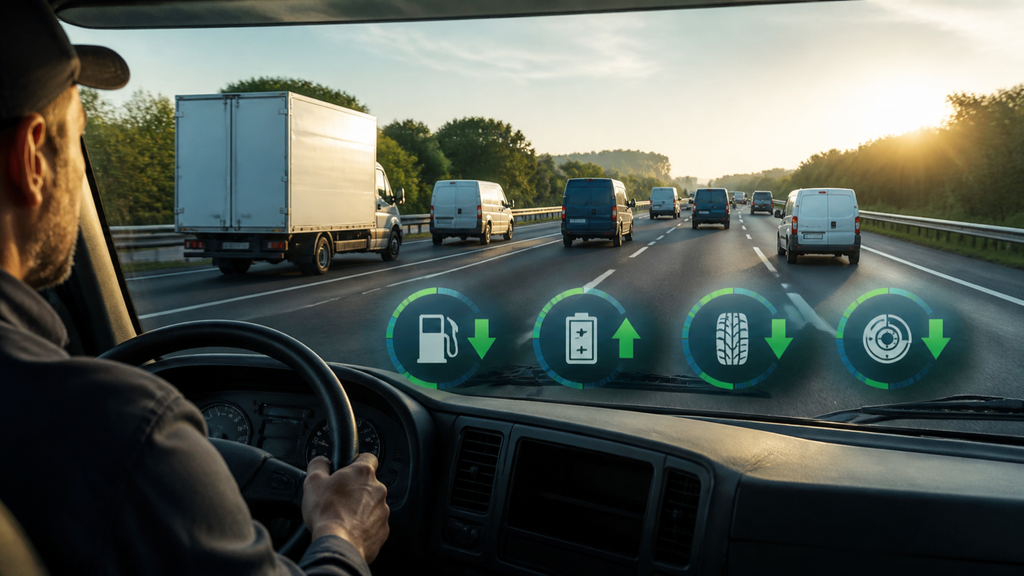
Practical Eco-Driving Techniques Every Van Driver Can Use
Although the technology differs between combustion-engine and electric vehicles, several driving habits can improve efficiency across both types.
Fleet managers should make these techniques part of everyday driver guidance rather than relying solely on occasional training sessions.
1. Look Further Ahead
One of the most important eco-driving techniques is anticipating what is happening further along the road.
Drivers who regularly look ahead can identify potential stops, changes in traffic flow and developing hazards earlier.
This allows them to adjust their speed gradually instead of relying on sudden braking or acceleration.
For example, approaching a red traffic light at speed before braking sharply wastes energy and creates additional wear on braking components. Recognising the situation earlier allows the driver to slow down more progressively.
2. Accelerate Smoothly
Rapid acceleration places additional demands on both conventional engines and electric powertrains.
Drivers should build speed progressively and avoid unnecessary bursts of acceleration, particularly in built-up areas where traffic conditions frequently require vehicles to slow down again.
This does not mean acceleration should be so slow that it creates a hazard or obstructs other road users. The objective is to use power appropriately rather than unnecessarily.
3. Avoid Unnecessary Braking
Repeated hard braking wastes momentum and increases wear on brake components.
Looking ahead, maintaining appropriate following distances and anticipating traffic changes can help drivers reduce the need for sudden braking.
Drivers should never compromise stopping distances or safety to improve efficiency. Smooth driving must always remain secondary to maintaining proper control of the vehicle.
4. Maintain Appropriate Tyre Pressures
Tyre pressure has an important influence on rolling resistance, fuel consumption and electric vehicle range.
Under-inflated tyres create additional resistance as they rotate, requiring more energy to move the vehicle. They can also affect handling, braking performance and tyre wear.
Drivers should check pressures in accordance with manufacturer recommendations, taking account of the vehicle’s load where applicable.
Regular inspections also help identify damage and uneven wear before they develop into more serious problems.
Our guide to fleet tyre safety explains why businesses should make tyre condition an important part of their vehicle management procedures.
5. Remove Unnecessary Weight
Commercial vans are frequently used to transport tools, equipment, stock and materials.
However, carrying items that are not required for the day’s work adds unnecessary weight and increases the energy needed to move the vehicle.
Businesses should encourage drivers to review their loads regularly, removing redundant equipment and ensuring materials are organised appropriately.
Load management should never compromise vehicle payload limits, weight distribution or load security. Businesses can use our van payload calculator to help understand their vehicle’s carrying capacity and avoid exceeding its permitted payload.
6. Plan Routes And Journeys
Poor journey planning can increase both mileage and operating costs.
Drivers who repeatedly travel through congested areas, make unnecessary return journeys or fail to coordinate nearby appointments may use more fuel or electricity than required.
Route planning systems can help businesses identify more efficient journeys, although the shortest route is not necessarily the most economical.
Traffic conditions, road types, vehicle restrictions, delivery schedules and charging requirements should all be considered.
Good planning can also reduce time pressure on drivers, helping them complete their work without feeling that they need to compensate by driving aggressively.
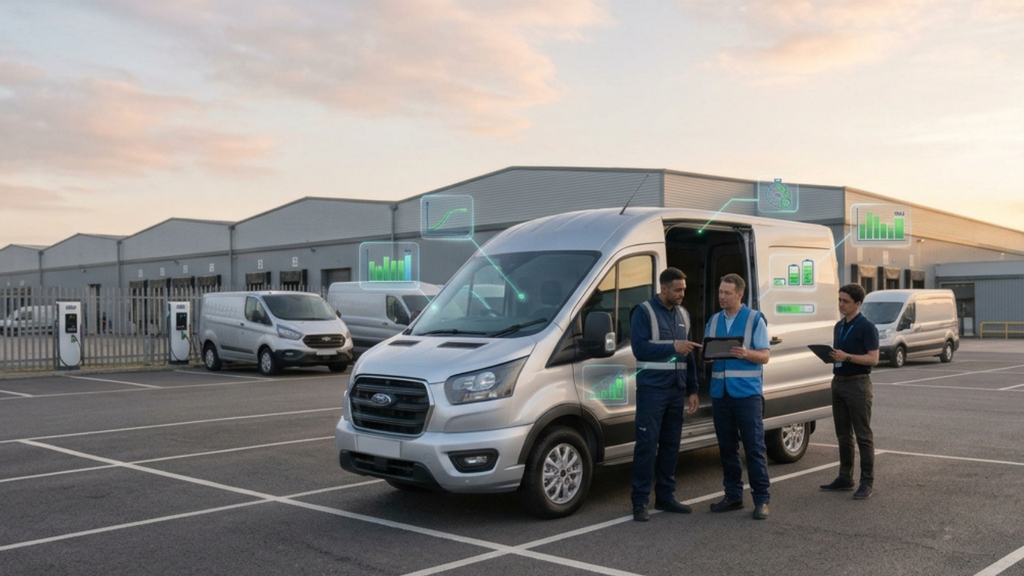
Why Driver Training Should Be Part Of Fleet Management
Providing drivers with information about eco-driving is a useful starting point, but businesses should not assume that distributing guidance will automatically change everyday behaviour.
Drivers may already have established habits, particularly if they have spent many years operating commercial vehicles.
Effective training should explain why certain techniques matter and demonstrate how they can be applied to the vehicles and journeys employees undertake.
A practical programme could include:
- Driver awareness sessions: Explaining how acceleration, braking, speed and idling influence vehicle efficiency.
- Practical driving instruction: Demonstrating smoother driving techniques using the actual vehicles operated by the business.
- Electric vehicle familiarisation: Helping drivers understand regenerative braking, driving modes, battery consumption and range management.
- Regular feedback: Providing drivers with information about their fuel or electricity consumption.
- Refresher training: Revisiting important techniques and addressing any areas where driving habits have deteriorated.
Training should also recognise that not every driver has the same requirements.
A delivery driver working in congested urban areas will encounter different challenges from an engineer travelling longer distances between customer sites.
The most effective approach is to tailor training to the vehicle, workload and typical operating environment.
Eco-driving should also complement wider fleet driver safety arrangements, ensuring that improving efficiency never takes priority over road safety.
Using Telematics To Monitor Driving Behaviour
Telematics provides businesses with another way to understand how their vehicles are being operated.
Modern systems can collect information about vehicle movements, mileage, fuel consumption and driving behaviour, allowing fleet managers to identify patterns that may otherwise be difficult to spot.
Depending on the system and vehicle, available information may include:
- Harsh acceleration and braking events.
- Excessive idling.
- Speeding and speed-limit compliance.
- Journey distances and vehicle utilisation.
- Fuel consumption.
- Electric vehicle energy consumption.
- Driving efficiency scores.
This information can help businesses compare vehicle performance and identify where additional driver support may be worthwhile.
For example, if two similar vans regularly complete comparable journeys but one consistently uses more fuel, fleet managers can investigate the reasons.
Possible explanations include different payloads, traffic conditions, route choices, driving styles or vehicle maintenance requirements.
For electric fleets, monitoring miles per kWh can help identify vehicles or journeys where energy consumption is higher than expected.
CVC’s guide to vehicle telematics and fleet tracking for small businesses explains how these systems can support vehicle oversight and operational management.
Making Driver Performance Monitoring Constructive
Telematics should be used to support improvement rather than simply penalise drivers who receive lower efficiency scores.
Driving conditions are not always comparable, and a driver working in a busy city centre may naturally record more braking events than someone travelling on quieter roads.
Fleet managers should therefore consider journey type, traffic conditions, vehicle load and working requirements when interpreting the information.
Explaining how driving data is collected and used is equally important.
Drivers should understand what is being monitored, why the information is being collected and how it will contribute to improving fleet efficiency and safety.
Recognising progress and sharing improvements can be more effective than creating unnecessary competition between employees.
Integrating Eco-Driving Into Everyday Fleet Management
Eco-driving is most effective when it forms part of a wider fleet management strategy.
Driver behaviour is only one influence on vehicle operating costs. Vehicle selection, maintenance, mileage, payload and contract arrangements also contribute to the overall financial picture.
Businesses should consider the following areas alongside driver training.
Establish Clear Company Vehicle Policies
A company vehicle policy should explain what is expected of employees when using business vehicles.
This can include responsibilities for vehicle condition, safe driving, reporting defects, managing loads and following company procedures.
Including guidance on efficient driving can help establish consistent expectations across the fleet.
Our company vehicle policy guide provides further information about the areas businesses should consider.
Introduce Consistent Vehicle Checks
Regular vehicle checks help identify issues that could affect efficiency, safety and reliability.
Drivers should be encouraged to check tyre pressures, look for visible damage and report any mechanical problems promptly.
For businesses operating commercial vans, daily van checks should form part of their wider vehicle management procedures.
Keep Vehicles Properly Maintained
Vehicle condition can influence fuel consumption and energy efficiency.
Incorrect tyre pressures, worn components and unresolved mechanical problems can all affect how efficiently a vehicle operates.
Businesses should ensure servicing and maintenance requirements are followed, with defects investigated and addressed appropriately.
CVC’s guide to fleet vehicle servicing and maintenance explains how planned maintenance can support vehicle reliability and help businesses manage their fleets.
Consider Total Cost Of Ownership
Fuel and electricity are important running costs, but they should not be considered in isolation.
Businesses also need to account for leasing payments, maintenance, tyres, insurance, taxation, downtime and other expenses associated with operating commercial vehicles.
Eco-driving can contribute towards reducing some of these costs, but it should be assessed alongside the wider financial performance of the fleet.
Our guide to total cost of ownership for business vehicles explores the different expenses businesses should consider when assessing their vehicle requirements.
How Businesses Can Measure The Results Of Eco-Driving
Introducing eco-driving practices is only worthwhile if businesses can understand whether they are making a difference.
Fleet managers should establish a baseline before introducing training, allowing subsequent performance to be compared against previous results.
For diesel and petrol vehicles, useful measurements include:
- Average miles per gallon.
- Total fuel expenditure.
- Fuel consumption per vehicle.
- Idle time.
- Annual mileage.
For electric vans, businesses should consider:
- Average miles per kWh.
- Electricity consumption per mile.
- Charging expenditure.
- Real-world driving range.
- Energy consumption across different routes and seasons.
Comparisons should take account of mileage, payload, journey type and seasonal conditions. Otherwise, changes in operating requirements could be mistaken for improvements or reductions in driving efficiency.
For example, a van covering more motorway miles may achieve different consumption figures from one operating almost exclusively in urban areas.
Businesses should also review performance over a reasonable period rather than relying on a few days of driving data.
An initial review after eight to twelve weeks can provide a useful indication of whether training is influencing behaviour, although longer-term monitoring will be needed to assess whether improvements are being maintained. Having access to accurate vehicle information can also help businesses monitor mileage, operating costs and fleet performance. CVC’s vehicle lease management portal provides a central point for managing vehicle information.
Common Eco-Driving Mistakes Businesses Should Avoid
Although eco-driving can provide practical benefits, poorly designed initiatives can create problems if businesses focus too heavily on individual performance targets.
Several mistakes are worth avoiding.
Prioritising fuel economy over safety: Drivers should never feel pressured to maintain an inefficiently low speed in inappropriate conditions, delay necessary braking or compromise safe driving distances to achieve a better score.
Using unrealistic targets: A delivery driver operating in heavy traffic will have different efficiency requirements from someone travelling longer distances on open roads.
Ignoring vehicle suitability: Driving behaviour cannot compensate for a vehicle that is unsuitable for its workload, particularly where payload, towing requirements or journey distances are concerned.
Failing to maintain vehicles: Eco-driving training will have limited value if businesses overlook tyre pressures, servicing and mechanical condition.
Treating training as a one-off exercise: Without regular feedback and reinforcement, drivers may gradually return to their previous habits.
Ignoring driver feedback: Employees often understand the practical challenges associated with their routes and vehicles better than anyone else. Their input can help businesses identify realistic opportunities for improvement.
The aim should be to create an approach that encourages efficiency while allowing drivers to complete their work safely and within realistic operational requirements.
How To Introduce An Eco-Driving Programme
Businesses do not necessarily need expensive technology or a major training budget to start improving driving efficiency.
A straightforward programme can begin with existing vehicle information and a small group of drivers.
A practical starting point involves five steps:
1. Establish Current Performance
Record existing fuel consumption or electricity usage, annual mileage and operating costs. Where possible, compare similar vehicles undertaking similar work.
2. Identify Areas For Improvement
Look for patterns involving excessive idling, harsh braking, unnecessary acceleration, high energy consumption or poor journey planning.
3. Introduce Driver Training
Provide practical guidance covering the driving techniques most relevant to the vehicles and journeys involved.
4. Monitor Results
Use existing fuel records, vehicle data or telematics to assess whether driving behaviour and energy consumption are changing.
5. Review And Improve
Discuss the results with drivers, recognise improvements and identify where additional training or operational changes may be required.
Starting with a smaller group can help businesses understand what works before extending the programme across the entire fleet.
For organisations operating both conventional and electric vehicles, it may also be useful to introduce separate guidance covering the different efficiency considerations associated with each powertrain.
 Call our expert team on