Any business that uses vehicles for work — whether company cars, vans, pickups or employees’ own vehicles — needs to identify and manage the risks associated with work-related driving.
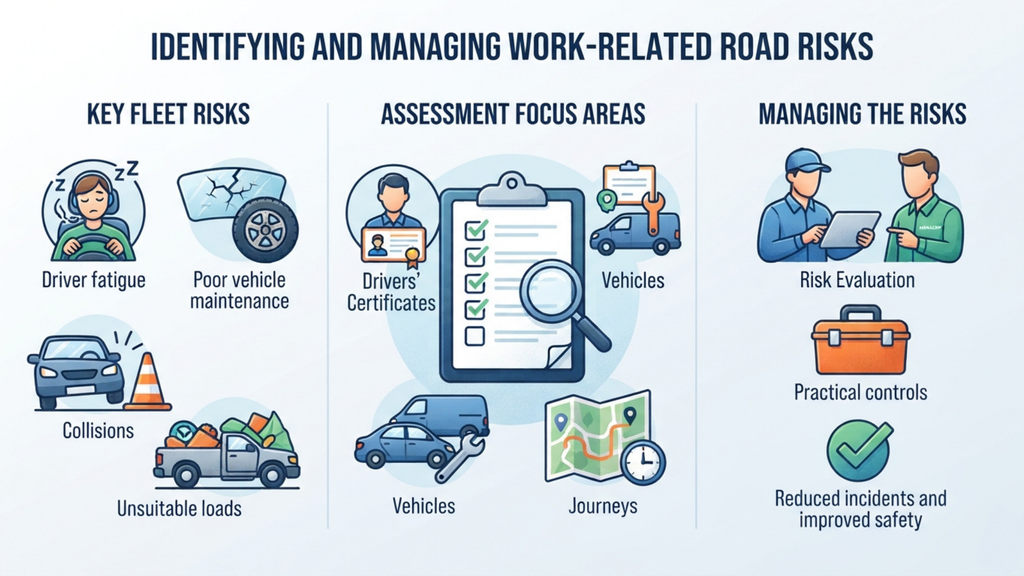
Road risk is an important part of workplace health and safety. Collisions, driver fatigue, poor vehicle maintenance, unsuitable loads and unrealistic journey schedules can put employees and other road users at risk. They can also lead to vehicle downtime, insurance claims, missed appointments and disruption to business operations.
A fleet risk assessment helps businesses understand these risks and decide what practical measures are needed to reduce them. It should cover drivers, vehicles and journeys, taking account of how vehicles are used and the work employees are expected to carry out.
For organisations operating multiple vehicles, risk assessment should form part of a wider approach to fleet management solutions, rather than being treated as a one-off compliance exercise.

What Is A Fleet Risk Assessment?
A fleet risk assessment is a structured process for identifying hazards associated with work-related driving, evaluating the risks they present and deciding what controls are needed.
It considers the people driving the vehicles, the condition and suitability of those vehicles, and the journeys undertaken as part of the business.
For example, a company operating delivery vans might identify risks associated with long driving hours, reversing in confined spaces, carrying heavy equipment or using vehicles that are not suitable for the loads being transported.
A business that allows employees to use their own cars for work must also consider the risks associated with those journeys. This is commonly known as grey fleet use.
The assessment should reflect the organisation’s actual activities. A business operating local service vans will not necessarily face the same risks as one whose employees regularly travel long distances between customer sites.
A suitable assessment should help the business to:
- Identify hazards: Understand what could cause an incident or injury during work-related driving.
- Evaluate risks: Consider how likely an incident is and how serious the consequences could be.
- Introduce controls: Put reasonable measures in place to reduce the identified risks.
- Assign responsibility: Make clear who is responsible for implementing and maintaining safety measures.
- Review performance: Reassess risks when working practices, vehicles, routes or circumstances change.
The aim is not to eliminate every conceivable risk, which may be impossible, but to identify significant risks and take proportionate action to manage them.
Why Is Fleet Risk Assessment Important?
Work-related driving can expose employees and other road users to a range of hazards. Businesses need to understand these risks and take appropriate action to manage them.
The Health and Safety Executive (HSE) provides guidance on work-related road safety, including employers’ responsibilities for managing driving risks.
The legal requirements that apply will depend on the circumstances, but the Health and Safety at Work etc. Act 1974 and the Management of Health and Safety at Work Regulations 1999 are particularly relevant to employers managing work activities.
Businesses should assess risks arising from their work and implement appropriate measures to protect employees and others who may be affected. A fleet risk assessment can help demonstrate how these responsibilities are being addressed, although completing a document alone does not guarantee compliance.
Effective risk management can also help businesses:
- Protect drivers and other road users by addressing preventable hazards.
- Reduce vehicle downtime by identifying maintenance requirements and recurring safety problems.
- Support consistent working practices through clear procedures and driver expectations.
- Improve incident management by establishing reporting and investigation processes.
- Inform fleet decisions by identifying where vehicles, equipment or working arrangements may need to change.
- Review insurance and operational exposure by understanding patterns of incidents and potential areas for improvement.
Risk assessment should therefore be viewed as part of responsible business management, not simply a paperwork requirement.
What Should A Fleet Risk Assessment Cover?
A practical assessment should consider three main areas: drivers, vehicles and journeys. Depending on the business, it may also need to address loads, equipment, customer sites and the wider working environment.
1. Driver Risk Assessment
Drivers are central to work-related road safety. Their experience, training, fitness to drive and working conditions can all influence risk.
Businesses should consider whether drivers have the appropriate licence for the vehicles they operate and whether they understand the responsibilities associated with driving for work. Businesses should also make sure employees understand their obligations when using a leased vehicle, including their responsibilities for vehicle care, reporting defects and following the relevant terms of use. See our guide to leased vehicle driver responsibilities.
Relevant factors include:
- Driving licences and entitlement: Check that drivers hold the appropriate entitlement and establish a process for monitoring licence status where appropriate.
- Experience and competence: Consider whether additional training or supervision is needed for particular vehicles, routes or tasks.
- Fatigue and working hours: Assess whether schedules, journey lengths and rest arrangements could contribute to tiredness.
- Health and fitness to drive: Consider relevant health, medication or fitness concerns through appropriate and proportionate procedures.
- Distraction: Address mobile phone use, navigation systems and other distractions while driving.
- Driving behaviour: Review relevant incident records, complaints and available driving information to identify potential patterns.
- Driver wellbeing: Consider whether working pressures, stress or unrealistic schedules could affect safe driving.
Driver training should reflect the risks identified rather than relying on a generic approach for every employee.
Businesses can also consider how wider workplace practices affect driver safety. Our guide to driver health and wellbeing provides a related resource for organisations looking at employee wellbeing.
2. Vehicle Risk Assessment
A vehicle must be suitable for the work it is expected to perform and maintained in a safe condition.
The assessment should consider the type of vehicle, its age and condition, its intended use, and any equipment or modifications that could affect safety.
Areas to review include:
- Vehicle condition: Establish suitable inspection and maintenance arrangements, including checks before use where appropriate.
- Tyres, brakes and lights: Ensure safety-critical components are inspected, and defects are dealt with promptly.
- Servicing and repairs: Maintain appropriate servicing schedules and records, and make sure defects are not left unresolved.
- Vehicle suitability: Confirm that the vehicle is appropriate for the job, including its payload, load space, access requirements and operating environment.
- Safety equipment: Check that relevant safety equipment is available and functioning correctly.
- Modifications and conversions: Consider whether fitted equipment or vehicle alterations introduce additional risks.
- Breakdown arrangements: Ensure drivers know what to do if a vehicle becomes unsafe or breaks down during a journey.
Businesses should establish clear procedures for reporting defects and deciding whether a vehicle can continue to be used.
A defect reporting system is only effective if reported problems are assessed and acted upon. Where a safety-critical fault makes a vehicle unsafe, it should not continue to be used until the issue has been appropriately addressed.
For more detail, see our guide to fleet vehicle servicing and maintenance, which explains the importance of maintaining vehicles and addressing defects appropriately.
3. Journey Risk Assessment
The risks associated with driving depend on more than the driver and vehicle. The journey itself can introduce additional hazards.
Businesses should consider how far employees travel, the roads they use, the conditions they may encounter and the pressures created by their schedules.
Relevant factors include:
- Journey length: Consider whether journeys are reasonable and allow sufficient time for breaks.
- Route selection: Assess whether routes involve challenging roads, restricted access, busy urban areas or other significant hazards.
- Weather and visibility: Establish how drivers should respond to severe weather, poor visibility and deteriorating road conditions.
- Time pressure: Avoid schedules that encourage speeding, unsafe driving or missed rest breaks.
- Night driving: Consider reduced visibility, fatigue and the additional risks associated with driving at night.
- Customer and delivery sites: Identify hazards associated with site access, reversing, pedestrian movements and loading areas.
- Changing circumstances: Make sure drivers can report delays, road closures or conditions that make a journey unsafe.
Journey planning should allow drivers to make safe decisions without being pressured to meet unrealistic deadlines.
For example, a delivery business may need to revise its scheduling process if drivers regularly face pressure to complete routes within insufficient time. The risk assessment should identify the underlying problem and support practical changes.

How To Carry Out A Fleet Risk Assessment
The HSE’s general approach to risk assessment provides a useful framework for businesses. Its guidance on managing risks and risk assessment explains the key stages involved.
For fleet operators, the process can be adapted to reflect the vehicles, drivers and journeys involved.
Step 1: Identify The Hazards
Start by understanding how the business uses vehicles and where risks could arise.
Review the types of vehicles operated, the work employees carry out, typical journeys, loading arrangements, working hours and any relevant incident history.
Speak to drivers and managers who understand the day-to-day operation. They may be aware of recurring problems that are not obvious from written procedures alone.
Examples of hazards include fatigue, reversing accidents, poorly secured loads, defective tyres and vehicles that are unsuitable for particular tasks.
Step 2: Identify Who Could Be Harmed And How
Consider who could be affected by each hazard.
This may include:
- Employees driving for work.
- Passengers travelling in company vehicles.
- Other road users, including cyclists and pedestrians.
- Employees and contractors working at customer sites.
- Members of the public affected by vehicle movements or loading activities.
For each hazard, consider how an incident could occur and what the potential consequences might be.
A reversing manoeuvre in a busy yard, for example, could present risks to pedestrians as well as the driver.
Step 3: Evaluate The Risks And Introduce Controls
Assess the likelihood of an incident and the seriousness of its potential consequences. Use this information to decide which risks require attention and what control measures are appropriate.
Controls might include driver training, revised journey schedules, more frequent vehicle inspections, improved load-securing arrangements or changes to site procedures.
When deciding on controls, consider whether the underlying hazard can be removed, whether exposure can be reduced and whether additional safeguards are needed.
Record the actions required, who is responsible for them and when they should be completed.
Step 4: Record Findings And Communicate Requirements
Businesses should record significant findings and ensure relevant employees understand the controls that apply to their work.
The level of documentation should be appropriate to the nature and complexity of the risks. Employers with five or more employees are generally required to record the significant findings of their risk assessments.
A useful record should identify:
- The hazards identified.
- Who could be harmed and how.
- The existing precautions and any additional controls required.
- The person responsible for each action.
- The target date for completing outstanding actions.
- The arrangements for reviewing the assessment.
Communicate relevant requirements to drivers and managers. A policy that employees do not understand or follow is unlikely to provide effective protection.
Step 5: Review And Update The Assessment
A fleet risk assessment should remain relevant as business operations change.
Review it periodically and whenever there is a significant change that could affect safety. Examples include introducing different vehicles, changing delivery routes, expanding operations, altering working hours or identifying a recurring incident pattern.
A collision, near miss or serious defect may also indicate that existing controls need to be reviewed.
Keep a record of significant changes and check that agreed actions have been completed. Businesses should also review whether their vehicles remain suitable as operational needs change. Our guide to fleet lifecycle management explores how vehicle replacement planning can support changing fleet requirements.
Downloadable Fleet Risk Assessment Checklist
Carrying out a fleet risk assessment is easier when businesses have a structured way to review potential hazards, record existing controls and identify where further action may be required.
To help with this process, use our Fleet Risk Assessment Checklist, a practical template for UK businesses operating cars, vans, pickups or employees’ own vehicles for work-related journeys.
The checklist covers:
- Driver safety: Licence entitlement, competence, fatigue, working hours and driver responsibilities.
- Vehicle condition: Maintenance, tyres, safety checks, defects, payload and vehicle suitability.
- Journey planning: Route risks, realistic schedules, weather conditions and loading or delivery locations.
- Grey fleet use: Business-use insurance, vehicle suitability and arrangements for employees using their own cars for work.
- Incident management: Reporting procedures, near misses, corrective actions and record-keeping.
- Review and improvement: Responsibilities, outstanding actions and assessment review dates.
The template also includes space to record hazards, identify who could be harmed, document existing precautions and assign further actions to a responsible person.
Download the Fleet Risk Assessment Checklist (PDF)
Prefer to adapt the document to your own operation? Download the editable Fleet Risk Assessment Template (Word).
Use the checklist as a starting point and adapt it to your vehicles, drivers, journeys and working environment. It does not replace a suitable and sufficient risk assessment, professional advice where required, or the need to implement and review appropriate safety measures.
Fleet Risk Assessments And Grey Fleet Vehicles
A grey fleet is made up of employees’ own vehicles used for business journeys.
Although these vehicles are not owned or leased by the employer, their use for work can still create risks that the business needs to consider. The organisation should establish suitable arrangements for ensuring that employees using their own cars for work are appropriately authorised and that relevant safety requirements are addressed.
Depending on the circumstances, checks may include:
- Driving licence entitlement: Establishing that the employee is legally entitled to drive for the journey.
- Vehicle roadworthiness: Taking reasonable steps to check that the vehicle is suitable and maintained appropriately.
- Insurance: Confirming that the insurance arrangements cover the intended business use.
- Journey necessity: Considering whether a business journey is necessary or whether a safer alternative is available.
- Driver fitness: Ensuring employees understand their responsibilities regarding fatigue, health and safe driving.
- Reporting procedures: Making clear how accidents, defects and other safety concerns should be reported.
Businesses should establish a consistent process for grey fleet use rather than assuming that an employee’s privately owned vehicle falls outside workplace safety arrangements.
Our grey fleet management guide explores the considerations involved in managing employees’ own vehicles used for work.
Common Fleet Risk Assessment Mistakes To Avoid
Even where an assessment has been completed, gaps in implementation can undermine its effectiveness.
Common problems include:
- Treating the assessment as a one-off exercise: Risks can change as vehicles, routes, drivers and working practices evolve.
- Using generic paperwork: A template that does not reflect the business’s actual activities may overlook important hazards.
- Ignoring driver feedback: Employees may have first-hand knowledge of recurring risks and unsafe working practices.
- Failing to address identified problems: Recording a risk is not enough if the necessary control measures are not implemented.
- Overlooking grey fleet vehicles: Employees’ own cars used for business journeys should not be automatically excluded from consideration.
- Neglecting vehicle suitability: A vehicle that is technically roadworthy may still be unsuitable for the work, load or operating environment.
- Setting unrealistic schedules: Pressure to meet deadlines can undermine otherwise appropriate safety procedures.
- Keeping unclear records: Responsibilities and completion dates should be clear enough for managers to monitor outstanding actions.
- Failing to investigate incidents: Collisions and near misses can reveal weaknesses in existing controls and procedures.
Businesses should also make sure their risk assessment is supported by clear rules for using company vehicles. A documented company vehicle policy can help explain driver responsibilities, vehicle use, defect reporting and accident procedures.
Managing Fleet Incidents And Reviewing Risk
Accidents and near misses should be reviewed to establish what happened, whether existing controls worked and whether further action is needed.
Businesses should have a clear procedure for reporting incidents, gathering relevant information, notifying the appropriate parties and arranging any necessary follow-up.
An effective process can help identify recurring problems, such as repeated vehicle defects, unsafe manoeuvres at particular sites or journeys that consistently place drivers under time pressure.
Reviewing incidents should be about understanding the causes and improving safety, rather than automatically assuming that every incident results from driver error.
For practical guidance, see our company vehicle accident procedure.
How Fleet Audits Can Support Risk Assessment
A fleet risk assessment identifies hazards and determines what measures are needed to manage them. A fleet audit can help businesses review whether their existing processes, records and controls are working as intended.
An audit may examine vehicle maintenance records, driver checks, incident reporting, policy compliance and the completion of actions identified during earlier assessments.
The findings can help managers identify gaps, establish priorities and monitor improvements.
For example, an assessment might identify the need for more consistent vehicle defect reporting. A subsequent audit could check whether drivers are reporting defects correctly, whether managers are recording them and whether repairs are being completed promptly.
Our guide to fleet audits for UK businesses provides further information on reviewing fleet processes.
The Role Of Vehicle Choice And Fleet Management
Risk management should inform decisions about the vehicles a business operates and how those vehicles are managed.
A vehicle that is unsuitable for a particular job may introduce unnecessary risks, even if it is maintained correctly. Payload requirements, load dimensions, access restrictions, driver needs and the operating environment should all be considered when selecting vehicles.
Businesses that require specialist equipment or modifications should also assess the implications for vehicle safety, maintenance and day-to-day use. Where vehicles need specialist equipment or alterations, our commercial vehicle conversions guide provides further information on the types of conversions available for business use.
Our guides to choosing the right business van to lease and commercial vehicle conversions can help businesses consider vehicle suitability and conversion requirements.
Where vehicles carry equipment or operate in demanding environments, businesses should also review relevant load-security, vehicle-use and workplace transport requirements. The RHA Van Standard compliance guide may be useful for businesses looking at van operating standards.
Fleet risk assessment should also connect with wider fleet management arrangements. Clear processes for maintenance, vehicle replacement, driver communication and record-keeping can help businesses act on the risks they identify.
For a broader overview, see our fleet management guide.
How Commercial Vehicle Contracts Can Help
Commercial Vehicle Contracts helps UK businesses source vehicles for their operational requirements, including cars, vans and pickups.
Choosing appropriate vehicles is one consideration within wider fleet planning. Businesses should also consider how vehicles will be used, the requirements of their drivers, maintenance arrangements and the risks associated with their journeys.
As an independent vehicle leasing broker, Commercial Vehicle Contracts can help businesses explore suitable leasing options for their needs. Our one-stop fleet solutions provide a starting point for businesses reviewing their vehicle requirements.
Fleet risk assessment and health and safety responsibilities remain with the relevant business and its appointed advisers. However, ensuring that vehicle selection and fleet planning reflect operational requirements can form part of a joined-up approach to managing work-related driving.
Related Guides
- Fleet Management Solutions
- Grey Fleet Management Guide
- Company Vehicle Policy: A UK Business Guide
- Company Vehicle Accident Procedure
- Fleet Audits: The Complete Guide For UK Businesses
- Fleet Vehicle Servicing And Maintenance
- Choosing The Right Business Van To Lease
- Fleet Lifecycle Management: The Complete Guide For UK Businesses
Frequently Asked Questions About Fleet Risk Assessments
A fleet risk assessment is a structured process for identifying and managing the risks associated with work-related driving. It considers factors such as driver competence, vehicle condition, journey planning, working hours and the type of driving employees undertake. The aim is to reduce the likelihood of collisions, injuries and disruption to business operations.
UK employers have legal duties to assess and manage relevant health and safety risks, including those arising from work-related driving. The Management of Health and Safety at Work Regulations 1999 require employers to assess risks to employees and others who may be affected by their work. The assessment should reflect the organisation’s activities and the risks involved.
The employer is responsible for ensuring that relevant workplace risks are assessed and managed. A fleet manager, health and safety manager or another suitably competent person may carry out the assessment, depending on the organisation’s size and complexity. Employers should ensure that the person undertaking it has the appropriate knowledge and access to information about drivers, vehicles and work-related journeys.
A fleet risk assessment should consider driver competence and fitness, vehicle condition and suitability, journey planning, working hours, road conditions and the nature of the work being undertaken. Businesses should also consider employees who use their own vehicles for work, known as grey fleet drivers. The assessment should identify appropriate control measures, assign responsibilities and explain how risks will be monitored.
There is no single review interval that applies to every fleet risk assessment. Businesses should review assessments regularly and whenever significant changes occur, such as introducing new vehicles, changing working practices, employing new drivers or identifying risks following a collision or near miss. The review frequency should reflect the level of risk and the circumstances of the business.
Yes, businesses should assess relevant risks associated with employees driving their own vehicles for work. Using a privately owned car or van does not remove the employer’s responsibility to manage work-related driving risks. Appropriate checks may include verifying that the vehicle is suitable, insured for business use where required, maintained in a safe condition and supported by the necessary documentation.
A fleet risk assessment examines the wider risks associated with work-related driving, including drivers, vehicles, journeys and working practices. A vehicle inspection focuses on the condition and roadworthiness of an individual vehicle, such as its tyres, lights, brakes and other safety-critical components. Both can contribute to safer fleet operations, but a vehicle inspection alone does not replace a wider assessment of work-related road risks.
Businesses can reduce fleet risk by checking driver competence, maintaining vehicles appropriately, planning realistic journeys, managing fatigue and providing suitable driver training. Clear vehicle-use policies, accident-reporting procedures and regular reviews of incidents can also help identify recurring problems. Effective fleet management brings these measures together so that risks are monitored and addressed over time.
 Call our expert team on