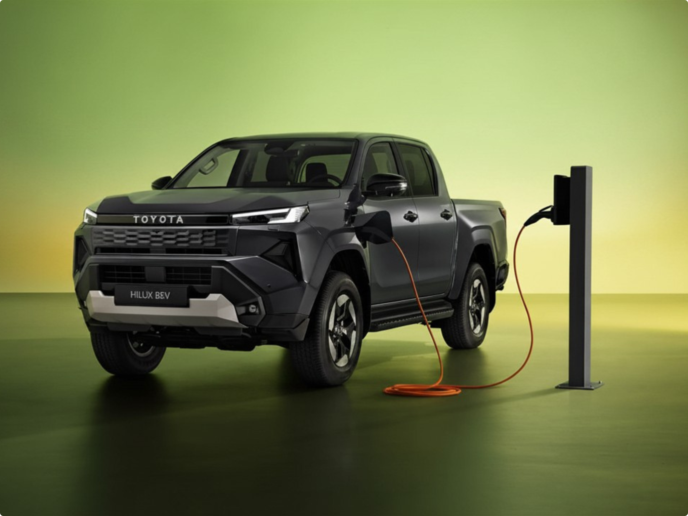
Toyota is preparing to introduce an all-electric version of its legendary Hilux, marking one of the most significant updates in the model’s long history. The Hilux BEV represents a major step in Toyota’s electrification strategy, bringing battery-electric technology into one of the world’s most recognisable and durable working vehicles.
Rather than replacing the traditional Hilux outright, the BEV sits within a broader multi-powertrain lineup that includes diesel, mild-hybrid, and future hydrogen fuel-cell options. This ensures the Hilux continues to serve a wide range of users across global markets, from urban fleets to demanding off-road industries.
Electric Powertrain Designed for Tough Environments
The Hilux BEV uses a 59.2 kWh lithium-ion battery integrated into a reinforced body-on-frame chassis. This structure is designed to protect the battery in harsh working conditions while maintaining the truck’s traditional strength and durability.
Electric drive is delivered through dual e-Axles (front and rear), providing permanent all-wheel drive and strong torque distribution. This setup is intended to improve traction across difficult terrain such as mud, sand, gravel, and uneven worksites.
The battery placement also lowers the vehicle’s centre of gravity, improving stability both on-road and off-road.
Range, Charging, and Real-World Use
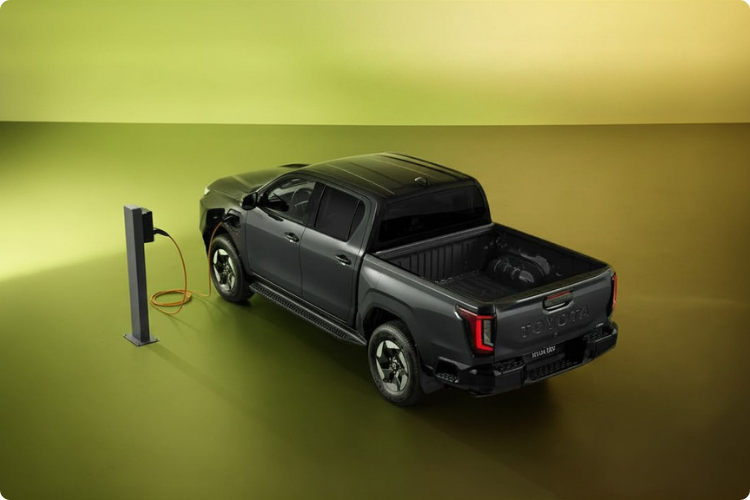
Toyota estimates the Hilux BEV will deliver a driving range of up to around 159 miles (WLTP) on a full charge, depending on load, terrain, and driving style.
Charging is designed to be flexible, with support for:
- Home charging
- Workplace charging
- Public rapid charging networks
The focus is clearly on predictable daily use rather than long-distance towing or extended highway travel, positioning the Hilux BEV primarily as a fleet and urban utility vehicle.
Key Specifications
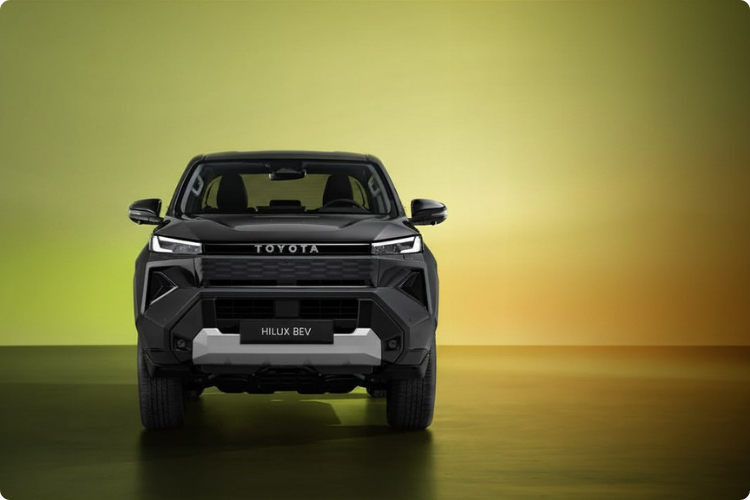
- WLTP CO₂: 0 g/km
- Power: 196 DIN hp
- Electric range: up to 159 miles (WLTP)
- Towing capacity: up to 1,700 kg
- Drivetrain: Permanent all-wheel drive via dual e-Axles
- Orders open: June 2026
Capability and Off-Road Performance
Despite the shift to electric power, Toyota has retained the Hilux’s core identity: durability and off-road ability.
Key systems include:
- Multi-Terrain Select (Rock, Sand, Mud, Dirt, Mogul modes)
- Off-road traction management via dual e-Axles
- Reinforced suspension for uneven loads and terrain
- Advanced driver assistance and safety systems (Toyota T-Mate suite)
This means the BEV version is still designed for construction sites, agriculture, and rugged environments — just with a quieter and cleaner drivetrain.
Practical Limitations
As with most electric pick-ups currently in development, there are trade-offs. The BEV version is expected to offer:
- Lower towing capacity than diesel variants
- Reduced payload compared to traditional Hilux models
- A shorter effective range when fully loaded or towing
For users requiring maximum heavy-duty capability, diesel and hybrid versions remain part of the Hilux range.
Market Timing and Positioning
The Hilux BEV is expected to go on sale in the UK around mid-2026, with orders opening slightly earlier. It forms part of Toyota’s broader strategy of offering multiple powertrain choices rather than a single EV-only solution.
Customise your Vehicle
We offer extensive customisation options to tailor to your specific needs:
Key systems include:
- Hard tops and roller shutters for secure load space
- Tow bars and electrical preparations
- Sports bars and styling enhancements
- Chapter 8: Chevrons for Traffic Management Compliance
- Specialist lighting, including beacons and light bars
- Off-road accessories for enhanced capability
Key Competitors in the Electric Pick-Up Segment
The Hilux BEV enters a growing but still relatively early-stage electric pick-up market. Its main rivals include both established manufacturers and emerging EV specialists.
Ford Ranger EV (Expected)
Ford Ranger EV is expected to be one of the closest mainstream rivals to the Hilux BEV in Europe. It will likely focus on fleet usability, off-road strength, and familiar pick-up practicality, mirroring the traditional strengths of the Ranger nameplate.
Isuzu D-Max EV
The Isuzu D-Max EV is a direct competitor in the one-tonne pick-up category. It is designed with commercial users in mind, prioritising durability, reliability, and worksite performance over lifestyle positioning.
Maxus T90 EV
The Maxus T90 EV is already available in parts of Europe and represents one of the first fully electric pick-ups on the market. It is positioned as a more affordable option, though it generally lacks the refinement and off-road capability of more established rivals.
BYD Shark and Emerging Chinese EV Pick-Ups
New entrants such as the BYD Shark and other Chinese electric pick-ups are rapidly expanding the global market. These models often combine competitive pricing with growing electrification technology, though their real-world capability varies significantly.
View our range of pick up trucks: Pick up truck lease deals, and the fully electric Maxus T90.
Final Outlook
The Toyota Hilux BEV represents a cautious but important step into electrification for one of the world’s most trusted pick-up trucks. Rather than reinventing the segment, Toyota is adapting its proven formula for an electric future while preserving its core identity of strength, reliability, and off-road capability.
However, competition is intensifying. Traditional rivals like Ford and Isuzu are electrifying their own pick-ups, while newer EV-focused manufacturers such as Rivian and BYD are reshaping expectations entirely.
The result is a market in transition — where the definition of a “workhorse” vehicle is being rewritten, but not yet fully replaced.
 Call our expert team on