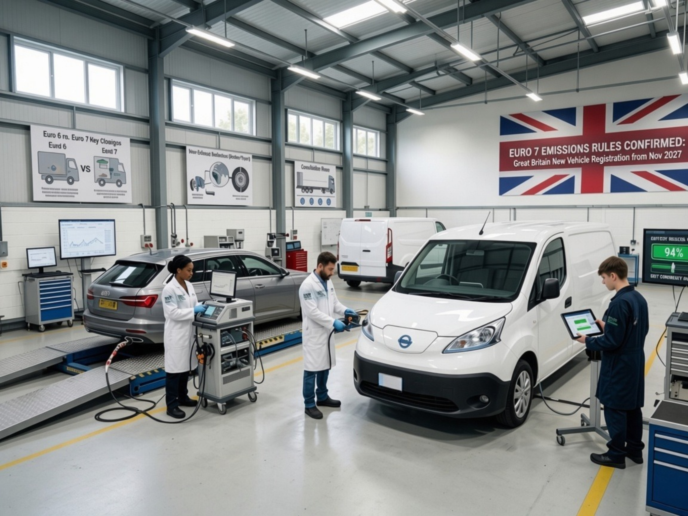
The UK Government has confirmed plans to introduce Euro 7 emissions standards for new cars and vans registered in Great Britain, with the new requirements applying to all new unlimited-volume registrations from 29 November 2027. The changes will extend beyond exhaust emissions, introducing new requirements for electric vehicle battery durability, brake and tyre particles, and longer-term emissions performance.
The Department for Transport (DfT) has confirmed its approach following a consultation on updating the minimum emissions standards for new road vehicles. The move is intended to improve air quality while maintaining closer alignment between Great Britain, Northern Ireland and the European Union on vehicle approval requirements.
For businesses operating company cars and commercial vehicles, the changes are worth understanding ahead of future vehicle replacement decisions. Although Euro 7 will not mean existing vehicles need to be replaced immediately, it could influence the vehicles available to lease and the considerations involved in planning a fleet.
Euro 7 Emissions Standards: Key Dates And Changes
| Area | What Businesses Need To Know |
|---|---|
| New cars and vans | Euro 7 applies to all new unlimited-volume registrations in Great Britain from 29 November 2027. |
| Small-volume manufacturers | Manufacturers registering fewer than 2,500 cars or vans annually in Great Britain have until 1 July 2030 for new light-duty vehicle registrations. |
| Trucks, buses and coaches | Implementation dates are still subject to further consultation. |
| Electric vehicle batteries | Minimum battery capacity retention requirements and improved battery health monitoring will be introduced for EVs and plug-in hybrids. |
| Brake and tyre emissions | New requirements will limit particulate emissions from brake wear and tyre abrasion. |
| Exhaust emissions | Existing pollutant limits for cars and vans are broadly retained, alongside changes to particle measurement and emissions durability. |
| Onboard monitoring | Systems will monitor emissions performance and alert drivers when emissions-control repairs may be needed. |
| Plug-in hybrids | Existing flexibility for qualifying PHEV CO₂ calculations will continue until 2030 under the relevant emissions trading arrangements. |
When Will Euro 7 Apply To New Cars And Vans?
The Government has confirmed that Euro 7 will apply to all new unlimited-volume car and van registrations in Great Britain from 29 November 2027.
The approach differs from the original proposal, which considered introducing the requirements for new light-duty vehicle types from 29 November 2026. Manufacturers raised concerns that this would not provide sufficient time to update vehicle ranges and align production plans.
Under the confirmed arrangements, small-volume manufacturers registering fewer than 2,500 cars or vans annually in Great Britain will have until 1 July 2030 to comply with the requirements for new light-duty vehicle registrations.
Euro 7 will also cover trucks, buses and coaches, although the implementation dates for these heavier vehicles remain subject to further consultation.
For businesses, the key distinction is that the November 2027 date concerns new vehicle registrations, rather than requiring existing cars and vans to be withdrawn from use. Fleet operators can therefore continue to consider replacement schedules based on their operational requirements, contract arrangements and budgets.
Businesses reviewing their next vehicle orders can use CVC’s guide to fleet planning and leasing to help consider how future requirements fit into longer-term replacement decisions. For a wider view of how vehicle selection, replacement cycles and operating costs fit together, see the fleet lifecycle management guide.
New Battery Durability Requirements For Electric Vehicles
One of the most significant elements of Euro 7 is the introduction of battery durability requirements for electric vehicles (EVs) and plug-in hybrid electric vehicles (PHEVs).
The standards will establish minimum battery capacity retention thresholds over defined mileage and time periods. Vehicles will also need more accurate and comparable battery health monitoring systems, making it easier to understand how battery condition changes over time.
Greater consistency in battery health information could be particularly useful in the used electric vehicle market, where buyers and businesses need to assess a vehicle’s remaining battery capacity alongside its age, mileage and overall condition.
For leasing customers, battery durability is another factor to consider when assessing an electric vehicle’s suitability for a business. Driving range, charging access, daily mileage and the type of work a vehicle needs to undertake will remain important considerations when choosing the right model.
Businesses considering the move to electric vans can read more about the practical considerations involved in the transition to an electric van fleet. CVC also explains the differences between powertrains in its guide to battery electric, plug-in hybrid, hybrid and combustion-engine vehicles.
The introduction of Euro 7 does not mean every electric vehicle will deliver the same battery performance. However, more consistent standards and monitoring could help provide a clearer basis for comparing battery durability across different makes and models.
Brake And Tyre Emissions Included In Euro 7
Euro 7 will also introduce limits on particulate emissions produced by brake wear and tyre abrasion.
These are known as non-exhaust emissions. They are becoming an increasingly important part of vehicle emissions policy as manufacturers reduce exhaust pollutants and more vehicles on the road become electrified.
The proposals have raised concerns among some fleet operators and component suppliers about the potential cost of compliant tyres, brakes and servicing. However, the overall effect on vehicle prices, maintenance bills and leasing rentals is not yet clear.
The Government has confirmed that replacement brake components fitted to Euro 7 vehicles will not initially have to meet the new brake-wear requirements. Further requirements for replacement components will depend on the development and introduction of relevant international regulations.
Businesses should therefore avoid assuming that Euro 7 will automatically lead to a particular increase in maintenance costs. Instead, operators should continue to consider the expected servicing requirements and whole-life costs of individual vehicles when comparing fleet options.
For practical guidance, CVC explains the distinction between vehicle maintenance and warranty cover. Businesses can also review its advice on fleet vehicle servicing and maintenance when considering how servicing requirements fit into their wider operating plans.
Businesses should continue to consider servicing requirements and routine upkeep when assessing the whole-life cost of a vehicle. CVC’s guide to vehicle maintenance provides further information on this aspect of vehicle ownership and operation. Businesses can also estimate potential running costs using CVC’s fuel cost calculator, helping them compare fuel expenditure when assessing different vehicle options.
What Will Change For Exhaust Emissions?
For cars and vans, Euro 7 will broadly retain the current Euro 6e pollutant limits while introducing changes to testing, particle measurement and the period over which emissions performance must be maintained.
One change is the move from PN23 to PN10 particle measurement, bringing smaller particles within the scope of the particle-number requirements.
The standards will also strengthen requirements around emissions durability, helping ensure vehicles continue to meet applicable limits over a longer period of their lives.
In addition, vehicles will need onboard monitoring systems to track emissions performance and alert drivers when repairs to emissions-control systems may be required.
These measures are intended to improve oversight of vehicle emissions beyond the initial approval and testing process. For businesses, they reinforce the importance of maintaining vehicles correctly and responding to any warnings or faults in line with manufacturer guidance.
For diesel vehicles, emissions-control equipment can include diesel particulate filters (DPFs) and AdBlue systems. Understanding their role and maintenance requirements can help operators make informed decisions when managing existing vehicles. CVC provides further information in its guides to diesel particulate filters and AdBlue.
Businesses operating in areas with restrictions on vehicle emissions should also consider the rules that already apply to their journeys. CVC’s UK ULEZ and Clean Air Zones guide provides a broader overview of these schemes, while its guide to van Clean Air Zone charges explains the potential implications for commercial vehicle journeys.
Euro 7 is a separate set of vehicle approval standards, so businesses should not assume that its introduction will automatically change the restrictions applying to existing vehicles in every clean air zone.
Plug-In Hybrid CO₂ Flexibility To Continue Until 2030
The Government has also confirmed that existing flexibility for certain plug-in hybrid CO₂ calculations will continue until 2030 under the relevant UK vehicle emissions trading arrangements.
The arrangements will be updated to account for Euro 7 vehicles, allowing qualifying plug-in hybrids to continue using CO₂ values calculated under the specified earlier Euro 6d framework for compliance with the non-zero-emission vehicle element of the scheme.
The measure is intended to avoid penalising manufacturers as official PHEV CO₂ calculations change.
For businesses comparing petrol, diesel, hybrid, plug-in hybrid and fully electric vehicles, the confirmation provides additional context around the regulatory treatment of plug-in hybrids. However, the most suitable option will still depend on factors such as mileage, journey patterns, charging availability, tax treatment and the vehicle’s intended use.
Companies considering plug-in hybrid company cars should also assess the relevant tax implications. CVC’s guide to UK plug-in hybrid Benefit-in-Kind rates for 2026 provides further information on this separate consideration.
What Does Euro 7 Mean For Business Vehicle Leasing?
The confirmed timetable gives businesses time to consider Euro 7 as part of their future vehicle planning, rather than treating it as a reason to replace vehicles immediately.
For companies approaching the end of existing lease agreements, it may be useful to review replacement dates and consider whether upcoming vehicle changes could affect the choice of models available. Businesses ordering vehicles well ahead of their intended delivery dates should also keep an eye on manufacturers’ product announcements and confirmed compliance information.
There are several practical areas worth reviewing:
- Replacement Planning: Consider when current vehicles are due to be replaced and whether the Euro 7 timetable is relevant to upcoming orders.
- Vehicle Suitability: Compare available cars and vans against the mileage, payload, range and operational requirements of the business.
- Maintenance Planning: Continue to review servicing needs and whole-life costs rather than assuming the new standards will automatically increase running costs.
- Electric Vehicle Decisions: Consider battery durability alongside range, charging access and the suitability of an EV for the work involved.
- Emissions-Related Restrictions: Check the rules affecting the areas in which vehicles operate, particularly where Clean Air Zones or other restrictions apply.
Looking at purchase or leasing costs alone may not give businesses the full picture. Insurance, servicing, energy or fuel, mileage requirements and vehicle downtime can all contribute to the overall cost of running a fleet. CVC’s guide to the total cost of ownership of business vehicles explores the wider costs businesses should consider when comparing vehicle options.
A structured review of vehicle use, costs and replacement priorities can help businesses make informed decisions as the new standards approach. CVC’s guide to fleet audits for UK businesses offers further information on reviewing fleet requirements and identifying areas that may need attention.
Businesses looking for support with their wider vehicle requirements can also explore CVC’s fleet management solutions.
At this stage, the precise effect of Euro 7 on individual vehicle prices, leasing rentals and maintenance costs remains uncertain. Businesses should base decisions on confirmed vehicle specifications, supplier information and their own operational needs as more details become available.
 Call our expert team on