Artificial intelligence (AI) could change how businesses manage their vehicle fleets, making it easier to turn complex data into practical insights. As fleet software evolves, managers may increasingly be able to ask questions in everyday language, identify potential inefficiencies and make better-informed decisions without navigating multiple dashboards and reports.
For businesses operating company cars, vans and other commercial vehicles, the potential benefits extend beyond convenience. Better access to fleet information could help identify rising operating costs, understand vehicle utilisation, plan maintenance and support decisions about when vehicles should be replaced.
The development comes as fleet management systems collect increasing amounts of information, creating both opportunities and challenges for businesses trying to understand what their data actually means.
From Fleet Data To Practical Business Insights
Fleet management software has traditionally relied on dashboards, reports and performance indicators to help managers monitor vehicles and drivers. While these tools can provide valuable information, finding a specific answer may require users to navigate several screens, apply filters and interpret the results themselves.
Artificial intelligence could offer another way of accessing that information.
Fleet software specialist FleetCheck has highlighted the potential for large language models (LLMs), including ChatGPT and Claude, to change how fleet professionals interact with their systems. Rather than manually searching through reports, users could ask direct questions and receive relevant information in a more accessible format. Businesses can also use CVC’s Fleet Source UK customer portal to access and manage information relating to their vehicle leasing arrangements.
For example, a fleet manager could ask which vehicles are consistently achieving fuel economy below expectations, which vehicles have incurred the highest maintenance expenditure or where mileage patterns suggest that a vehicle’s usage should be reviewed.
Instead of building a report from scratch, the manager could receive a more focused starting point for further investigation.
This reflects a wider shift in fleet management towards making information easier to interpret and act upon, rather than simply increasing the volume of data available. Businesses can explore the potential applications in more detail in our guide to AI fleet management business benefits.
Better use of fleet information can also support wider efforts to improve fleet efficiency, particularly when businesses regularly review vehicle usage, operating costs and maintenance requirements.
Businesses looking to improve their wider approach to vehicle operations can also explore our guide to fleet management solutions. Businesses reviewing their wider fleet arrangements can find out more about CVC’s one-stop fleet solutions.
How AI Could Help Businesses Control Fleet Costs
Vehicle operating costs can come from numerous sources, including fuel, electricity, servicing, repairs, insurance, mileage and vehicle downtime. These expenses can be difficult to assess collectively when information is spread across different systems.
A structured fleet audit can provide a broader review of vehicle costs, utilisation, maintenance and replacement requirements. For businesses operating commercial vehicles, understanding the cost of running a van provides a useful starting point for reviewing expenditure.
AI-assisted analysis could help businesses identify patterns that might otherwise take considerable time to uncover.
For example, a manager could ask which vehicles have experienced the largest increase in running costs over the past six months, or whether particular vehicles are costing more to maintain than others with similar mileages.
Such questions could help direct attention towards areas that warrant further investigation.
Potential applications include:
- Fuel and energy expenditure: identifying unusual consumption patterns or vehicles that may benefit from a review of their usage.
- Maintenance costs: highlighting vehicles with repeated repairs or expenditure that differs significantly from comparable vehicles.
- Vehicle utilisation: identifying vehicles that appear underused or where mileage patterns may indicate an opportunity to review allocations.
- Mileage management: identifying vehicles approaching their contracted mileage limits and helping managers investigate potential excess mileage charges.
- Operational downtime: bringing together maintenance records and vehicle availability information to help managers understand where disruption is occurring.
Regular reviews of fleet vehicle servicing and maintenance can help businesses keep track of scheduled work, repair requirements and potential disruption.
Businesses can use our fuel cost calculator to estimate fuel expenditure and help assess how mileage, fuel economy and fuel prices affect running costs.
These applications could complement existing approaches to total cost of ownership for business vehicles, helping decision-makers consider more than the monthly rental when assessing their fleet. For a closer look at how AI could contribute to this process, read our guide to AI fleet management and reducing total cost of ownership.
However, AI does not automatically reduce expenditure. Its value depends on the accuracy of the underlying information, the quality of the analysis and whether the business takes appropriate action in response to the findings. For further practical guidance, see how businesses can take control of rising fleet operating costs.
Could AI Make Fleet Reporting Easier?
One of the most significant potential changes is the way employees access fleet information.
A traditional dashboard may be designed around predefined metrics, meaning users need to know which report to open and which filters to apply. An AI-powered interface could allow them to describe the information they need in ordinary language.
Consider the following examples.
| Fleet management question | Potential benefit |
|---|---|
| Which vehicles have fuel economy significantly below expectations? | Helps identify vehicles or usage patterns for further investigation. |
| Which vehicles have recorded the highest maintenance costs this year? | Supports maintenance reviews and cost comparisons. |
| Which vehicles are approaching their contracted mileage allowance? | Helps managers review mileage forecasts and potential additional charges. |
| Which vehicles have experienced repeated periods off the road? | Helps identify possible reliability or operational issues. |
| Which vehicles may need replacing within the next 12 months? | Provides a starting point for vehicle replacement planning. |
| How do the running costs of our electric vehicles compare with our petrol and diesel vehicles? | Helps assess costs across different powertrains, provided the relevant data is available. |
For leased vehicles, monitoring mileage against contract allowances is important. Our guide to mileage allowance in vehicle leasing explains how mileage limits affect leasing agreements.
The answers would still need to be checked against reliable records, and more complicated questions may require additional analysis. Nevertheless, making fleet information easier to access could help managers spend less time preparing reports and more time considering what the results mean for their business. For businesses that need help managing the administrative side of their fleet, CVC also provides fleet administration and account support.
For organisations managing several types of vehicles, this could be particularly useful. Businesses may operate cars, vans, specialist vehicles and electric vehicles simultaneously, each with different operational requirements.
Our fleet management guide provides further information on the wider considerations involved in managing business vehicles effectively.
Supporting Vehicle Replacement And Fleet Planning
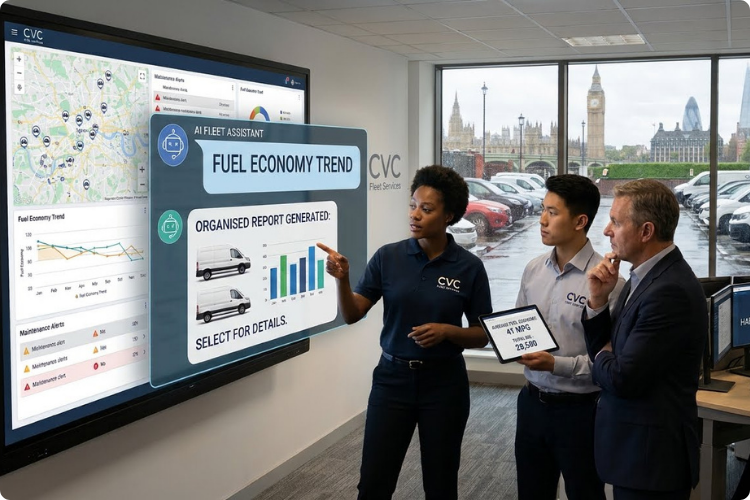
Fleet decisions rarely depend on one figure alone. A vehicle that appears economical based on its monthly rental could have different implications when mileage, maintenance, downtime, suitability and replacement timing are considered together. Businesses should also compare the available business vehicle leasing and finance options when planning future vehicle requirements.
A structured approach to fleet planning and leasing can help businesses assess vehicle requirements, contract arrangements and future replacement needs.
AI could help managers bring these factors into the same discussion by making it easier to query available records and compare relevant information.
For example, a business planning its next vehicle replacement cycle might want to identify vehicles with high mileage, increasing maintenance expenditure or a history of operational disruption.
An AI-assisted system could help highlight vehicles that meet those criteria, allowing managers to investigate which replacements should be prioritised.
This could support a more structured approach to fleet lifecycle management, from selecting vehicles and monitoring their performance to planning replacements.
It could also help businesses consider whether their current vehicles remain appropriate for the work being undertaken. For businesses reviewing their commercial vehicles, our guide to choosing the right business van to lease explains some of the practical considerations involved in selecting a suitable vehicle.
For example, a company reviewing its fleet might need to assess payload requirements, annual mileage, journey patterns and access to charging facilities before deciding whether to introduce electric vans. AI could help organise and analyse the relevant information, but the final decision would still require operational judgement.
Businesses considering electrification can explore our guide to the electric van fleet transition and compare the practical and financial considerations of electric vans versus diesel vans.
Bringing Fleet, Finance And HR Information Together
Fleet management does not operate in isolation. Decisions about vehicles can affect finance teams, human resources departments, procurement and employees who rely on company vehicles.
AI could make it easier for different departments to access relevant information, provided their systems can share the necessary data and appropriate permissions are in place.
Finance teams, for example, may want to understand how vehicle expenditure compares with budgets. Fleet managers may be more concerned with vehicle availability, mileage and maintenance, while HR teams could need information relevant to company car policies and employee arrangements.
Clear procedures are important too, and our company vehicle policy guide outlines areas businesses should consider when setting expectations for company vehicle use.
Making information easier to retrieve could help these teams work from a more consistent understanding of fleet performance. CVC customers can also use the vehicle lease management portal to access and manage information relating to their vehicle leasing arrangements.
However, integrating information across departments is not simply a matter of adding an AI tool. Businesses may need to address disconnected software, inconsistent records and restrictions on who can access particular information.
Our article on fragmented fleet data and business costs explores why disconnected information can make effective fleet management more difficult.
What Businesses Should Consider Before Adopting AI
Although AI offers potential benefits, businesses should assess whether it addresses a genuine operational problem before investing in new technology.
The usefulness of any AI-powered fleet system will depend partly on the information available to it. A fleet audit can help establish a baseline for vehicle costs, maintenance, utilisation and existing fleet processes before new technology is introduced. Incomplete maintenance records, inaccurate mileage figures or inconsistent cost reporting can lead to misleading conclusions. Maintaining reliable vehicle maintenance records is one part of building a more accurate picture of fleet performance.
There are several considerations worth reviewing before introducing AI into fleet operations.
Data quality: Businesses should establish whether their vehicle, mileage, maintenance and cost records are accurate, current and sufficiently detailed.
System integration: Managers should check whether the relevant information can be accessed across existing fleet, finance and maintenance systems, rather than assuming that all records will automatically be available.
Data security and permissions: Fleet records can include commercially sensitive information and personal data. Businesses should understand how information is processed, stored and accessed, particularly when using third-party AI services.
Accuracy and oversight: AI-generated answers should be checked against source records before they inform significant spending, compliance or vehicle replacement decisions.
Measurable benefits: Businesses should identify what they want to improve, whether that is reducing the time spent preparing reports, improving vehicle utilisation or identifying avoidable expenditure. Measuring performance before and after implementation can help establish whether the technology is delivering meaningful results.
AI should therefore be viewed as a potential aid to decision-making, rather than a substitute for sound fleet management processes or professional judgement. Businesses can also review their wider processes using our fleet efficiency business guide.
The Role Of Fleet Management Software Is Evolving
The increasing use of AI could change the way businesses interact with fleet management software. Instead of relying exclusively on predefined dashboards and reports, managers may increasingly expect systems to answer specific questions and help them investigate emerging issues.
For businesses with access to reliable fleet data, this could make complex information more accessible and support more informed decisions about costs, maintenance, utilisation and replacement planning.
However, the technology’s practical value will depend on how well it integrates with existing systems, the quality of the information available and the ability of businesses to turn its findings into appropriate action.
For now, AI represents a developing opportunity rather than a guaranteed solution. Businesses that understand their existing fleet data and operational priorities will be better placed to assess where these tools could offer genuine benefits.
 Call our expert team on