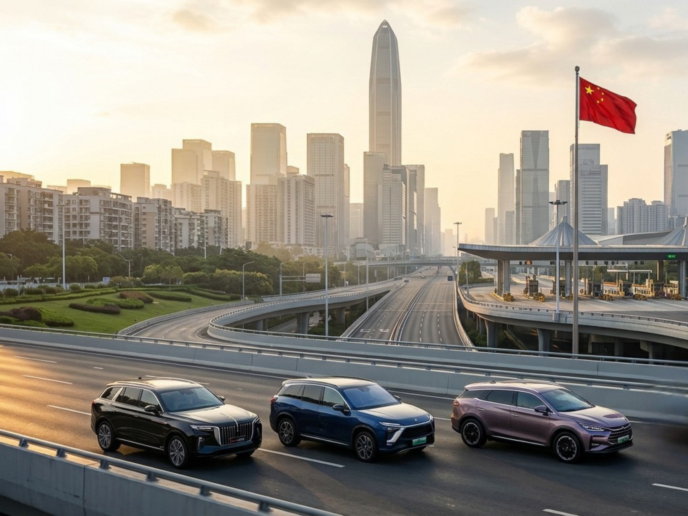
The global automotive industry could undergo a major transformation over the next decade, with Chinese manufacturers expected to account for a growing share of the world’s biggest carmakers.
Research from KPMG, based on a survey of 775 senior automotive executives worldwide, found that 48% expect six of the world’s 10 largest original equipment manufacturers (OEMs) to be headquartered in China by 2035. The findings highlight the increasing influence of Chinese automotive brands and the pressure on established manufacturers to adapt to a rapidly changing market.
The shift is being driven by more than vehicle production alone. Software, artificial intelligence (AI) and digital technology are also expected to play an increasingly important role in determining which manufacturers gain a competitive advantage.
Software And AI Could Redefine Automotive Competition
More than half (51%) of the executives surveyed expect software and digital technology to become the main source of competitive differentiation for their businesses by 2035.
The industry is already moving towards software-defined vehicles, in which digital systems play a greater role in vehicle functions, features and ongoing improvements. As vehicles become increasingly dependent on digital systems, questions around vehicle software and the right to repair are also becoming more important to drivers and the wider automotive industry. Almost half (49%) of respondents said their software-defined products and over-the-air update capabilities were already established or embedded within their organisations.
However, implementing new technology at scale remains a challenge. Only 36% of AI and software initiatives had successfully progressed beyond the pilot stage, while 92% of respondents said deploying a new enterprise-wide AI, digital or software capability took at least 12 months.
For manufacturers, the challenge is no longer simply identifying promising technologies. They must also find practical ways to integrate them into their operations, improve the customer experience and generate measurable commercial benefits.
Manufacturers Face Increasing Pressure To Adapt
KPMG’s findings point to a decade in which manufacturers will need to respond to several overlapping challenges, including geopolitical uncertainty, sustainability requirements, operating costs, changing customer expectations and evolving business models.
More than half (52%) of respondents said continuous transformation had become the norm for the automotive industry.
These pressures create competing demands on investment. Manufacturers must fund technological development while managing production costs, responding to regulatory changes and maintaining their position in increasingly competitive markets.
Andreas Ries, global head of automotive at KPMG International, said industry leaders were having to manage several moving targets simultaneously, with technology, geopolitics and customer expectations all competing for attention and resources.
He argued that manufacturers able to turn technological advances into meaningful customer benefits, while retaining the flexibility to respond to different markets, would be better placed to lead the next phase of the industry.
Nicolas Nowicki, partner at KPMG France and EMA region head of automotive, also highlighted how technology was changing what customers value, how manufacturers differentiate their products and where future profits could be generated.
China’s growing influence is one of the clearest indications of this changing competitive landscape. However, success will depend on more than manufacturing scale or geographical location.
Chinese Manufacturers Could Increase Competition In The UK
The growing presence of Chinese car manufacturers is changing the UK automotive market, giving motorists and businesses more choice when comparing vehicles, technology and prices. Our guide to the UK electric vehicle market explores the wider trends influencing EV adoption and vehicle choice.
Chinese manufacturers are becoming increasingly established in the electric and hybrid vehicle sectors, challenging familiar European, Japanese, South Korean and American brands. Their influence is also growing among business customers, with Chinese EV brands gaining ground in the UK fleet market.
The scale of this growth is reflected in UK registration figures. Chinese car brands accounted for 15% of the new car market in the first half of 2026, increasing the competitive pressure on established manufacturers. This could lead to greater competition over pricing, vehicle specifications, technology and overall value. Read more about the growth of Chinese car brands in the UK.
The EU is also considering potential restrictions on Chinese-made hybrid vehicles, which could affect how manufacturers supply the UK market. Read more about potential EU restrictions on Chinese hybrid vehicles.
Trade policy could also affect the prices and competitiveness of imported vehicles. The UK’s approach differs from the EU’s, which has introduced additional duties on Chinese electric cars. Our guide to Chinese EV tariffs in the UK explains the issues, while our article on EU restrictions affecting Chinese hybrid vehicles examines the wider regulatory debate.
For businesses choosing their next company cars, the growing range of manufacturers creates more options to compare through business car leasing. However, the lowest monthly rental will not necessarily represent the best value. Fleet operators should consider vehicle suitability, specifications, expected mileage, fuel or electricity costs, servicing, warranty coverage and the potential impact of downtime.
Company car tax and benefit-in-kind implications may also affect the overall cost of running a fleet. Businesses assessing their options can review the different approaches to business vehicle leasing and finance and consider how their choices fit into a wider fleet planning and leasing strategy.
Technology is another important consideration. Connected services, software updates and AI-powered features may improve the driving experience or help businesses manage vehicles more effectively. However, fleet operators should also assess reliability, ease of use and the manufacturer’s long-term support before committing to unfamiliar models.
For a closer look at the potential business benefits, read our guide to how AI can support fleet management, including its applications in cost analysis, driver safety and vehicle maintenance.
A Changing Market For Drivers And Fleet Operators
The research does not guarantee that Chinese manufacturers will dominate the global automotive industry by 2035. Instead, it highlights the scale of the changes industry leaders expect over the coming decade.
Established manufacturers will need to continue investing in technology, responding to changing customer demands and competing with businesses that may approach vehicle development and production differently.
For UK motorists and fleet operators, the potential outcome is a broader choice of vehicles and greater competition between manufacturers. This could create new opportunities when comparing leasing options, although individual vehicle costs, suitability and long-term support will remain important considerations.
As the market evolves, businesses will need to look beyond familiar brand names and assess vehicles against their actual operational requirements. The manufacturers that combine competitive pricing with dependable products, useful technology and strong customer support are likely to be best placed to win over the next generation of car buyers and fleet customers. Businesses managing several vehicles can also review their approach to fleet planning and leasing when assessing vehicle choices and future replacement requirements.
 Call our expert team on