Calculate how much weight your van can legally carry using its Gross Vehicle Weight (GVW) and kerb weight. Use our van payload calculator to estimate your available payload capacity, understand vehicle weight limits and make informed decisions when choosing a commercial vehicle for your business.
How to Calculate Your Van’s Payload
Understanding your van’s payload is essential when choosing a commercial vehicle, particularly if your business regularly transports tools, equipment, materials or goods.
Payload is the maximum additional weight a van can carry, including its load, passengers and any items added to the vehicle that are not already accounted for in its kerb weight.
To calculate your van’s payload, subtract its kerb weight from its Gross Vehicle Weight (GVW).
Van Payload = Gross Vehicle Weight (GVW) − Kerb Weight
For example, a van with a GVW of 3,500kg and a kerb weight of 2,200kg has a theoretical payload capacity of 1,300kg.
This means the combined weight of everything carried by the vehicle must remain within its permitted weight limits.
Your actual available carrying capacity will depend on the vehicle’s specification, passengers, additional equipment and any modifications or conversions fitted.
Van Payload Calculator
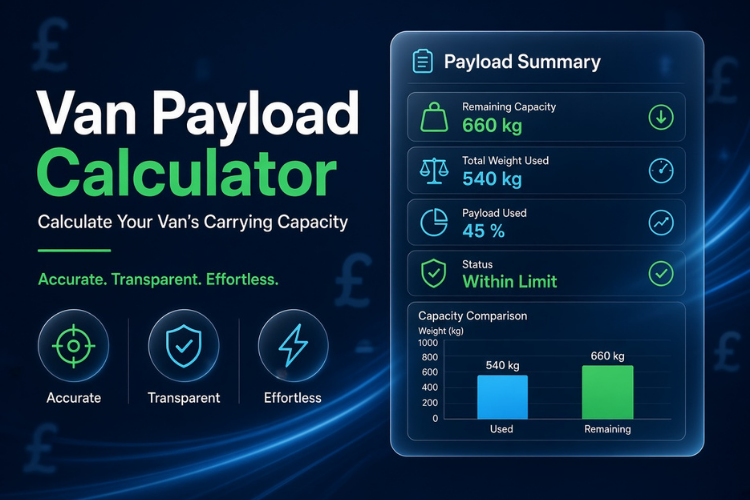
Check how much weight your van can legally carry. Enter the van’s maximum payload and the weight of the driver, passengers, tools and cargo to see your remaining capacity.
This is the manufacturer’s maximum payload figure (usually found in the van’s handbook or brochure).
Remaining payload capacity
This is an estimate only. Always check the official payload figure for your specific van and never exceed the Gross Vehicle Weight (GVW). Weights of driver, passengers and equipment should be realistic.
What Is Gross Vehicle Weight (GVW)?
Gross Vehicle Weight (GVW), also known as Gross Vehicle Mass (GVM) or Maximum Authorised Mass (MAM), is the maximum permitted weight of a fully loaded vehicle.
This includes the vehicle itself, driver, passengers, fuel, tools, equipment and any goods being transported.
The GVW is determined by the manufacturer and must not be exceeded when the vehicle is in use.
You can usually find your van's maximum permitted weight on its vehicle identification plate (VIN plate), which is generally located around the driver's door opening or engine compartment. You can also refer to the manufacturer's handbook or vehicle specifications.
What Is Kerb Weight?
Kerb weight is the weight of an unladen vehicle in its standard specification, with the necessary operating fluids and equipment included according to the manufacturer's stated definition.
It is important to check the manufacturer's kerb weight figure for the exact model, engine, transmission, wheelbase and trim level, as these can all affect the vehicle's overall weight.
Optional extras, accessories and specialist equipment can also increase the vehicle's weight and reduce the payload available for carrying goods.
When calculating your available payload, make sure you account for any additional weight that is not included in the published kerb weight.
What Affects Van Payload Capacity?
Several factors influence how much weight a van can carry. Understanding these is important when selecting a commercial vehicle for your business.
- Vehicle size and specification: Larger vans do not automatically have higher payload capacities. Engine choices, body dimensions, transmission and equipment can all affect the vehicle's weight.
- Passengers: The driver and any passengers contribute towards the vehicle's overall weight and must be included when calculating the remaining carrying capacity.
- Tools and equipment: Shelving, racking, roof racks, ladder carriers and other fitted equipment add weight, reducing the capacity available for goods and materials.
- Vehicle conversions: Specialist conversions, including tippers, dropsides, refrigerated vans and mobile workshops, can significantly affect payload capacity.
- Fuel and additional equipment: Fuel and any items not included in the manufacturer's kerb weight figure must also be accounted for.
Businesses should consider their typical working loads when choosing a van rather than relying solely on its advertised maximum payload.
Why Is Van Payload Important for Businesses?
Choosing a van with the right payload capacity is essential for businesses that regularly transport heavy equipment, materials or goods.
A vehicle with insufficient payload may require additional journeys, alternative transport arrangements or a different vehicle specification to complete the same work.
Overloading a van can also create safety risks, affect braking and handling, increase tyre wear and potentially result in enforcement action and penalties.
Understanding your vehicle's weight limits is particularly important when selecting a commercial vehicle for business use. Our guide to van payload and carrying capacity explains how payload works, what contributes towards a van's total weight and why staying within permitted limits matters.
If your business regularly carries heavy loads, it is worth comparing different models before committing to a vehicle.
Our guide to medium vans with the highest payload compares commercial vehicles with substantial carrying capacities to help businesses identify suitable options.
How Do Van Conversions Affect Payload?
Commercial vehicle conversions can provide businesses with specialist vehicles designed around their operational requirements. However, additional equipment and modifications can reduce the available payload.
For example, a van fitted with shelving, racking, storage units, refrigeration equipment, a tail lift or a specialist body conversion will weigh more than the standard vehicle.
This means the original manufacturer's payload figure may no longer reflect the carrying capacity of the completed vehicle.
Businesses considering a converted van should establish its finished weight and remaining payload before deciding whether it is suitable for their requirements.
Our commercial vehicle conversions guide explains the different conversion options available, including tippers, dropsides, refrigerated vans and mobile workshops.
Staying Within Your Van's Legal Weight Limits
Businesses operating commercial vehicles must ensure their vans remain within their permitted weight limits.
Exceeding the vehicle's GVW is illegal and can result in fines, vehicle prohibitions and other enforcement action. Overloading can also compromise vehicle stability, braking performance and road safety.
It is also important to understand that the vehicle's individual axle weight limits must not be exceeded. A van can be within its overall GVW while still having too much weight concentrated over one axle.
For businesses operating multiple vans, monitoring vehicle weights and ensuring drivers understand loading requirements can help reduce compliance risks.
The RHA Van Standard compliance guide provides further guidance on vehicle safety, maintenance and responsibilities for commercial van operators.
For a more detailed explanation of van payload, including how carrying capacity is calculated, the differences between vehicle weight terminology and the risks of overloading, read our guide to van payload and carrying capacity.
Choosing the Right Van for Your Business
Payload should be one of the main considerations when selecting a commercial vehicle, alongside load space, vehicle dimensions, running costs and suitability for the work being carried out.
A van with a large load area may not necessarily offer the highest payload, so businesses should compare both measurements when assessing different models.
It is also worth considering whether your requirements could change over the duration of a leasing agreement. Choosing a vehicle with sufficient carrying capacity can help accommodate changes in equipment, materials and business operations.
If you're reviewing your fleet requirements, our fleet management solutions can help with vehicle sourcing, procurement, maintenance management and replacement planning.
Calculate Your Van's Payload Capacity
Knowing your van's payload capacity helps ensure you choose a vehicle that can safely accommodate your business requirements.
Use our van payload calculator to estimate how much weight your vehicle can carry based on its GVW and kerb weight. By understanding the available payload, you can compare different vans, assess their suitability for your work and make more informed decisions when selecting your next commercial vehicle.
 Call our expert team on