Towing a trailer with a van can make it easier for tradespeople and businesses to transport tools, building materials, machinery and specialist equipment. However, it also brings additional responsibilities. Drivers must make sure they have the correct licence, the van is approved to tow the intended weight and the trailer is loaded and maintained safely.
Getting these details wrong can lead to penalties, insurance complications and potentially dangerous driving conditions. Businesses that operate vans and trailers also need to consider operator licensing, drivers’ hours and their responsibilities for vehicle safety.
This guide explains the main UK van towing rules, including licence categories, weight limits, speed restrictions and the checks businesses should carry out before putting a van and trailer on the road. This guide focuses on van towing rules in Great Britain. Businesses operating in Northern Ireland should check the separate requirements that apply there.
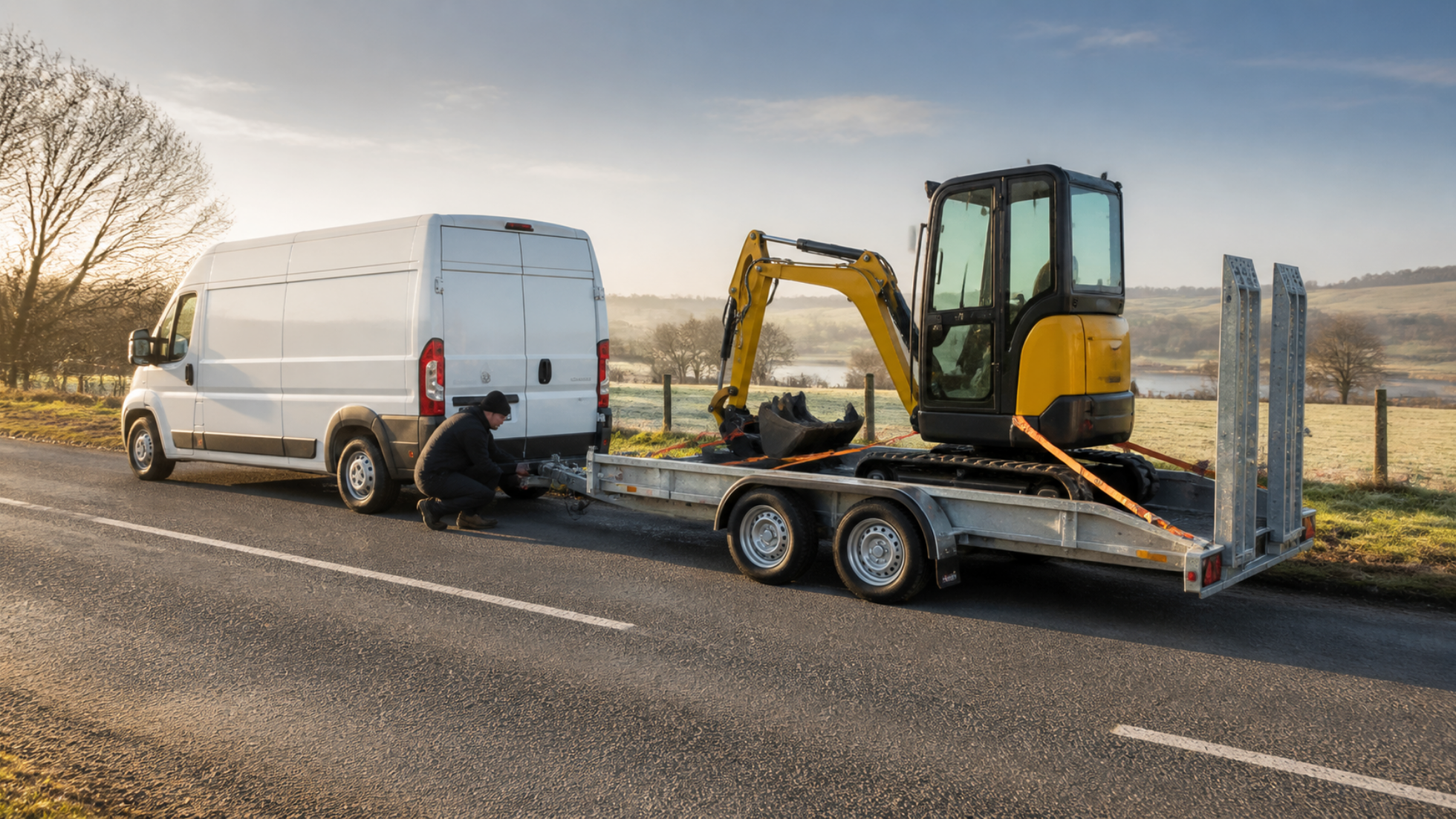
Can You Tow A Trailer With A Van On A Standard Car Licence?
Whether you can tow a trailer with a van depends on the vehicle’s weight, the trailer’s weight and the entitlements shown on your driving licence.
There is a separate allowance for certain zero-emission vans. Drivers with a Category B licence can drive an eligible electric or hydrogen-powered van with a MAM of up to 4,250kg, subject to the relevant conditions. When towing, the combined MAM of the van and trailer must not exceed 7,000kg, and the trailer’s MAM must not exceed 3,500kg. The van’s own manufacturer-approved towing capacity and gross train weight must also be respected.
Drivers who passed their car test on or after 1 January 1997 can generally drive a van with a MAM of up to 3,500kg. Category BE entitlement allows them to tow a trailer with a MAM of up to 3,500kg, provided the entitlement is valid for that trailer weight. The combined MAM of the van and trailer must not exceed 7,000kg, and the combination must also comply with the van’s gross train weight and manufacturer-approved towing capacity.
Drivers who passed their test before 1 January 1997 generally have additional entitlement, allowing them to drive a vehicle and trailer combination with a combined MAM of up to 8,250kg, subject to individual licence restrictions.
Before towing, check the categories and restrictions on your driving licence. Our guide to whether you can drive a van on a car licence explains the main licence requirements for commercial van drivers.
Understanding Van Towing Weights
One of the most important parts of towing legally is understanding the different weight limits that apply to the van and trailer.
Several figures may be relevant:
- Maximum Authorised Mass (MAM): The maximum permitted weight of a vehicle or trailer when fully loaded, including its own weight, passengers and cargo where applicable.
- Gross Vehicle Weight (GVW): The maximum permitted loaded weight of the van.
- Gross Train Weight (GTW): The maximum permitted combined weight of the loaded van and loaded trailer.
- Maximum Towing Capacity: The maximum trailer weight the manufacturer permits the van to tow.
- Kerb Weight: The weight of the van in running order, generally excluding the driver, passengers and load.
These figures are not interchangeable. A driver must stay within the limits for the vehicle, trailer, towing combination and driving licence.
For example, a van may have a manufacturer-approved towing capacity of 2,500kg, but the driver’s licence entitlement or the van’s gross train weight may impose a lower practical limit.
Where To Find Your Van’s Towing Capacity
The manufacturer’s handbook and vehicle specification should identify the van’s towing limits. The vehicle identification number (VIN) plate may also show the gross vehicle weight and gross train weight.
If the van has no stated gross train weight, do not assume it is suitable for towing. Check with the manufacturer or an authorised dealer before attaching a trailer.
Businesses should also consider how much equipment and material is already being carried inside the van. The weight of the driver, passengers, fuel, tools and other cargo all count towards the van’s permitted weight.
Our guide to van payload and weight limits explains how payload affects the amount of equipment a commercial vehicle can legally carry.
Van And Trailer Weight Limits: What Businesses Need To Check
The maximum weight a van can tow varies significantly between models. Some smaller vans are designed for relatively light trailers, while larger commercial vehicles may be approved to tow considerably more.
The trailer’s plated MAM is important, but drivers must also consider its actual loaded weight and the towing vehicle’s limits.
Before towing, check:
- The van’s maximum towing capacity.
- The van’s gross vehicle weight.
- The van’s gross train weight.
- The trailer’s maximum authorised mass.
- The actual loaded weight of the van and trailer.
- The driver’s licence entitlement.
The combined loaded weight must not exceed the van’s gross train weight. The trailer must also remain within its own permitted weight, and the van must not exceed its individual axle limits.
A trailer that is within its own weight limit can still create an illegal combination if the van and trailer together exceed the gross train weight.
Trailer Dimensions
There are also restrictions on trailer dimensions. For a towing vehicle with a MAM of 3,500kg or less, the maximum trailer length is generally 7 metres, excluding the A-frame connecting the trailer to the towing vehicle. The maximum permitted trailer width is 2.55 metres.
Businesses transporting long or wide equipment should check the relevant vehicle and trailer dimensions before setting off. Loads must not create an unsafe overhang or obstruct the driver’s view.
Van Towing Speed Limits In The UK
Towing a trailer changes the speed limits that apply to a van. Drivers must follow the lower limits for a van and trailer combination rather than the standard limits for an unladen or solo van.
| Road type | Van and trailer speed limit |
|---|---|
| Built-up areas | 30mph |
| Single carriageways | 50mph |
| Dual carriageways | 60mph |
| Motorways | 60mph |
These limits apply in England, Scotland and Wales, unless road signs specify a lower limit. Drivers should also be aware that local restrictions and temporary limits may apply.
Driving too quickly when towing can make a combination harder to control, particularly when braking, cornering or travelling in strong crosswinds. Extra stopping distance should be allowed, and sudden steering or braking movements should be avoided.
For further guidance, read our UK van speed limit rules.
Trailer Brakes, Towbars And Safety Equipment
The van and trailer must be properly equipped and maintained before being used on public roads.
Trailer Brakes
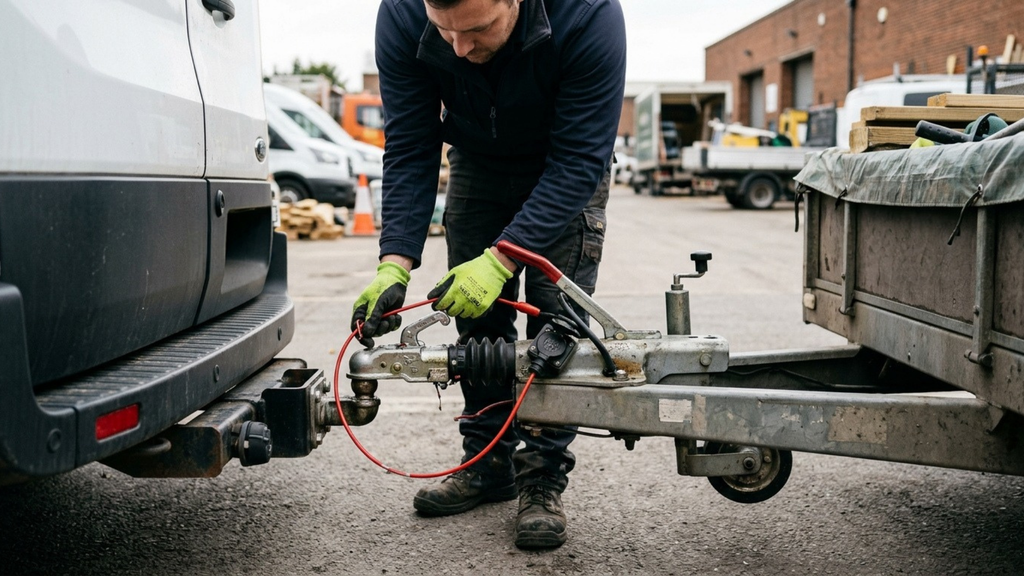
A trailer weighing more than 750kg when loaded must have a working braking system. If brakes are fitted to a lighter trailer, they must also be maintained in good working order.
Unbraked trailers are subject to additional weight restrictions. The loaded trailer must not exceed 750kg or its maximum permitted gross weight, whichever is lower. The towing vehicle’s kerbside weight must also be at least twice the trailer’s total loaded weight. Drivers should check the van and trailer specifications carefully before towing.
Drivers should check that the trailer’s braking system operates correctly and that the breakaway cable or secondary coupling is correctly attached. This is designed to help activate the trailer brakes if it becomes detached from the towing vehicle. The condition of the towing vehicle is equally important, particularly its tyres and braking system. Our guide to fleet compliance and faulty brakes and tyres explains why these checks matter for businesses operating commercial vehicles.
Businesses operating vans and trailers regularly should also have a planned inspection and maintenance schedule covering braking systems, tyres, lights, couplings and towing equipment. Our Fleet Maintenance Planning Guide explains how businesses can organise preventative maintenance and reduce the risk of vehicle downtime.
Towbar Requirements
The towbar must be suitable for the van and the intended trailer. It should be correctly installed and compatible with the vehicle manufacturer’s towing specification.
A towbar that is not designed for the van, or that has been fitted incorrectly, can compromise the safety of the combination. Businesses arranging vehicle conversions or additional equipment should make sure towing requirements are considered before installation. This is particularly important where a van is being adapted for a specific trade or business operation. Our Commercial Vehicle Conversions Guide explains the different types of modifications and equipment businesses can consider.
Businesses using leased vans should also check their lease agreement before arranging towbar installation or other modifications. Some agreements may require the leasing provider’s permission before changes are made to the vehicle. Confirming this in advance can help avoid problems when the vehicle is returned at the end of the agreement.
CVC provides a towbar fitting service for businesses that need suitable towing equipment.
Lights And Number Plates
The trailer must have working lights, including indicators, brake lights and rear lights. Its number plate must display the same registration as the towing vehicle.
Drivers should check that electrical connections are secure and that all lights work before every journey.
Mirrors And Visibility
Drivers must have an adequate view of the road behind them. If the trailer obstructs the view provided by the van’s existing mirrors, suitable additional towing mirrors may be required.
The trailer must also be positioned and loaded so that it does not create an unnecessary visibility or stability risk.
Loading A Trailer Safely
How a trailer is loaded can affect its stability, braking performance and handling. Poorly distributed equipment can increase the risk of trailer sway or loss of control.
Businesses should make sure that:
- Loads are distributed evenly and secured firmly.
- Heavy equipment is positioned appropriately and kept as low as practicable.
- The trailer is not overloaded.
- Straps, restraints and other securing equipment are suitable for the load.
- The load does not obscure lights, number plates or reflectors.
- Any permitted load overhang is safe and correctly marked where required.
- The nose weight remains within the limits specified by the van and towbar manufacturers.
Nose weight is the downward force the trailer places on the towbar’s coupling point. Too much weight can overload the towbar or the rear of the van, while too little can affect trailer stability. The permitted nose weight must not exceed the lowest limit specified by the van, towbar and trailer manufacturers.
Plant machinery, building materials and trade equipment should be secured using suitable restraints. Drivers should not assume that a heavy item will remain in place simply because it is difficult to move by hand.
A trailer should also be checked after loading to make sure it is level and properly connected. If the combination feels unstable or behaves unusually, the driver should stop somewhere safe and investigate.
Do Businesses Need A Goods Vehicle Operator’s Licence When Towing?
Businesses using vans and trailers may need a goods vehicle operator’s licence, depending on the weights involved and the type of operation.
For a van and trailer combination, GOV.UK states that an operator’s licence is required where:
- The van and trailer are plated, and their combined gross plated weights exceed 3,500kg; or
- The total unladen weight of the van and trailer combination exceeds 1,525kg.
There is an exemption where the trailer’s unladen weight is less than 1,020kg and the business is only carrying its own goods.
These rules can be more complicated than they first appear. Businesses should check the full operator licensing requirements for their particular vehicles, trailers and activities before operating. Businesses should also understand the wider requirements for operating commercial vans, including vehicle standards, driver responsibilities and compliance procedures. Our RHA Van Standard Compliance Guide explains some of the key considerations.
The position can also differ for international journeys and for vehicles carrying goods for hire or reward. Separate requirements may apply when transporting goods outside the UK.
For businesses operating several commercial vehicles, it is important to understand the wider responsibilities involved in running a compliant fleet. Our guide to company vehicle licence checks covers how employers can check that drivers have the appropriate driving entitlements.
Drivers’ Hours And Tachograph Requirements
In Great Britain, drivers using a van for business for more than four hours a day must follow domestic drivers’ hours rules.
Additional requirements may apply when towing a trailer. If the combined design gross weight of the van and trailer exceeds 3.5 tonnes, the assimilated drivers’ hours rules may apply, meaning drivers may need to record their activity using a tachograph. Exemptions are available for certain vehicles and types of work.
Separate requirements also apply to certain lighter goods vehicles used on international journeys. Since 1 July 2026, the assimilated rules have extended to qualifying goods vehicles and combinations exceeding 2.5 tonnes when used for relevant international transport operations.
Businesses should check which rules apply to their particular vehicle combination, journey and type of work. A vehicle being classed as a van does not automatically mean it is exempt from commercial drivers’ hours requirements.
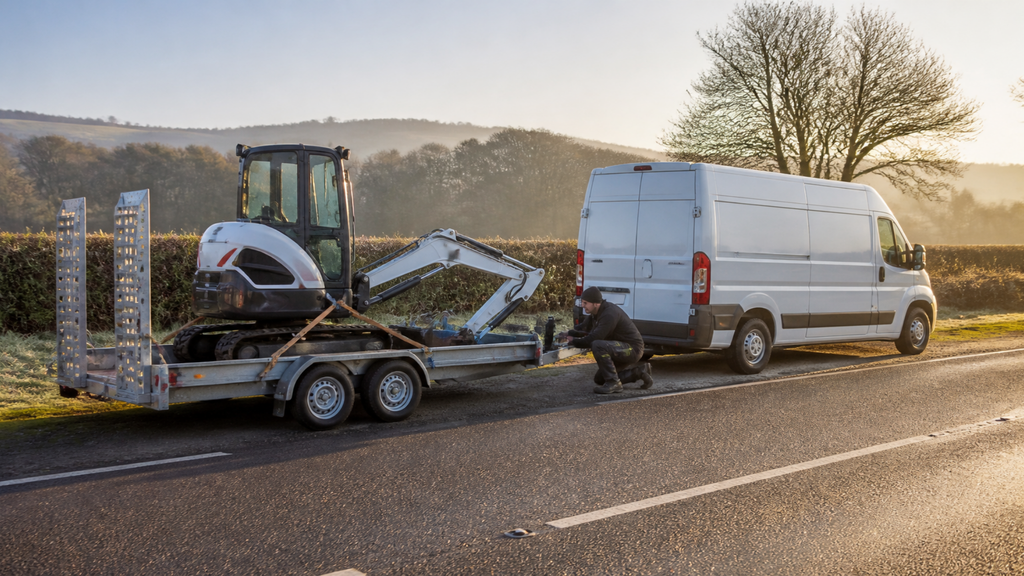
Van Towing Rules And Employer Responsibilities
Businesses have a responsibility to make sure that vehicles used for work are safe and suitable for their intended purpose. This includes vans, trailers, towing equipment and the loads being transported.
Employers and self-employed operators should consider towing as part of their wider workplace transport risk assessments, identifying potential hazards associated with trailer loading, vehicle stability, reversing, coupling equipment and driver competence. Our Fleet Risk Assessment Guide provides further guidance on identifying and managing risks across business vehicles.
Practical steps include:
- Checking that drivers hold the correct licence entitlement.
- Confirming that the van is approved to tow the intended trailer and load.
- Checking operator licensing and drivers’ hours requirements.
- Providing suitable training for employees who tow trailers.
- Making sure trailers, brakes, tyres, lights and couplings are inspected and maintained.
- Establishing clear procedures for loading and securing equipment.
- Keeping records of relevant vehicle checks and maintenance.
A company vehicle policy should explain who is permitted to tow, what equipment can be transported and what checks drivers must complete before a journey. Employees using leased vehicles should also understand their responsibilities when operating the vehicle for work, including following the relevant vehicle-use requirements. Our guide to leased vehicle driver responsibilities explains what drivers need to consider.
Our company vehicle policy guide provides further guidance on setting out responsibilities and expectations for employees using vehicles for work.
Drivers should also carry out regular walkaround checks. Our guide to daily van checks and business legal responsibilities explains the checks businesses should build into their vehicle procedures.
Choosing The Right Van For Towing Equipment
Not every van is suitable for every towing task. Businesses should consider the weight and dimensions of the equipment they need to transport, how frequently they will tow and whether the vehicle has sufficient payload and towing capacity.
Businesses should also check that their insurance arrangements cover the intended use of the van and trailer, including the equipment being transported and any relevant towing requirements. Our guide to insuring a leased van explains the insurance considerations involved when running a leased commercial vehicle.
For tradespeople, this could mean transporting tools and materials alongside a trailer carrying heavier machinery. Builders, landscapers, electricians and other contractors may have different requirements depending on the equipment they use.
A van should be selected with the full working load in mind, rather than simply its advertised towing capacity. The weight of passengers, tools, materials and any fitted storage or conversion equipment can all affect how much capacity remains available.
Businesses comparing vehicle options can use our guide to the best vans for tradespeople as a starting point.
When considering a new commercial vehicle, business van leasing can also provide an alternative to purchasing outright. However, businesses should confirm the towing specification of the chosen model before committing to a vehicle.
Frequently Asked Questions About Van Towing Rules
You may be able to, depending on the van’s approved towing capacity, gross train weight, trailer weight and your driving licence entitlement. The van’s 3,500kg MAM does not automatically determine how much it can tow.
There is no single maximum trailer weight for all vans. The permitted figure depends on the manufacturer’s towing limit, gross train weight, trailer specification and the driver’s licence entitlement.
In England, Scotland and Wales, the usual limits for a van towing a trailer are 30mph in built-up areas, 50mph on single carriageways, 60mph on dual carriageways and 60mph on motorways. Lower signed limits still apply.
Most full car licence holders can tow a trailer within their Category BE entitlement, subject to the applicable vehicle, trailer and combination weight limits. Drivers should check their individual licence details and the van manufacturer’s towing specification before setting off.
Some businesses do. Operator licensing can apply when the combined plated gross weights of a van and trailer exceed 3,500kg, or when their combined unladen weight exceeds 1,525kg. An exemption may apply if the trailer’s unladen weight is below 1,020kg and the business only carries its own goods.
A trailer must have a working braking system if it weighs more than 750kg when loaded. Any brakes fitted to a lighter trailer must also be in good working order.
Yes, provided the van, trailer, driver and combination comply with the relevant legal requirements. The usual motorway speed limit for a van towing a trailer is 60mph.
You should check your insurance policy and confirm that the intended business use and towing activity are covered. Do not assume that cover for the van automatically provides all the protection required for a trailer, its contents or equipment being transported.
 Call our expert team on