The 2026 IAA Transportation show in Hanover has highlighted a significant shift in the way van manufacturers are approaching the fleet market.
While new electric vans, trucks and commercial vehicles remained a major part of the event, a growing number of manufacturers used the show to promote something beyond the vehicle itself: the services, technology and support designed to keep commercial vehicles working for longer.
From predictive maintenance and connected vehicle data to charging support, finance, servicing and fleet management, manufacturers are increasingly presenting themselves as long-term partners rather than simply vehicle suppliers.
That focus on vehicle uptime was particularly evident across a number of the major van brands exhibiting at IAA Transportation 2026.
For businesses operating multiple commercial vehicles, this forms part of a much wider approach to managing vehicles throughout their working life. CVC’s guide to Fleet Lifecycle Management looks at how businesses can approach everything from vehicle acquisition and maintenance through to replacement and disposal.
Mercedes-Benz Expands Its Connected Fleet Offering
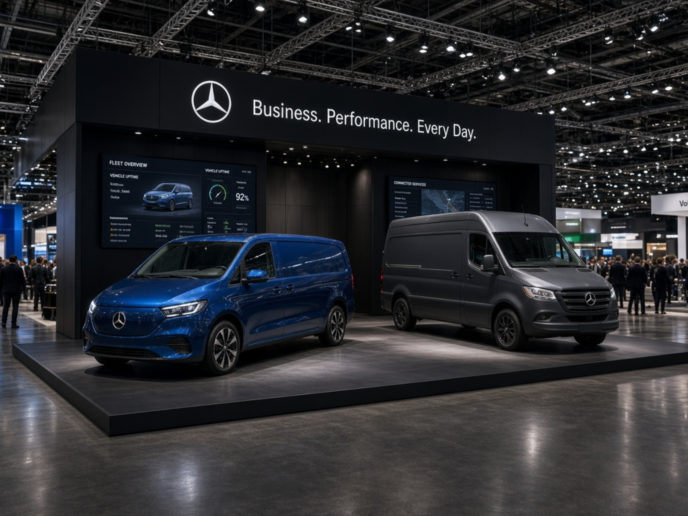
Mercedes-Benz Vans used IAA Transportation to introduce the next generation of Mercedes-Benz Pro, with the manufacturer positioning the platform as a much broader business ecosystem than its previous digital service proposition.
The new Mercedes-Benz Pro has been organised around five key areas, covering connectivity, conversions, electrification, finance and vehicle servicing.
For fleet operators, the connectivity element could be particularly significant.
Mercedes-Benz Fleet Pilot is designed to give fleet managers access to live vehicle information, including alerts relating to potential maintenance requirements. Alongside this, the Mercedes-Benz Van Uptime Monitor is intended to provide greater visibility of vehicle condition and upcoming servicing requirements.
The objective is to identify potential problems earlier and reduce the likelihood of unexpected vehicle downtime.
This is particularly relevant for businesses where vehicle availability directly affects day-to-day operations. CVC’s Fleet Management Solutions provide a useful starting point for businesses looking at how their wider commercial vehicle operation can be managed.
Mercedes-Benz is also expanding its approach to van conversions. A wider partner network and new online platform are intended to make it easier for customers to find both factory and third-party conversions through a single system.
For businesses requiring something beyond a standard panel van, CVC also offers a range of Commercial Vehicle Conversions, covering specialist requirements across different industries.
Electrification forms another part of the new Mercedes-Benz Pro proposition, with services aimed at helping businesses plan charging infrastructure and manage charging payments.
Charging is becoming an increasingly important consideration for businesses moving commercial fleets towards electric vehicles, particularly where vehicles return to a depot or workplace. CVC’s guide to Electric Vehicle Charging For Businesses covers some of the key considerations around workplace and employee charging.
The finance element goes further than traditional vehicle finance, with Mercedes-Benz looking to bring leasing, maintenance, warranty, insurance and digital services together into a single package.
For businesses comparing different ways of funding their vehicles, CVC’s Van Finance Guide explains the main options available to UK businesses.
The final area focuses on keeping vehicles operational, including a mobile servicing programme which Mercedes-Benz says could cover as much as 80% of potential servicing requirements without the vehicle necessarily needing to visit a workshop.
For businesses operating commercial vehicles every day, that emphasis on reducing unnecessary workshop visits could be just as important as the specification of the van itself.
CVC’s guide to Vehicle Maintenance also highlights the importance of keeping commercial vehicles properly maintained throughout their lease or ownership period.
Renault Puts Predictive Maintenance At The Heart Of Fleet Support
Renault also used the Hanover show to look beyond the vehicles themselves, outlining its forthcoming Uptimize programme.
Due to launch in 2027, the system is being developed around connected vehicle data, with the aim of improving availability, reliability and fleet efficiency.
Renault’s latest approach follows the wider direction of its commercial vehicle strategy, including the New Trafic E-Tech And Five New LCVs Planned By 2028.
Rather than waiting for a fault to occur, Renault wants connected vehicle information to help identify potential problems before they develop into more serious issues.
This could allow maintenance to be planned around the vehicle and the fleet’s requirements, rather than relying solely on fixed servicing schedules.
Renault says Uptimize will use AI to help optimise maintenance planning, potentially reducing both the number and length of workshop visits.
The manufacturer also says its support system will provide more personalised assistance when an incident does occur, with a stated ambition of reducing downtime by as much as 50%.
There is also a fleet management element, with an in-vehicle application designed to automatically apply settings selected by fleet managers across eligible vehicles. These can include preferences relating to efficiency, performance and safety.
For operators, the wider objective is straightforward: use vehicle data to spend less time dealing with faults and more time keeping vans on the road.
That focus also reinforces the importance of understanding the difference between routine maintenance and issues covered by a manufacturer’s warranty. CVC’s Maintenance Vs Warranty Guide explains how the two areas differ.
BYD Expands Its Commercial Vehicle Line-Up
BYD’s presence at IAA Transportation 2026 was largely focused on heavier commercial vehicles, but the manufacturer also provided an update on its plans for the lighter commercial vehicle market.
One of the highlights was the BYD T35, an electric truck designed for vehicles in the 3.5- to 4.25-tonne category.
Production is currently scheduled to begin during the third quarter of 2027, with the vehicle being developed with urban deliveries, last-mile operations and local authority use in mind.
Its compact design is intended to make it suitable for operating in built-up areas, with a turning circle of less than seven metres.
The T35 is expected to offer a payload capacity of up to 2,580kg, while the electric motor can produce up to 204PS. Power comes from a 62kWh battery, with DC charging capability of up to 157kW.
A further feature is an 18kW power take-off system, allowing the vehicle’s battery to supply power to equipment and tools.
European production specifications have yet to be finalised, so some details could change before the vehicle reaches the market.
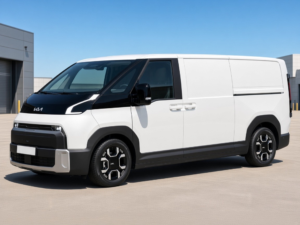
BYD also provided an update on its e-Vali electric van, which was originally presented at IAA Transportation two years ago.
The manufacturer is now carrying out real-world testing with selected customers, operators and bodybuilders. The programme is intended to provide additional information about how the van performs in practical fleet applications and, importantly, what commercial vehicle operators actually require from an electric van.
That feedback could play an important role as BYD continues expanding its presence in Europe’s commercial vehicle market.
The growing choice of electric commercial vehicles also means businesses have more options when considering a transition away from conventional powertrains. CVC’s guide to Switching To An Electric Vehicle looks at some of the issues businesses need to consider before making the move.
Farizon Looks Beyond Vehicle Pricing
Farizon also used IAA Transportation to underline its ambitions in the European van market.
The manufacturer’s V7E electric van secured third place in the International Van of the Year 2027 competition, while attention at the show also turned to developments for its larger SV electric van.
The SV, which entered the UK market in early 2025, is being updated with improvements including faster charging and a more efficient electric drivetrain.
Farizon says the revised battery system will be capable of charging from 20% to 80% in 18 minutes, while the vehicle’s combined-cycle energy consumption is expected to fall to around 24.2kWh per 100km.
A four-wheel-drive version is also planned.
However, Farizon’s message at IAA Transportation extended beyond vehicle specifications.
The manufacturer was keen to emphasise that its strategy is not simply based around competing on purchase price. Instead, it wants to develop a wider ecosystem around its vehicles, including finance, leasing, charging and aftersales support.
This is another example of the changing commercial vehicle market, with manufacturers increasingly looking at the complete ownership and operating experience rather than treating the van as a standalone product.
Farizon has also established a European spare parts warehouse in Germany, designed to improve access to components and support its growing customer base.
For fleet operators, the availability of parts, servicing and technical support can have a direct impact on how long a vehicle remains off the road when something does go wrong.
For businesses running larger fleets, this is also where a dedicated Fleet Van Leasing approach can become particularly relevant, allowing vehicle requirements, funding and replacement cycles to be considered as part of a wider fleet strategy.
Uptime Is Becoming A Key Part Of The Van Proposition
One of the clearest messages to emerge from IAA Transportation 2026 is that the commercial vehicle itself is only becoming one part of the overall fleet proposition.
Manufacturers are investing heavily in connected technology that can provide greater insight into vehicle condition, maintenance requirements, charging and driver behaviour.
At the same time, finance, servicing, conversions, charging infrastructure and parts supply are increasingly being brought together into wider packages.
This is particularly relevant for businesses that rely on vans to generate revenue.
A vehicle that is sitting in a workshop is not delivering for the business, which means reducing unexpected downtime can be just as important as improving payload, range or fuel consumption.
For businesses considering their next generation of commercial vehicles, the developments showcased at IAA Transportation demonstrate that it is worth looking beyond the headline specification.
Connectivity, maintenance support, charging infrastructure and aftersales provision are all becoming increasingly important parts of the modern van market.
 Call our expert team on