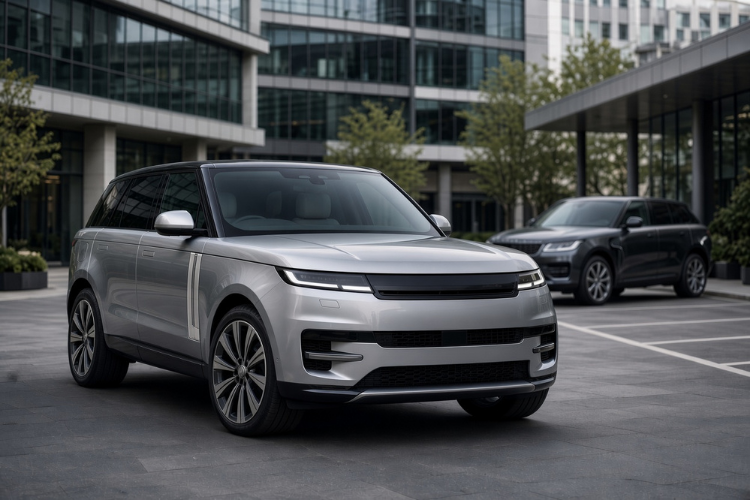
The new Range Rover Electric could offer company car drivers a significant Benefit-in-Kind (BIK) tax saving compared with the brand’s plug-in hybrid models, despite its £154,070 starting price.
The first fully electric Range Rover is due to arrive with a 4% BIK rate for the 2026/27 tax year, while offering up to 372 miles of WLTP range.
For higher-rate taxpayers running a premium company car, the difference in tax could make the electric model particularly attractive.
Range Rover Electric BIK Rate Could Cut Company Car Tax
The Range Rover Electric’s £154,070 starting price puts it firmly into the luxury vehicle market, but its low BIK percentage significantly reduces the amount of tax payable by company car drivers.
A 40% taxpayer choosing the electric Range Rover at its starting price would pay approximately £2,465 in company car tax during 2026/27.
The electric BIK rate is then scheduled to increase to 5% in 2027/28, followed by 7% in 2028/29 and 9% in 2029/30.
That remains considerably below the tax rates applied to many higher-emission vehicles.
The difference is particularly noticeable when compared with Range Rover’s plug-in hybrid models, which currently have BIK rates starting at 7%.
A PHEV attracting a 7% BIK rate could cost a 40% taxpayer around £3,300 per year in company car tax based on the relevant vehicle value.
As PHEV BIK rates increase, the gap could become even more substantial, with a vehicle attracting a 19% rate potentially resulting in a tax bill approaching £9,000 per year by 2029.
For drivers choosing expensive company cars, the BiK calculation can therefore have a major impact on the overall cost of running the vehicle.
| Specification | Range Rover Electric | Range Rover PHEV |
|---|---|---|
| Starting price | £154,070 | Model dependent |
| 2026/27 BiK rate | 4% | From 7% |
| 40% taxpayer annual tax | Approx. £2,465 | Approx. £3,300+ |
| BiK rate by 2029/30 | 9% | Up to 19% |
| Official range | Up to 372 miles | Model dependent |
| Battery | 118.5kWh | Model dependent |
| Power | Up to 550PS | Model dependent |
| 0-60mph | 4.3 seconds | Model dependent |
For a higher-rate company car driver, the lower BIK percentage could make the Range Rover Electric considerably cheaper to tax than a comparable PHEV, despite its high list price.
Range Rover Electric BiK Rate
The company car Benefit-in-Kind rate for the Range Rover Electric is scheduled to rise from 4% in 2026/27 to 9% in 2029/30
| Tax Year | BiK |
|---|---|
| 2026/27 | 4% |
| 2027/28 | 5% |
| 2028/29 | 7% |
| 2029/30 | 9% |
| Vehicle | BiK Rate | Approx. Annual Tax at 40% |
|---|---|---|
| Range Rover Electric | 4% | £2,465 |
| Range Rover PHEV | 7% | £3,300 |
| Difference | 3 percentage points | Approx. £835 per year |
Electric Power Suits The Range Rover Formula
JLR does not believe the Range Rover Electric’s appeal will be based solely on its company car tax position. The model also forms part of JLR’s wider expansion of its luxury electric SUV range, alongside new Jaguar models such as the Jaguar Type 01.
The manufacturer argues that electric power is particularly well suited to a luxury SUV, providing the smooth, quiet and refined driving experience expected from a Range Rover. The luxury electric SUV segment is also attracting new premium models, including the Genesis GV90.
Performance is also a major part of the package.
The vehicle uses twin electric motors producing up to 550PS and 850Nm of torque, enabling it to accelerate from 0-60mph in just 4.3 seconds.
A 118.5kWh battery provides up to 372 miles of official WLTP range, while the estimated real-world range is around 333 miles.
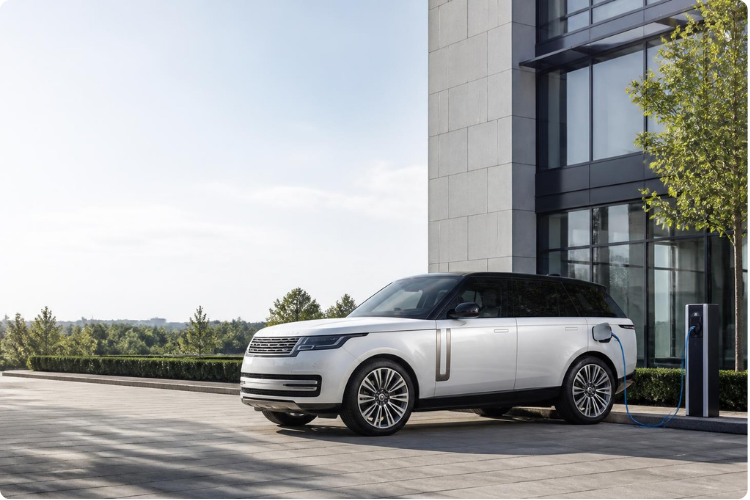
Rapid Charging Supports Long-Distance Use
Charging performance will also be important for company car drivers covering significant annual mileage.
Using a suitable 350kW rapid charger, the Range Rover Electric can recharge from 10% to 80% in approximately 22 minutes.
Home charging is considerably slower, with a 7kW charger taking around 19 hours to deliver a full charge.
For drivers able to charge overnight at home, however, this should provide enough opportunity to start most working days with a substantial amount of usable range.
JLR Focuses On Residual Values
The transition to electric power also creates challenges around used EV values, particularly for a vehicle positioned at the premium end of the market.
JLR says it intends to manage production carefully rather than allowing supply of the electric model to outpace demand.
The Range Rover Electric can be manufactured alongside plug-in hybrid and combustion-powered versions at the company’s Solihull facility, giving JLR flexibility to adjust production according to customer demand.
This approach is designed to help protect residual values as the Range Rover line-up becomes increasingly electrified.
Eight-Year Battery Warranty Adds Reassurance
Battery longevity will be another important consideration for businesses and drivers looking at premium electric vehicles.
The Range Rover Electric will come with an eight-year or 100,000-mile battery warranty.
JLR is also developing digital twins for individual batteries, allowing battery health to be monitored throughout their lifespan.
The technology could help identify potential problems at an early stage while giving customers greater visibility of battery condition.
Retail Network Receives EV Training
JLR has also been preparing its retailer network for the arrival of the electric Range Rover.
Around 900 retailer representatives have received additional training covering electric vehicle charging, payment systems, servicing, maintenance and diagnostics.
The aim is to ensure retailers can provide the specialist support required by customers making the move from conventional or hybrid power to a fully electric vehicle.
Strong Interest Before Launch
JLR says the Range Rover Electric has already generated around 80,000 expressions of interest, with approximately 70% coming from people who do not currently own a Range Rover.
The level of interest could give JLR a significant opportunity to attract new customers as it expands its electric vehicle line-up and introduces more models aimed at the premium end of the market.
It could also broaden the Range Rover’s appeal among company car drivers looking for a luxury electric SUV while keeping their BIK liability as low as possible.
 Call our expert team on