
Fleet management has evolved far beyond simply purchasing vehicles and replacing them when they become unreliable. In today’s competitive business environment, every vehicle in your fleet represents a significant investment that must deliver value throughout its operational life.
Whether your business operates a single company van or manages a nationwide fleet of hundreds of commercial vehicles, adopting an effective fleet lifecycle management strategy can reduce operating costs, improve vehicle reliability, minimise downtime and help achieve wider business objectives.
For many UK businesses, vehicles are essential to daily operations. Engineers rely on them to reach customers, couriers depend on them to make timely deliveries, and sales teams use company cars to visit clients across the country. Every hour a vehicle is off the road can lead to lost productivity, missed appointments and dissatisfied customers.
Fleet lifecycle management provides a structured approach to planning, acquiring, operating, maintaining and replacing vehicles. Rather than reacting to unexpected breakdowns or spiralling repair costs, businesses can make informed decisions that improve efficiency while keeping budgets under control.
As businesses continue transitioning towards lower-emission vehicles, embracing connected vehicle technology and navigating changing legislation, having a clear fleet lifecycle strategy has never been more important.
This comprehensive guide explains every stage of fleet lifecycle management, helping fleet managers, business owners and procurement teams maximise the value of their vehicle investment.

What Is Fleet Lifecycle Management?
Fleet lifecycle management is the process of managing every stage of a vehicle’s life within a business, from identifying the need for a vehicle through to its eventual replacement or disposal.
Rather than viewing vehicles as standalone assets, lifecycle management considers the total journey of each vehicle and aims to maximise efficiency, reliability and return on investment throughout its operational life.
A successful lifecycle strategy typically includes:
- Planning future vehicle requirements
- Selecting the right vehicles for the job
- Funding or leasing vehicles
- Managing servicing and maintenance
- Monitoring running costs
- Improving driver safety
- Reducing downtime
- Planning replacement at the optimum time
- Returning or disposing of vehicles efficiently
Businesses that actively manage the lifecycle of their fleet are often able to reduce operating costs while improving customer service and maintaining higher levels of compliance.
Fleet Lifecycle vs Traditional Fleet Management
Many businesses mistakenly believe fleet management simply involves arranging vehicle servicing and renewing insurance policies.
Fleet lifecycle management takes a far broader approach.
Instead of focusing solely on keeping vehicles on the road, lifecycle management considers questions such as:
- Are these still the right vehicles for our business?
- Are maintenance costs increasing?
- Would newer vehicles reduce fuel costs?
- Is it time to transition towards electric vehicles?
- Are we replacing vehicles too early or too late?
- Could leasing provide better financial flexibility?
Answering these questions allows businesses to make strategic decisions rather than reactive ones.
The Fleet Lifecycle Process
Every commercial vehicle typically follows the same lifecycle.
Planning → Acquisition →
Operation → Maintenance →
Replacement → Disposal →
Repeat
Each stage influences the next.
For example, selecting the wrong vehicle at the planning stage may result in higher maintenance costs, increased fuel consumption and earlier replacement.
Likewise, poor maintenance can shorten vehicle lifespan and increase downtime, while replacing vehicles too late often leads to expensive repair bills and operational disruption.
Viewing the fleet as a continuous lifecycle rather than a one-off purchase enables businesses to make better long-term decisions.
Key Takeaways: Fleet Lifecycle Management
Fleet lifecycle management helps businesses make smarter decisions about their vehicles by managing every stage of the vehicle journey — from initial planning and acquisition through to maintenance, replacement and disposal.
Key benefits include:
- Reduced operating costs by monitoring total cost of ownership (TCO) rather than focusing only on purchase price or monthly payments.
- Improved vehicle reliability through preventative maintenance and planned replacement cycles.
- Less downtime by identifying potential issues before they disrupt business operations.
- Better budgeting with predictable vehicle costs and planned replacement strategies.
- Improved driver satisfaction through safer, newer and more suitable vehicles.
- Greater sustainability by supporting the transition towards electric and lower-emission vehicles.
- Smarter fleet decisions through telematics, connected vehicles and performance data.
- A more productive business fleet by ensuring every vehicle continues to deliver value throughout its working life.
A successful fleet lifecycle strategy allows businesses to move away from reactive vehicle management and adopt a proactive approach that reduces costs, improves efficiency and supports long-term growth.
The Fleet Lifecycle Management Process Explained
Every vehicle within a business follows a journey. Effective fleet lifecycle management ensures each stage is carefully planned to maximise efficiency, control costs and improve operational performance.
The Six Stages of Fleet Lifecycle Management
1. Planning
Understanding business requirements before selecting vehicles.
This stage involves analysing:
- Vehicle purpose
- Payload requirements
- Mileage expectations
- Driver needs
- Future business growth
- Fuel type suitability
Choosing the right vehicle at the beginning prevents unnecessary costs later.
↓
2. Acquisition
Selecting the right funding method and sourcing suitable vehicles.
Businesses consider:
- Contract Hire
- Finance Lease
- Vehicle purchase
- Maintenance packages
- Specialist conversions
- Electric vehicle options
The correct acquisition strategy helps maintain cash flow and supports predictable budgeting.
↓
3. Operation
Managing vehicles effectively while they are in daily use.
This includes:
- Driver behaviour monitoring
- Fuel management
- Route optimisation
- Vehicle utilisation
- Telematics monitoring
Efficient operation reduces running costs and improves productivity.
↓
4. Maintenance
Keeping vehicles safe, reliable and compliant.
A proactive maintenance programme includes:
- Scheduled servicing
- MOT planning
- Tyre management
- Safety inspections
- Repairs
- Warranty management
Preventative maintenance reduces breakdowns and extends vehicle lifespan.
↓
5. Replacement
Identifying the optimum time to replace vehicles.
Replacement decisions should consider:
- Vehicle age
- Mileage
- Repair costs
- Downtime
- Reliability
- Business requirements
- New technology
Replacing vehicles at the right time avoids unnecessary costs.
↓
6. Disposal
Completing the lifecycle and preparing for the next vehicle cycle.
This involves:
- Vehicle return
- Resale
- Part exchange
- Reviewing performance
- Planning future requirements
Each replacement cycle provides valuable information that helps improve future fleet decisions.
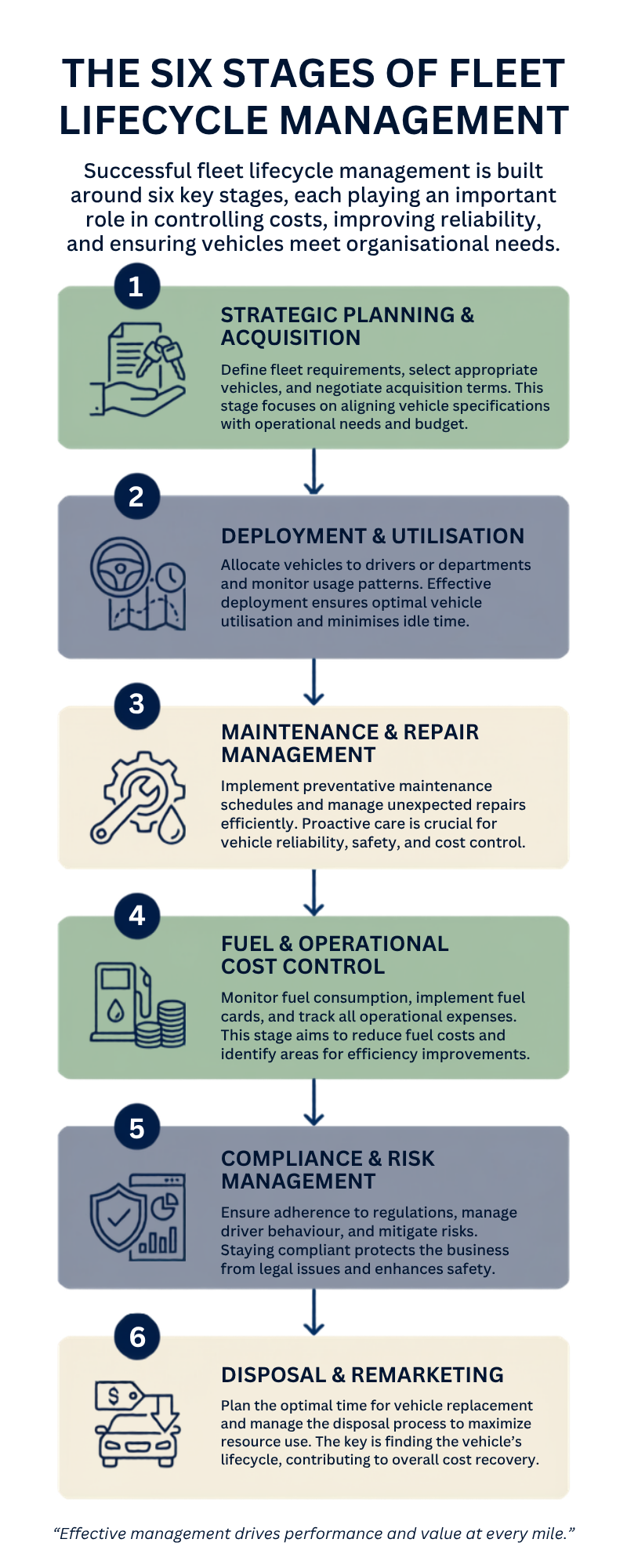
Fleet Lifecycle Management Cycle
The process is continuous.
Every replacement cycle provides new data and insights, allowing businesses to make better decisions with each generation of vehicles.
Why Fleet Lifecycle Management Matters
Commercial vehicles are often among the largest capital investments a business makes.
Without a clear lifecycle strategy, businesses may unknowingly spend thousands of pounds more than necessary through poor purchasing decisions, inefficient maintenance programmes or delayed vehicle replacement.
An effective fleet lifecycle management strategy delivers benefits across every part of the business.
Lower Operating Costs
One of the biggest advantages is reducing the overall cost of operating each vehicle.
Older vehicles generally become more expensive to maintain as components wear, servicing becomes more frequent and repairs become increasingly unpredictable.
By replacing vehicles at the right time, businesses can often avoid escalating maintenance costs while benefiting from improved fuel economy and lower emissions.
Rather than focusing purely on monthly payments or purchase price, lifecycle management considers the total cost of ownership (TCO), helping businesses make more informed financial decisions.
Reduced Vehicle Downtime
Unexpected breakdowns don’t just generate repair bills.
They can also result in:
- Missed customer appointments
- Delayed deliveries
- Lost productivity
- Overtime costs
- Temporary vehicle hire
- Reduced customer satisfaction
Preventative maintenance and planned replacement significantly reduce the likelihood of vehicles being unexpectedly taken off the road.
For many service-based businesses, maintaining high fleet availability is just as important as controlling costs.
Improved Driver Satisfaction
Drivers spend many hours every week behind the wheel.
Modern vehicles offer improved comfort, better safety technology, enhanced connectivity and lower driver fatigue.
Providing employees with newer, well-maintained vehicles can improve morale, increase productivity and even assist with staff recruitment and retention.
Drivers are also more likely to perform regular vehicle checks and report issues promptly when they have confidence in the vehicles they use.
Better Compliance
Businesses operating commercial vehicles must comply with numerous legal obligations.
Fleet lifecycle management helps ensure vehicles remain compliant through:
- Scheduled servicing
- MOT planning
- Tyre inspections
- Safety recalls
- Warranty management
- Driver walkaround checks
- Maintenance record keeping
A structured maintenance programme reduces the risk of compliance failures while helping businesses demonstrate duty of care.
More Accurate Budgeting
Unexpected repair bills can place considerable pressure on business finances.
Lifecycle management allows organisations to forecast vehicle replacement, maintenance expenditure and operating costs more accurately.
Many businesses choose vehicle leasing because fixed monthly payments make budgeting easier while avoiding the significant upfront cost of purchasing vehicles outright.
Predictable vehicle costs support better financial planning across the organisation.
Supporting Sustainability Goals
Environmental performance has become an increasingly important consideration for businesses of every size.
An effective lifecycle strategy enables organisations to:
- Replace older, higher-emission vehicles
- Introduce electric or plug-in hybrid vehicles where appropriate
- Reduce fuel consumption
- Lower carbon emissions
- Support ESG reporting
- Improve environmental credentials when tendering for contracts
Many customers now expect suppliers to demonstrate sustainability initiatives, making fleet renewal an important part of wider business strategy.
Enhanced Business Reputation
Reliable vehicles help businesses deliver a more consistent customer experience.
Whether transporting goods, visiting customer sites or providing emergency services, dependable vehicles improve punctuality and professionalism.
Modern vehicles also present a better image, particularly when professionally signwritten and maintained to a high standard.
For customer-facing businesses, the fleet often serves as a mobile advertisement for the company.
Who Benefits from Fleet Lifecycle Management?
Fleet lifecycle management is valuable for organisations of all sizes.
It is particularly beneficial for:
- Fleet managers
- Small and medium-sized businesses (SMEs)
- National delivery companies
- Local authorities
- Construction firms
- Utility companies
- Housing associations
- Healthcare providers
- Engineering companies
- Courier businesses
- Facilities management companies
- Trade businesses operating multiple vans
Even businesses with just two or three vehicles can reduce costs and improve operational efficiency by adopting lifecycle management principles.
The Cost of Ignoring Fleet Lifecycle Management
Businesses without a structured fleet strategy often experience similar problems.
These may include:
- Vehicles kept beyond their economical lifespan
- Rising repair costs
- Increasing fuel bills
- Higher insurance claims
- More frequent breakdowns
- Lost productivity
- Driver dissatisfaction
- Unexpected capital expenditure
- Reduced resale values
- Difficulty budgeting for replacements
While these issues may appear unrelated, they often stem from one common problem: replacing reactive fleet management with a proactive lifecycle strategy.
By understanding every stage of the fleet lifecycle, businesses can make informed decisions that improve reliability, reduce costs and support long-term growth.
Traditional Fleet Management vs Fleet Lifecycle Management
While the terms are often used interchangeably, traditional fleet management and fleet lifecycle management have different objectives. Traditional fleet management typically focuses on keeping vehicles operational day-to-day, whereas fleet lifecycle management takes a long-term strategic approach to maximise the value of every vehicle throughout its entire lifespan.
| Traditional Fleet Management | Fleet Lifecycle Management |
|---|---|
| Reactive approach to vehicle issues | Proactive long-term strategy |
| Focuses on servicing and repairs | Manages every stage of the vehicle’s lifecycle |
| Replaces vehicles when problems arise | Plans replacements based on data and performance |
| Often concentrates on short-term costs | Focuses on Total Cost of Ownership (TCO) |
| Limited analysis of vehicle performance | Uses data, telematics and KPIs to improve efficiency |
| Maintenance-driven | Business strategy-driven |
| Higher risk of unexpected downtime | Planned maintenance reduces downtime |
| Budgets can be unpredictable | Predictable budgeting through planned replacement cycles |
| Vehicles may be kept beyond their economical lifespan | Vehicles are replaced at the optimum time |
| Supports daily operations | Supports wider business growth, sustainability and profitability |
Why Fleet Lifecycle Management Delivers Better Long-Term Value
Businesses that adopt a lifecycle management strategy don’t simply maintain vehicles—they continuously evaluate whether each vehicle remains the most suitable, cost-effective and productive asset for the job.
By monitoring operating costs, vehicle utilisation, maintenance history and future business requirements, organisations can make informed decisions that reduce downtime, improve driver satisfaction and maximise return on investment.
Rather than reacting to problems after they occur, fleet lifecycle management helps businesses stay ahead of them, creating a safer, more reliable and more cost-effective fleet for the future.
Top Tip: Fleet lifecycle management isn’t just for large organisations. Even businesses operating two or three vehicles can reduce costs and improve efficiency by planning vehicle replacement, monitoring running costs and maintaining a structured servicing programme.
The Six Stages of Fleet Lifecycle Management
Successful fleet lifecycle management is built around six key stages. While every business has different operational requirements, each stage plays an important role in controlling costs, improving reliability and ensuring vehicles continue to meet the needs of the organisation.
Businesses that actively manage every phase of the lifecycle are far more likely to maximise vehicle uptime, minimise unexpected expenditure and achieve the lowest possible total cost of ownership (TCO).
Stage 1: Planning Your Fleet
Every successful fleet begins with careful planning.
Choosing a vehicle based solely on price or manufacturer loyalty can lead to higher running costs, reduced productivity and expensive replacement decisions later. Instead, businesses should start by identifying exactly what the vehicle needs to achieve.
The right vehicle should not only meet today’s requirements but also support future business growth.
Understand Your Business Requirements
Before selecting any vehicle, consider the role it will perform.
Questions to ask include:
- What type of goods or equipment will it carry?
- What payload capacity is required?
- Will it need to tow trailers or machinery?
- How many miles will it cover each year?
- Will it mainly operate in towns, cities or rural areas?
- Does it require specialist conversions?
- How many people need to travel in the vehicle?
- Will drivers require four-wheel drive?
- Could an electric vehicle perform the same role?
The answers to these questions often narrow the choice considerably and help prevent businesses from over- or under-specifying their fleet.
Selecting the Right Vehicle
The commercial vehicle market offers more choice than ever before.
Businesses can choose from:
- Small vans
- Medium vans
- Large panel vans
- Pick-up trucks
- Chassis cabs
- Tippers
- Dropsides
- Luton vans
- Curtain-side vehicles
- Refrigerated vans
- Crew vans
- Electric vans
- Plug-in hybrid vehicles
- Company cars
Choosing the correct vehicle for the job improves efficiency while reducing unnecessary operating costs.
For example, operating a large panel van for light city deliveries may increase fuel costs unnecessarily, while selecting a vehicle with insufficient payload could result in additional journeys or even legal compliance issues through overloading.
Planning for Future Growth
Many businesses make the mistake of planning only for today’s workload.
Fleet lifecycle management encourages organisations to consider where the business will be in three, four or five years.
Consider:
- Will additional staff be recruited?
- Is geographical expansion planned?
- Will customer demand increase?
- Could legislation affect vehicle choice?
- Will electric vehicles become more suitable?
- Is additional storage or payload likely to be required?
Future-proofing vehicle selection helps avoid replacing vehicles prematurely.
Considering Electric Vehicles
The transition towards lower-emission transport continues to accelerate.
During the planning stage, businesses should assess whether electric or plug-in hybrid vehicles could meet operational requirements.
Questions to consider include:
- What are the typical daily driving distances?
- Are suitable charging facilities available?
- Will drivers charge at home or at work?
- Are government incentives available?
- How will electric vehicles affect running costs?
For many urban fleets, electric vans now offer lower running costs and reduced maintenance requirements compared with diesel alternatives.
Stage 2: Vehicle Acquisition
Once vehicle requirements have been identified, the next step is deciding how to fund or acquire the fleet.
There is no single solution suitable for every business, and the most appropriate option often depends on cash flow, tax considerations and long-term business strategy.
Contract Hire
Contract Hire remains one of the UK’s most popular methods of funding commercial vehicles.
Benefits include:
- Fixed monthly payments
- No large capital outlay
- Easier budgeting
- Optional maintenance packages
- Access to new vehicles
- Regular replacement cycles
Many businesses prefer Contract Hire because it removes concerns around depreciation while allowing predictable fleet budgeting.
Finance Lease
Finance Lease provides another flexible funding option.
Businesses benefit from:
- Fixed rental payments
- Flexibility at the end of the agreement
- No significant upfront purchase cost
- Improved cash flow
This option is particularly attractive for businesses wanting greater flexibility while preserving working capital.
Outright Purchase
Some organisations continue purchasing vehicles outright.
Advantages include:
- Full ownership
- No monthly finance payments after purchase
- Freedom to modify vehicles
However, purchasing ties up capital and leaves the business responsible for depreciation and disposal.
For growing businesses, preserving cash flow through leasing often provides greater financial flexibility.
Selecting the Right Supplier
Choosing the right leasing or fleet partner is equally important.
A knowledgeable provider should offer:
- Access to multiple manufacturers
- Competitive funding options
- Independent advice
- Maintenance packages
- Conversion expertise
- Dedicated account management
- Nationwide vehicle delivery
- Ongoing fleet support
Building a long-term relationship with a trusted leasing broker can simplify future vehicle replacement and fleet expansion.
Stage 3: Operating the Fleet
Once vehicles enter service, attention turns to maximising performance while controlling operating costs.
Even the newest fleet can become expensive if day-to-day management is neglected.
Driver Behaviour
Driver behaviour has a significant impact on fleet performance.
Poor driving habits can increase:
- Fuel consumption
- Tyre wear
- Brake wear
- Accident rates
- Maintenance costs
Simple improvements such as smoother acceleration, reduced idling and better route planning can significantly reduce operating costs.
Telematics
Modern telematics systems provide valuable insights into vehicle usage.
Fleet managers can monitor:
- Vehicle location
- Fuel efficiency
- Driver behaviour
- Excessive idling
- Harsh braking
- Speeding
- Journey history
- Vehicle utilisation
Using telematics data helps businesses identify opportunities to improve efficiency while reducing unnecessary costs.
Route Planning
Efficient route planning benefits both businesses and customers.
Optimised routes reduce:
- Fuel consumption
- Vehicle wear
- Driver fatigue
- Journey times
- Carbon emissions
Many fleet management systems now use live traffic information and artificial intelligence to recommend more efficient routes.
Fuel Management
Fuel remains one of the largest operating expenses for many commercial fleets.
Businesses should regularly monitor:
- Average MPG
- Fuel card usage
- Driver performance
- Vehicle suitability
- Fuel theft
- Idle time
Small improvements across an entire fleet can produce substantial annual savings.
Stage 4: Fleet Maintenance
Maintenance is one of the most important elements of fleet lifecycle management.
Regular servicing not only keeps vehicles reliable but also helps preserve manufacturer warranties, reduce breakdowns and improve resale values.
Preventative maintenance is almost always less expensive than emergency repairs.
Planned Servicing
Following manufacturer servicing schedules helps identify issues before they become serious problems.
Routine servicing typically includes:
- Oil changes
- Filters
- Brake inspections
- Suspension checks
- Battery testing
- Cooling systems
- Software updates
Keeping accurate service records also supports warranty claims and demonstrates responsible fleet management.
Tyres
Tyres directly affect:
- Safety
- Fuel economy
- Braking performance
- Driver comfort
Regular inspections should check:
- Tread depth
- Inflation pressures
- Damage
- Uneven wear
Replacing tyres before they become unsafe helps reduce the risk of accidents and costly roadside breakdowns.
Daily Walkaround Checks
Drivers should complete daily vehicle inspections before every journey.
Checks typically include:
- Tyres
- Lights
- Mirrors
- Windscreen
- Wipers
- Fluid levels
- Number plates
- Body damage
- Warning lights
These simple inspections often identify issues before they become serious mechanical failures.
Maintenance Packages
Many businesses choose maintenance-inclusive leasing agreements.
These often cover:
- Routine servicing
- MOT testing
- Replacement tyres
- Mechanical repairs
- Labour costs
- Approved parts
Maintenance packages make budgeting easier while helping keep vehicles in excellent condition throughout the lease period.
Stage 5: Knowing When to Replace Vehicles
One of the most valuable aspects of fleet lifecycle management is recognising the optimum replacement point.
Keeping vehicles for too long often leads to increasing maintenance costs, reduced reliability and lower productivity.
Replacing them too early, however, may prevent businesses from maximising the value of their investment.
Finding the right balance is essential.
Common signs that replacement should be considered include:
- Increasing repair bills
- More frequent breakdowns
- Higher fuel consumption
- Expiring warranties
- Poor reliability
- Longer workshop downtime
- Reduced driver satisfaction
- New technology offering significant efficiency gains
- Changes in emissions legislation
- Business growth requiring different vehicle types
Planned replacement allows businesses to budget effectively while maintaining a modern, reliable fleet.
Expert Tip: Don’t wait until a vehicle becomes unreliable before replacing it. Monitor repair costs, downtime and fuel consumption over time. If these costs begin to rise significantly, replacing the vehicle may be more cost-effective than continuing to maintain it.
Stage 6: Vehicle Disposal and Renewal
The final stage completes the lifecycle and prepares the business for the next generation of vehicles.
For leased vehicles, this usually involves returning the vehicle at the end of the agreement, ensuring it meets fair wear and tear standards.
Businesses that own vehicles may choose to:
- Sell privately
- Trade in against new vehicles
- Use dealer part exchange
- Sell through auctions
A well-maintained vehicle with a complete service history generally achieves stronger resale values and attracts greater buyer confidence.
Importantly, the disposal stage also provides an opportunity to review the success of the outgoing vehicle.
Questions worth asking include:
- Did the vehicle meet operational requirements?
- Were maintenance costs acceptable?
- Was the payload sufficient?
- Did drivers like using it?
- Would a different fuel type be more suitable next time?
Learning from each replacement cycle allows businesses to continually improve fleet performance over time.
Key Takeaway
Fleet lifecycle management isn’t simply about replacing old vehicles—it’s about making smarter decisions throughout every stage of a vehicle’s life. From selecting the right vehicle and funding option to monitoring performance, maintaining reliability and planning timely replacements, each stage contributes to lower operating costs, improved efficiency and a more productive fleet.
Businesses that adopt a structured lifecycle approach are better positioned to reduce downtime, improve driver satisfaction, control costs and support long-term business growth.

Choosing the Right Fleet Replacement Cycle
One of the biggest challenges facing fleet managers is deciding when to replace vehicles.
Replace them too early, and you may not maximise the value of your investment. Replace them too late, and increasing maintenance costs, breakdowns and downtime can quickly outweigh any savings made by extending their service life.
There is no universal replacement schedule that suits every business. Instead, organisations should assess several factors to determine the most cost-effective replacement point for each vehicle.
These factors include:
- Annual mileage
- Vehicle age
- Maintenance and repair costs
- Fuel or energy efficiency
- Reliability
- Downtime
- Driver feedback
- Warranty status
- Business requirements
- Technological advancements
Businesses that regularly review these factors are better placed to make informed replacement decisions rather than reacting to unexpected vehicle failures.
Typical Fleet Replacement Cycles
While every business is different, the following table provides a general guide to typical replacement cycles for company vehicles.
| Vehicle Type | Typical Replacement Cycle |
|---|---|
| Small Vans | 3–5 years |
| Medium Vans | 4–5 years |
| Large Vans | 4–6 years |
| Pick-Up Trucks | 4–5 years |
| Company Cars | 3–4 years |
| Executive Vehicles | 3–4 years |
| Electric Vans | 4–6 years (depending on battery health and usage) |
These are only guidelines. A vehicle covering 40,000 miles each year may need replacing much sooner than one travelling 8,000 miles annually.
Signs It’s Time to Replace a Fleet Vehicle
Waiting until a vehicle suffers a major mechanical failure is rarely the most cost-effective approach.
Common warning signs include:
- Repair costs increasing year after year
- Frequent breakdowns
- Reduced reliability
- Excessive workshop downtime
- Declining fuel economy
- Higher emissions
- Drivers reporting recurring issues
- Warranty cover coming to an end
- Replacement parts becoming difficult to source
- Newer vehicles offering significant efficiency or safety improvements
Replacing vehicles before these issues begin affecting operations can reduce overall fleet costs and improve productivity.
Measuring Fleet Performance with Key Performance Indicators (KPIs)
Successful fleet lifecycle management relies on data rather than guesswork.
Key Performance Indicators (KPIs) help businesses monitor vehicle performance, identify trends and make informed decisions about maintenance, replacement and investment.
Without meaningful data, it is difficult to know whether a fleet is operating efficiently.
Cost Per Mile
Cost per mile is one of the most valuable fleet performance indicators.
It combines many operating costs into a single measurement, including:
- Fuel or electricity
- Maintenance
- Tyres
- Servicing
- Repairs
- Insurance
- Vehicle finance
Tracking cost per mile allows businesses to compare vehicles across the fleet and identify those becoming increasingly expensive to operate.
Vehicle Utilisation
Not every vehicle works equally hard.
Vehicle utilisation measures how effectively each vehicle is being used.
Questions to consider include:
- Are some vehicles sitting idle for long periods?
- Could fewer vehicles perform the same workload?
- Are some vehicles consistently overloaded while others remain underused?
- Could different vehicle types improve efficiency?
Improving utilisation often reduces the need for additional fleet investment.
Fleet Availability
Fleet availability measures the percentage of vehicles available for work at any given time.
Low availability usually indicates problems with:
- Maintenance planning
- Vehicle reliability
- Parts availability
- Workshop scheduling
- Driver damage
Keeping fleet availability high helps businesses maintain customer service levels and reduce operational disruption.
Fuel and Energy Efficiency
Monitoring fuel consumption provides valuable insight into vehicle performance and driver behaviour.
Fleet managers should regularly review:
- Average MPG
- Electricity consumption
- Idle time
- Route efficiency
- Vehicle suitability
- Driver performance
Improving fuel efficiency not only reduces operating costs but also supports sustainability targets.
Maintenance Costs
Maintenance expenditure should be reviewed throughout each vehicle’s life.
Businesses should monitor:
- Routine servicing costs
- Unexpected repairs
- Warranty claims
- Tyre replacement
- Brake replacement
- Vehicle downtime
If maintenance costs continue to rise, replacement may become the more economical option.
Driver Safety
Drivers play a major role in fleet performance.
Useful safety KPIs include:
- Accident frequency
- Harsh braking events
- Speeding incidents
- Driver training completion
- Insurance claims
- Near misses
Safer drivers generally reduce repair costs while improving vehicle longevity.
Understanding Total Cost of Ownership (TCO)
Many businesses focus primarily on a vehicle’s purchase price or monthly lease payment.
However, these represent only a small proportion of the overall cost of operating a vehicle.
Fleet lifecycle management encourages organisations to consider the Total Cost of Ownership (TCO) before making purchasing decisions.
TCO considers every expense associated with operating a vehicle throughout its working life.
Typical costs include:
- Monthly lease or finance payments
- Depreciation (for owned vehicles)
- Fuel or electricity
- Insurance
- Vehicle Excise Duty (where applicable)
- Maintenance and servicing
- Tyres
- Repairs
- Downtime
- Replacement vehicle hire
- Administration
- Residual value
A vehicle with a higher monthly payment may actually prove cheaper over its lifetime if it offers better fuel economy, lower maintenance costs and stronger resale value.
This is why experienced fleet managers rarely make decisions based solely on headline monthly costs.
How Technology Is Transforming Fleet Lifecycle Management
Technology has transformed the way businesses manage commercial vehicles.
Today’s fleet managers have access to real-time information that simply wasn’t available a decade ago.
Rather than waiting for problems to occur, businesses can identify issues early and make proactive decisions.
Connected Vehicles
Many modern vehicles are permanently connected to the internet.
This allows fleet managers to receive information about:
- Vehicle location
- Service requirements
- Mechanical faults
- Battery health
- Fuel consumption
- Software updates
Connected vehicles improve visibility across the entire fleet while reducing administrative workload.
Artificial Intelligence (AI)
Artificial intelligence is becoming increasingly important in fleet management.
AI can analyse thousands of pieces of vehicle data to:
- Predict servicing requirements
- Identify inefficient routes
- Improve vehicle utilisation
- Reduce fuel consumption
- Detect unusual vehicle behaviour
- Support replacement planning
Rather than replacing fleet managers, AI provides valuable insights that support faster, more informed decision-making.
Predictive Maintenance
Traditional maintenance is based on fixed service intervals.
Predictive maintenance uses vehicle data to identify when components are likely to fail before they actually do.
Benefits include:
- Reduced breakdowns
- Lower repair costs
- Less vehicle downtime
- Longer vehicle lifespan
- Improved fleet availability
As connected vehicle technology continues to develop, predictive maintenance is expected to become standard across many commercial fleets.
Remote Diagnostics
Many manufacturers now offer remote diagnostics.
These systems allow faults to be identified before a vehicle even arrives at the workshop.
Benefits include:
- Faster repairs
- Improved workshop efficiency
- Reduced downtime
- Better first-time fix rates
Remote diagnostics also enable software updates to be carried out without requiring dealership visits in some cases.
Why Data Is Becoming Every Fleet Manager’s Most Valuable Asset
The most successful fleet managers no longer rely solely on experience or intuition. They combine practical knowledge with accurate data to make better decisions throughout the vehicle lifecycle.
By analysing performance trends, operating costs and driver behaviour, businesses can continuously improve fleet efficiency, reduce unnecessary expenditure and ensure every vehicle delivers maximum value throughout its working life.
Electric Vehicles and Fleet Lifecycle Management
The transition towards electric vehicles (EVs) is one of the biggest changes affecting fleet management in the UK.
For businesses reviewing their fleet lifecycle strategy, vehicle replacement decisions are no longer based solely on age, mileage and maintenance costs. Fuel type, charging infrastructure, emissions regulations and long-term operating costs now play an increasingly important role.
Electric vehicles should not be introduced simply because they are a newer technology. They should form part of a wider lifecycle strategy that considers whether they are suitable for the business, drivers and daily operations.
Assessing Whether Electric Vehicles Are Right for Your Fleet
Before replacing existing vehicles with electric alternatives, businesses should analyse how vehicles are used.
Important considerations include:
- Daily mileage requirements
- Average journey length
- Vehicle payload requirements
- Charging availability
- Driver access to home charging
- Depot infrastructure
- Operating environment
- Future business requirements
For many urban and regional fleets, electric vans can provide significant benefits due to lower running costs, reduced maintenance requirements and improved environmental performance.
However, businesses operating vehicles on long-distance routes, carrying heavy payloads or working in remote locations may need to carefully assess whether current EV technology meets their operational needs.
The Financial Benefits of Electric Fleet Replacement
While electric vehicles often have a higher initial purchase price, lifecycle costs can be considerably lower.
Potential savings include:
- Reduced fuel expenditure
- Lower servicing requirements
- Fewer mechanical components
- Reduced brake wear through regenerative braking
- Lower emissions-related charges
- Improved employee benefit schemes
When assessing electric vehicles, businesses should focus on the Total Cost of Ownership rather than the upfront cost alone.
A vehicle that costs more initially may deliver greater savings over its operational lifespan.
Planning EV Charging Infrastructure
Charging infrastructure should be considered alongside vehicle replacement planning.
Businesses should evaluate:
- How many vehicles require charging?
- Where will vehicles be parked overnight?
- Are workplace chargers required?
- Will drivers charge at home?
- How much electricity capacity is available?
- Could future fleet expansion increase charging demand?
Poor charging planning can create operational challenges, even if the vehicles themselves are suitable.
A successful EV transition requires both the right vehicles and the right infrastructure.
Common Fleet Lifecycle Management Mistakes
Even businesses with experienced fleet managers can make mistakes that increase costs and reduce efficiency.
Understanding the most common issues helps organisations create a more effective long-term strategy.
Replacing Vehicles Too Late
One of the biggest mistakes is keeping vehicles beyond their economical lifespan.
Older vehicles often experience:
- Higher repair bills
- Increased downtime
- Lower fuel efficiency
- Reduced reliability
- Falling resale values
A vehicle may appear cheaper because it has already been paid for, but increasing operating costs can make replacement the more financially sensible option.
Choosing Vehicles Based Only on Purchase Price
The cheapest vehicle is not always the most cost-effective option.
Businesses should consider:
- Whole-life costs
- Reliability
- Fuel economy
- Maintenance requirements
- Residual values
- Driver suitability
Selecting the wrong vehicle can create years of unnecessary expense.
Failing to Monitor Fleet Data
Without accurate information, fleet decisions often become reactive.
Businesses should regularly review:
- Vehicle utilisation
- Maintenance costs
- Downtime
- Driver behaviour
- Fuel consumption
- Mileage patterns
Data allows organisations to identify problems before they become expensive.
Ignoring Driver Feedback
Drivers are often the first people to notice vehicle issues.
They understand:
- Whether vehicles are practical
- Whether payload capacity is sufficient
- Whether comfort levels are acceptable
- Whether new vehicles would improve productivity
Ignoring driver feedback can lead to poor replacement decisions.
Treating Every Vehicle the Same
Not every vehicle has the same operational requirements.
A delivery van covering 50,000 miles per year should not follow the same replacement strategy as a vehicle covering 10,000 miles.
Lifecycle management works best when decisions are based on individual vehicle performance.
How Commercial Vehicle Contracts Can Support Fleet Lifecycle Management
For many UK businesses, vehicle leasing plays an important role in creating an effective fleet lifecycle strategy.
Rather than purchasing vehicles outright and managing depreciation, leasing allows businesses to plan replacement cycles more effectively.
A structured leasing approach can provide:
Predictable Monthly Costs
Fixed monthly payments make budgeting easier and reduce the uncertainty associated with unexpected repair bills or vehicle depreciation.
Regular Vehicle Replacement
Leasing naturally encourages businesses to replace vehicles at planned intervals rather than operating them beyond their most economical period.
This helps maintain:
- Modern vehicles
- Improved reliability
- Better fuel efficiency
- Access to the latest safety technology
Reduced Administrative Burden
Managing ownership responsibilities can be time-consuming.
Leasing providers can often support businesses with:
- Vehicle sourcing
- Funding solutions
- Maintenance packages
- Compliance support
- Vehicle replacement planning
Access to Specialist Vehicles
Many businesses require more than standard panel vans.
A fleet lifecycle approach allows organisations to plan specialist vehicles such as:
- Refrigerated vans
- Tippers
- Dropsides
- Lutons
- Minibuses
- Bespoke conversions
- Electric commercial vehicles
Selecting the right vehicle specification at the beginning of the lifecycle helps maximise productivity throughout ownership or lease.
Benefits Of Leasing Through Commercial Vehicle Contracts Include:
- Flexible contract hire and finance lease options.
- Competitive business van leasing solutions.
- Access to a wide range of refrigerated commercial vehicles.
- Expert advice from commercial vehicle specialists.
- Professional refrigerated van conversions and accessories.
- Nationwide delivery across the UK.
- Support with bespoke vehicle modifications.
- Dedicated account management throughout your lease.
Whatever your business requirements, we’ll help you find the right commercial vehicles to improve efficiency, reduce downtime and support your long-term growth.
 Call our expert team on
 Drop us a message