There is something fascinating about looking at the names attached to some of the world’s most famous cars.
Mercedes-Benz. Ford. Ferrari. Porsche. Lamborghini. Bugatti. Rolls-Royce. Aston Martin. BMW. Toyota. Volkswagen.
Today, these names carry enormous weight.
They represent decades of engineering, motorsport success, technological development, luxury, performance, reliability and, in some cases, social status.
But none of them started that way.
Before they became household names, they were new businesses. Their founders had ideas that had not yet been proven, products that had to earn the confidence of customers and competitors that were just as determined to succeed.
In other words, every established automotive brand was once a newcomer.
And that makes what is happening in the car industry today particularly interesting.
Because some of the brands entering the UK and European markets now could, potentially, be at the very beginning of their own long stories.
Every Automotive Legend Had A Beginning
Take Mercedes-Benz.
Carl Benz patented his three-wheeled motor car in 1886, an event Mercedes-Benz itself describes as the birth certificate of the automobile. Gottlieb Daimler was developing his own automotive technology around the same time, with the two companies eventually becoming part of the business that would become Daimler-Benz.
It is difficult to imagine Mercedes-Benz as anything other than an established automotive institution today.
But in 1886, the automobile itself was new.
There was no established car market in the modern sense. There was no enormous global dealer network. There was no long history of customer expectations about reliability, servicing, residual values or brand reputation.
The technology itself had to be explained and proven.
That is an important distinction.
The brands we now regard as established did not inherit their reputations. They built them.
Rolls-Royce Started With Two Very Different People
The Rolls-Royce story provides another good example.
Henry Royce was an engineer who had established his own engineering business, while Charles Rolls was an entrepreneur, motorist and car dealer.
The two met in Manchester in 1904 and formed a partnership based around producing and selling high-quality motor cars. Rolls-Royce was officially formed in 1906, following the success of its early cars.
Today, Rolls-Royce is almost synonymous with automotive luxury.
Yet its story began with two individuals bringing different skills to the same opportunity.
One was heavily focused on engineering.
The other understood the business and customer side.
That combination would become incredibly powerful.
And there is a lesson here that remains relevant today: great automotive brands are rarely built by engineering alone.
They need technology, manufacturing, finance, marketing, distribution, customer confidence and a compelling identity.
Ferrari Wasn’t Always Ferrari
Ferrari is another name that now seems inseparable from automotive history.
Enzo Ferrari founded Scuderia Ferrari in 1929, initially running Alfa Romeo racing cars. He later established Auto Avio Costruzioni before producing cars under the Ferrari name, with Ferrari’s history as a manufacturer beginning in 1947.
The Ferrari badge is now one of the most recognisable symbols in the automotive world.
But the foundation of that reputation was not simply building expensive road cars.
It was competition.
Racing helped Ferrari establish an identity based around performance, engineering and exclusivity.
The brand’s history demonstrates another important point about automotive success.
A company doesn’t necessarily need to start with everything it eventually becomes famous for.
It can develop an identity over time.
Lamborghini Arrived As The New Challenger
Then there is Lamborghini.
Ferruccio Lamborghini was not a traditional car manufacturer when he decided to enter the sports car market.
He had already built a successful business producing tractors before turning his attention towards high-performance cars. His interest in the automotive world eventually led him to establish Automobili Lamborghini in 1963.
The company entered a market where established names already had enormous reputations.
And it did not attempt to quietly blend into the background.
The Lamborghini approach was different.
The company produced cars with dramatic styling and sophisticated engineering, beginning with the 350 GT and eventually creating cars such as the Miura and Countach that helped define the modern supercar.
Think about that for a moment.
Lamborghini was once the new challenger.
Today, it is one of the names that new challengers are measured against.
Ford Changed The Entire Automotive Industry
Henry Ford’s story is slightly different again.
Ford Motor Company was established in 1903, with Henry Ford and 12 others investing $28,000 to create the company.
Ford’s importance wasn’t simply that it produced cars.
It helped change how cars were manufactured and how widely they could be made available.
The Model T and the development of large-scale production transformed the relationship between automobiles and ordinary consumers.
Again, the company we know today started with something remarkably small compared with the global organisation it would become.
Ford is an important reminder that becoming an automotive giant isn’t necessarily about producing the most exotic or technologically advanced vehicle.
Sometimes, the biggest impact comes from changing how people use and access cars.
Porsche Started With Engineering
The Porsche story is another fascinating example.
Ferdinand Porsche established his engineering office in 1931, working on vehicle development and technology for other manufacturers.
The first vehicle to carry the Porsche name was the 356, which emerged after the Second World War.
Today, Porsche is one of the world’s most recognisable performance brands.
Back then, it was a new name on a sports car.
The company would eventually expand far beyond the traditional sports-car market, developing models such as the Cayenne, Panamera, Macan and Taycan alongside the iconic 911.
That evolution demonstrates another important feature of successful automotive brands.
They don’t necessarily remain the same company they were when they started.
They adapt.
And Then There Was Bugatti
Ettore Bugatti established his own company in Molsheim in 1909.
His early cars were built around lightweight engineering, technical innovation and performance, with the Type 10 representing one of the earliest examples of his engineering philosophy.
More than a century later, Bugatti is associated with some of the world’s most extreme road cars.
The brand has survived ownership changes, financial difficulties and long periods away from the automotive mainstream.
That is another reminder that automotive legends are not always created in a straight line.
Some brands rise.
Some struggle.
Some disappear.
Some return.
And some reinvent themselves completely.
BMW Wasn’t Always A Car Manufacturer
BMW provides another fascinating example.
The company has roots stretching back to the early 20th century and became closely associated with aircraft engines before developing motorcycles and eventually cars.
BMW’s first production car was the Dixi, based on the Austin Seven, before the company went on to develop its own increasingly distinctive vehicles.
Today, BMW is one of the world’s most recognisable premium automotive brands.
Its history demonstrates just how much an automotive company can change over time.
The BMW badge now immediately brings to mind performance cars, luxury saloons and SUVs.
That wasn’t how the story began.
Toyota Had To Build Its Global Reputation
Toyota is perhaps one of the most useful examples when considering today’s newer automotive manufacturers.
Toyota Motor Corporation was established in 1937, with the company developing from the wider Toyoda industrial business.
Its early vehicles were not competing on the same global stage as the established European and American manufacturers that dominated many international markets.
Over subsequent decades, however, Toyota expanded dramatically.
The company developed a reputation for manufacturing efficiency, reliability and engineering, eventually becoming one of the world’s largest vehicle manufacturers.
The Toyota story is particularly relevant because it demonstrates that a manufacturer can arrive from a different automotive market and eventually become a global benchmark.
That is exactly the type of transformation that makes today’s changing automotive landscape so interesting.
Honda Took A Different Route
Honda’s history is equally fascinating.
Soichiro Honda founded Honda Motor Co. in 1948, initially building a business around motorcycles and small engines.
The company eventually entered the car market, with Honda’s first production automobiles arriving in the 1960s.
From there, Honda developed into a major global manufacturer producing everything from small hatchbacks to performance cars and SUVs.
Its rise demonstrates that an automotive brand does not necessarily need to begin with conventional cars.
Honda built expertise in another part of the mobility industry before becoming a major car manufacturer.
That is particularly relevant today as technology companies, battery manufacturers and other businesses increasingly become involved in vehicle production.
Volkswagen Started With A Single Idea
Volkswagen provides another extraordinary example.
The Volkswagen name became synonymous with the idea of a car for ordinary people, with the Beetle eventually becoming one of the most recognisable vehicles ever produced.
The company would go on to develop into the Volkswagen Group, one of the world’s largest automotive organisations.
Today, the group includes brands such as Audi, Porsche, Škoda, SEAT/CUPRA, Bentley, Lamborghini and others.
That transformation is almost difficult to comprehend when viewed from the perspective of Volkswagen’s early history.
A manufacturer associated with one people’s car eventually became a global automotive empire containing some of the most prestigious brands in the world.
It shows how dramatically an automotive company can evolve.
Hyundai And Kia Show How Quickly Things Can Change
Hyundai is another particularly useful example.
Hyundai Motor Company was established in 1967 and began producing cars in South Korea before expanding internationally.
Today, Hyundai is a major global manufacturer with an increasingly broad range of petrol, hybrid and electric vehicles.
Its transformation is significant because Hyundai was not always perceived internationally in the same way it is today.
The company spent decades building its engineering capabilities, manufacturing operations and global reputation.
Kia provides a similar story.
The company’s roots go back to 1944, when it was established as Kyungsung Precision Industry. It initially produced bicycle components and later expanded into bicycles, motorcycles and commercial vehicles before becoming the global car manufacturer we know today.
Both brands demonstrate that global automotive status can be built over generations rather than inherited from the beginning.
Aston Martin And McLaren Took Different Paths
Britain provides some fascinating examples too.
Aston Martin was founded in 1913 by Lionel Martin and Robert Bamford.
The company eventually became one of Britain’s most recognisable luxury sports-car manufacturers.
Its association with James Bond helped create an extraordinary cultural identity around the brand, but that came long after the company itself had been established.
McLaren took a very different route.
Bruce McLaren founded the racing team in 1963, and motorsport became the foundation of the company’s identity.
McLaren Automotive was established much later, eventually producing road cars such as the F1 and the company’s modern range of high-performance vehicles.
Again, the lesson is clear.
There isn’t one route to becoming a famous car manufacturer.
Some companies begin with mass-market cars.
Some begin with racing.
Some begin with engineering.
Some begin with motorcycles.
And some begin somewhere completely different.
Tesla Changed The Modern Automotive Conversation
Then there is Tesla.
This may be the most relevant modern comparison of all.
Tesla was founded in 2003.
At the time, the idea that a relatively new company could become a globally recognised automotive manufacturer seemed extremely ambitious.
Established manufacturers had spent decades developing production systems, dealer networks, engineering expertise and customer relationships.
Tesla entered the market with a very different proposition.
Electric power was central to its identity from the beginning.
The company also placed enormous emphasis on software, technology and direct interaction with customers.
Whatever view people have of Tesla, its rise demonstrated something important.
A new automotive brand can become globally recognised far more quickly than previous generations of manufacturers.
Tesla did not need a century to become a familiar name.
It did it within a couple of decades.
And that naturally raises an interesting question.
If Tesla could go from newcomer to globally recognised automotive brand in such a relatively short period, could some of today’s emerging manufacturers follow a similar path?
There is no guarantee that they will.
But the possibility is certainly worth considering.
So What About The New Names?
This is where things get particularly interesting.
Walk into the UK car market today, and there are names that would have been unfamiliar to many British motorists only a few years ago.
- BYD
- Chery
- Geely
- Omoda
- Jaecoo
- Zeekr
- NIO
- Li Auto
And even technology companies such as Xiaomi are now entering the automotive conversation.
Some of these companies are not actually young businesses.
That is an important distinction.
BYD, for example, was founded in 1995 as a battery manufacturer before entering the automotive industry in 2003.
Its history in batteries has subsequently become an important part of its approach to electrified vehicles.
Chery was established in 1997 and has expanded from its Chinese roots into international markets, with brands including Omoda and Jaecoo forming part of its global strategy.
Geely is another fascinating example.
The company has developed from a Chinese automotive manufacturer into a much larger automotive group with interests and brands spanning different parts of the global industry.
Its acquisition of Volvo Cars in 2010 was a particularly significant moment in its international development.
NIO is considerably younger as an automotive name.
Founded in 2014, it produced its first mass-produced ES8 in 2018 and has subsequently expanded its international presence.
The different ages of these companies are fascinating.
Some of today’s so-called newcomers have actually been developing automotive technology and manufacturing experience for decades.
Others really are young companies attempting to establish themselves in a highly competitive global market.
The Technology Story Is Particularly Interesting
There is another reason why today’s new automotive brands are worth watching.
They are entering the industry during one of the biggest technological changes in its history.
The transition towards electric vehicles has changed the competitive landscape.
Battery technology, software, connectivity, driver assistance systems and digital interfaces are becoming increasingly important parts of the car itself.
That potentially creates opportunities for companies that do not have to carry the same legacy product structures as manufacturers that have spent decades building businesses around internal combustion engines.
BYD is an obvious example.
Its origins in battery manufacturing give it a very different history from a traditional car manufacturer. It subsequently used that experience to move into vehicles and electrification.
This is part of a much wider change in the UK market, where electric vehicles are now available across an increasingly broad range of segments.
CVC’s Best Electric Cars To Lease guide looks at the growing range of EVs now available to UK drivers, including models from both established manufacturers and newer automotive brands.
That doesn’t automatically make a newer manufacturer better.
But it does mean the competitive landscape is changing.
And established manufacturers are having to respond.
The UK Is Already Seeing The Change
This isn’t simply a theoretical discussion about what might happen in the future.
Chinese automotive brands are already becoming increasingly visible in Britain.
CVC has previously looked at Chinese Car Manufacturers Strengthening Their Position In The UK Automotive Market, while more recent registration data shows just how quickly the market has changed.
During the first half of 2026, Chinese-owned brands accounted for around 15% of all new car registrations in the UK, with almost 175,000 vehicles registered between January and June.
BYD, MG, Jaecoo, Omoda and Chery were among the strongest performers, while several other Chinese manufacturers also recorded UK registrations.
The figures demonstrate that these brands are no longer operating solely on the fringes of the market.
They are becoming increasingly visible to British motorists and businesses.
The change is also particularly relevant to fleets.
Chinese brands accounted for 16% of true fleet registrations during the first half of 2026, according to the registration data covered in CVC’s analysis.
That suggests the story isn’t simply about private motorists experimenting with unfamiliar badges.
Businesses are increasingly considering these manufacturers when choosing their next company cars and fleets.
For a deeper look at the latest figures, see CVC’s analysis of Chinese Car Brands Continue Rapid UK Growth With 15% Market Share In The First Half Of 2026.
The Market Is Becoming More Competitive
The arrival of more manufacturers is creating a very different automotive market.
Established manufacturers remain hugely important, but they are now facing competition from companies that can sometimes develop products and technologies at a very different pace.
The result is more choice.
For customers, that means there are now more vehicles to compare across price, equipment, technology, powertrain and practicality.
It also means that the badge on the bonnet is becoming only one part of the decision.
A manufacturer might be relatively unknown but offer a vehicle with an impressive specification.
Another might have decades of history but be slower to introduce a particular technology.
A third might offer a compelling combination of price, equipment and warranty support.
For businesses, the calculation can be even more complicated.
The vehicle needs to fit the job, the budget and the way it will actually be used.
That is one reason why CVC’s coverage of the changing UK vehicle market has increasingly focused on value rather than simply brand recognition.
Our recent article, More Choice, Greater Value: How The UK Vehicle Market Is Changing, looks at how the growing number of manufacturers, expanding EV market and changing consumer expectations are affecting UK businesses.
The Electric Vehicle Market Is Helping New Brands
Electric vehicles have arguably created one of the biggest opportunities for newer manufacturers.
The traditional automotive industry has spent more than a century refining petrol and diesel technology.
Companies that have invested heavily in engines, transmissions, exhaust systems and other internal combustion technology have enormous expertise in those areas.
Electric vehicles require a different technological skill set.
Batteries matter.
Software matters.
Electric motors matter.
Charging technology matters.
Energy management matters.
And the way a vehicle interacts with its driver is increasingly software-led.
That has opened the door for companies with strong backgrounds in batteries, electronics and technology.
It is one reason why some relatively new automotive brands have been able to make such a strong impression in the EV market.
The UK market is also giving customers more opportunities to compare these vehicles directly.
As CVC’s Best Electric Cars To Lease guide demonstrates, today’s EV market includes everything from compact hatchbacks to family SUVs and premium executive cars.
The choice is no longer limited to a handful of manufacturers.
But Becoming A Legend Is Much Harder Than Selling Cars
This is where the comparison with Ferrari, Porsche, Ford or Mercedes-Benz needs some caution.
Selling a lot of cars does not automatically create a legendary brand.
A manufacturer needs to build something much more difficult to measure.
Trust.
Customers need to believe that the company will still be there.
They need confidence in servicing and parts.
They need to know that their vehicle will be supported.
They need confidence in reliability and safety.
They need to understand what the badge represents.
And eventually, the brand needs an emotional connection with its customers.
That can take decades.
A new car company can produce an impressive vehicle very quickly.
Building a reputation that survives generations is considerably harder.
The Biggest Test May Be Time
This is perhaps the most interesting part of the whole discussion.
We already know which automotive brands survived long enough to become legends.
We know the names of their founders.
We know their famous models.
We know their successes and failures.
But when we look at today’s automotive industry, we don’t yet know which names will still matter in 2050.
That is impossible to know.
Some companies that look significant today may struggle.
Some relatively small brands could grow dramatically.
Some could disappear.
Others might merge with larger groups or evolve into something completely different.
The automotive industry has done this repeatedly throughout its history.
And that makes today’s market particularly fascinating.
Today’s Newcomers Could Become Tomorrow’s Heritage
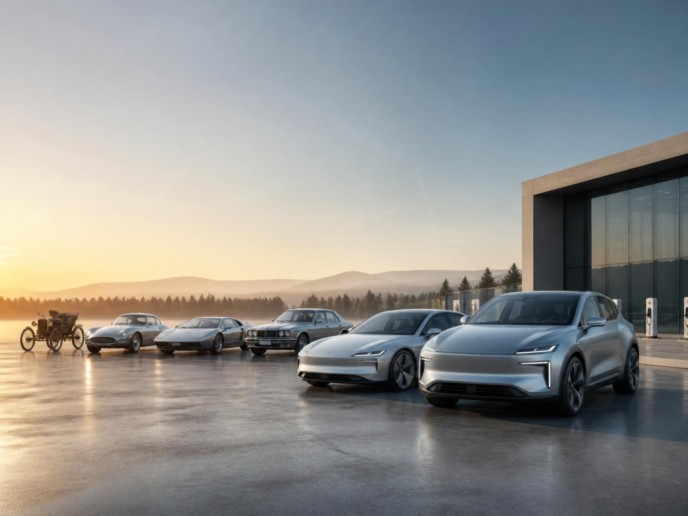
Imagine looking back at 2026 from 2056.
Perhaps some of the cars arriving in Britain today will be regarded as early examples of a brand that eventually became globally important.
A first-generation BYD model might be remembered in the same way we now look at early models from established manufacturers.
The first generation of a Chery, Geely, Omoda, Jaecoo, Zeekr or NIO sold in Britain could eventually become part of that company’s history.
Not necessarily because the cars themselves become collectors’ items.
But because they represent the moment when the brand established itself in a new market.
And that is exactly what happened with so many manufacturers that we now take for granted.
The first Ford sold in Britain was not a piece of automotive heritage at the time.
The first Porsche 356 wasn’t a legendary Porsche.
The first Lamborghini wasn’t a Lamborghini in the sense that we understand the brand today.
They were simply new cars from companies attempting to establish themselves.
Chinese Brands Are Moving Beyond The “Cheap Alternative” Label
One of the most interesting changes is how the conversation around Chinese vehicles has developed.
Early perceptions often focused heavily on price.
But the latest generation of Chinese vehicles is increasingly competing on a much broader combination of factors.
Equipment.
Technology.
Electric range.
Interior quality.
Design.
Warranty provision.
Hybrid powertrains.
Charging capability.
And, importantly, overall value.
CVC’s recent coverage of Chinese Car Brands Reaching 15% Of The UK New Car Market highlights how manufacturers including BYD, Jaecoo, Omoda and Chery are increasing their presence across the UK.
The growth of these brands is also taking place alongside a wider increase in vehicle choice.
For businesses, that means there may be more opportunities to compare vehicles according to their actual requirements rather than automatically selecting from a small group of familiar manufacturers.
The Relationship Between Established And New Manufacturers Is Changing
It is also important to remember that the automotive industry isn’t divided neatly into “old manufacturers” and “new manufacturers”.
Modern automotive groups are incredibly interconnected.
Companies acquire other manufacturers.
Brands share platforms.
Manufacturers share components.
Technology is developed jointly.
Production facilities can be used by different companies.
And established manufacturers can work with newer automotive groups.
The potential relationship between Nissan and Chery in the UK is an interesting example of this changing landscape.
CVC has previously reported on the proposed arrangement that could see Chery vehicles produced at Nissan’s Sunderland manufacturing facility.
If the agreement progresses as proposed, it would represent another significant example of how established and emerging automotive companies are increasingly operating alongside one another.
It demonstrates that the future automotive industry may be defined by collaboration as much as direct competition.
A New Automotive Landscape Is Taking Shape
The rise of newer manufacturers is therefore about much more than a collection of unfamiliar badges appearing on British roads.
It reflects a wider transformation in the automotive industry.
Electric vehicles are changing the technology underneath the car.
Global supply chains are changing where vehicles and components are produced.
Chinese manufacturers are expanding internationally.
Established manufacturers are adapting their businesses.
Consumers have more choice.
Businesses have more choice.
And leasing providers are increasingly helping customers navigate that expanding market.
CVC has also covered the growing role of leasing providers in fleet electrification. Research covered in Leasing Providers Continue To Drive Fleet Electrification found that more than half of surveyed fleet operators said their leasing provider had influenced their decision to move towards electric vehicles.
That reflects an important change in the role of leasing.
It is no longer simply about finding a vehicle and arranging finance.
As the market becomes more complicated, businesses increasingly need help comparing different technologies, manufacturers and operating costs.
What Does It Take To Become A Legendary Car Brand?
Looking back at the history of Ford, Ferrari, Porsche, Lamborghini, Bugatti, Rolls-Royce, Toyota, Honda, BMW, Volkswagen, Hyundai, Kia, Tesla, Aston Martin and McLaren, there isn’t one single formula.
Their stories are completely different.
Ford became closely associated with mass production and making cars accessible to a much wider market.
Ferrari built an identity around racing and performance.
Porsche established itself through engineering and sports cars before expanding into a much broader range of vehicles.
Lamborghini built an unmistakable identity around dramatic high-performance cars.
Rolls-Royce developed a reputation for engineering excellence and luxury.
Bugatti became associated with technical ambition, performance and exclusivity.
Toyota built a global reputation around manufacturing scale, engineering and reliability.
Honda grew from motorcycles and small engines into a global automotive manufacturer.
BMW evolved from an engineering company with aircraft-engine roots into one of the world’s best-known premium car brands.
Volkswagen grew from the concept of a people’s car into a huge global automotive group.
Hyundai and Kia developed from Korean manufacturers into global competitors.
Tesla demonstrated how rapidly a new automotive company could establish a global identity around electric vehicles and technology.
Aston Martin developed a distinctive British luxury sports-car identity.
McLaren turned motorsport heritage into one of the world’s most recognisable high-performance road-car brands.
Their paths were different.
But they all had one thing in common.
They had to start somewhere.
And their earliest cars could not possibly have carried the historical significance that their later models would acquire.
History gave those vehicles their significance.
The Next Generation Is Being Built Now
That is perhaps the most interesting way to look at the automotive market in 2026.
We know the names that have already become legends.
But we are currently watching a new group of manufacturers attempt to establish their own identities.
BYD is expanding internationally.
Chery is growing its UK presence.
Omoda and Jaecoo are becoming increasingly familiar on British roads.
Geely continues to operate on a much larger international scale.
Zeekr is expanding its global ambitions.
NIO continues to develop its electric vehicle proposition.
Li Auto is looking towards international expansion.
Xiaomi has entered the automotive sector from the technology industry.
And other manufacturers are waiting in the wings.
Some of these names may become permanent fixtures in the automotive industry.
Others may evolve, merge, disappear or take completely different directions.
Nobody knows which path each company will ultimately follow.
But that uncertainty is exactly what makes the current automotive landscape so interesting.
The Automotive Industry Has Never Stood Still
There is a temptation to look at established manufacturers and assume that their position is permanent.
History suggests otherwise.
The companies that dominate one generation do not necessarily dominate the next.
Technology changes.
Consumer expectations change.
Regulations change.
Manufacturing changes.
New competitors arrive.
And occasionally, an entirely new approach changes the rules.
That is what makes the current automotive landscape so interesting.
The names we associate with automotive history were once the disruptors, the ambitious newcomers and the companies trying to convince customers that their products deserved a place on the road.
Now, a new generation is attempting to do exactly the same thing.
Whether today’s emerging brands eventually become tomorrow’s automotive legends is something only time will tell.
But perhaps that is the most exciting part.
We aren’t just watching automotive history.
We could be watching the next chapter being written.
 Call our expert team on