Electric vehicle drivers could save hundreds of pounds a year on residential parking permits in some parts of the UK, but the financial benefits vary considerably depending on where they live.
Research examining resident parking permit charges across 66 local authority areas has highlighted significant differences in how councils price permits for electric, petrol and diesel vehicles. While some councils offer substantial discounts for low-emission vehicles, others apply identical charges regardless of fuel type.
For businesses introducing electric company cars, employees who rely on residential parking permits and fleet managers assessing the wider costs of electrification, these differences are worth considering. Businesses considering a change to their company car arrangements should also assess the different business car leasing options available in the UK. Choosing the right vehicle involves more than comparing monthly rentals, particularly when employees face different parking, charging and running costs depending on where they live.
Although leasing costs, electricity prices, vehicle taxation and charging infrastructure remain important parts of the transition, local parking charges can also influence the overall cost of running an electric vehicle.

How Much Can EV Drivers Save On Residential Parking Permits?
Research published by Parking Permit Costs in November 2026 compared the first-year cost of residential parking permits across 66 UK council areas, using a selection of example vehicles.
The findings revealed substantial differences between electric and conventional vehicles in certain locations.
One of the largest differences was identified in Lambeth, London, where an example driver of a diesel Mercedes-Benz G-Class 450d would pay £870.85 for a first-year residential parking permit.
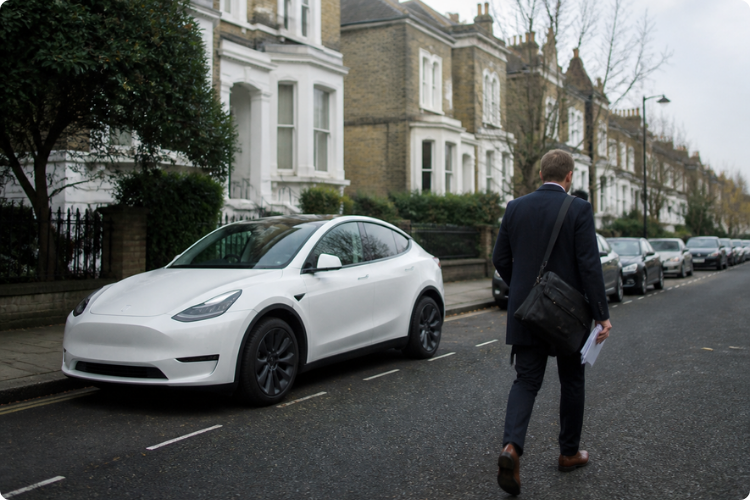
By comparison, a Tesla Model Y driver would pay £135.96.
This represents a potential annual saving of £734.89 for the electric vehicle driver.
However, the research also found that 33 of the 66 councils examined did not offer a difference in parking permit costs between the vehicle types included in the comparison.
In some areas, therefore, switching from a petrol or diesel vehicle to an electric alternative provides no residential parking permit saving at all.
Leeds, Nottingham and Sunderland were also highlighted as examples of councils where residential permits are free, regardless of vehicle fuel type or emissions.
The findings demonstrate why drivers should check their local authority’s parking policy rather than automatically assuming an electric vehicle will qualify for cheaper parking.
Why Do Electric Vehicle Parking Permit Charges Vary?
Residential parking permits are administered by individual local authorities, meaning there is no single national pricing structure for electric vehicles.
Councils can determine their own charging policies, with some using vehicle emissions as the main factor and others considering additional characteristics.
Common approaches include:
- CO2 emissions: Petrol and diesel vehicles with higher emissions may attract more expensive permits, while zero-emission vehicles receive reduced rates.
- Battery capacity: Some councils introduce different permit bands depending on the size of an electric vehicle’s battery.
- Vehicle size and weight: Certain parking policies consider vehicle dimensions or weight when determining charges.
- Standard permit pricing: Other authorities apply the same charge regardless of whether a vehicle uses petrol, diesel, electricity or hybrid technology.
These differences mean that two electric car drivers living in different parts of the country could face very different annual parking expenses.
They also demonstrate how local authority policies can influence the financial attractiveness of switching to an electric vehicle.
Do All Councils Offer Cheaper Parking For Electric Cars?
No. The November 2026 research found that half of the 66 council areas examined offered no difference in permit costs between the example vehicle types.
For drivers living in areas where parking is free or charged at a standard rate, choosing an electric vehicle may not provide any additional financial benefit through residential parking permits.
However, other councils have introduced more detailed pricing structures that favour vehicles with lower emissions.
This is particularly relevant in London, where residential parking policies can vary significantly between boroughs.
Drivers should check the latest permit charges, eligibility requirements and vehicle classifications directly with their local authority before making assumptions about potential savings.
Battery Size Can Affect Electric Vehicle Parking Costs
One of the more unusual findings from the research was that some councils consider battery capacity when calculating residential parking permit charges.
This means that not every electric vehicle necessarily qualifies for the same discounted rate.
Islington provides an example of this approach. Its residential parking permit structure includes different charges depending on the capacity of an electric vehicle’s battery.
The research identified the following first-year permit costs:
| Electric vehicle battery capacity | Annual permit cost |
|---|---|
| 39kWh or smaller | £115.95 |
| 90kWh or larger | £253.35 |
The difference is £137.40 per year.
This approach introduces another consideration for drivers choosing between electric vehicles, particularly where larger batteries are associated with longer driving ranges and higher vehicle prices.
There can also be administrative complications when councils cannot easily establish a vehicle’s official battery capacity.
The research highlighted Tesla Model Y owners in Islington as an example. Because the council had indicated that Tesla did not publish an official battery capacity for the model, some owners were reportedly required to purchase the highest-rate permit initially and provide supporting evidence to seek a refund.
For drivers considering an electric vehicle, it is therefore worth checking how their council classifies individual models before applying for a permit.
What Do Parking Permit Costs Mean For Company Car Drivers?
Residential parking charges are not always included in the headline cost of running a company car.
For employees who take their vehicles home overnight, the availability and cost of local parking can influence the practical benefits of having an electric company car.
This is particularly relevant for businesses operating company car schemes, salary sacrifice arrangements or fleets where employees are responsible for arranging their own residential parking.
For example, an employee living in a borough that offers substantial discounts for electric vehicles could benefit from lower annual parking costs when switching from a petrol or diesel company car.
However, an employee living in an area with standard permit pricing may see no additional saving.
Businesses should consider these differences when reviewing their wider total cost of ownership for business vehicles.
The total cost of running a company vehicle can include:
- Monthly leasing payments.
- Electricity, petrol or diesel.
- Vehicle excise duty.
- Insurance.
- Servicing and maintenance.
- Charging equipment and installation.
- Congestion and clean air zone charges.
- Residential and workplace parking.
- Driver mileage reimbursement.
For organisations managing several company cars or commercial vehicles, these expenses can be harder to monitor individually. Effective fleet management solutions can help businesses maintain oversight of vehicle expenditure, administration and ongoing operational requirements.
Individually, some of these expenses may appear relatively small. However, when multiplied across a fleet, they can become a more significant part of the overall operating budget.
Businesses reviewing their vehicle expenditure should also consider how to take control of rising fleet operating costs and whether their existing fleet arrangements remain suitable.

EV Parking Permits And The Wider Cost Of Electrification
Parking permit savings are only one part of the financial considerations involved in switching to electric vehicles.
Businesses evaluating electric cars and vans need to consider how their vehicles will be used, where they will be parked and how drivers will access charging facilities.
For employees with off-street parking, installing a home charging point may provide access to convenient overnight charging. However, drivers without a driveway may need to rely on public charging infrastructure.
Businesses looking to replace existing petrol and diesel vehicles should also consider the available electric vehicle leasing options for businesses. Vehicle suitability, operating range, charging access and employee circumstances can all influence which electric models are appropriate for a particular fleet.
CVC’s guide to EV charging without a driveway explains some of the considerations for drivers who cannot install a private charger at home.
Charging costs can also vary depending on whether electricity is purchased through a domestic energy tariff, a workplace charging facility or a public charging network.
Our guide to EV charging costs at home and on public networks explores some of the differences businesses and drivers should understand.
For employers reimbursing staff for business mileage in electric vehicles, HMRC’s Advisory Electricity Rate and the wider mileage reimbursement rules are also relevant. CVC’s AER reimbursement calculator can help businesses calculate applicable electric vehicle mileage reimbursement.
These considerations should form part of a wider electrification strategy rather than being assessed in isolation.
Businesses can also review CVC’s guidance to switching to an electric vehicle for further information about the practical and financial implications.
How Clean Air Zones And Emission Policies Affect Vehicle Costs
Residential parking permits are not the only local charges that can influence the cost of running a company vehicle.
Clean Air Zones and other emissions-based charging schemes can also affect businesses operating vehicles in urban areas.
Some locations impose charges on older or more polluting vehicles, while compliant electric vehicles are generally exempt from these emissions-based charges.
However, exemption rules depend on the individual scheme, and drivers should check the requirements before travelling.
CVC’s UK ULEZ and Clean Air Zones guide explains how these schemes operate and what businesses need to consider when operating vehicles in affected areas.
London’s charging arrangements are also changing, making it important for businesses to understand the latest rules. Our article covering London Congestion Charge changes for electric vehicles in 2026 provides further information.
For fleet operators working across multiple towns and cities, these charges should be considered alongside parking, fuel or electricity and other operating expenses.
What Should Businesses Consider Before Leasing Electric Vehicles?
The differences in residential parking permit costs reinforce the importance of looking beyond monthly leasing payments when evaluating electric company cars.
A vehicle that appears financially attractive on paper may involve additional costs depending on where it is driven, parked and charged.
Before introducing electric vehicles into a company fleet, businesses should consider several factors.
1. Where vehicles will be parked
Establish whether employees have access to off-street parking, residential permits or workplace parking facilities. Local authority charges may influence the cost of operating company cars.
2. Access to charging infrastructure
Consider whether employees can charge at home, at the workplace or through public charging networks. Businesses should also assess whether additional charging infrastructure will be required.
3. Vehicle range and battery capacity
Larger batteries may provide additional driving range, but they can also influence vehicle prices and, in some council areas, parking permit charges. The available choice of electric models is also worth considering. Businesses reviewing their company car options can compare some of the best electric cars to lease, taking account of driving range, practicality, equipment and monthly leasing costs.
4. Local emissions restrictions
Businesses operating in urban areas should understand the requirements of ULEZ and Clean Air Zones, particularly when deciding whether to replace existing petrol or diesel vehicles.
5. The total cost of ownership
Comparing these expenses alongside monthly rentals provides a more realistic picture of the total cost of ownership of business vehicles, helping organisations assess whether switching to electric vehicles will deliver the expected financial benefits.
6. Driver circumstances
Company car policies should account for differences between employees. Not every driver will have access to a driveway, private charging or affordable residential parking.
CVC’s company vehicle policy guide provides further guidance on establishing suitable arrangements for employees using company vehicles. Businesses managing multiple vehicles and drivers may also benefit from having centralised access to their fleet information. CVC’s vehicle lease management portal provides an additional resource for managing vehicle arrangements and keeping track of leasing requirements.
Businesses can also consider a broader fleet electrification strategy when planning the replacement of existing petrol and diesel vehicles.
How To Check Your Local Council’s Electric Vehicle Parking Charges
Drivers should always check their local authority’s current residential parking permit requirements before purchasing or leasing an electric vehicle.
The rules can differ between neighbouring boroughs, so relying on general assumptions about EV discounts could lead to unexpected costs.
The following steps can help establish the likely expense:
- Identify the local authority responsible for the residential parking zone.
- Visit its official website and locate the residential parking permit section.
- Check whether fully electric vehicles qualify for discounted rates or exemptions.
- Establish whether battery capacity, vehicle emissions, weight or other specifications affect the permit price.
- Confirm the annual charge, application fee and renewal conditions.
- Check whether the council requires supporting documentation to verify the vehicle’s electric classification or battery capacity.
It is also worth checking whether the permit covers a specific parking zone, whether visitor permits are available and whether additional restrictions apply.
For employees using company-provided vehicles, businesses may need to help establish which vehicle documentation is required to complete the application.
For businesses reviewing their wider vehicle requirements, it is also worth considering whether their existing leasing arrangements remain suitable. CVC provides one-stop fleet solutions for organisations looking to manage their commercial vehicle and fleet requirements through an experienced leasing partner.
Ultimately, the relevant council’s published policy should be treated as the definitive source of information, as charges and eligibility conditions can change.

 Call our expert team on