There was a time—not that long ago—when Plug-in Hybrid Electric Vehicles (PHEVs) were the undisputed sweet spot of the company car world.
Low tax. No range anxiety. Best of both worlds.
Fast forward to 2026, and things feel… different.
Yes, PHEVs are still relevant. But with Benefit-in-Kind (BIK) rates shifting and fully electric vehicles pulling further ahead, the question is no longer “Are PHEVs a no-brainer?”
It’s now:
“Do they still make sense—for you?”
What is a PHEV?
A Plug-in Hybrid Electric Vehicle (PHEV) is a car that combines a traditional petrol engine with an electric motor and a rechargeable battery.
Unlike standard hybrids, a PHEV can be plugged in to charge, allowing it to drive on electric power alone for short distances—typically between 30 and 70 miles depending on the model.
This means for many drivers, everyday journeys such as commuting or school runs can be completed with zero fuel use and zero tailpipe emissions.
How Does a PHEV Work?
A PHEV operates using two power sources:
- Electric motor – used for short trips and low-speed driving
- Petrol engine – takes over for longer journeys or when the battery runs out
The car automatically switches between the two, or combines them when needed for performance.
When the battery is depleted, the vehicle continues to run like a conventional hybrid—so you’re never reliant solely on charging infrastructure.
How Do You Charge a PHEV?
PHEVs can be charged in several ways:
- Home wallbox charger (fastest and most common)
- Standard household plug socket
- Public charging points
Charging typically takes:
- 2–4 hours using a home charger
- Longer via a standard plug
Regular charging is key to getting the most benefit from a PHEV.
What Are the Benefits of a PHEV?
- Lower fuel costs when driven in electric mode
- Reduced emissions compared to petrol or diesel cars
- Lower Benefit-in-Kind (BIK) tax for company car drivers
- No range anxiety thanks to the petrol engine backup
Are There Any Downsides?
- Higher upfront cost than petrol vehicles
- Real savings depend on how often you charge
- Less tax-efficient than fully electric vehicles
- Heavier due to dual powertrain
Who Should Consider a PHEV?
PHEVs are ideal for drivers who:
- Can charge regularly at home or work
- Drive short distances during the week
- Still need flexibility for longer journeys
They are often seen as a stepping stone between petrol cars and fully electric vehicles, offering a balance between efficiency and practicality.
Now that we understand how PHEVs work, let’s look at how they’re taxed in 2026/27—and where the real costs begin.
The 2026/27 BIK Reality
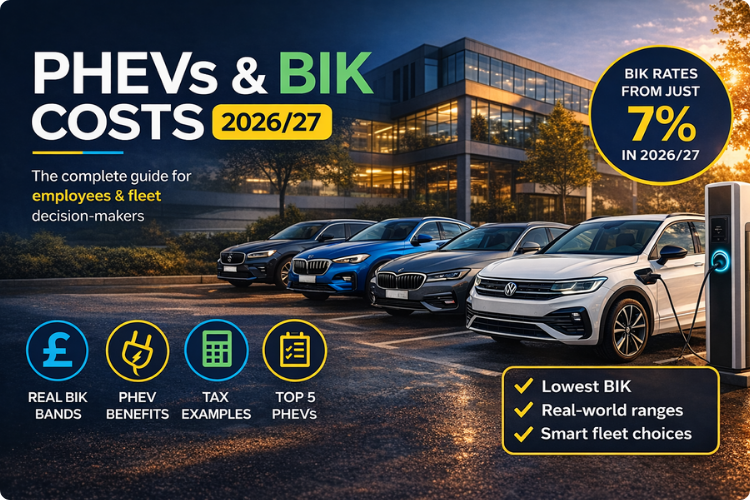
For the 2026/27 tax year, PHEVs (cars emitting 1–50g/km CO₂) are taxed based heavily on their electric-only range:
- 70–129 miles → 7% BIK
- 40–69 miles → 10% BIK
- 30–39 miles → 14% BIK
- <30 miles → 16% BIK
At the extreme top end:
- 130+ miles → 4% BIK (rare, but emerging)
For context:
- Fully electric vehicles → 4% BIK
- Petrol/diesel → often 25%–37%+
Translation:
PHEVs are no longer competing with petrol cars. They’re competing with EVs—and that’s a much tougher fight.
Why the Government Is Tightening the Rules
This shift isn’t accidental.
The UK government is:
- Pushing toward net-zero emissions targets
- Incentivising zero-emission vehicles (EVs)
- Gradually phasing out reliance on hybrid technology
PHEVs were always intended as a bridge technology—and that bridge is slowly narrowing.
Electric Range: The Metric That Now Defines Everything
A few years ago, an electric range was a “nice-to-have”.
In 2026, it directly determines:
- Your tax rate
- Your real-world fuel costs
- Your overall value from the vehicle
A 25-mile PHEV and a 70-mile PHEV are fundamentally different financial decisions.
This is why newer models have become dramatically more competitive—manufacturers have focused heavily on increasing battery capacity to stay within favourable BIK bands.
The Real-World Usage Gap (And Why It Matters)
Here’s where theory and reality often diverge.
On paper:
- PHEVs look efficient
- Emissions are low
- BIK is attractive
In reality:
- Many drivers rarely charge
- Petrol usage dominates
- Efficiency drops significantly
This creates a “performance gap” between expected savings and actual costs
A PHEV that isn’t plugged in regularly:
- Uses more fuel than expected
- Delivers fewer environmental benefits
- Reduces the value of its tax advantages
Total Cost of Ownership: The Bigger Picture
BIK is only part of the story.
To properly evaluate a PHEV, you need to consider:
1. Fuel vs Electricity Costs
- Regular charging = significant fuel savings
- No charging = costs similar to petrol vehicles
2. Maintenance
- Potentially lower brake wear (regenerative braking)
- But more complex systems (engine + battery)
3. Residual Values
- Strong for newer, high-range PHEVs
- Weaker for older, low-range models
Real Cost Comparison: It Adds Up Fast
Scenario:
£50,000 company car, 20% taxpayer
High-range PHEV (7% BIK):
- Taxable value: £3,500
- Annual tax: £700
Low-range PHEV (16% BIK):
- Taxable value: £8,000
- Annual tax: £1,600
Fully electric (4% BIK):
- Taxable value: £2,000
- Annual tax: £400
Choosing the wrong PHEV can cost you £900+ per year
Top 5 PHEVs for Lowest BIK in 2026
Not all PHEVs are equal anymore. These models deliver the strongest balance of electric range and tax efficiency:
BMW 530e
- Electric range: ~60–65 miles
- BIK: ~10%
Volkswagen Tiguan eHybrid
- Electric range: ~70–75 miles
- BIK: ~7-10%
Škoda Superb iV
- Electric range: ~60–70 miles
- BIK: ~7-10%
Ford Kuga PHEV
- Electric range: ~40-45 miles
- BIK: ~10-14%
Volvo XC90 Recharge
- Electric range: ~60+ miles
- BIK: ~7-10%
Key takeaway:
70+ miles of electric range is now the sweet spot.
PHEV vs EV: The Decision Is Getting Harder
This is the real comparison in 2026.
| Factor | PHEV | EV |
|---|---|---|
| BIK (2026/27) | 7% – 16% | 4% |
| Electric Range | 30 – 70+ miles | 200 – 400+ miles |
| Total Range | Unlimited (petrol backup) | Limited to battery |
| Charging Dependency | Moderate | High |
| Running Costs | Variable (depends on charging) | Typically lower |
| Fuel Costs | Lower if charged regularly | None |
| Flexibility | High | Medium |
| Best For | Mixed driving | Fully electric driving |
👉 EVs win on tax and simplicity
👉 PHEVs win on flexibility
For Fleet Decision-Makers: It’s About Strategy
PHEVs are now a targeted tool, not a default choice.
Where They Still Work:
- Drivers without home charging
- Mixed-use, high-mileage roles
- Transitional fleet strategies
The Biggest Hidden Risk:
Drivers not charging vehicles
This leads to:
- Increased fuel costs
- Missed ESG targets
- Reduced cost efficiency
Best Practice in 2026:
- Limit PHEVs to high-range models only
- Implement charging policies
- Prioritise EV adoption where possible
For Employees: It’s About Monthly Cost
Your focus should be simple:
What will this actually cost me?
Key Factors:
- BIK rate
- Tax bracket
- Charging access
Simple Decision Guide:
- Charge regularly → PHEV viable
- Want the lowest tax → EV wins
- No charging access → PHEV safer

The Future Outlook: Where Are PHEVs Heading?
Looking ahead, several trends are clear:
- EV BIK will remain low (though gradually rising)
- PHEV advantages will continue to shrink
- Electric ranges will continue increasing
- Fleet policies will become stricter
PHEVs are unlikely to disappear—but they will become more niche
The Bottom Line
PHEVs have evolved.
They’re no longer:
- The default option
- The cheapest solution
- The obvious choice
But they are:
A smart, flexible option—when chosen carefully
Business Contract Hire vs Finance Lease agreements
For UK limited companies, Business Contract Hire (BCH) and Finance Lease are the most popular options:
- Business Contract Hire – Fixed monthly payments; return the van at the end of the contract with no further obligations.
- Finance Lease – Lower monthly payments; at the end of the term, you sell the vehicle to a third party and use the proceeds to pay the balloon payment. If the vehicle sells for more than the balloon payment, your business keeps the difference.
Both options allow your company to drive a new van without ownership, but the key difference is the handling at the end of the lease.
Explore our extensive range of electric cars and vans available for lease.
Speak to our team today to find the right solution for your needs and see how Commercial Vehicle Contracts can drive your business forward.

 Call our expert team on