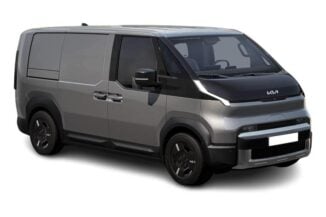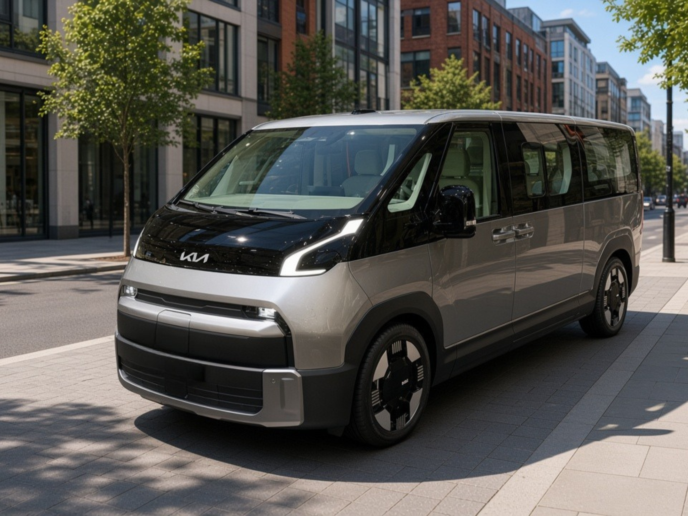
Kia has unveiled the passenger version of its new all-electric PV7, offering a flexible interior that can accommodate up to nine people in most markets and as many as 11 in South Korea.
Revealed alongside the Cargo model at IAA Transportation 2026 in Hanover, the Kia PV7 Passenger is being developed as part of the wider Kia PV7 electric van range, with applications including shuttle services, tourism, rental operations, crew transport and private passenger use.
The new model is scheduled to arrive in Europe during the second half of 2027, adding a larger passenger vehicle to Kia’s growing electric commercial vehicle range.
How Many Seats Does The Kia PV7 Passenger Have?
The Kia PV7 Passenger will be offered with different seating arrangements, allowing the vehicle to be adapted to different passenger and luggage requirements.
Seven-, nine- and 11-seat configurations are planned globally, although the 11-seat version will be restricted to Kia’s home market of South Korea. European buyers are therefore expected to have access to seven- and nine-seat versions.
The seven-seat model uses Kia’s Long-Rail Easy Remove Seat System, allowing individual seats to be moved along rails or removed entirely. This gives operators greater freedom to alter the interior depending on whether they need additional passenger capacity or more room for luggage and equipment.
The nine-seat version will also be available in different configurations, including layouts with or without a fourth row.
This flexibility could make the PV7 Passenger particularly suitable for operators looking for an alternative to traditional minibus vans, with the ability to adapt the cabin to different passenger transport requirements.
Kia PV7 Passenger Dimensions
The first PV7 Passenger model revealed by Kia is the Passenger Long, which measures more than five metres in length.
Its preliminary dimensions are:
| Specification | Kia PV7 Passenger Long |
|---|---|
| Length | 5,350mm |
| Width | 1,995mm |
| Height | 1,990mm |
| Wheelbase | 3,500mm |
The PV7 Passenger Long shares its main dimensions with the Cargo Long, while Kia’s wider passenger range is also set to include a Compact version.
The vehicle is built around Kia’s dedicated E-GMP.S electric platform, which has been developed specifically for its purpose-built vehicle range.
One of the advantages of this architecture is the flat floor, which allows Kia to make better use of the available interior space while providing greater freedom when developing different seating layouts and vehicle derivatives.
Kia’s wider PV7 programme is expected to extend well beyond the Passenger and Cargo models, with the company planning a 23-variant PV7 family covering Cargo, Passenger, Chassis Cab and converted vehicles. The Passenger range will include Compact and Long versions, while the Chassis Cab will provide a basis for more specialist applications. Kia’s Flexible Body System has been designed to support different body styles and conversions around its E-GMP.S architecture. The approach follows the wider Kia PBV strategy already seen with the Kia PV5 Cargo Standard Range 52kWh, which gives businesses an existing smaller electric cargo van option.
The Kia PV5 Chassis Cab provides an earlier example of how Kia’s PBV approach can be used as a foundation for specialist vehicle applications. This flexible approach could also make the PV7 relevant to businesses considering commercial vehicle conversions for more specialist requirements.
More Premium Interior For Kia PV7 Passenger
Although the PV7 Passenger shares its basic platform and architecture with the Cargo version, Kia has designed the passenger model with a greater emphasis on comfort and convenience.
The cabin can be specified with ambient lighting, enclosed storage and a centre console that can be converted into a table when the vehicle is stationary.
Rear passengers will also benefit from dedicated climate control, while power-operated sliding doors are available to make boarding and exiting easier.
This could be particularly useful for vehicles used on shuttle routes or other applications where passengers are regularly getting in and out of the vehicle.
Kia has also incorporated 100W USB-C charging connections, allowing passengers to charge compatible devices while travelling.
The company has made changes to the cabin layout to maximise usable storage space. The front passenger airbag has been positioned in the roof rather than the dashboard, creating additional room for storage in the front of the cabin.
Kia PV7 Gets New Pleos Connect System
The front of the PV7 Passenger features a technology-focused dashboard with 12.9-inch and 14.6-inch displays.
The vehicle uses Kia’s new Pleos Connect system, which is based on Android Automotive OS.
The system is designed to provide connected navigation, configurable displays and over-the-air software updates. Kia also plans to provide an integrated app marketplace containing both Kia and third-party applications.
The PV7 Passenger will also feature Gleo AI, an artificial intelligence-powered voice assistant.
Gleo AI is designed to allow drivers to use natural-language commands to control functions such as navigation, messaging and vehicle settings.
This technology forms part of Kia’s wider approach to its PBV range, with the company looking to combine electric powertrains with software and flexible vehicle configurations.
What Battery Does The Kia PV7 Passenger Use?
The Kia PV7 Passenger will share the PV7 Cargo’s two battery options.
Buyers will be offered 71.5kWh and 96.2kWh battery packs, giving operators a choice depending on their range and operating requirements.
The electric motor produces up to 200kW of power and 420Nm of torque, with the initial version driving the front wheels.
Kia has also confirmed that an all-wheel-drive version of the PV7 is planned for a later date.
The larger battery option is expected to provide the longest range, although Kia has yet to confirm the final European range figures specifically for the Passenger versions.
For comparison, Kia is targeting more than 460km of WLTP range for the long-range PV7 Cargo Long, equivalent to more than 285 miles.
800V Charging For The Kia PV7
One of the PV7’s key technical features is its 800V electrical architecture.
This allows the electric van to support very rapid DC charging, with Kia targeting a 10-80% charge in the mid-20-minute range when using a 350kW charger.
The final charging performance will depend on the production specification and charging conditions, with Kia stating that the figure remains subject to confirmation.
The rapid-charging capability could be particularly important for passenger operators, where vehicles may be required to complete several journeys throughout the day with limited time available for charging.
For businesses considering switching to an electric vehicle, charging speed is becoming an increasingly important consideration alongside battery capacity and driving range.
Kia PV7 Passenger Designed For Multiple Uses
The flexibility of the PV7 Passenger means Kia is targeting considerably more than one type of customer.
The vehicle could be used for airport and hotel shuttle services, tourism, crew transport, rental operations and private passenger transport, with the different seating layouts allowing operators to prioritise either passenger capacity or additional interior space. Kia’s smaller PV5 Passenger already provides an electric passenger vehicle option, including the Kia PV5 Passenger Long Range 71kWh, giving businesses an existing Kia alternative while they wait for the larger PV7 Passenger to arrive.
The removable and adjustable seating system should also make the PV7 more adaptable than a conventional fixed-seat passenger vehicle.
The availability of seven- and nine-seat versions in Europe could also give businesses another option when looking at minibus leasing for transporting employees, customers or other groups.
Kia PV7 Passenger To Arrive In Europe In 2027
Kia is expected to launch the PV7 Passenger in Europe during the second half of 2027. The PV7 will also form part of a wider Kia PBV line-up, with the smaller PV5 already available and the larger PV9 planned for 2029. Kia is targeting annual global PBV sales of 232,000 units by 2030 as it expands its dedicated electric commercial vehicle range.
Further UK-specific information, including final seating configurations, battery range, pricing and exact specifications, is expected to be announced closer to the vehicle’s launch.
 Call our expert team on