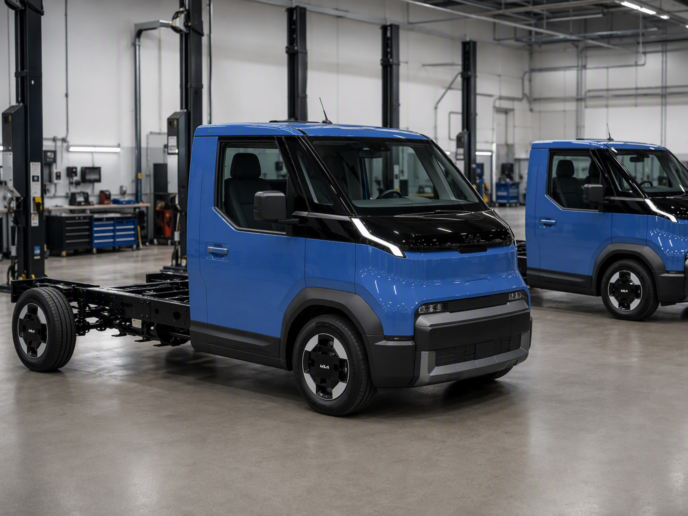
Kia is continuing to expand its electric commercial vehicle ambitions with the PV5 Chassis Cab, a flexible new platform designed for businesses that need something more than a conventional panel van.
First unveiled at the 2025 Solutrans commercial vehicle show in France, the Kia PV5 has since progressed into Kia’s wider PBV strategy, with the manufacturer demonstrating a growing range of specialist conversion possibilities. However, for UK businesses, one important point remains: the PV5 Chassis Cab is not yet available for sale in the UK, and final UK specifications are still subject to confirmation.
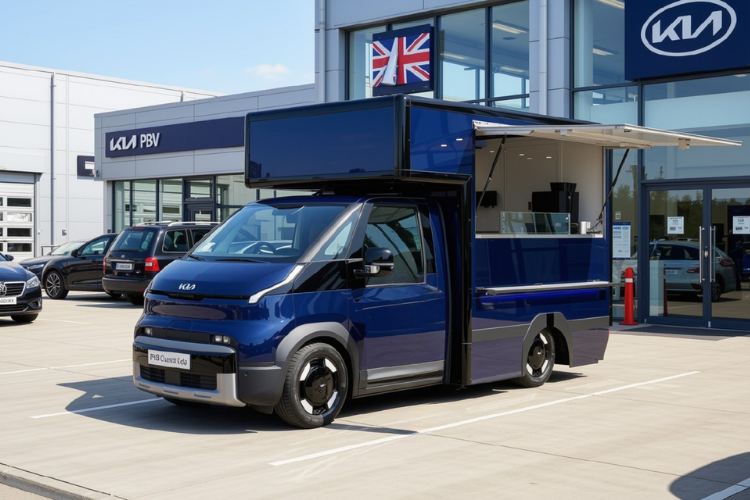
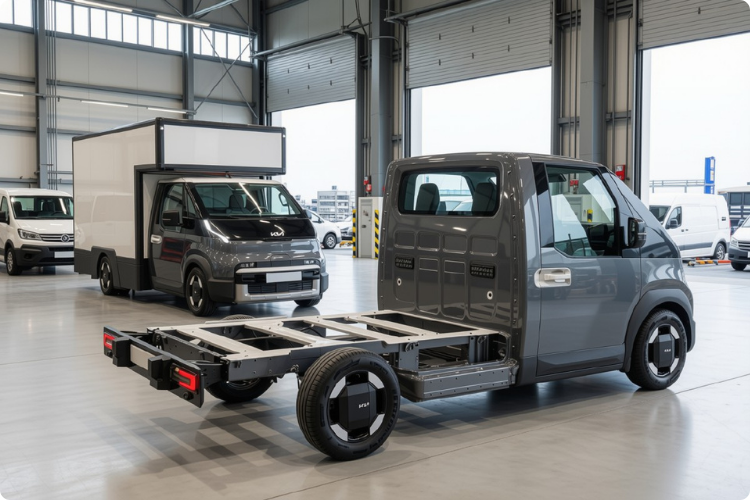
Unlike a conventional panel van, the Chassis Cab provides a flexible base for commercial vehicle conversions, allowing it to be adapted for different applications. Kia’s current conversion programme includes options such as box bodies, refrigerated vehicles, mobile workshops and tippers, with the manufacturer working alongside approved conversion partners.
A Versatile Platform For Business Use
The PV5 Chassis Cab has been developed around the idea of adaptability. Rather than providing businesses with one fixed body style, Kia supplies the vehicle as a factory-built chassis cab that can be configured for a range of specialist applications.
Kia’s current conversion programme covers applications including:
- Dropside bodies
- Box bodies
- Refrigerated vehicles
- Mobile workshops
- Tippers
- Specialist service vehicles
The manufacturer has already demonstrated how the platform can be adapted for different sectors. At the 2026 Commercial Vehicle Show in Birmingham, Kia displayed a PV5 Chassis converted into a tipper alongside a PV5 Cargo converted into a refrigerated van. Both were developed through Kia’s PBV Approved Converter network.
The underlying dimensions are also interesting for businesses operating in urban areas. Kia describes the PV5 Chassis Cab as a sub-five-metre vehicle, while its European specification provides up to 8.0m³ of cargo space depending on the conversion. The current published payload figure is up to 1,005kg, although businesses should always consider how their chosen body and equipment will affect the vehicle’s usable payload. Understanding van payload is particularly important when choosing a specialist commercial vehicle, as exceeding the permitted limit can create safety and compliance issues.
That combination could make the PV5 particularly useful for businesses that need a specialist body but don’t necessarily want to move into a larger commercial vehicle.
Electric Powertrain And Battery
The PV5 Chassis Cab is based on Kia’s dedicated E-GMP.S electric commercial vehicle platform, rather than being an electric version of an existing diesel van.
Kia’s current Chassis Cab information lists a 51.5kWh battery and a payload of up to 1,005kg. The manufacturer continues to state that technical specifications are subject to further development and homologation, meaning final UK production specifications could still change.
This is an important distinction when looking at the PV5 Chassis Cab in 2026. The larger 71.2kWh battery is available within the wider Kia PV5 Cargo range, but Kia has not yet published a confirmed UK Chassis Cab range figure based on that battery. The current Chassis Cab information states that its WLTP range is still pending official homologation. For businesses considering a switch to electric commercial vehicles, electric vehicle charging infrastructure will also be an important part of assessing whether a vehicle is suitable for day-to-day operations.
As a result, it would be misleading to apply the PV5 Cargo’s maximum range directly to the Chassis Cab.
The eventual range of a converted Chassis Cab will also depend on the body fitted, payload, weight and aerodynamics. A refrigerated body, box body or other specialist conversion could therefore produce a different real-world range from the standard PV5 Cargo.
Businesses comparing the wider electric van market can also see how the standard PV5 Cargo compares with the Volkswagen ID. Buzz in our Volkswagen ID. Buzz vs Kia PV5 electric van comparison.
A Smaller Alternative To Traditional Chassis Cabs
One of the most interesting aspects of the PV5 Chassis Cab is its size.
Traditional chassis cab vans are often based on larger commercial vehicle platforms, particularly in the medium-van sector. Kia is taking a different approach by offering a compact, sub-five-metre chassis cab that can still support larger-volume specialist conversions.
That could make the PV5 attractive to businesses that need a dedicated commercial vehicle but don’t require the dimensions of a larger van, particularly those considering small electric vans for urban operations.
For businesses working in towns and cities, the smaller footprint could also be useful. Kia quotes a 5.5-metre turning radius, helping the vehicle retain a degree of manoeuvrability that could be beneficial for urban deliveries, service work and specialist trades.
The real question for businesses will be whether the PV5 can provide enough payload, range and body capacity for their particular operation.
For some operators, the compact dimensions could be a major advantage. For others, particularly businesses carrying heavier equipment or requiring a larger conversion, a traditional medium or large van may remain the better fit.
Kia Is Building Its Commercial Vehicle Presence In The UK
The PV5 represents a major change for Kia, which has traditionally been associated with passenger cars rather than vans.
Kia entered the UK commercial vehicle market with the PV5 Cargo and established a dedicated PBV dealer network to support commercial customers. According to Kia, its UK network includes 63 dedicated PBV centres, providing sales, servicing and commercial vehicle support.
That dealer infrastructure could be important as Kia attempts to establish itself in the competitive UK van market.
For smaller businesses and SMEs, access to local commercial vehicle support can be just as important as the vehicle itself. A van is often an essential part of day-to-day operations, so servicing, maintenance and aftersales support all form part of the overall ownership or leasing decision.
Kia’s PBV strategy is also designed to appeal to a wide range of commercial users, from larger fleets to smaller businesses such as tradespeople, retailers and delivery operators.
Specialist Conversions Are A Major Part Of The PV5 Strategy
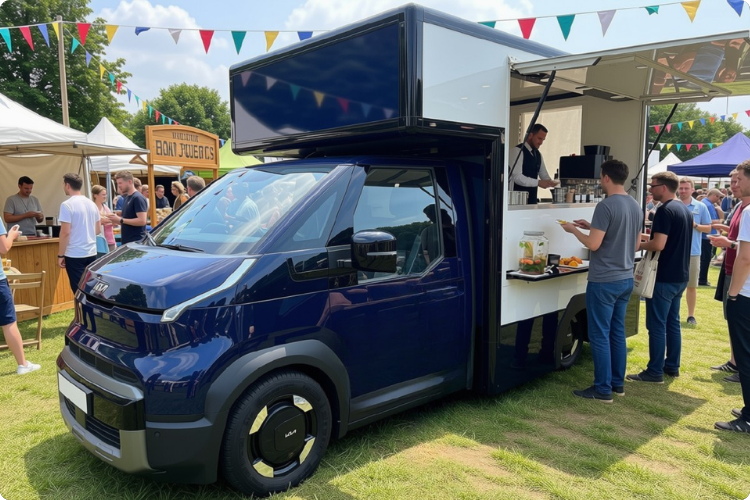
The biggest selling point of the PV5 Chassis Cab may ultimately be its ability to become different types of commercial vehicles.
The wider van conversion market is increasingly focused on creating vehicles around specific business requirements rather than relying solely on standard factory body styles.
Kia’s current conversion programme includes refrigerated vans, mobile workshops, specialist service vehicles, box bodies and tippers. The company is also working with approved European conversion partners to develop and support these applications.
This gives the PV5 potential beyond the traditional delivery van market.
A business could potentially use the platform as a refrigerated vehicle for temperature-controlled deliveries, a tipper for certain construction or municipal applications, a mobile workshop for engineering and maintenance work, or a box van for parcel and distribution operations.
Kia has also emphasised that approved conversions are supported by its warranty and conversion partner network, providing a more integrated route to specialist vehicle configuration.
For businesses considering an electric van lease, this flexibility could be particularly important. The ability to select a body around the job rather than adapting the business around a standard panel van could make electric commercial vehicles suitable for a broader range of applications.
Pricing And Leasing Potential
The PV5 has attracted attention partly because Kia has positioned its electric commercial vehicle offering competitively.
However, it is important not to apply existing PV5 Cargo pricing directly to the Chassis Cab. Kia has not yet confirmed final UK pricing for the PV5 Chassis Cab, and the vehicle is not currently available for sale in the UK.
For businesses looking at future van leasing options, pricing will therefore be an important factor to watch.
The overall cost of running an electric commercial vehicle involves more than the monthly lease payment. Businesses may also consider electricity costs, maintenance, tax treatment, charging requirements and the vehicle’s suitability for their daily mileage and payload requirements.
Once Kia confirms UK availability, specification and pricing for the Chassis Cab, it will be much easier to assess how competitive it is against other electric chassis cab and specialist commercial vehicle options.
What About The Kia PV7 And PV9?
The PV5 is only the first stage of Kia’s wider Platform Beyond Vehicle (PBV) commercial vehicle strategy. The wider PV5 line-up already extends beyond the Cargo van, with the Kia PV5 Passenger offering a longer-range 71.2kWh option for passenger-focused applications.
Kia’s plans continue to include the larger PV7 in 2027 and the PV9 in 2029, extending the company’s electric commercial vehicle line-up into larger vehicle segments.
The PV7 is expected to move Kia into the larger electric van market, providing significantly more space than the PV5. The PV9 will follow as an even larger PBV, giving Kia a broader presence across the commercial vehicle sector.
These vehicles remain part of Kia’s longer-term PBV strategy, with the company aiming to build a range that can cover different business requirements rather than relying on a single electric van.
For UK businesses, the arrival of the PV7 and PV9 could eventually give Kia a much broader commercial vehicle offering, particularly for operators that need more capacity than the PV5 can provide.
Could The PV5 Chassis Cab Be Right For Your Business?
The PV5 Chassis Cab is an interesting proposition because it doesn’t simply attempt to replace a conventional panel van.
Instead, Kia is offering a compact electric platform that can be adapted around different commercial requirements.
Its up to 1,005kg payload, potential for up to 8m³ of cargo space, dedicated electric platform and wide range of conversion possibilities give it the potential to serve businesses across several sectors. However, final specifications and WLTP range figures for the Chassis Cab remain subject to homologation, while UK availability has yet to be confirmed.
For businesses that need a specialist vehicle, this flexibility could be one of the PV5’s biggest advantages. Rather than choosing a larger van simply because it is the easiest platform to convert, operators could have a more compact electric alternative designed specifically around their requirements.
 Call our expert team on