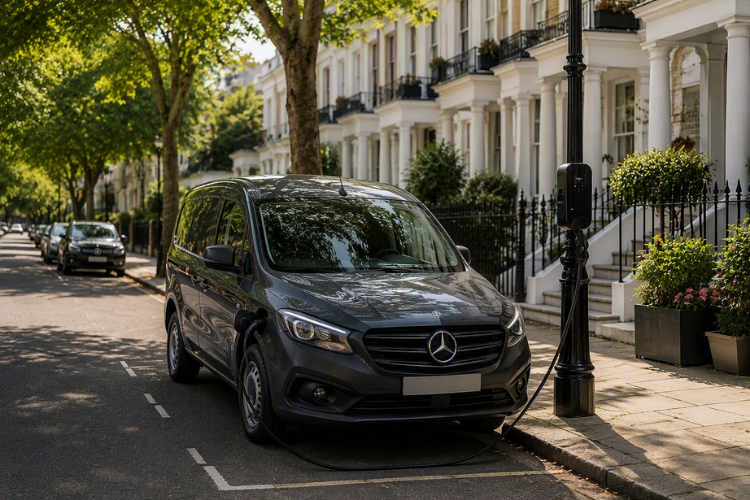
The UK’s public electric vehicle charging network continues to expand, with more councils now providing on-street charging despite significant regional differences across the country.
New research from Vauxhall highlights the progress being made since 2023, while also showing that there is still work to do to ensure drivers without access to private parking can conveniently charge an electric vehicle close to home.
The research, based on a Freedom of Information request covering 414 local authorities, found that more than 90% of UK councils now have at least one public EV charger within their area.
While around half of councils still do not currently provide on-street charging, the proportion offering this type of infrastructure has increased significantly over the past three years.
In 2023, just 31% of councils provided on-street charging. That figure has now risen to 39%, while the proportion with no on-street provision has fallen from 66% to 50%.
For businesses considering the switch to electric vehicles, the continued expansion of public infrastructure is an encouraging sign.
Key UK EV Charging Figures
| Key EV Charging Figure | Latest Position |
|---|---|
| Councils with at least one public charger | More than 90% |
| Councils offering on-street charging | 39% |
| Councils with no on-street charging | 50% |
| Councils with on-street charging in 2023 | 31% |
| Councils installing on-street chargers in 2025 | 78 |
| Councils with a residential charging strategy | 32% |
| Councils with a dedicated EV charging policy officer | 46% |
| Public charging points across the UK | 122,000+ |
| Public charging points added since the end of 2023 | 50,000+ |
| Streets registered for on-street charging demand | 13,000+ |
The figures show that while gaps remain, the overall charging infrastructure is moving in the right direction.
More On-Street Chargers Are Being Installed
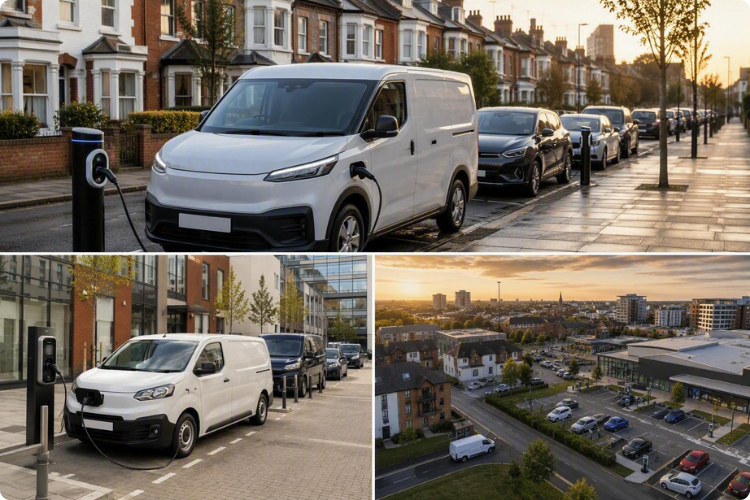
The growth in on-street charging has accelerated in recent years, with 78 councils installing at least one on-street charger during 2025.
The research also found that 32% of councils now have a published strategy covering residential on-street charging, demonstrating that local authorities are increasingly planning for the needs of EV drivers.
There has also been an increase in specialist expertise within councils.
Around 46% now employ a dedicated EV charging policy officer, compared with 31% in 2023.
Having dedicated staff and formal charging strategies should help councils identify areas where additional infrastructure is required and support further expansion of the public network.
For company car and van drivers, this is particularly important where vehicles are regularly taken home but the driver does not have access to a driveway or private parking space.
Public Charging Network Passes 122,000 Points
The wider UK charging network has also experienced substantial growth.
According to Zapmap figures referenced by Vauxhall, more than 50,000 public charging points have been added since the end of 2023, taking the total number of public charge points across the UK to more than 122,000.
On-street chargers now account for around 32% of the country’s public charging network.
They also represented more than 55% of new public charging installations during 2025, highlighting the increasing importance of charging infrastructure located within residential areas.
This is particularly relevant for EV drivers who cannot rely on home charging, making reliable electric vehicle charging infrastructure increasingly important for businesses and their drivers. particularly relevant for EV drivers who cannot rely on home charging.
Significant Regional Differences Remain
Despite the overall progress, charging infrastructure remains unevenly distributed across the UK.
More than 70% of the on-street chargers installed across the country by the end of 2025 were located in London, highlighting the substantial regional differences that remain.
This means that businesses operating electric fleets across different parts of the UK can still experience very different levels of charging availability.
However, the continued investment from councils and charging providers provides an increasingly positive outlook for businesses planning their transition to electric vehicles.
Demand For Residential Charging Continues To Grow
Vauxhall’s Electric Streets of Britain campaign has also provided an indication of where drivers want additional charging infrastructure.
Since launching in 2023, the initiative has received registrations from more than 13,000 streets where residents have identified a need for on-street EV charging.
The information has subsequently been shared with Vauxhall’s Electric Streets of Britain partners, including char.gy, Connected Kerb and Kerbo Charge, to help inform their installation strategies and improve charging access in areas where it is most needed.
The aim is to help identify where demand exists and support the installation of charging infrastructure in locations where it could have the greatest impact.
Coventry provides one example of how this approach can translate into new infrastructure.
The city currently has more than 1,856 public charging sockets, serving more than 9,000 registered users. Vauxhall says more than 900 Connected Kerb sockets have been installed within a 15-minute walk of postcodes registered through the Electric Streets programme.
A Positive Sign For Businesses Moving To Electric
For businesses considering electric vans, the expansion of public charging infrastructure is an important part of the wider transition towards lower-emission transport.
Home charging remains one of the most convenient options for drivers who have suitable off-street parking. However, not every employee or business driver has access to a driveway or dedicated charging facility.
The growing number of public and on-street chargers therefore gives businesses greater flexibility when considering an electric vehicle for their fleet.
This is particularly relevant for companies using electric vans that are taken home overnight, as drivers can increasingly access charging away from their workplace when private charging is not available.
At Commercial Vehicle Contracts, the continued expansion of the UK’s charging infrastructure provides further encouragement for businesses considering electric vans.
As more charging points are installed and councils become better equipped to plan local infrastructure, the practical case for electric vans continues to strengthen.
For businesses looking at their next vehicle, this means electric vans are becoming an increasingly realistic option for a wider range of operations, particularly as charging infrastructure continues to improve.
 Call our expert team on