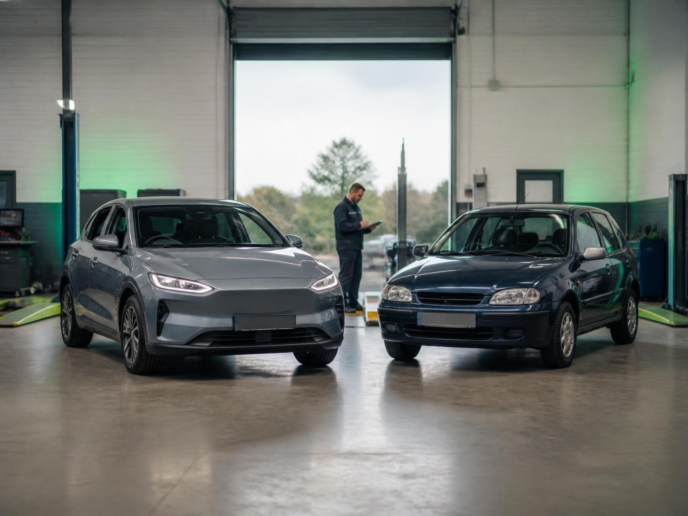
Electric cars with high mileage could be proving more durable than their petrol counterparts, with new research showing that the gap in MOT failure rates widens significantly as vehicles accumulate miles.
An analysis of 47.4 million MOT tests commissioned by the British Vehicle Rental and Leasing Association (BVRLA) and carried out by New AutoMotive has examined how petrol and battery electric vehicles (BEVs) perform as they get older and cover more miles.
The findings challenge the long-standing assumption that a car with a high mileage should automatically be considered less reliable.
While there is relatively little difference between electric and petrol cars at lower mileages, the research found that the MOT failure rate for electric vehicles begins to level off at around 60,000 miles. Petrol cars, meanwhile, continue to see their failure rate increase as mileage rises.
For buyers considering a used electric car, the results could provide further reassurance that a high odometer reading does not necessarily mean an EV is approaching the end of its useful life.
Electric Cars Pull Ahead As Mileage Increases
At lower mileages, the difference between petrol and electric cars is relatively small.
Between 20,000 and 40,000 miles, around 12% of battery electric vehicles failed their MOT, compared with 11.7% of petrol cars.
However, the picture begins to change as mileage increases.
Once electric vehicles reach around 60,000 miles, their MOT failure rate begins to flatten out at approximately 16%. Petrol cars continue to experience increasing failure rates as mileage rises.
The difference becomes particularly noticeable among vehicles aged between three and eight years.
For cars that had covered between 90,000 and 120,000 miles, 16.5% of electric vehicles failed their MOT compared with 22.2% of petrol cars.
That means the electric vehicles in this particular age and mileage group were around a quarter less likely to fail their MOT than their petrol equivalents.
Above 120,000 miles, the difference became even wider.
The failure rate for electric cars remained around 16%, while the rate for petrol cars increased to approximately 23.5%.
This is significant because mileage has traditionally been one of the first things used to judge the condition and potential longevity of a used vehicle.
The research suggests that this approach may not necessarily work in the same way for electric cars.
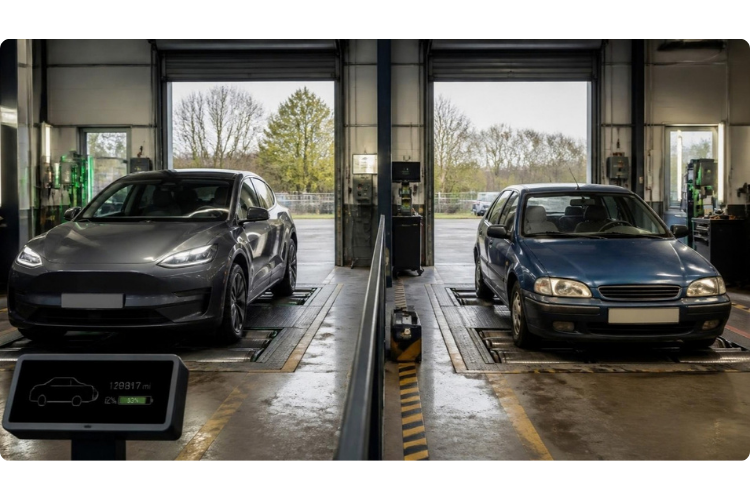
Why Could High-Mileage EVs Be Holding Up So Well?
One possible explanation is the mechanical simplicity of an electric drivetrain.
A conventional petrol car contains an engine with numerous moving components, along with systems such as an exhaust, gearbox and other mechanical components that can experience wear over time.
An electric vehicle has a fundamentally different powertrain.
Although EVs still contain suspension, steering, brakes, tyres and other components that require maintenance, the electric drivetrain itself has fewer mechanical parts that are subject to traditional wear.
This is also reflected in the maintenance requirements of EVs. Electric vehicles generally require less routine maintenance than petrol and diesel models, although they still need regular inspections and servicing. CVC’s guide to vehicle maintenance explains what is involved in keeping a leased vehicle serviced, roadworthy and properly maintained.
The MOT results appear to reflect some of these differences.
The research found that, once age and mileage were taken into account, the failure rate of electric vehicles did not continue rising at the same rate as petrol cars.
This does not mean that every high-mileage EV will be in better condition than every petrol car. Vehicle history, maintenance, driving conditions and individual component wear will all remain important.
However, the data suggests that 80,000 or 100,000 miles on an electric car should not automatically be interpreted as a sign that the vehicle is nearing the end of its life.
That could become increasingly relevant as more electric vehicles move from company and leasing fleets into the used-car market.
Older Electric Cars Are Not Simply Being Used Less
One possible explanation for the results could have been that older electric cars are being retained as low-mileage second vehicles.
The research does not appear to support that theory.
Electric vehicles recorded a higher median annual mileage than petrol cars at every age examined between four and 16 years.
At 12 years old, for example, an electric car covered a median of approximately 4,920 miles per year, compared with around 4,410 miles for a petrol vehicle.
This is important because simply looking at overall MOT failure figures could produce a misleading comparison.
The UK electric car fleet is considerably younger than the petrol fleet, while electric vehicles have also tended to accumulate different mileage patterns.
By comparing vehicles according to both their age and mileage, the researchers were able to establish a clearer picture of how the different powertrains perform as they get older.
The results show that the advantage for electric vehicles becomes increasingly apparent at higher mileage.
What About Electric Vehicle Tyres?
The research did not show that electric cars outperform petrol vehicles in every individual area.
Tyres were one notable exception.
Across the data analysed, battery electric vehicles recorded approximately 1.8 times as many tyre defects as petrol cars.
This appears to be particularly relevant to some earlier electric vehicles that were based on platforms originally developed for internal combustion engines.
The additional weight associated with some EVs, combined with the instant torque produced by electric motors, can place greater demands on tyres.
However, the researchers found no equivalent penalty when it came to suspension components.
Between 60,000 and 90,000 miles, electric cars recorded approximately 4.7 suspension defects per 100 MOT tests, compared with 6.1 for petrol cars.
That means the idea that the additional weight of an EV automatically results in significantly greater suspension wear was not supported by this part of the analysis.
Regular maintenance and tyre checks remain important regardless of powertrain, particularly for higher-mileage vehicles.
Regenerative Braking Creates Another Difference
Braking also produces an interesting comparison between the two powertrains.
Electric vehicles can use regenerative braking to recover energy and return it to the battery. This means the conventional friction brakes are often used less frequently than they are in a petrol or diesel car.
At higher mileage, electric vehicles recorded substantially fewer brake-related defects.
However, the situation changes among older EVs that have covered relatively few miles.
The research found an increase in friction-brake defects among these vehicles, with corrosion considered a possible explanation.
When conventional brakes are used less frequently, their components can be more susceptible to corrosion and deterioration.
So while regenerative braking can reduce wear on brake components, it does not mean the physical braking system can simply be ignored.
How Long Do Electric Cars Stay On The Road?
The research also looked beyond individual MOT failures to consider whether electric cars continue returning for MOT tests as they age.
Among vehicles reaching 15 years old, 94.6% of electric cars returned for another MOT within the relevant period, compared with 88.1% of petrol cars.
That produces an implied road-exit rate of 5.4% for electric cars compared with 11.9% for petrol vehicles.
However, this figure needs to be interpreted carefully.
A vehicle disappearing from the MOT data does not necessarily mean it has been scrapped. It could have been exported, taken off the road or registered as SORN, among other possibilities.
The research therefore does not claim that every vehicle that disappeared from the dataset had reached the end of its usable life.
Nevertheless, the findings provide another indication that electric vehicles are not necessarily disappearing from the UK’s roads earlier than petrol cars.
Hybrid Cars Also Perform Strongly
The comparison was not limited to battery electric and petrol vehicles.
Hybrid cars also performed strongly in several areas of the research, with hybrids recording lower MOT failure rates than both petrol cars and BEVs in some categories.
This highlights an important point from the study: the results should not be interpreted as proof that one particular powertrain is universally more reliable.
Instead, the research provides a much broader look at how different types of vehicles perform as they age and accumulate mileage.
For motorists considering their next vehicle, factors such as the vehicle’s individual condition, maintenance history and intended use remain important regardless of the powertrain.
What Does This Mean For The Used EV Market?
Perhaps the most significant implication of the research is what it could mean for the growing used electric vehicle market.
Many EVs now entering the second-hand market have spent their first few years with company car users or within leasing fleets.
As a result, some will arrive on the used market with considerably higher mileage than buyers might traditionally expect from a relatively young electric car.
The new findings suggest that this should not automatically be viewed negatively.
A well-maintained EV with 80,000 or 100,000 miles could potentially have plenty of useful life remaining, and the MOT data suggests that high mileage does not necessarily result in the same increase in roadworthiness problems seen with petrol vehicles.
This could be particularly important as the UK continues to move towards greater electric vehicle adoption.
The availability of more affordable used EVs will be an important part of making electric motoring accessible to a wider range of motorists.
For anyone considering switching to an electric vehicle, the condition of an individual vehicle should therefore be considered alongside its mileage.
The wider used EV market is also developing rapidly, with battery condition becoming an increasingly important consideration for anyone assessing a second-hand electric vehicle. CVC’s recent article on used EV battery health and cell imbalance looks at why a vehicle’s overall battery health figure does not always tell the complete story.
An MOT Does Not Tell You Everything About An EV
There is one particularly important limitation to this research.
An MOT test is designed to assess whether a vehicle meets the required roadworthiness standards. It checks areas such as tyres, brakes, suspension, steering, lights and other components. The MOT system is also changing, with new measures being introduced to improve the integrity of testing. CVC has previously covered the new requirement for vehicle photographs, which is intended to help tackle fraudulent MOT testing and provide greater confidence in MOT records.
It does not assess the health of an electric vehicle’s battery.
That means an EV could pass its MOT while still having a battery that has experienced significant degradation.
Battery condition, remaining capacity and charging performance therefore need to be considered separately when purchasing a used electric vehicle.
A used EV buyer should look at the vehicle’s service and maintenance history, MOT record, tyres and general condition, while also establishing as much as possible about the battery’s condition and remaining capacity.
Battery condition can be affected by factors including age, mileage, usage and charging habits. For example, CVC’s guide to charging an electric vehicle to 100% explains how charging habits can influence long-term battery ageing and why manufacturers often recommend different charging limits for everyday use.
The same principle applies to any used vehicle: mileage is only one part of the overall picture. There are also wider questions around the future of MOT testing, including calls for MOT fees to be increased to better reflect the cost of carrying out tests.
Electric Vehicle Reliability Still Needs To Be Considered In Context
The research provides a useful comparison between petrol and electric vehicles, but it should not be interpreted as meaning that EVs are maintenance-free or immune to problems.
Electric vehicles can still experience breakdowns, software faults, charging issues and other problems. CVC’s guide to what happens if an electric vehicle breaks down looks at some of the issues that can affect EV drivers and why specialist recovery can sometimes be required.
For businesses operating electric vehicles, reliability also needs to be considered as part of the wider fleet strategy.
Vehicle downtime, servicing schedules, mileage, replacement cycles and the suitability of individual vehicles all contribute to the overall cost of running a fleet.
CVC’s fleet management solutions include maintenance management, MOT and servicing reminders, replacement planning and support for businesses moving towards electric fleets.
 Call our expert team on