Commercial vehicle fleets can be more efficient than passenger vehicles in some of Europe’s busiest cities, with new research highlighting the impact that routing, scheduling and congestion can have on business vehicle operations.
Commercial vehicles have recorded better road-efficiency scores than passenger vehicles in five of seven European capitals analysed as part of new research from Geotab.
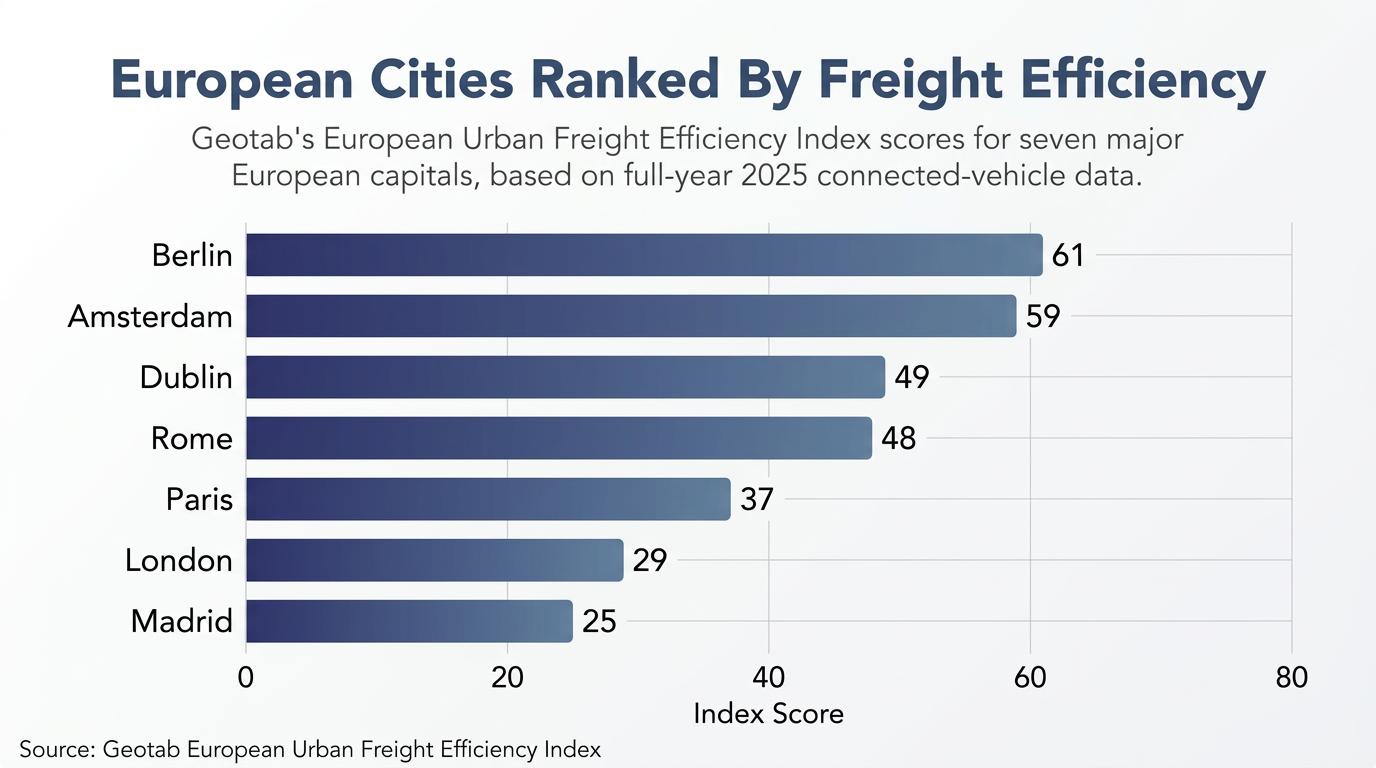
The findings come from Geotab’s European Urban Freight Efficiency Index, which examined a full year of connected-vehicle data from 2025 across Berlin, Amsterdam, Dublin, Rome, Paris, London and Madrid.
The research looked at how effectively vehicles move around each city, as well as the operational waste created by congestion, including fuel used while vehicles are stationary.
Overall, Berlin achieved the highest city efficiency score at 61 out of 100, while Madrid ranked lowest at 25. London recorded a score of 29, placing it sixth among the seven cities studied.
| City | Overall Efficiency Score | Position |
|---|---|---|
| Berlin | 61 | 1st |
| Amsterdam | 59 | 2nd |
| Dublin | 49 | 3rd |
| Rome | 48 | 4th |
| Paris | 37 | 5th |
| London | 29 | 6th |
| Madrid | 25 | 7th |
Commercial Fleets Often Outperform Passenger Vehicles
One of the most notable findings is the difference between commercial and passenger vehicle performance.
Commercial vehicle fleets achieved higher scores than passenger vehicles in five of the seven cities.
The largest difference was recorded in Rome, where commercial vehicles scored 63 compared with 37 for passenger vehicles – a 26-point advantage.
Berlin also recorded a significant difference, with commercial vehicles scoring 71 compared with 55 for passenger vehicles.
The gap was 14 points in Dublin, 10 points in Amsterdam and 15 points in Paris.
London and Madrid were the exceptions. In London, passenger vehicles scored slightly higher than commercial vehicles, while Madrid recorded the largest disadvantage for commercial vehicles, with trucks scoring six points below passenger vehicles.
The results suggest that commercial vehicles are not necessarily disadvantaged simply because they operate in busy urban environments.
Instead, the way professional fleets are managed can have a significant influence on how efficiently vehicles move.
Why Commercial Vehicles Can Perform Better
Geotab’s research points towards the importance of professional fleet operations.
Commercial vehicles are often operated according to planned delivery schedules, established routes and specific freight requirements. Businesses may also use connected-vehicle data to adjust routes and timings according to traffic conditions.
This can give professional fleets an advantage over private motorists who may have less flexibility over when and where they travel.
The research suggests that structured routing, scheduled deliveries and effective fleet management can help commercial vehicles operate more effectively, even where congestion is a significant problem.
For businesses operating vans throughout the working day, these factors can have a direct impact on operating costs.
Avoiding unnecessary time in traffic can reduce fuel consumption, improve journey-time reliability and potentially allow drivers to complete more work during their scheduled hours.
London Faces A Particular Challenge
London presents a different picture.
The capital recorded an overall efficiency score of 29, putting it sixth in the study and well behind Berlin and Amsterdam.
It was also one of only two cities where passenger vehicles outperformed commercial vehicles.
Geotab’s data highlights the difficult conditions facing commercial operators in the capital, where congestion, restricted road access and the demands of urban deliveries can all affect vehicle efficiency.
Commercial vehicles recorded a score of 27 compared with 29 for passenger vehicles, creating a two-point difference.
London also recorded the highest commercial vehicle fuel consumption in the study, at 36.75 litres per 100km.
The research suggests that the city’s road layout, restrictions affecting commercial vehicles and the timing of deliveries can all contribute to the challenges faced by businesses operating vans and trucks in London.
For companies making multiple urban deliveries every day, even relatively small delays can accumulate into significant amounts of lost time and additional fuel consumption, adding to the overall cost of running a van.
| City | Commercial Vehicle Idle Rate |
|---|---|
| Rome | 2.8% |
| Dublin | 5.8% |
| Berlin | 8.5% |
| London | 11.1% |
| Amsterdam | 12.5% |
| Paris | 18.2% |
Congestion Is Also Increasing Fuel Waste
The research highlights the financial consequences of vehicles spending time stationary in traffic.
Across the seven cities analysed, connected vehicles burned an estimated 1.58 million litres of fuel while stationary during 2025.
Geotab estimates that this represented around €2.6 million in wasted fuel based on average European fuel prices during the year.
Commercial vehicles accounted for around €600,000 of this estimated idle-fuel cost, according to the index.
London’s commercial vehicles used 11.1% of their fuel while idling, compared with 13.6% for passenger vehicles.
Although this was not the highest commercial vehicle figure recorded, it demonstrates how stop-start urban traffic can create an additional running cost for businesses.
Paris recorded the highest commercial vehicle idle rate, with 18.2% of fuel being consumed while vehicles were stationary.
Rome, by comparison, recorded a commercial vehicle idle rate of just 2.8%.
Rome Shows The Potential For Better Fleet Efficiency
Rome produced the biggest difference between commercial and passenger vehicle performance.
Commercial vehicles scored 63 compared with 37 for passenger vehicles.
The research suggests that freight-specific access arrangements, professional routing and the way commercial operators schedule journeys can help fleets navigate the city’s challenging road network more effectively.
Interestingly, Rome also recorded the lowest commercial vehicle idle-fuel figure in the study, at 2.8%.
This demonstrates that a city does not necessarily need to have light traffic for commercial vehicles to operate efficiently.
Instead, predictability and the ability to plan around congestion can be just as important.
Berlin Leads The European Index
Berlin came out on top of the overall index, recording a score of 61.
The German capital also provided the strongest commercial vehicle performance, with trucks achieving a score of 71 compared with 55 for passenger vehicles.
Geotab attributes some of Berlin’s strong performance to its more distributed urban structure, which spreads traffic demand across multiple areas rather than concentrating it around a single dominant centre.
The city also performed strongly for journey-time predictability, helping businesses create more reliable delivery schedules.
For commercial operators, predictability can be almost as important as outright journey speed.
Knowing roughly how long a delivery route is likely to take makes it easier to schedule drivers, plan customer appointments and manage vehicle utilisation.
What Does This Mean For UK Businesses?
The findings highlight that vehicle choice is only one part of managing commercial vehicle running costs.
This is also where fleet lifecycle management becomes important, as businesses need to consider how vehicles perform throughout their time in the fleet rather than focusing solely on the initial acquisition cost.
How a van is operated can have an equally important influence.
Businesses running vehicles in urban areas can potentially reduce wasted time and fuel by carefully considering:
- Route planning and traffic conditions
- Delivery schedules and operating windows
- Vehicle utilisation throughout the working day
- Congestion and likely journey times
- Fuel consumption and unnecessary idling
- The suitability of a vehicle for its intended work
- Whether an electric or alternative-fuel vehicle could reduce operating costs
For businesses that rely on vans for deliveries, engineering visits, installations or other mobile work, small improvements across multiple journeys can add up over the course of a year.
The research also reinforces the importance of understanding where a vehicle will spend most of its time.
A van primarily operating in congested urban areas can face very different conditions from one covering longer distances between towns and cities.
Choosing the right vehicle for the workload can also have a significant effect on fuel economy, particularly for businesses covering high annual mileages.
Commercial Vehicle Efficiency Goes Beyond The Vehicle Itself
Geotab’s findings provide an interesting reminder that commercial vehicle efficiency is not simply about the vehicle’s specification.
Traffic conditions, road infrastructure, delivery restrictions and operational planning can all influence how much time and fuel a business vehicle uses.
The difference between cities in the study is considerable. Berlin recorded an overall score of 61, compared with just 25 in Madrid, while London scored 29. Geotab estimates that bringing all seven cities up to Berlin’s efficiency level could deliver a collective improvement of around 39%.
For UK businesses, particularly those operating in and around major urban areas, the message is clear: better planning can help commercial vehicles work more efficiently, but the road environment itself also has a major role to play.
As congestion, emissions requirements and restrictions on urban vehicle access continue to shape how businesses operate, understanding the real-world costs of keeping commercial vehicles moving will become increasingly important.
 Call our expert team on