
New MOT rules introduced on 14 October 2026 mean that approved LED replacement bulbs fitted to compatible halogen headlights can now pass their MOT, provided the required approval sticker is present. The change affects cars, vans and other specified vehicle classes, giving businesses another maintenance requirement to consider when checking their commercial vehicles.
The Driver and Vehicle Standards Agency (DVSA) has updated its MOT inspection rules to allow ECE-approved LED replacement (LEDr) bulbs in compatible halogen headlamp units. However, the change does not mean every aftermarket LED conversion is automatically legal or guaranteed to pass an MOT.
For businesses operating vans, pickups and wider commercial fleets, understanding the new requirements can help avoid preventable MOT failures and unnecessary vehicle downtime.
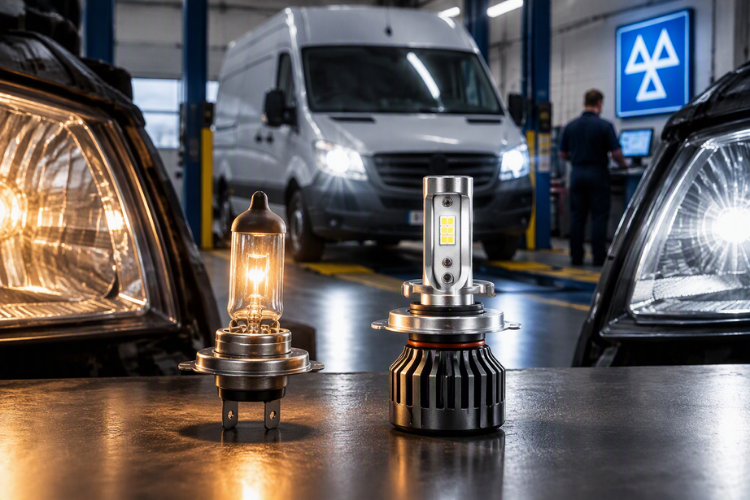
What Has Changed Under The New MOT Rules?
Previously, LED bulbs fitted as replacements in halogen headlamp units could be rejected during an MOT because testers had no straightforward way to establish whether the replacement light source was approved.
Under the updated rules, MOT testers must accept ECE-approved LED replacement bulbs in compatible halogen headlamp units, provided the product meets the approval requirements and has the correct manufacturer-issued sticker attached to the vehicle.
The change took effect on 14 October 2026 and applies in England, Scotland and Wales.
It is a change to how qualifying headlamp conversions are assessed, rather than a blanket relaxation of vehicle lighting requirements. Headlamps must still meet the applicable inspection standards, and non-approved conversions remain outside the new allowance.
Which Vehicles Are Affected?
The revised rules apply to vehicles in MOT classes 3, 4, 5 and 7 that have existing halogen headlamp units fitted with ECE-approved LED replacement bulbs.
| MOT class | Vehicles covered |
|---|---|
| Class 3 | Certain three-wheeled vehicles up to 450kg unladen weight |
| Class 4 | Cars, many vans, taxis and other vehicles covered by this class |
| Class 5 | Specified passenger vehicles, including those with 13 or more passenger seats |
| Class 7 | Goods vehicles over 3,000kg and up to 3,500kg design gross weight, plus qualifying zero-emission goods vehicles up to 4,250kg |
Class 7 is particularly relevant to commercial vehicle operators. Businesses running vans should check whether any vehicles have had their original halogen bulbs replaced with aftermarket LED alternatives.
The change does not apply to Class 1 and Class 2 motorcycles, halogen headlamp units converted to use high-intensity discharge (HID) bulbs, or complete LED headlamp unit replacements.
Operators should check the exact vehicle and lighting configuration rather than assume every LED headlamp conversion falls within the new rules.
What Is The New LED Approval Sticker?
Approved LED replacement bulbs must come with a secure approval sticker supplied by the manufacturer. This must be permanently attached to the vehicle in a position where it can be easily seen during an MOT inspection.
The sticker must contain the following information:
- Bulb category: For example, H11 LEDr.
- Variant: The approved product variant.
- Rated voltage: The bulb’s specified voltage.
- ECE approval number: The relevant approval reference.
- Manufacturer’s name: Identifying the product manufacturer.
- Security feature: Such as a hologram.
Manufacturers can use different sticker designs, provided the required information and security features are present.
MOT testers do not need to cross-reference the approval number, markings or manufacturer details against external databases or supporting documentation. They must check that the required sticker is present.
Drivers and fleet managers should check that the manufacturer-issued approval sticker has been permanently attached to the vehicle in a clearly visible position. It should not be left in the packaging or stored separately from the vehicle.
The LED headlight changes are another development in the MOT testing system. CVC has also covered the introduction of vehicle photography to help tackle MOT fraud, a separate initiative intended to improve confidence in MOT testing.
When Will An LED Headlamp Fail Its MOT?
The updated rules specify circumstances in which the headlamp must fail the MOT inspection. These include cases where an LED replacement bulb is fitted and:
- The required approval sticker is missing.
- The sticker is unreadable.
- The sticker appears to have been tampered with.
- The sticker clearly does not match the bulb fitted.
The tester must record the major defect as “light source and lamp not compatible”.
This is particularly important for businesses that have bought used vans or inherited vehicles from another operator. A previous owner may have modified the lighting without passing on the relevant approval information.
A quick check before an MOT appointment can help identify potential problems early, allowing the business to investigate the bulb and its approval status before the vehicle is booked in.
What Should Fleet Operators Do Now?
The rule change provides an opportunity for businesses to review their vehicle-maintenance procedures, particularly where vehicles have been modified or are managed by multiple drivers.
1. Check existing headlamp conversions
Establish whether any fleet vehicles have LED replacement bulbs fitted in original halogen headlamp units. Do not assume that every aftermarket LED bulb is covered by the new allowance.
2. Check the approval sticker
Where an eligible LED replacement bulb is fitted, confirm that the manufacturer’s approval sticker is present, readable, untampered with and consistent with the fitted bulb.
3. Include lighting in routine vehicle checks
Drivers should continue to check that their lights operate correctly and report damage or faults. Businesses can reinforce these checks through their existing vehicle inspection procedures.
CVC’s guide to fleet compliance, including faulty brakes and tyres provides a relevant starting point for businesses reviewing their wider vehicle-checking responsibilities.
4. Review maintenance arrangements
Businesses should make sure that vehicle servicing, repairs and inspections are properly coordinated. CVC’s guide to vehicle maintenance explains the importance of keeping vehicles maintained throughout their working life.
For leased vans, drivers should also understand their responsibilities for reporting faults and looking after the vehicle. CVC’s leased vehicle driver responsibilities guide offers further information.
5. Address problems before the MOT appointment
If the bulb approval or sticker is unclear, seek advice from a competent vehicle-lighting specialist or the product manufacturer. Do not assume that an LED bulb will pass simply because it fits the headlamp.
Why MOT Compliance Matters For Businesses
For a business that relies on its vans every day, an MOT problem can create more than an administrative inconvenience. A vehicle that cannot be used as planned may disrupt appointments, deliveries and scheduled work.
Keeping accurate vehicle records, documenting modifications and addressing maintenance issues promptly can help businesses reduce avoidable disruption. This is particularly important for tradespeople and operators who depend on their vans every day. CVC’s guides to choosing the right business van and managing a commercial fleet offer further advice on vehicle selection and fleet management.
Businesses considering replacement vehicles should also understand the maintenance arrangements available through different leasing options. The appropriate approach will depend on the vehicle, contract and level of maintenance support selected.
MOT testing is also part of the wider cost of keeping commercial vehicles roadworthy. With calls for the Government to increase MOT fees for cars and vans, businesses need to factor inspections and ongoing maintenance into their fleet budgets.

 Call our expert team on