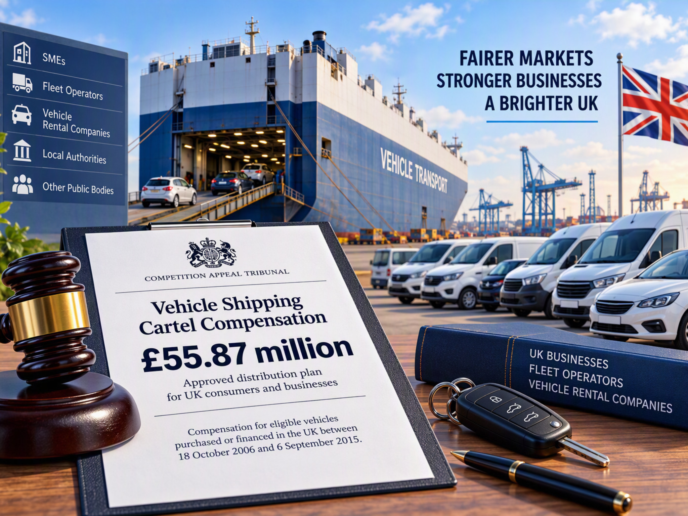
UK businesses, fleet operators and vehicle rental companies could be eligible to claim compensation from a £55.87 million fund following a long-running legal case involving a cartel that affected the intercontinental shipping of new vehicles.
The Competition Appeal Tribunal has approved a distribution plan that will determine how settlement money recovered from several international shipping companies is distributed among eligible consumers and businesses.
The ruling, issued on 23 September 2026, brings the compensation process a significant step closer to opening for claims. The Tribunal’s case records confirm that the proceedings relate to an infringement decision by the European Commission concerning the maritime transport of vehicles, with the cartel operating between October 2006 and September 2012.
The wider claim covers qualifying new vehicles purchased or financed in the UK between 18 October 2006 and 6 September 2015, with both individual consumers and businesses included in the class.
For businesses that operated fleets during this period, the ruling could be particularly relevant.
What Is The Vehicle Shipping Cartel?
The case follows a European Commission investigation into a cartel involving major international vehicle shipping companies.
In February 2018, the European Commission found that five shipping companies had participated in a cartel involving the intercontinental transport of vehicles. The companies involved were MOL, K Line, NYK, WWL-EUKOR and CSAV.
The Commission found that the companies had coordinated aspects of their commercial activities, including prices, customers and commercially sensitive information relating to the transport of vehicles between Europe and other continents.
The Commission imposed fines totalling approximately €395 million on the companies involved in the vehicle shipping cartel.
The subsequent UK collective proceedings argued that the increased shipping costs were ultimately passed through the vehicle supply chain.
According to the Competition Appeal Tribunal’s latest ruling, the case was based on the argument that cartel-related overcharges increased the cost of deep-sea shipping services into Europe, with some of those costs being passed on by vehicle manufacturers through vehicle delivery charges. The claim then sought compensation for the resulting overcharge ultimately borne by purchasers and lessees of affected vehicles.
£92.75 Million Recovered From Shipping Companies
The collective action has now resulted in settlements totalling £92.75 million.
The Competition Appeal Tribunal has confirmed that £55.87 million of that amount forms the damages pot available for distribution to represented consumers and businesses.
The remaining settlement money is allocated across areas including legal and other costs, distribution costs and other provisions associated with the settlements.
The Tribunal approved the distribution plan on 23 September 2026, subject to amendments made during the approval process.
This means the case has now moved from the settlement stage towards the practical process of distributing compensation to eligible claimants.

Could Businesses And Fleet Operators Claim?
Businesses are specifically included within the class covered by the proceedings.
The Tribunal says the class broadly consists of people who purchased or financed qualifying new vehicles in the UK between 18 October 2006 and 6 September 2015, subject to specified exclusions.
It includes both individuals and businesses.
The Tribunal estimates that around 25.1 million affected vehicles were purchased or leased by members of the class during the claim period. Around 52% were purchased or leased by corporate entities.
The corporate part of the class includes:
- Small and medium-sized businesses
- Fleet operators
- Vehicle rental businesses
- Local authorities
- Other public bodies
This means businesses that operated vehicle fleets during the relevant period could potentially have a claim, provided their vehicles meet the scheme’s eligibility requirements.
The ruling does not mean that every vehicle purchased or financed during this period will automatically qualify. Businesses will need to check whether their vehicles fall within the definition of qualifying vehicles and whether any exclusions apply.
For businesses that no longer have records going back to the late 2000s or early 2010s, the claims process is also intended to address some of the practical difficulties associated with historic vehicle information.
How Much Compensation Could Businesses Receive?
Under the approved distribution structure, compensation is based on the number of eligible vehicles claimed.
The current structure provides:
| Eligible Vehicles | Initial Compensation |
|---|---|
| First vehicle | £25 |
| Vehicles 2–6 | £5 each |
| Seventh vehicle onwards | £2.50 each initially |
There is an important additional provision for businesses with larger numbers of vehicles.
The Tribunal has directed that the £2.50 payment for the seventh and subsequent vehicles could be followed by a further payment of up to £2.50 per vehicle, depending on how much money remains after the claims period.
That means the eventual amount for vehicles from the seventh onwards could potentially reach £5 per vehicle, although the additional payment is not guaranteed.
The structure was designed partly to encourage eligible people and businesses to participate in the claims process while ensuring that the available settlement funds can be distributed across the class.

How Will Fleet Claims Be Verified?
One of the challenges facing the compensation scheme is that the vehicles involved may have been purchased or financed more than a decade ago.
Many businesses will no longer have invoices, purchase documents or other records relating to vehicles acquired during the relevant period.
The Tribunal specifically considered this issue when approving the distribution plan.
For claims involving up to six vehicles, the plan provides for a self-verification process supported by a formal statement of truth.
Larger claims will face additional verification requirements, including structured data, risk-based checks, auditing and, where necessary, supporting documentation.
For fleet operators, however, the scheme has an important additional feature.
The claims process is expected to make use of granular DVLA fleet data to simplify verification for fleet claimants where the relevant information is available.
The Tribunal said this could substantially reduce the evidential burden for fleet operators attempting to establish vehicle ownership or use many years after the vehicles were acquired.
That could be particularly relevant to larger businesses that may have changed fleet management systems, ownership structures or record-keeping processes since the relevant vehicles were acquired. Effective fleet lifecycle management can also help businesses maintain clearer records as vehicles are added to and removed from their fleets.
Larger Businesses May Face More Checks
The process is not necessarily going to be equally straightforward for every business.
The Tribunal highlighted particular concerns about non-fleet corporate claimants with more than six eligible vehicles where the simplified DVLA verification process may not be available.
Those businesses could face more detailed requests for evidence showing which vehicles they purchased during the relevant period.
The Tribunal acknowledged that this could create a practical barrier where historic records are difficult to locate.
It also said the claims process should consider how evidential requirements could be modified or waived in practice where appropriate.
Businesses with older vehicle records should therefore avoid assuming that they will need to locate every original document immediately, but they should also be prepared for additional verification if they are making a larger claim.
When Can Businesses Make A Claim?
The approved distribution plan provides for a six-month claims period.
However, the Competition Appeal Tribunal’s ruling does not itself provide a specific opening date for claims.
The distribution process is expected to be supported by publicity and direct engagement with different groups of potential claimants.
The Tribunal has also required monthly reporting on the progress of the distribution process and has retained the ability to consider changes if practical difficulties arise.
Businesses should therefore look for further information from the official claims process before submitting any information or providing payment details.
Why Does The Case Matter To UK Fleets?
For fleet operators, the case is significant because the Tribunal has specifically recognised businesses with multiple vehicles as an important part of the class.
The Tribunal’s ruling says that corporate entities account for approximately 52% of the affected vehicles estimated to have been purchased or leased by class members during the claim period. This could be relevant to businesses operating mixed fleets, covering both business car leasing and commercial vehicle leasing.
It also says the median fleet size in the modelling used for the distribution plan was 66 vehicles, illustrating the potentially much larger number of eligible vehicles that some corporate claimants could have compared with individual consumers.
The actual amount any business receives will depend on the number of qualifying vehicles and the final operation of the distribution process.
For businesses that currently operate fleets, maintaining accurate records is already an important part of effective fleet management, particularly when vehicles are replaced regularly and fleet requirements change.
Older fleet records could now also become relevant to businesses looking to establish whether they have an eligible claim.
What Should Businesses Do Now?
Businesses that operated vehicle fleets between 2006 and 2015 may want to start considering whether they have historic records that could help establish which vehicles they purchased or financed.
Potentially useful information could include vehicle registration numbers, fleet records, purchase or finance documentation and other historic records showing when vehicles were acquired.
However, businesses should not assume that every vehicle from the period qualifies.
The claim relates to qualifying vehicles within the defined class, and the distribution process includes exclusions and verification requirements.
The official claims process should provide the information businesses need to establish eligibility once it opens.
For businesses that currently lease commercial vehicles, keeping clear records of vehicle acquisitions, finance arrangements and fleet changes can also make future administration easier. CVC provides information on fleet vehicle leasing and vehicle finance options for businesses and companies reviewing their current vehicle requirements.
A Long-Running Vehicle Cartel Case Moves Towards Payouts
The latest Competition Appeal Tribunal ruling marks an important stage in a case that has been running for several years.
The original European Commission investigation found that international vehicle shipping companies had operated a cartel affecting the intercontinental transport of vehicles. The subsequent UK collective proceedings resulted in settlements totalling £92.75 million, with £55.87 million now allocated to the damages pot for eligible class members.
The approved distribution plan provides different levels of compensation depending on the number of eligible vehicles claimed and includes specific arrangements intended to make it easier for fleet operators to verify historic vehicles.
For UK businesses that acquired qualifying vehicles during the relevant period, the next step will be to establish whether they fall within the class and, once the claims process opens, submit the necessary information within the six-month claims window.

 Call our expert team on