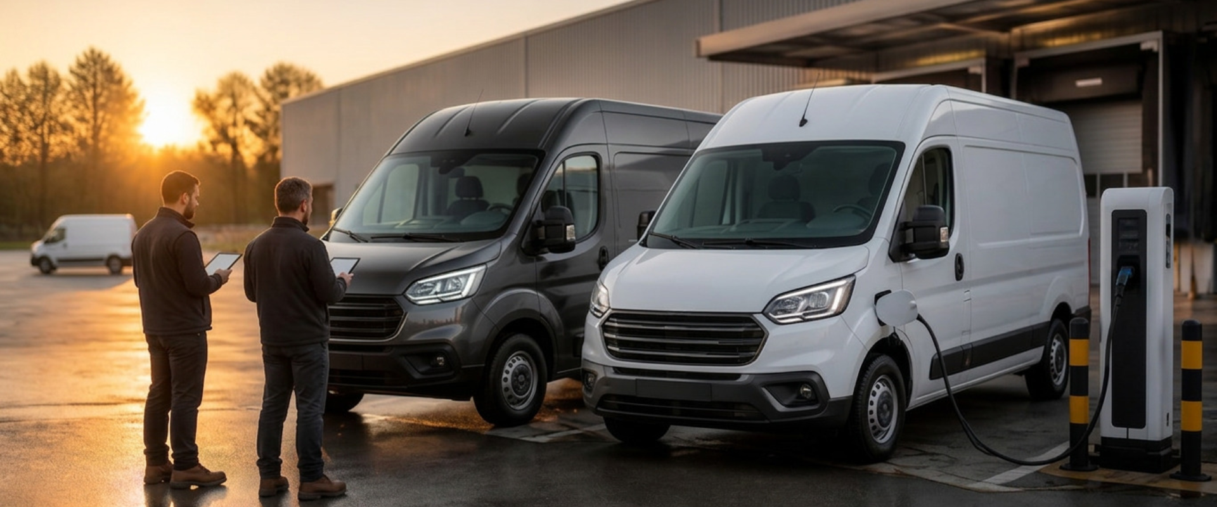
For businesses covering 20,000 miles a year, switching from a 2.0-litre diesel van to an electric van could significantly reduce annual energy costs, particularly when most charging is carried out at home or at the business premises.
For many businesses, the cost of changing vehicles is about much more than the monthly lease payment. Fuel and energy can make up a substantial part of a van’s running costs, particularly when the vehicle is covering tens of thousands of miles every year.
A van travelling 20,000 miles annually is covering more than 1,600 miles every month. At that sort of mileage, even a relatively small difference in the cost of each mile can add up to thousands of pounds over the course of a year.
So how much could a business actually save by replacing a conventional 2.0-litre diesel van with an electric van?
20,000 Miles A Year Makes A Big Difference
HMRC’s current advisory rates provide a useful way of illustrating the difference.
From September 2026, the advisory rate for diesel cars and vans with engines between 1,601cc and 2,000cc is 16p per mile. For fully electric vehicles, the advisory electric rate is 7p per mile when charging at home and 15p per mile when charging using public charging infrastructure.
Using those figures, a vehicle covering 20,000 miles would produce the following annual energy costs:
| Vehicle | Cost per mile | Cost over 20,000 miles |
|---|---|---|
| 2.0-litre diesel | 16p | £3,200 |
| Electric – home charging | 7p | £1,400 |
| Electric – public charging | 15p | £3,000 |
That means a driver covering 20,000 miles could potentially save £1,800 a year on energy costs if an electric van was predominantly charged at home or at the business premises.
That’s equivalent to £150 a month.
However, the charging situation is extremely important.
An electric van relying heavily on public charging would produce a much smaller saving using the current HMRC rates. At 15p per mile, 20,000 miles would cost around £3,000, compared with £3,200 for the 2.0-litre diesel example.
The figures therefore demonstrate something important: where an electric van is charged can be just as important as what van you choose.
Why High-Mileage Van Drivers Could See The Biggest Difference
The more miles a van covers, the more significant the cost per mile becomes.
Consider two businesses using identical diesel vans. One covers 8,000 miles a year, while the other covers 20,000 miles.
At 16p per mile, the first business would have an indicative annual fuel cost of £1,280, while the second would be looking at £3,200.
The potential difference created by switching to home-charged electric therefore becomes much more noticeable for the higher-mileage operator.
At 7p per mile, 20,000 miles in an electric van would equate to around £1,400 of electricity, creating a theoretical £1,800 annual difference against the 2.0-litre diesel benchmark.
Over three years, that could represent £5,400 in energy costs alone.
Of course, these are illustrative calculations rather than a guarantee of what an individual driver will spend. Actual diesel consumption, electricity prices, driving conditions, payload, temperature, driving style and charging method will all affect the final figure.
For businesses considering the move from diesel to electric, there are also several practical factors to consider beyond the cost per mile. Our guide to switching to an electric vehicle looks at some of the key considerations involved in making the transition.
Home Charging Is Where Electric Vans Can Really Make Sense
For businesses considering an electric van, access to charging should be one of the first things to consider.
A van that returns to a business premises every evening can potentially be plugged in after the working day and charged, ready for the following morning.
This is very different from a driver who spends most of the day away from their base and relies on public rapid chargers.
The latter can be considerably more expensive, particularly when rapid or ultra-rapid charging is required.
This means an electric van isn’t automatically cheaper to run simply because it uses electricity. The charging strategy matters.
Businesses should look at their typical mileage, daily routes, parking arrangements and whether vehicles return to base before deciding whether an electric van is suitable.
For businesses considering installing workplace charging, our guide to charging infrastructure explains more about the infrastructure and support available for electric vehicles. You can also read our guide to How EV Charging Works For Businesses for more information on the practical considerations around charging electric vehicles.
What About Businesses Without Off-Street Parking?
This is one of the biggest considerations for operators moving away from diesel.
A driver who can charge overnight at home has a very different cost profile from somebody who lives somewhere without access to private parking.
Public charging can still make an electric van viable, but the cost calculation needs to reflect the charging network being used. For businesses operating in or travelling through urban areas, local vehicle restrictions can also influence which vans are practical to operate. Our ULEZ and Clean Air Zones guide explains the rules and requirements businesses need to be aware of across the UK.
This is particularly relevant for tradespeople and other van drivers who may spend much of their working day travelling between customers.
Before making the switch, businesses should consider:
- How many miles the van covers each day
- Whether it returns to base every evening
- Whether the driver can charge at home
- Whether workplace charging is available
- How much public charging is likely to be required
- The type of work being carried out
- Payload and equipment requirements
- The vehicle’s expected real-world range
The cheapest energy cost on paper isn’t particularly useful if the vehicle doesn’t fit the working pattern.
The Wider Move Towards Electric Vans
Running costs aren’t the only reason electric vans are becoming increasingly relevant to businesses. The UK vehicle market is also undergoing a wider transition towards zero-emission vehicles, with manufacturers facing targets under the Government’s Zero Emission Vehicle (ZEV) Mandate.
The ZEV Mandate is designed to increase the proportion of new zero-emission vehicles sold by manufacturers, meaning electric vehicles are becoming an increasingly important part of the new vehicle market. For businesses considering their next van, it is therefore worth understanding how electric vehicles could fit into their operations rather than simply looking at today’s diesel running costs.
Electric Vans Can Offer More Than Lower Energy Costs
Energy costs are only one part of the equation.
Electric vans also have fewer moving parts than conventional internal combustion vehicles, which can mean less routine mechanical maintenance.
There is no engine oil to replace, no conventional exhaust system and no diesel particulate filter to maintain.
That doesn’t mean an electric van is maintenance-free. Tyres, brakes, suspension, fluids and other components still require inspection and replacement, while the battery and high-voltage systems require specialist attention when necessary.
However, for a business operating several vans, even relatively small differences in running costs can become significant when multiplied across an entire fleet.
This is where looking at the whole cost of operating a vehicle, rather than simply the monthly lease payment, becomes particularly important.
What If You Drive More Than 20,000 Miles?
The potential difference becomes even more significant as mileage increases.
Using the same illustrative HMRC rates:
| Annual mileage | 2.0-litre diesel at 16p | Electric at 7p | Potential difference |
|---|---|---|---|
| 10,000 miles | £1,600 | £700 | £900 |
| 15,000 miles | £2,400 | £1,050 | £1,350 |
| 20,000 miles | £3,200 | £1,400 | £1,800 |
| 25,000 miles | £4,000 | £1,750 | £2,250 |
| 30,000 miles | £4,800 | £2,100 | £2,700 |
These figures are simply the mileage multiplied by the current HMRC advisory rates, so they should be treated as an illustration rather than a prediction of an individual vehicle’s actual costs.
They do, however, demonstrate why high-mileage businesses are worth considering when assessing the potential financial benefits of electrification.
The Diesel Price Factor
Fuel prices can also have a major effect on the calculation.
Unlike a fixed vehicle lease payment, the cost of running a diesel van changes whenever pump prices change.
That can make budgeting more difficult for businesses covering substantial annual mileage.
Recent diesel price movements have demonstrated just how quickly fuel costs can change. Current market conditions have pushed UK diesel prices close to £2 a litre, highlighting the exposure businesses can have to fluctuations in conventional fuel costs.
Electricity prices can also fluctuate, particularly when relying on public charging, but businesses with suitable premises and access to their own charging infrastructure may have greater control over when and how their vehicles are charged.
Is An Electric Van Right For Your Business?
There isn’t a single answer for every van operator.
For a business covering 20,000 miles a year, however, the energy-cost calculation is certainly worth investigating. Electric vans are also becoming a more established option for UK businesses, with research showing growing adoption among fleets and SMEs. Our guide to electric van adoption among UK business fleets looks at the latest trends and what they could mean for businesses considering the switch.
A diesel van travelling that distance can consume a considerable amount of fuel over the course of a year. An electric equivalent charged predominantly at home or at a business premises could potentially reduce the energy cost substantially.
Using the current HMRC advisory rates, the difference works out at £1,800 a year at 20,000 miles, or around £150 a month.
But the biggest lesson is that the saving depends heavily on charging arrangements.
A business that can charge cheaply at its own premises could potentially see a very different running-cost calculation from one whose drivers depend heavily on public charging.
That’s why businesses considering an electric van should look beyond the headline range figure and monthly lease cost and consider how the vehicle will actually be used every day. Businesses considering the transition should also take account of the wider practical barriers involved in electrification, including charging, vehicle suitability and operating requirements.
Our guide to overcoming the barriers to EV adoption looks at some of the challenges businesses may face when moving towards a more sustainable fleet.
Calculate The Potential Cost Of Going Electric
If your business is considering an electric van, the next step is to look at the numbers for your own mileage and driving pattern.
Our electric van leasing options cover a growing range of electric commercial vehicles, while our AER reimbursement calculator can help businesses understand the electricity reimbursement side of running an electric vehicle.
For businesses operating multiple vehicles, our one-stop fleet solutions can provide a broader view of managing vehicle requirements across a fleet. Leasing providers can also play an important role in helping businesses assess their options, understand the costs involved and plan the transition, with our guide to how leasing providers can help fleets electrify explaining more about the process.
The potential savings aren’t simply about replacing diesel with electricity. It is about matching the right vehicle, charging arrangement and operating pattern to the business.
For a business covering 20,000 miles every year, that calculation could be worth thousands of pounds over the life of a vehicle.
 Call our expert team on