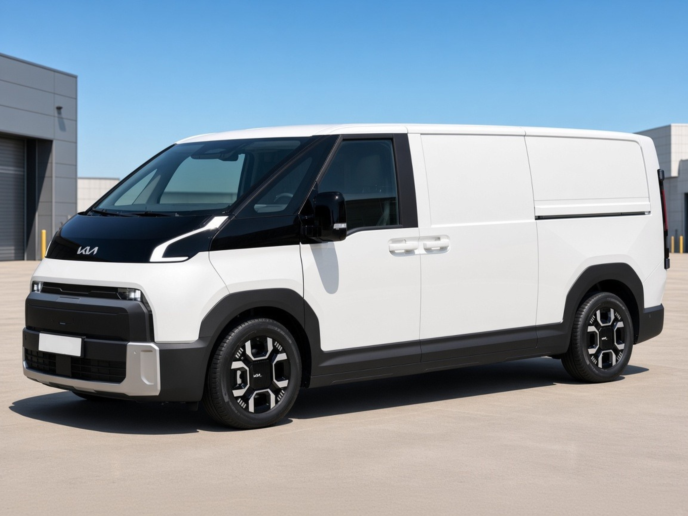
Kia is expanding its electric commercial vehicle line-up with the new Kia PV7 electric van, a larger electric van designed to bring greater capacity, flexibility and connected technology to businesses and fleet operators.
Unveiled at IAA Transportation 2026 in Hannover, the PV7 is the second model in Kia’s Platform Beyond Vehicle (PBV) strategy, following the smaller PV5. It will be offered in both Cargo and Passenger configurations, with the European launch planned for the second half of 2027.
The new model moves Kia further into the medium electric van market, with the company positioning the PV7 towards applications including logistics, deliveries, fleet operations, passenger transport and shared mobility.
It will eventually be joined by the larger PV9, giving Kia a three-model PBV range covering a much broader selection of commercial and passenger applications.
Kia Expects PV7 To Become Its Biggest PBV Seller
Kia expects the PV7 to become the highest-volume model within its PBV range, largely because of the size and importance of the medium van market.
While the Kia PV5 is already aimed at a broad range of businesses and applications, the PV7 provides significantly more space and is intended to handle larger loads and more demanding operating requirements.
That makes the PV7 particularly relevant to businesses running multiple vehicles, where factors such as payload, cargo capacity, uptime, charging, driver productivity and fleet management can all influence operating costs.
Businesses looking at larger electric vans can also compare the PV7 with other options through CVC’s fleet van leasing solutions.
Kia has identified logistics and delivery companies, utilities, passenger transport operators, ride-hailing businesses and other fleet users as potential customers for the new model.
The PV7 is therefore being developed with a somewhat different customer profile from the PV5, with Kia expecting larger fleet operators to play a particularly important role.
PV7 Designed Around Larger Fleet Operations
One of the most significant aspects of the PV7 is that Kia is not treating it simply as an electric replacement for a conventional diesel van.
The company is developing a wider ecosystem around its PBV range, combining the vehicle itself with connected services, fleet management technology, charging solutions and conversion capabilities.
For larger operators, connected vehicle information can become increasingly important as the size of a fleet grows.
Data can help businesses monitor vehicle utilisation, driving behaviour, charging requirements, maintenance needs and overall fleet efficiency. Kia’s wider PBV strategy includes connected services designed to support these requirements.
For businesses managing multiple vehicles, CVC’s fleet management solutions can also form part of a wider approach to managing commercial vehicles, maintenance and operational requirements.
The PV7’s digital systems are intended to support businesses in getting more information from their vehicles, rather than simply providing another method of propulsion.
Kia PV7 Will Work With Third-Party Fleet Platforms
Integration with existing fleet management systems will be particularly important for larger businesses.
Kia has already worked with established fleet technology providers and has highlighted the importance of allowing connected vehicle data to work alongside the systems businesses already use.
Platforms such as Geotab, Samsara and Webfleet are examples of the technology used by modern fleet operators to manage vehicles, drivers and operational data.
Rather than forcing businesses to manage Kia vehicles separately, the company’s PBV strategy is intended to make vehicle information available through wider fleet management ecosystems.
This could be particularly useful for mixed fleets, where businesses operate electric vans alongside diesel, petrol and other vehicle types.
Kia Wants To Provide More Than Just An Electric Van
The biggest difference between Kia’s PBV approach and a conventional van launch is the emphasis on the wider ecosystem surrounding the vehicle.
The PV7 has been developed around four key areas: the vehicle itself, charging, connectivity and the way businesses use and adapt their vehicles.
This means vehicle conversions are an important part of Kia’s plans.
The company is developing a dedicated PBV conversion ecosystem, with Kia’s own facilities supporting the development of converted vehicles alongside regional conversion partners. Kia has also highlighted a broad programme of future derivatives and conversion models.
This is particularly relevant to businesses that need something more specialised than a standard panel van.
CVC already provides a range of commercial vehicle conversions and bespoke van leasing and customisation services, covering the types of modifications businesses may need to make their vehicles suitable for specific jobs.
The potential for the PV7 to be adapted for different applications could therefore make it more useful across a wide variety of industries.
Kia says its wider PV7 range is expected to eventually include numerous variants, with Cargo, Passenger, Chassis Cab and conversion models forming part of the broader PBV strategy.
PV7 Passenger Could Fill A Gap Left By Traditional MPVs
The PV7 will not be restricted to commercial cargo applications.
Kia is also developing a PV7 Passenger, designed to provide flexible people-moving capability alongside the practicality of an electric commercial vehicle.
European versions are planned with seven- and nine-seat configurations, giving the model potential applications in shuttle services, passenger transport, private hire and other businesses that need to move larger groups of people.
The Passenger version could also appeal to organisations that need a large, flexible vehicle without moving into a traditional minibus format.
Businesses looking at passenger transport requirements can also explore CVC’s minibus leasing options.
The flexibility of the PBV platform means Kia can use the same underlying architecture for several different applications, rather than developing an entirely separate vehicle for every use case.
Electric Van Market Continues To Expand
The arrival of the PV7 highlights how quickly the electric van market is expanding beyond compact urban vehicles.
Kia’s strategy now includes the PV5, PV7 and planned PV9, with each model targeting different sizes and applications.
The Kia PV5 has already established the manufacturer’s presence in the electric LCV market, while the PV7 will give Kia a vehicle capable of competing in a larger section of the market. The PV5 is already being compared with other established electric vans, including the Volkswagen ID. Buzz — see CVC’s ID. Buzz vs Kia PV5 electric van comparison for a closer look at how the two models compare. The PV5 is available in different configurations, including the Kia PV5 Cargo Standard Range 52kWh and Kia PV5 Passenger Long Range 71kWh, demonstrating the flexibility of Kia’s PBV approach.
The company has also demonstrated how the PV5 platform can be adapted for different uses, including the Kia PV5 Chassis Cab.
For businesses considering a move away from diesel, the growing range of electric vans means the decision is increasingly about selecting the right vehicle size, range, charging strategy and body configuration rather than simply deciding whether an EV is suitable.
CVC’s guide to switching to an electric vehicle provides further information for businesses considering electrification.
The Importance Of Charging Infrastructure
Charging will be an important consideration for businesses considering a vehicle such as the PV7.
Larger vans can cover significant annual mileage, particularly when used for delivery, logistics and fleet operations. The ability to charge vehicles efficiently therefore becomes an important part of the overall fleet strategy.
Kia’s dedicated PBV platform uses 800-volt charging technology, with the manufacturer targeting rapid charging capability for the PV7.
However, businesses will still need to consider where their vehicles are parked, how many vehicles need charging and when they are available for charging.
For fleets operating from a central depot, installing suitable charging infrastructure can be particularly important.
CVC’s electric vehicle charging explained guide provides more information about the different charging options and considerations for EV drivers and businesses.
There are also government-backed infrastructure initiatives that businesses may be able to consider when planning commercial EV charging installations, including the Department for Transport EV infrastructure support service in England.
PV7 Brings More Practicality For Commercial Operators
The PV7 is based on Kia’s dedicated E-GMP.S platform, which has been developed specifically for PBV applications.
A flat floor is one of the key features of the architecture, helping Kia maximise the usable space within the vehicle and provide greater flexibility for different body configurations.
The PV7 Cargo Long is expected to offer up to 6.1m³ of cargo volume, while the High Roof version can provide up to 8.0m³. Kia has also stated that payload can reach up to 1,200kg, depending on the final configuration.
| Kia PV7 Cargo | Expected capability |
|---|---|
| Cargo volume – Long | Up to 6.1m³ |
| Cargo volume – High Roof | Up to 8.0m³ |
| Maximum payload | Up to 1,200kg |
| Charging technology | 800V |
| Body types | Cargo, Passenger, Chassis Cab and conversions |
| European launch | Second half of 2027 |
The combination of cargo capacity, payload and electric power could make the PV7 particularly relevant to businesses that have traditionally relied on larger diesel panel vans.
The vehicle will also support Vehicle-to-Load (V2L) functionality, providing the ability to use energy from the vehicle to power compatible electrical equipment.
For certain trades and specialist applications, this could provide an additional benefit by allowing equipment to be powered away from a fixed electrical supply.
Kia PV7 Offers Rapid Charging Capability
The PV7’s 800V electrical architecture is another important feature for commercial operators.
Kia says the vehicle is designed to support rapid charging, with a targeted 10–80% charging time in the mid-20-minute range under suitable charging conditions.
That could be particularly useful for businesses where vehicles are operating for much of the day, and charging opportunities need to be kept as short as possible.
Kia is also targeting more than 460km of WLTP range, equivalent to more than 285 miles, although final UK specifications and homologated figures will need to be confirmed closer to launch.
As with every electric vehicle, actual range will depend on factors such as payload, speed, weather, temperature, driving style and use of heating or air conditioning.
For commercial operators, the important consideration will therefore be whether the PV7’s real-world range fits comfortably within the daily routes covered by the business.
Kia’s Wider PBV Strategy
The PV7 forms part of a much larger plan from Kia to establish itself in the commercial vehicle market.
The manufacturer is targeting 23 PV7 variants as the range expands, including different Cargo configurations, Passenger versions, a Chassis Cab and a range of conversion models.
This approach allows the same underlying vehicle technology to support very different applications.
A standard panel van could be used for general deliveries, while a Chassis Cab could form the basis of a specialist conversion. Passenger versions could support shuttle services, while other conversions could be designed around specific industries.
This is where Kia’s PBV strategy becomes particularly relevant to the wider commercial vehicle market.
Rather than simply offering an electric van with a choice of battery sizes, Kia is attempting to create a platform that can be adapted around the customer’s business.
The company has already established a dedicated PBV conversion centre and is working with regional conversion partners to expand the number of applications available.
Conversion Potential Could Make PV7 More Versatile
Conversion capability could ultimately become one of the PV7’s most important selling points for specialist businesses.
Many commercial vehicle users require more than a standard load area. Depending on the industry, a van may need additional storage, specialist equipment, refrigeration, access equipment or a completely different body configuration.
Kia’s PBV approach is designed to make these types of applications part of the vehicle’s development from the outset.
The PV7 could therefore form the basis of vehicles designed for logistics, mobile services, passenger transport and specialist commercial applications.
For businesses requiring a vehicle to be adapted around their specific operation, CVC’s bespoke van leasing, conversions and customisation services can provide a useful route to creating a more suitable working vehicle.
This could become increasingly important as more businesses move towards electric vans but still require specialist bodywork or equipment.
What Could The Kia PV7 Mean For Fleet Operators?
The arrival of the PV7 could give fleet operators another option when replacing larger diesel vans with electric alternatives.
Its combination of cargo capacity, range, rapid charging, connected technology and potential conversion capability means the vehicle is being developed around the wider requirements of commercial fleets rather than simply the basic need to transport goods.
For larger operators, this could also make it easier to standardise vehicles across different parts of a business.
A fleet could potentially use different PV7 configurations depending on the role, while retaining common technology, connectivity and charging requirements.
Kia’s wider approach also reflects how fleet management is changing.
Electric fleet operators increasingly need to consider charging infrastructure, energy use, route planning, vehicle availability and maintenance alongside traditional fleet considerations.
For businesses looking at several aspects of vehicle provision together, CVC’s one-stop fleet solutions provide a broader approach to fleet requirements.
PV7 Passenger Expands Kia’s Commercial Potential
The Passenger version could allow Kia to move beyond traditional goods transportation and into a wider range of mobility applications.
The company’s own descriptions of the model highlight potential uses including shuttle services, ride-hailing and other passenger transport applications.
A flexible seating arrangement could make the vehicle suitable for businesses that need to transport people during the week while retaining a degree of flexibility for different journeys.
The same basic PBV philosophy could therefore support everything from employee transport and hotel shuttles to private hire and specialist passenger services.
This flexibility is one of the main reasons Kia is positioning PBVs as more than conventional commercial vehicles.
When Will The Kia PV7 Be Available In The UK?
Kia has confirmed that the PV7 Cargo and PV7 Passenger are planned for European markets in the second half of 2027.
The vehicle is not yet on sale, meaning final UK specifications, equipment levels, battery options, payload figures, pricing and leasing availability have yet to be confirmed.
Kia has also made clear that specifications shown at the global premiere are provisional and that final market-specific details will be confirmed closer to launch.
This means UK businesses interested in the PV7 will need to wait for further information before making detailed comparisons with existing electric vans.
However, its position within Kia’s PBV strategy already gives an indication of where the manufacturer sees an opportunity: larger electric vans designed around the needs of businesses, fleets and passenger transport operators.
Kia PV7 Could Bring A New Dimension To Electric Vans
The PV7 represents a significant expansion of Kia’s presence in the electric commercial vehicle market.
Where the PV5 provides a smaller and highly adaptable electric van option, the PV7 moves into a larger category with greater cargo capacity and a stronger focus on fleet operations.
Its combination of up to 8.0m³ of cargo space, rapid 800V charging, connected fleet technology, multiple body configurations and conversion potential gives Kia a platform that can be adapted to a wide variety of commercial applications.
The planned Passenger version also extends the vehicle beyond traditional van use, while Kia’s conversion programme could allow businesses to tailor the platform around more specialised requirements.
With the European launch planned for the second half of 2027, the PV7 will be one to watch as the electric van market continues to expand into larger and more demanding commercial applications.
 Call our expert team on