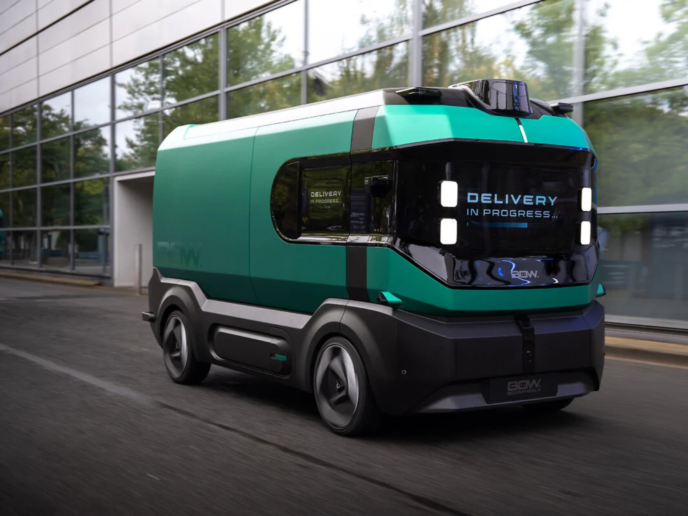
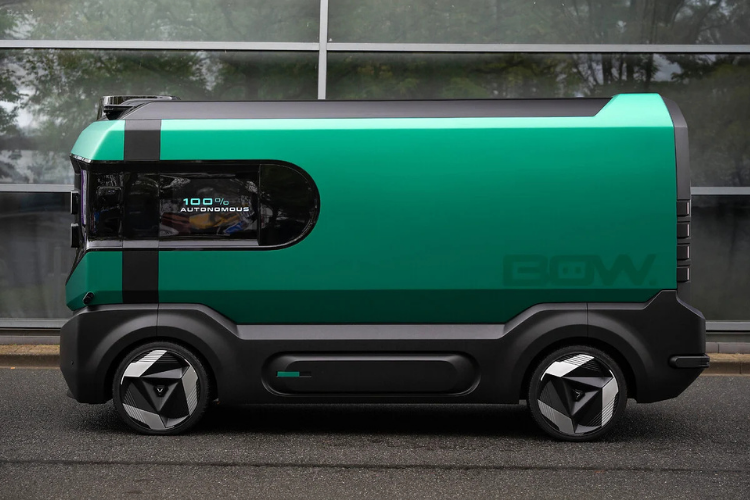
Stellantis is exploring a radically different approach to urban deliveries with Box-on-Wheels, a fully electric autonomous commercial vehicle designed to transport goods without a driver on board.
The new concept has been presented by Stellantis Pro One at IAA Transportation 2026 in Hanover and has been developed in partnership with UQI Robotics, a company specialising in artificial intelligence, robotics and autonomous driving.
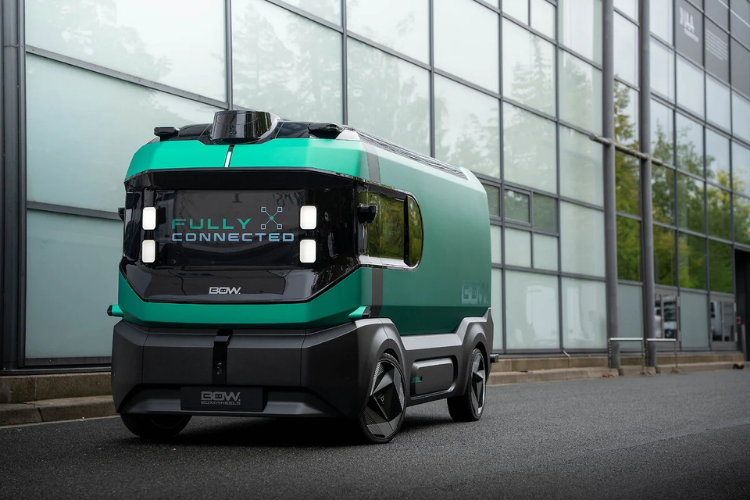
Rather than adapting an existing van to accommodate autonomous technology, Stellantis has taken a different approach. Box-on-Wheels has been designed around the absence of a driver, eliminating the conventional cab, windscreen, steering wheel and driving position.
This leaves much more of the vehicle’s footprint available for carrying goods and allows the same underlying platform to accommodate different body styles.
Stellantis has demonstrated both an enclosed box body and a flatbed configuration, highlighting the potential for the concept to perform a variety of commercial tasks.
Potential applications include parcel deliveries, food distribution, healthcare logistics, industrial operations, airport transport and wholesale deliveries.
What Is Stellantis Box-On-Wheels?
Box-on-Wheels is essentially an autonomous electric load-carrying platform that can be configured for different types of work.
The concept’s modular design means that the body mounted on the platform could potentially be changed depending on the intended application. An enclosed load area could be suited to parcels, food or other protected goods, while a flatbed arrangement could be used for transporting equipment and materials around industrial locations.
The vehicle is also designed to operate without a driver, using autonomous driving technology to navigate its surroundings.
Stellantis says the concept is particularly relevant to applications where vehicles follow predictable routes or operate in environments where conventional commercial vehicles may be less practical.
That could include factories, hospitals, airports, warehouses and other controlled or semi-controlled locations, as well as certain urban delivery operations.
The vehicle is fully electric and has been designed around overnight charging, although Stellantis has not yet provided detailed information about its battery capacity, charging speed or driving range.
Why Has Stellantis Developed Box-On-Wheels?
The project forms part of Stellantis’ wider investigation into autonomous mobility, following its Stellantis, Wayve and Uber robotaxi partnership and efforts to develop autonomous vehicle technology for future transport applications.
Autonomous logistics vehicles are already being deployed in parts of the Chinese market, giving manufacturers and technology companies an opportunity to develop systems for moving goods without a conventional driver.
Stellantis is working with UQI Robotics to assess how similar autonomous vehicle technology could potentially be adapted for other markets and different customer requirements.
UQI brings expertise in artificial intelligence, robotics and autonomous logistics, while Stellantis Pro One contributes its experience in commercial vehicles, fleet operations and servicing.
The partnership is therefore looking beyond the technology itself and towards where autonomous vehicles could provide a practical commercial benefit.
That could be particularly relevant where businesses need to move goods repeatedly along defined routes, potentially allowing autonomous vehicles to undertake tasks that would otherwise require a driver.
However, Stellantis is not suggesting that Box-on-Wheels is about to replace conventional vans.
Instead, the concept is being used to investigate new forms of commercial transport and autonomous logistics.
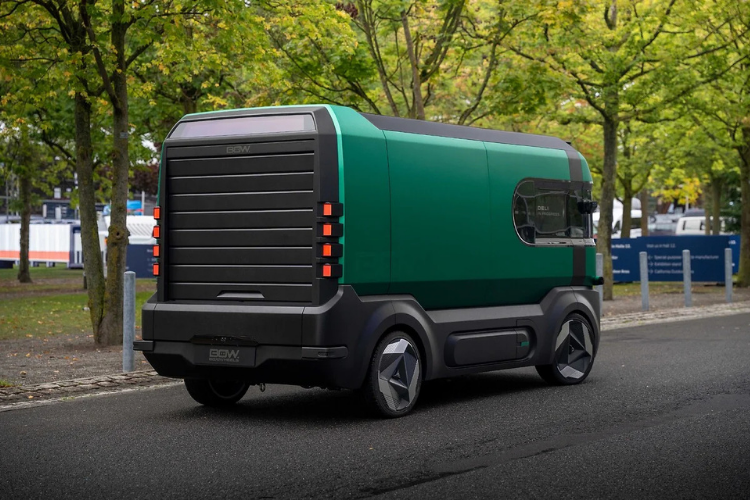
A Commercial Vehicle Without A Cab
One of the most significant features of Box-on-Wheels is also one of the most obvious: there is no driver’s cab.
A conventional van has to accommodate the driver and all of the equipment associated with operating the vehicle. Seats, steering controls, pedals, airbags, visibility requirements, heating and ventilation and other driver-related systems all take up space.
By removing the need for a driver, Stellantis can use a much greater proportion of the vehicle’s footprint for carrying goods.
That could potentially improve the efficiency of the overall vehicle package, particularly for operations where the vehicle spends most of its time transporting relatively small loads between predictable destinations.
The modular architecture could also mean that one basic platform could support multiple applications rather than requiring a separate vehicle for every type of delivery or logistics task.
However, the concept is still at an early stage, and Stellantis has not released the technical information that would allow its practical capabilities to be assessed fully.
There are currently no confirmed figures for payload, dimensions, battery capacity, range or maximum speed.
Those specifications will become increasingly important if Stellantis eventually decides to develop Box-on-Wheels into a production vehicle.
Where Could An Autonomous Electric Vehicle Be Used?
Controlled environments are likely to be among the most obvious potential applications.
A factory, warehouse complex or airport can provide a considerably more predictable operating environment than a busy public road. Vehicles may repeatedly travel between the same loading points, follow established routes and operate within areas where access and traffic conditions can be more tightly controlled.
This could make autonomous operation easier to implement.
Healthcare and industrial logistics could also provide opportunities, particularly where equipment, supplies or other goods need to be moved regularly between fixed locations.
Urban deliveries present another potential application.
Stellantis demonstrated Box-on-Wheels carrying items such as parcels, flowers and food, illustrating how a small autonomous vehicle could potentially perform last-mile deliveries without requiring a conventional delivery van and driver for every journey.
That could become increasingly interesting as cities introduce restrictions affecting commercial vehicles and businesses look for more efficient ways of completing the final stage of a delivery.
However, autonomous operation on public roads presents considerably greater challenges than operating within a controlled site. Regulations, pedestrian safety, unpredictable traffic conditions and interaction with other road users would all need to be addressed before a vehicle such as Box-on-Wheels could be widely deployed.
Stellantis Is Expanding Its Commercial Vehicle Strategy
Box-on-Wheels also needs to be viewed within Stellantis’ wider commercial vehicle expansion plans.
Stellantis Pro One currently estimates that its products cover around 70% of the potential global commercial vehicle market, with the company targeting around 90% coverage through its future product programme.
The manufacturer plans to introduce 11 new commercial vehicle models globally by 2030, including two new generations of vans and a new multi-energy mid-size pickup platform.
That future range is not being built exclusively around electric vehicles either.
Stellantis is continuing to develop commercial vehicles using a mixture of powertrain technologies, including internal combustion engines, hybrid systems and fully electric powertrains.
The company is also investigating smaller forms of urban transport, with the Fiat Tris electric three-wheeler forming part of its expanding commercial vehicle offering.
Box-on-Wheels takes that thinking another step further by questioning whether a future commercial vehicle needs to resemble a traditional van at all.
Will Box-On-Wheels Go Into Production?
There is currently no confirmed production date for Stellantis Box-on-Wheels.
Stellantis has described the vehicle as a concept and has not announced pricing, final specifications or plans for it to enter series production.
That means businesses looking for a commercial vehicle today should not view Box-on-Wheels as an upcoming replacement for conventional vans.
However, the fact that Stellantis has demonstrated a functioning autonomous vehicle at IAA Transportation rather than simply displaying a design exercise gives an indication of the technology the company is actively investigating.
The concept also highlights how the definition of a commercial vehicle could change as autonomous driving technology develops.
Traditional vans will continue to play an important role in business and logistics, but autonomous platforms could eventually create new options for specific delivery and transport applications.
For UK businesses, the growing range of electric vans already provides a more immediately available route towards lower-emission commercial vehicle operation, while developments such as Box-on-Wheels show where the industry could be heading in the longer term.
 Call our expert team on