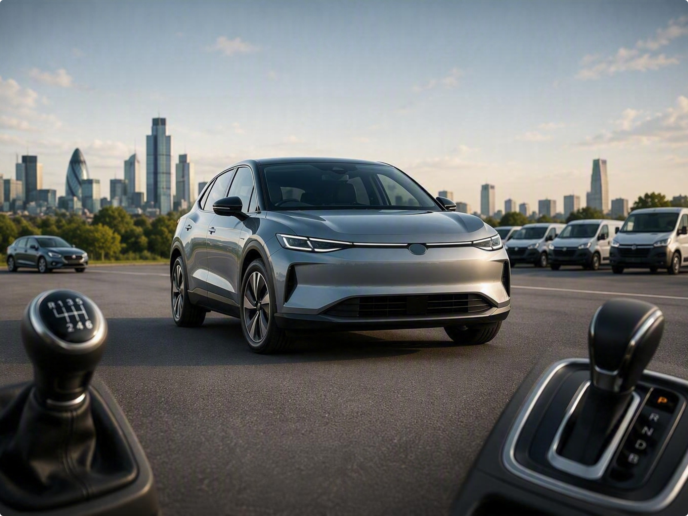
The decline of the manual gearbox in the UK new-car market is accelerating, with new figures showing that drivers are increasingly choosing automatic vehicles.
Analysis from Carwow indicates that manual cars accounted for just 8% of new-car enquiries during the first half of 2026. That represents a significant fall from 14% in 2025 and 21% in 2024.
The shift reflects both changing driver preferences and the rapidly changing make-up of the new-vehicle market, where electric and hybrid models are becoming increasingly common.
Manual Gearboxes Becoming Harder To Find
The decline in demand for manual cars is happening alongside a reduction in the number of new vehicles available with a manual transmission.
According to Carwow, only around one in five new-car models available through its marketplace can now be ordered with a manual gearbox.
The growth of electric vehicles is an important factor. Fully electric vehicles use a single-speed transmission and are therefore driven using an automatic-style setup. Most plug-in hybrids and conventional hybrids are also sold with automatic transmissions.
Together, hybrids and electric vehicles accounted for 52% of UK new-car registrations so far in 2026, further reducing the proportion of new vehicles available to drivers who specifically want a manual gearbox.
Carwow’s configurator data provides a similar picture. Manual transmissions featured in around 11% of vehicle configurations during the first half of 2026, compared with 14% during the same period last year.
The figures suggest that the decline is not simply down to drivers choosing automatic versions of cars that are also available with a manual gearbox. Increasingly, drivers are shopping in a market where manual versions simply aren’t available.
Why Are Drivers Moving Away From Manual Cars?
Convenience is one of the biggest factors behind the change.
Automatic vehicles remove the need for drivers to operate a clutch and manually select gears, which can make driving in congested urban areas and stop-start traffic considerably easier.
The growing availability of electric and hybrid vehicles is also changing expectations among new-car buyers.
As more drivers move into EVs and hybrids, automatic transmissions are becoming the norm rather than an alternative.
For some motorists, particularly those buying their first new vehicle, there may therefore be little reason to specifically seek out a manual car.
More Learners Are Choosing Automatic Driving Tests
The changing vehicle market is also having an impact on the way new drivers learn to drive.
More learner drivers are choosing to take their driving test in an automatic vehicle. While this can make sense for someone who expects to drive an automatic car or an EV, it can create limitations later if they need to operate a manual vehicle.
Drivers who pass their test in an automatic are generally restricted to automatic vehicles unless they subsequently take the required test to gain manual entitlement. This can become particularly important when drivers need to operate a van on a car licence.
Figures highlighted by the AA show how quickly this change is taking place. Automatic driving tests accounted for just 4% of tests in 2007/08, but this had risen to 29.4% by 2025/26.
That trend could become increasingly important for businesses that provide vehicles to employees.
Could The Decline In Manual Cars Affect Company Drivers?
For businesses operating cars and vans, the gradual disappearance of manual vehicles from the market is unlikely to cause an immediate problem.
However, employers may need to consider driving licence restrictions when allocating vehicles to employees.
A driver who has only passed an automatic test may be unable to drive a manual company vehicle, even if they are otherwise fully qualified to drive the vehicle’s category.
This could be particularly relevant to businesses operating mixed fleets, where employees may have access to different vehicles depending on the work they are carrying out.
For example, a company car driver may normally use an automatic electric car but occasionally need to use an older manual vehicle within the business fleet.
Employers should therefore make sure they understand the licence entitlement of employees before allowing them to drive company vehicles.
What Does This Mean For Vans?
The move towards automatic vehicles is also relevant to the van market.
Electric vans are becoming a more significant part of the UK commercial vehicle market, and these vehicles do not require conventional manual gear changes.
Many modern diesel vans are also available with automatic transmissions, giving businesses greater choice when replacing older vehicles.
For businesses moving towards electric vans, the transition away from manual gearboxes is unlikely to be a major issue. Drivers who move from a conventional manual van into an electric model may actually find the driving experience simpler.
Businesses retaining older diesel vans alongside newer electric or automatic vehicles should consider whether every member of their driving workforce has the appropriate licence entitlement, particularly when managing a business fleet.
The Manual Gearbox Is Becoming A Niche Choice
The manual gearbox is unlikely to disappear from UK roads overnight. There are still plenty of used manual cars and commercial vehicles in circulation, and some new vehicles continue to offer manual transmission.
However, the direction of travel is becoming increasingly clear.
The combination of rising EV and hybrid sales, greater availability of automatic vehicles and changing driver preferences means that manual transmissions are becoming a much smaller part of the new-vehicle market.
For younger drivers in particular, an automatic licence may increasingly be viewed as sufficient for everyday driving.
The challenge for businesses will be ensuring that this changing pattern of driving licences does not create problems when employees need to operate vehicles that still use a manual gearbox.
As the UK vehicle market continues its transition towards electrification, the traditional manual gearbox could become increasingly unusual in new cars — and eventually, a choice that fewer drivers have any reason to make.
 Call our expert team on
  Drop us a message