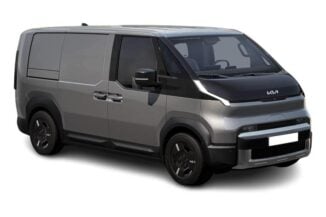
Buying a van outright can provide a straightforward way for a business to acquire a commercial vehicle without entering into a finance or leasing agreement.
Instead of making monthly finance payments, you pay the full purchase price of the vehicle upfront. Once the purchase has been completed, ownership of the vehicle passes to the business.
For businesses with sufficient capital available, outright purchase can offer complete ownership, no finance agreement and no contractual mileage restrictions.
It can also give you greater flexibility over how long you keep the vehicle, how you use it and when you decide to sell or replace it.
However, buying a van outright is not necessarily the right option for every business.
Using a large amount of capital to purchase a vehicle means that money is no longer available for other business expenses or investment. You also take responsibility for the vehicle’s depreciation and future resale value.
In this guide, we explain how outright purchase works, the benefits and disadvantages, how it compares with other van finance options and what businesses should consider before buying a van outright.
What Is Outright Purchase?
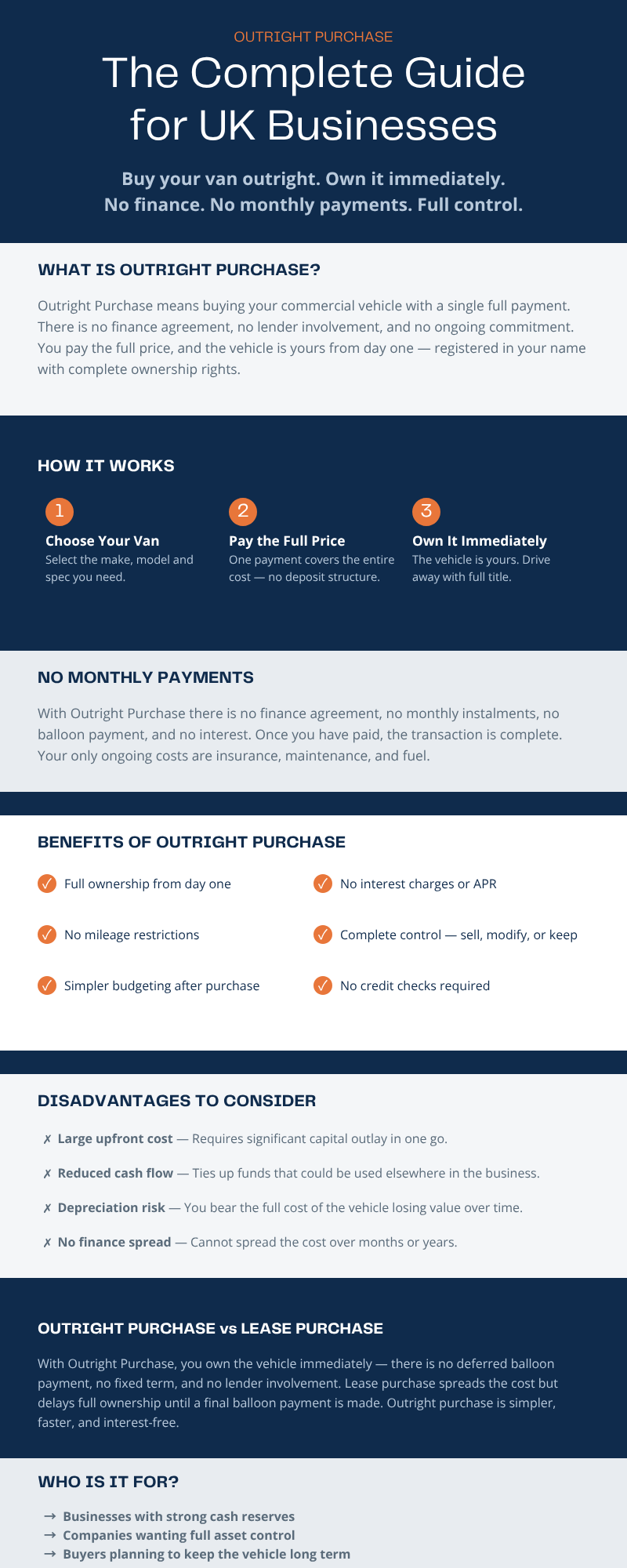
Outright purchase is the simplest way to acquire a van.
Rather than financing or leasing the vehicle, you pay the full purchase price upfront.
Once the purchase has been completed, you own the vehicle outright.
An outright purchase typically involves:
- Choosing your vehicle
- Agreeing on the purchase price
- Paying the full amount upfront
- Taking ownership of the vehicle
- Managing the vehicle’s ongoing running costs
There are no monthly finance payments because there is no finance agreement.
There is also no final balloon payment, as the full purchase price has already been paid.
This makes outright purchase particularly attractive to businesses that have sufficient funds available and want immediate ownership of their commercial vehicle.
How Does Outright Purchase Work?
Buying a van outright is relatively straightforward.
The process normally works like this:
1. Choose Your Van
You select the commercial vehicle that meets your business requirements.
This could be a:
- Small van
- Medium van
- Large van
- Electric van
- Pick-up truck
- Crew van
- Dropside van
- Tipper
- Luton van
- Refrigerated van
- Specialist commercial vehicle
- Converted commercial vehicle
The vehicle can then be specified around your requirements.
2. Agree The Purchase Price
Once you have selected the vehicle, an outright purchase price can be provided.
The price will depend on factors such as the vehicle, specification, optional equipment, conversions and availability.
If you require a specialist vehicle or conversion, these costs can also be incorporated into the overall purchase price.
3. Pay For The Vehicle
Unlike finance or leasing, the full purchase price is paid upfront.
There are no monthly repayments because you are not borrowing money to fund the purchase.
4. Take Ownership
Once the purchase has been completed, you own the vehicle.
You can then use it for your business without being tied to a finance or leasing agreement.
5. Keep, Sell Or Replace The Vehicle
Because you own the vehicle, you decide what happens to it.
You can keep it for as long as you want, sell it when you choose or trade it in against another vehicle.
What Are The Benefits Of Buying A Van Outright?
Buying a van outright can offer several advantages for businesses.
Immediate Ownership
One of the biggest advantages is that you own the vehicle immediately.
You do not have to wait until a finance agreement has been completed before ownership transfers.
Once the purchase has been completed, the vehicle is yours.
This gives you complete control over the vehicle and how long you want to keep it.
No Monthly Finance Payments
Because you have paid for the vehicle upfront, there are no monthly finance repayments.
This can make the ongoing financial commitment easier to manage once the initial purchase has been made.
Businesses do, of course, still need to budget for running costs such as insurance, servicing, maintenance, fuel and repairs.
No Finance Agreement
An outright purchase does not involve a finance agreement.
You are therefore not tied to a fixed finance term or required to make monthly payments for a specified period.
This can provide greater flexibility for businesses that want to retain control over their vehicles.
No Annual Mileage Restriction
Buying a van outright does not involve an agreed annual mileage allowance.
You can use the vehicle as much as your business requires.
This can be particularly useful for businesses covering high or unpredictable mileage.
For example, a courier business covering 30,000 or 40,000 miles a year does not need to structure its purchase around a leasing mileage allowance.
However, high mileage can affect the vehicle’s future resale value, so this should still be considered when deciding how long you intend to keep the van.
Sell The Vehicle Whenever You Choose
Because you own the vehicle, you are not tied to the end date of a finance or leasing agreement.
You can sell or trade in the vehicle when you decide the time is right.
This can be useful if your business changes and you need a different type of commercial vehicle.
No Balloon Payment
Unlike Lease Purchase, there is no large final payment to plan for.
The entire purchase price has already been paid at the beginning.
This means there is no risk of reaching the end of an agreement and having to find a substantial balloon payment to take ownership of the vehicle.
What Are The Disadvantages Of Buying A Van Outright?
Although outright purchase can offer complete ownership and flexibility, there are also disadvantages to consider.
Large Initial Investment
The biggest consideration is the amount of money required upfront.
Buying a new commercial vehicle outright can require a substantial amount of capital.
For a small or growing business, using a large proportion of its available cash to purchase a van may not be the most appropriate option.
The business needs to consider whether that money could be better used elsewhere.
Your Capital Is Tied Up In The Vehicle
Once you have purchased the van, your money is tied up in the vehicle.
Although you can sell the van later, you may not recover the amount you originally paid.
This means businesses should consider the expected length of ownership and likely resale value before making a purchase.
You Take The Depreciation Risk
When you own the vehicle, you take responsibility for its depreciation.
The value of a commercial vehicle can fall over time due to:
- Age
- Mileage
- Condition
- Market demand
- Vehicle specification
- Changes in technology
- Changes in the wider commercial vehicle market
This is particularly important when purchasing a new vehicle because the vehicle will normally lose value as it gets older and accumulates mileage.
Running Costs Remain Your Responsibility
Buying a vehicle outright does not remove the cost of running it.
Once you own the van, you are responsible for costs such as:
- Insurance
- Servicing
- MOT testing where applicable
- Repairs
- Tyres
- Fuel
- Charging
- Vehicle tax where applicable
These costs need to be considered alongside the initial purchase price.
Is Outright Purchase Better Than Leasing?
There is no universally better option.
It depends on the financial position of the business, how the vehicle will be used and whether immediate ownership is important.
Outright purchase can be attractive if you have the capital available and want to own the vehicle immediately.
Leasing can be more suitable if preserving capital and spreading the cost through monthly payments are higher priorities.
With Contract Hire, for example, you make an initial payment followed by regular rentals and normally return the vehicle at the end of the agreement.
With outright purchase, you own the vehicle and decide when you want to sell or replace it.
The best option therefore depends on your individual circumstances.
Outright Purchase Vs Hire Purchase
Outright Purchase and Hire Purchase can both ultimately result in vehicle ownership, but the way you pay for the vehicle is very different.
With outright purchase, the full purchase price is paid upfront, and you own the vehicle.
With Hire Purchase, the cost is spread through an initial payment and regular monthly instalments over an agreed term. Ownership normally transfers once the agreement has been completed, subject to the terms of the agreement.
Outright Purchase
- Full payment upfront
- Immediate ownership
- No monthly finance payments
- No finance agreement
- No balloon payment
- No annual mileage restriction
- You can sell the vehicle whenever you choose
Hire Purchase
- Initial payment
- Monthly payments
- Finance agreement
- Interest and applicable fees
- Ownership after completion of the agreement
- No standard Contract Hire mileage allowance
If you have the money available, outright purchase avoids the need to finance the vehicle.
If you would rather retain your capital and spread the cost, Hire Purchase may be worth considering.
Outright Purchase Vs Lease Purchase
Outright Purchase and Lease Purchase are fundamentally different.
With Lease Purchase, the vehicle is financed over an agreed period, with part of the balance deferred until the end as a balloon payment.
With outright purchase, there is no finance agreement and no deferred balance.
The full purchase price is paid at the beginning.
Outright Purchase
Full payment upfront → Immediate ownership
Lease Purchase
Initial payment → Monthly payments → Balloon payment → Ownership
Lease Purchase can therefore provide a way of spreading the cost while working towards ownership.
Outright purchase is simpler because there is no finance agreement or final balloon payment to manage.
Outright Purchase Vs Contract Hire
Contract Hire is designed around using a vehicle for an agreed period rather than purchasing it outright.
You normally pay an initial rental followed by monthly rentals and return the vehicle at the end of the agreement, subject to the contract terms.
An agreed annual mileage is normally part of the contract.
With outright purchase, there is no requirement to return the vehicle.
You own it and can continue using it for as long as you wish.
This can make outright purchase particularly attractive to businesses that want to keep their vans for many years or cover high annual mileage.
Is There A Mileage Limit When Buying A Van Outright?
No.
There is no annual mileage allowance attached to an outright purchase.
You can use the vehicle for as many miles as your business requires.
This can be a major advantage for businesses where annual mileage is difficult to predict.
For example, a delivery company may cover 20,000 miles one year and 40,000 miles the next.
With an outright purchase, there is no excess mileage charge because there is no contractual mileage allowance.
However, mileage will affect the vehicle’s condition and resale value.
A van with very high mileage may be worth less when you eventually sell it, so expected mileage should still be considered when deciding how long you intend to keep the vehicle.
Can I Buy An Electric Van Outright?
Yes.
Electric vans can be purchased outright, subject to the vehicle and availability.
For businesses considering an electric commercial vehicle, outright purchase provides immediate ownership without entering into a finance or leasing agreement.
Before buying an electric van, businesses should consider:
- Daily mileageDaily mileage
- Battery range
- Charging availability
- Charging speeds
- Payload
- Vehicle size
- Access to workplace charging
- Access to home charging
- Expected ownership period
If you plan to keep the vehicle for many years, outright purchase can provide flexibility over how and when the vehicle is eventually replaced.
Can I Buy A Pick-Up Truck Outright?
Yes.
Outright purchase is not limited to conventional panel vans.
Businesses can also purchase pick-up trucks outright, subject to availability.
This can include vehicles used by:
- Builders
- Farmers
- Landscapers
- Tradespeople
- Utilities businesses
- Construction companies
- Groundworkers
- Rural businesses
If you need a pick-up for work and have the capital available, buying outright can provide immediate ownership without a finance agreement.
Can I Buy A Converted Van Outright?
Yes.
Outright purchase can also be used for specialist commercial vehicles and commercial vehicle conversions, subject to availability.
This can include:
- Tippers
- Dropsides
- Flatbeds
- Luton vans
- Curtainsiders
- Refrigerated vans
- Freezer vans
- Cherry pickers
- Utility vans
- Welfare vans
- Specialist commercial vehicles
The vehicle can be specified around the requirements of your business.
This can be particularly useful for businesses intending to keep the vehicle for several years and wanting a specification designed specifically for their operation.
Does Outright Purchase Include Maintenance?
No, not automatically.
When you buy a van outright, you become responsible for the vehicle’s ongoing running costs.
This includes servicing, maintenance, repairs, tyres, insurance and other operating costs.
A separate maintenance or servicing package may be available depending on the vehicle and supplier.
It is important to consider these costs when calculating the overall cost of ownership.
Can A Business Buy A Van Outright?
Yes.
Businesses can buy commercial vehicles outright where a suitable vehicle and purchase arrangement are available.
For an established business with sufficient capital, outright purchase can be a straightforward way to acquire a commercial vehicle without taking on additional finance commitments.
However, businesses should consider whether using a significant amount of available capital to purchase a vehicle is appropriate for their wider financial position.
Is Buying A Van Outright Good For A Business?
Outright purchase can be a good option for businesses that:
- Have sufficient capital available
- Want immediate ownership
- Want to avoid monthly finance payments
- Cover high annual mileage
- Plan to keep the vehicle for several years
- Want the freedom to sell the vehicle whenever they choose
- Do not want to enter into a finance agreement
It may be less suitable for a business that needs to preserve cash or would prefer to spread the cost of acquiring the vehicle.
In that situation, finance or leasing may provide a more suitable alternative.
What Should I Consider Before Buying A Van Outright?
Before committing to an outright purchase, it is worth considering the full cost of ownership rather than just the purchase price.
Think about:
- The amount of capital required
- The impact on business cash flow
- Expected annual mileage
- Expected ownership period
- Vehicle depreciation
- Future resale value
- Servicing and maintenance costs
- Insurance
- Fuel or charging costs
- Whether finance or leasing could provide better use of your available capital
Buying a van outright is a major investment, so it is important to consider how the purchase fits into your wider business plans.
What Are The Tax Implications Of Buying A Van Outright?
The tax treatment of purchasing a commercial vehicle depends on factors including your business structure, VAT status, how the vehicle is used and the applicable HMRC rules.
VAT treatment and capital allowances can also depend on the circumstances of the business and vehicle.
Businesses should therefore speak to their accountant or tax adviser before making a purchase based on potential tax benefits.
Tax treatment should not be the only factor when deciding how to acquire a commercial vehicle.
Can I Buy A Used Van Outright?
Yes.
Buying a used van outright can provide an alternative to purchasing a brand-new commercial vehicle.
A used van can have a lower upfront purchase price, which may make outright ownership more accessible.
However, businesses should consider the vehicle’s age, mileage, condition, service history and likely future maintenance requirements.
The right choice will depend on the type of work the vehicle needs to perform and how long you intend to keep it.
How Much Does It Cost To Buy A Van Outright?
The cost depends on the vehicle and specification.
Factors that can affect the price include:
- Make and model
- Vehicle size
- Engine or powertrain
- Electric or diesel
- Trim level
- Payload
- Wheelbase
- Optional equipment
- Accessories
- Specialist conversions
- Vehicle availability
A small van will naturally have a very different outright purchase price from a large commercial vehicle or specialist conversion.
For an accurate price, you should discuss your requirements with the supplier.
Why Choose Commercial Vehicle Contracts?
At Commercial Vehicle Contracts, we understand that choosing a commercial vehicle is only part of the decision.
The way you acquire that vehicle also needs to work for your business.
With more than 25 years of experience helping UK businesses source commercial vehicles and finance solutions, we can help you consider the available options and find a vehicle that meets your requirements.
Whether you are looking for a standard panel van, pick-up, electric van or specialist commercial vehicle, our team can discuss your requirements and help you find a suitable vehicle.
If you have the capital available and want to own your vehicle immediately, we can also discuss outright purchase options.
Is Outright Purchase Right For Your Business?
Outright purchase can be an attractive option for businesses that have sufficient capital available and want complete ownership of their commercial vehicle.
You pay for the vehicle upfront, own it immediately and have complete freedom over how long you keep it.
There are no monthly finance payments, no balloon payment and no annual mileage allowance attached to an outright purchase.
However, the large initial investment means that businesses need to consider cash flow carefully.
If using a substantial amount of capital to purchase a van would restrict your ability to invest elsewhere in the business, Hire Purchase, Lease Purchase or Contract Hire may be worth considering instead.
The most suitable option will depend on your circumstances, budget, mileage and plans for the vehicle.
Outright Purchase FAQs
Buying a van outright means paying the full purchase price upfront rather than using finance or a leasing agreement. Once the purchase has been completed, you own the vehicle.
No. With outright purchase, the full price is paid upfront, and you own the vehicle immediately. With Hire Purchase, the cost is spread through an initial payment and monthly instalments, with ownership normally transferring once the agreement has been completed.
No. Outright purchase does not have an agreed annual mileage allowance. You can use the vehicle for as many miles as your business requires.
Yes. Because you own the vehicle, you can sell or trade it in whenever you choose. Its value will depend on factors such as age, mileage, condition, specification and the used vehicle market.
Yes. Electric vans can be purchased outright, subject to vehicle availability.
Yes. Pick-up trucks can also be purchased outright, subject to availability.
Yes. Depending on availability, outright purchase can be used for specialist commercial vehicles and conversions such as tippers, dropsides, Lutons, refrigerated vans and other commercial vehicle conversions.
Yes. The defining feature of outright purchase is that the full purchase price is paid upfront rather than being spread through a finance agreement.
No. There is no balloon payment because the full purchase price has already been paid.
Not automatically. Once you own the vehicle, you are responsible for servicing, maintenance, repairs, tyres, insurance and other running costs unless a separate maintenance arrangement has been agreed.
It depends on your circumstances. Outright purchase provides immediate ownership and avoids monthly finance or lease payments, but requires a larger upfront investment. Leasing can help businesses preserve capital and spread the cost through monthly payments.
Yes. Businesses can purchase commercial vehicles outright where suitable vehicles and purchase arrangements are available.
Yes. Used commercial vehicles can also be purchased outright, subject to availability.
The main disadvantages are the large upfront cost, tying up business capital and taking responsibility for the vehicle’s depreciation and future resale value.
It can be. There is no contractual mileage allowance with an outright purchase, making it suitable for businesses that cover high or unpredictable mileage. However, higher mileage can affect the vehicle’s future resale value.
Contact Commercial Vehicle Contracts with details of the vehicle you require. The team can discuss your requirements and provide an outright purchase quotation where available.
Outright Purchase involves paying for the vehicle in full and owning it immediately, whereas Hire Purchase allows the business to spread the cost through regular payments before ownership transfers once the agreement is completed.
Outright Purchase means the business pays for the vehicle upfront and owns it immediately, while Finance Lease allows the business to spread the cost through regular rentals without normally taking ownership of the vehicle.
Outright Purchase provides immediate ownership after the vehicle has been paid for in full, whereas Lease Purchase allows the business to spread the cost through regular payments with a final balloon payment before ownership can transfer, subject to the agreement.
Outright Purchase involves buying the vehicle outright and taking immediate ownership, while Business Contract Hire allows the business to use the vehicle for an agreed period and mileage before normally returning it.
 Call our expert team on