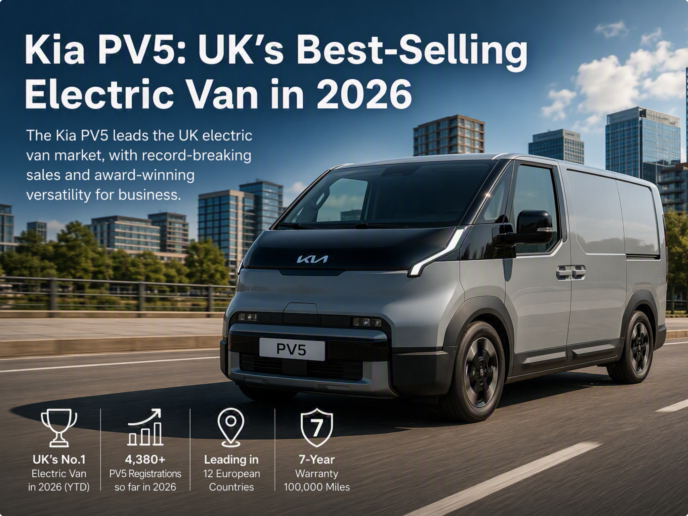
The Kia PV5 has quickly established itself as one of the UK’s leading electric commercial vehicles, becoming the country’s best-selling electric van so far in 2026.
New registration figures show that the PV5 Cargo is currently leading the UK electric light commercial vehicle market on year-to-date registrations, despite only entering the UK market towards the end of 2025.
The achievement represents a significant breakthrough for Kia’s commercial vehicle ambitions. The manufacturer began 2026 without an established position in the UK’s electric LCV market, but strong demand for the PV5 has now pushed Kia into third place in both the July and year-to-date electric LCV rankings.
The latest figures also come during a record-breaking month for Kia, with the manufacturer recording its strongest July performance in the UK.
The Kia PV5 is already making a major impact in the UK electric van market — and we have special Kia PV5 leasing offers available for UK businesses.
View our latest Kia PV5 offers and find out how much you could save on your next electric van.
View Kia PV5 Passenger Van Special Offers
View Kia PV5 Cargo Van Special Offers
Kia PV5 Sales Continue To Gather Pace
Kia registered more than 1,000 PV5 models in the UK during July alone for the first time.
The monthly total consisted of 784 PV5 Cargo vans and 235 PV5 Passenger models, taking Kia’s year-to-date registrations to 3,239 PV5 Cargo models and 1,141 PV5 Passenger variants.
The combined total of 4,380 PV5 registrations is particularly significant given how recently the model was introduced to the UK market.
Kia has also comfortably exceeded its original sales expectations for the PV5, with demand proving considerably stronger than anticipated.
The figures demonstrate how quickly the electric van market is evolving, with businesses now having access to an increasing number of dedicated electric commercial vehicles rather than simply electric versions of existing petrol or diesel vans.
Kia Has Made An Immediate Impact On The Electric Van Market
The PV5’s success has allowed Kia to establish itself as a serious competitor in the UK electric LCV market in a remarkably short period of time.
The manufacturer now sits third in the UK’s electric light commercial vehicle market both for July and year-to-date registrations.
That is an impressive result for a manufacturer that had no established presence in the sector at the beginning of the year.
The PV5 is also helping Kia build a wider commercial vehicle offering around its Platform Beyond Vehicle, or PBV, strategy.
Rather than simply producing a conventional panel van with an electric powertrain, Kia has designed the PV5 as a dedicated platform that can support different vehicle configurations and business applications.
This gives the model potential beyond traditional delivery work, with Cargo, Passenger and Chassis Cab versions forming the basis of a wider range of commercial and specialist applications.
What Makes The Kia PV5 Attractive To Businesses?
The PV5 has entered an increasingly competitive electric van market, so its early success suggests it is offering something that is appealing to business users.
One of its biggest advantages is the range of configurations available.
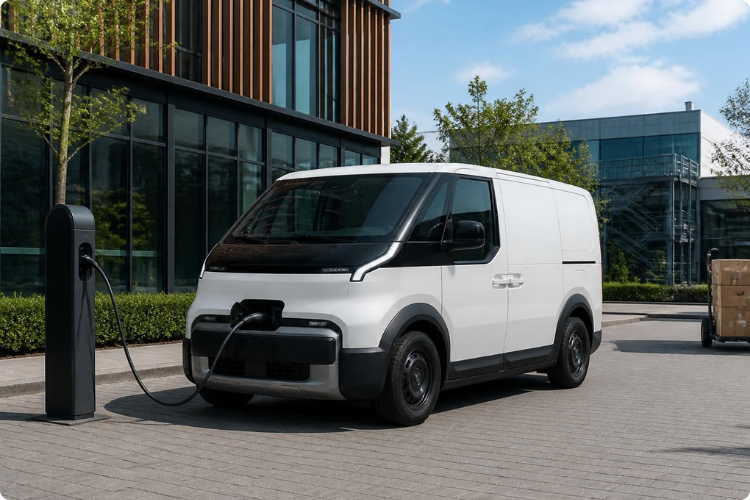
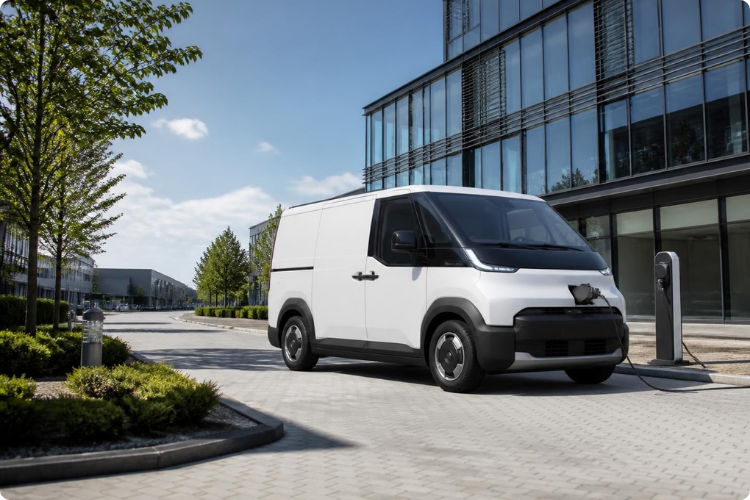
The PV5 Cargo is aimed at businesses that need a practical electric panel van for transporting goods, equipment and tools. Kia says the Cargo can provide up to 4.4m³ of load space, with a payload of up to 800kg depending on specification.
The design also focuses heavily on making the van easy to use during the working day.
A low loading step, wide rear doors and mounting points for storage and racking can make the PV5 particularly suitable for businesses that spend much of their time loading and unloading equipment.
The Cargo is also available with rapid charging capability, with Kia quoting approximately 30 minutes to charge from 10% to 80% under suitable conditions. The maximum quoted WLTP range is up to 258 miles, although real-world range will vary depending on factors such as load, driving conditions, temperature and speed.
For businesses operating mainly in urban and regional environments, these characteristics could make the PV5 a practical alternative to a conventional diesel van.
More Than Just A Cargo Van
One of the key differences between Kia’s approach and that of some established van manufacturers is the wider PBV strategy behind the PV5.
Alongside the Cargo model, Kia offers the PV5 Passenger, providing a flexible electric vehicle aimed at transporting people as well as their luggage and equipment. For businesses comparing electric passenger-focused vehicles, our [Kia PV5 vs Volkswagen ID. Buzz comparison] provides a closer look at how the two models compare.
The Passenger model can provide up to 1,330 litres of luggage capacity behind five seats, while Kia has also continued to expand the PV5 range with additional variants.
The availability of a Chassis Cab version also opens the door to more specialist commercial applications.
This could be particularly relevant to businesses requiring conversions, with the underlying vehicle potentially being adapted for specific operational requirements.
For fleet operators, having a common electric platform that can serve several different purposes could make it easier to introduce electric vehicles across different areas of a business.
Kia PV5 Success Extends Across Europe
The PV5’s success is not limited to the UK.
The model has also established itself as Europe’s best-selling electric light commercial vehicle in the small van, or C-segment, category.
Figures reported from European industry data show the PV5 accounting for around 37% of electric vans sold in the European C-segment, with the model leading its category in 12 countries.
The UK has become one of the most important markets for the PV5, with strong demand helping Kia establish a significant position within Europe’s rapidly expanding electric van sector.
The results suggest that the PV5’s appeal is not simply the result of one particularly strong market. Instead, the model appears to be gaining traction across several European countries.
Read our Kia PV5 Passenger review
Kia Records Its Best-Ever July
The success of the PV5 formed part of an exceptionally strong month for Kia in the UK.
The manufacturer registered 9,870 vehicles across its passenger car and PBV ranges during July, making it Kia’s strongest July on record.
The company ranked third in the combined UK passenger car and light commercial vehicle market and second in the passenger car market.
Electric vehicles were another major contributor to Kia’s performance.
The manufacturer recorded 3,731 battery electric vehicle registrations during July, making Kia the UK’s best-selling EV brand for the month.
The Kia EV3 was also one of the UK’s strongest-performing electric cars, with 1,691 registrations, placing it second in the country’s EV market for July.
The figures underline the growing importance of electrification to Kia’s overall UK business, with both passenger cars and commercial vehicles contributing to the manufacturer’s expanding electric portfolio.
Kia PV5 Provides Another Option For Electric Fleets
The PV5’s rapid rise is particularly significant for UK businesses looking to move their commercial fleets away from diesel.
Electric van choice has increased considerably in recent years, but fleet operators still need to consider factors such as range, payload, charging, purchase or leasing costs, vehicle availability and suitability for their particular operation.
The arrival of the PV5 gives businesses another option in the competitive medium-sized electric van market.
Businesses considering their options can also compare the Kia PV5 directly with the Volkswagen ID. Buzz to see how the two electric vehicles differ in terms of practicality, space and suitability for business use.
For companies operating predominantly within towns and cities, an electric van can offer several potential benefits, including zero tailpipe emissions and the ability to operate without the restrictions associated with some urban clean-air and emissions zones.
However, businesses considering an electric van need to look beyond the headline range figure.
Daily mileage, payload, charging access and the availability of workplace or depot charging can all have a significant impact on whether an electric van is suitable.
For fleets with predictable daily routes and access to charging infrastructure, the PV5 could provide an increasingly compelling alternative to a diesel-powered van.
The PV5 Is Building A Strong Reputation
Sales are not the only area where the PV5 has made an impression.
The model has also picked up industry recognition since its arrival, strengthening Kia’s credibility in the commercial vehicle market.
The PV5 Cargo has received positive attention for its practicality, technology and electric powertrain, while its arrival represents Kia’s first major step into the dedicated light commercial vehicle sector.
That is important because businesses purchasing or leasing commercial vehicles tend to place significant emphasis on reliability, running costs, practicality and aftersales support.
Kia’s established reputation in the passenger car market, combined with its seven-year/100,000-mile warranty, also gives the PV5 an advantage when businesses are considering long-term ownership or leasing costs.
Kia PV5 Could Become A Major Player In UK Van Leasing
The speed at which the PV5 has climbed the electric LCV rankings demonstrates how quickly the UK’s electric van market is changing.
Kia has gone from having little presence in the electric commercial vehicle market to becoming one of the UK’s leading manufacturers within just a few months.
For businesses, that growing competition is good news.
More manufacturers entering the electric van market means greater choice in terms of vehicle size, specification, payload, range and price. It also gives fleet operators more opportunity to find an electric vehicle that genuinely fits their business rather than having to compromise around a limited selection of models.
The PV5’s availability in several configurations could make it particularly interesting to businesses with different vehicle requirements across their fleet.
Whether it is being used for deliveries, transporting equipment, carrying passengers or forming the basis of a specialist conversion, the platform has been designed with flexibility in mind.
What Does The Kia PV5’s Success Mean For UK Fleets?
The Kia PV5’s rapid rise is another indication that electric vans are becoming an increasingly important part of the UK commercial vehicle market.
While diesel remains an important choice for many businesses, particularly those covering long distances or carrying heavy loads, electric vans are becoming increasingly viable for companies with the right operating profile.
The PV5 gives businesses another modern electric option, combining dedicated EV architecture with practical commercial vehicle features and Kia’s established warranty package.
Its sales performance also suggests that demand for electric vans is continuing to grow where the vehicle can meet the operational requirements of the business.
For fleet operators considering their next vehicle, the key question is therefore no longer simply whether an electric van is available. Instead, it is whether a particular electric van can provide the range, payload, charging capability and practicality required for the working day.
The PV5 is clearly proving that it can meet those requirements for a growing number of UK customers.
View our latest Kia PV5 – Cargo and Passenger offers and find out how much you could save on your next electric van.
 Call our expert team on