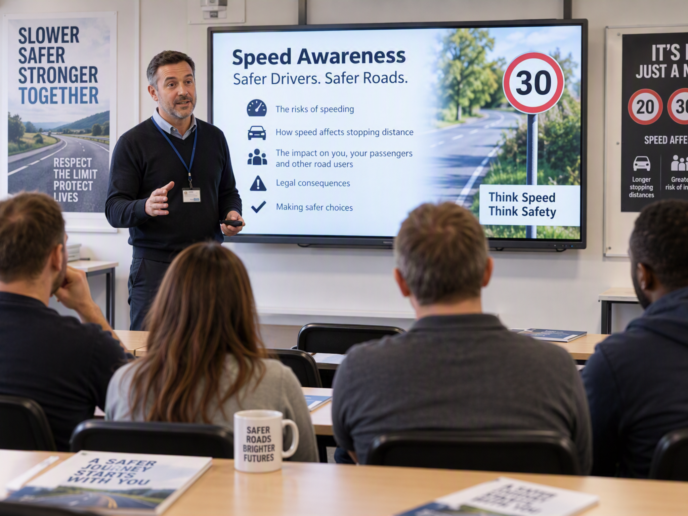
Getting caught speeding is something most drivers hope never happens. But if you are caught travelling only slightly above the speed limit, you may be offered a choice: accept a fixed penalty and penalty points, or attend a speed awareness course instead.
On paper, the decision can appear straightforward. A speed awareness course means no penalty points, while accepting the fixed penalty normally means paying the applicable fine and receiving three points on your driving licence.
But there is another side to the calculation.
The cost of a speed awareness course can vary, and attending one takes several hours. Depending on where and when the course is held, it could also mean taking time away from work and paying for fuel, parking or other travel costs. For drivers who use a van for work, there can also be different speed limits depending on the vehicle and circumstances, as explained in our Guide To Speed Limit Rules For Vans In The UK.
So which option actually costs more?
I recently found myself asking exactly that question after being caught travelling at 34mph in a 30mph limit. I was offered a speed awareness course and decided to take it rather than accept three penalty points.
The course itself was straightforward, but by the time I had paid the £96.20 course fee, taken half a day of annual leave, travelled 40 minutes to Eastbourne and 40 minutes back, and spent more than three hours in a classroom, I started wondering whether accepting the standard £100 fixed penalty and three points would actually have been the simpler option.
That does not mean a speed awareness course is necessarily the wrong choice. There are significant benefits to avoiding penalty points, and the course is designed as an educational intervention rather than simply another punishment.
But it does raise an interesting question: what are the real costs of a speed awareness course compared with accepting three points?
What Is A Speed Awareness Course?
A National Speed Awareness Course is part of the National Driver Offender Retraining Scheme (NDORS), which provides educational courses as an alternative to prosecution or a fixed penalty for certain lower-level driving offences.
The police decide whether a driver is offered a course. It is not something a motorist can simply choose instead of a speeding fine whenever they want.
If you are invited to attend, you book directly with the course provider. GOV.UK states that the course provider sets the final price, so the cost can vary depending on the police force and provider.
Drivetech, which delivers police-referred courses under the NDORS scheme, offers its National Speed Awareness Course online as well as at selected classroom venues. The online course typically takes around four hours to complete, while classroom courses can have different timings depending on the course and venue. This means the time commitment can vary depending on how and where the course is delivered.
The course is designed to help drivers understand why speed limits exist, recognise the risks associated with speeding and consider how their driving behaviour can change in the future.
There is no traditional pass-or-fail test. However, participants are required to attend for the full session and participate fully.
What Happens If You Accept The Fixed Penalty?
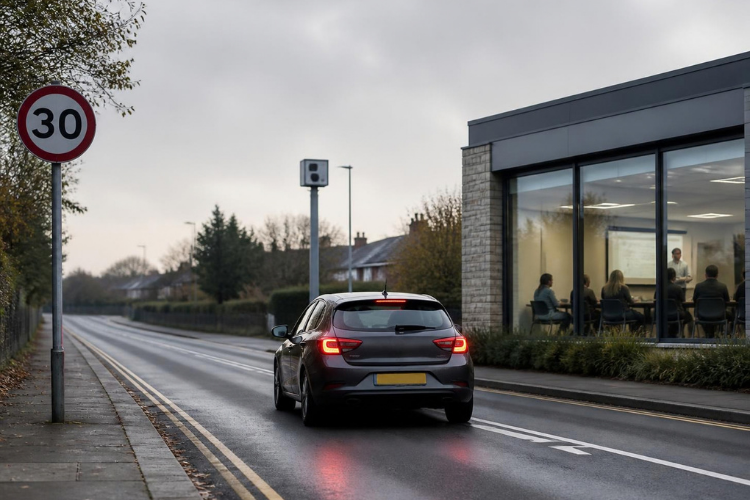
If you are given a Fixed Penalty Notice for speeding and accept it, the standard penalty is normally a £100 fine and three penalty points, although the exact circumstances of an individual offence can vary.
GOV.UK states that the driving licence code associated with the offence remains on the driving record for four years.
For someone who has never received penalty points before, three points may not seem particularly serious.
However, penalty points are cumulative. Receiving further endorsements in the future can eventually lead to much more serious consequences, including disqualification.
There is also a difference between simply having three points and having no endorsement at all, particularly when it comes to questions asked by motor insurers.
Speed Awareness Course vs 3 Points
At first glance, the comparison looks simple.
| Factor | Speed Awareness Course | Fixed Penalty |
|---|---|---|
| Course fee | Yes | No |
| Speeding fine | No, if course completed successfully | Normally applies |
| Penalty points | No | Normally 3 |
| Time commitment | Around 3 hours for Drivetech’s course; overall time can vary | Minimal |
| Travel | None for online attendance; may be required for classroom attendance | Generally none |
| Time off work | Potentially required | Generally none |
| Licence endorsement | No penalty points | Yes |
| Insurance implications | Course is not a speeding endorsement | Conviction/endorsement may need to be disclosed |
| Educational element | Yes | No course |
| Repeat-course restrictions | Yes | Not applicable |
The important point is that there is no single answer that applies to every driver.
The financial calculation is only one part of the decision.

The Financial Cost Of A Speed Awareness Course
The course itself has a fee, but there is no single nationwide price that applies to every driver. In my case, the Drivetech speed awareness course cost £96.20.
GOV.UK states that the course provider sets the final price, meaning the amount can vary depending on the provider and police force involved.
The standard fixed penalty for speeding is normally £100 and three penalty points. That meant the course itself was £3.80 cheaper than the fixed penalty in my case.
However, the course also involved travel, fuel, several hours of my time and half a day of annual leave.
This means the course should not simply be viewed as a direct financial alternative to the fixed penalty.
Successfully completing the course means you do not pay the speeding fine and do not receive the penalty points associated with the offence.
For many drivers, avoiding the endorsement will be the main reason for accepting the course.
But the course fee isn’t necessarily the end of the calculation.
The Hidden Cost: Your Time
This is where the comparison becomes more interesting.
The course itself may only account for part of the total time commitment. If the course is held during working hours, you may have to take annual leave or lose working time. There could also be travel to and from the venue.
If the course is held during working hours, you may have to take annual leave or lose working time. There could also be travel to and from the venue.
In my case, the course itself lasted more than three hours, but I also had to travel 40 minutes to Eastbourne and another 40 minutes back. I also had to take approximately half a day of annual leave to attend.
That meant the course and travel accounted for at least 4 hours and 20 minutes of my day, before allowing for any additional time around arriving at the venue. The actual cost to me was therefore greater than the £96.20 course fee alone.
For someone who is self-employed, the calculation could be even more significant. If attending the course means losing several hours of billable work, the opportunity cost could be considerably higher than the course fee.
For an employee, meanwhile, the financial impact may depend on whether the employer allows the time to be taken as annual leave, unpaid leave or working time.

What About Travel Costs?
There can also be a travel cost.
Some drivers may be able to complete the course online, while others may attend a classroom venue. Drivetech, which delivers police-referred courses under the NDORS scheme, offers its National Speed Awareness Course online as well as at selected classroom venues. Drivetech currently states that the course duration is three hours, although the overall time commitment can vary depending on how and where the course is delivered.
That can make a significant difference to the overall cost and time commitment. An online course may still require several hours away from work, but there is no journey to and from a course venue, meaning there could be no additional fuel, parking or public transport costs.
For classroom courses, the driver may have to travel to a venue.
The total cost can therefore include:
Course fee + fuel + parking + public transport costs + time away from work.
For businesses, these additional running costs are part of the wider calculation involved in operating a commercial vehicle. Our guide to The True Cost Of Running A Van looks at the different costs businesses need to budget for.
For someone travelling a significant distance, those additional costs can be worth considering.

Does A Speed Awareness Course Add Points To Your Licence?
No.
One of the biggest advantages of successfully completing a speed awareness course is that you do not receive the penalty points associated with the original speeding offence.
Drivetech confirms that successful completion results in no fine and no penalty points being added to the driver’s licence.
This is fundamentally different from accepting the fixed penalty.
If you accept the standard speeding penalty, GOV.UK states that three points are normally added to your licence.
For a driver with an otherwise clean licence, three points may not immediately cause any practical problems. If you are concerned about whether penalty points affect your ability to lease a vehicle, our Vehicle Leasing FAQs explain how points on your licence are treated when applying for a car, van or pickup lease.
However, keeping a clean licence can have value in itself, particularly if you drive regularly for work.
What About Car Insurance?
Insurance is one of the most important differences to consider when comparing a speed awareness course with accepting penalty points.
A successfully completed speed awareness course does not result in penalty points being added to your driving licence. It is therefore different from accepting a fixed penalty and receiving a speeding endorsement.
Receiving three penalty points does not automatically mean that your insurance premium will increase by a specific amount. However, insurers can take driving convictions and endorsements into account when assessing risk and calculating premiums.
The impact can vary considerably between drivers and insurers. Factors such as age, location, vehicle, driving history and the type and number of convictions can all influence the price quoted.
This means there is no reliable figure that can be applied to every driver. One motorist might see little or no difference, while another could receive a higher quote when their driving history changes.
A speed awareness course is treated differently from a speeding conviction. The Association of British Insurers has stated that speed awareness courses are not classed as convictions. However, drivers should always answer their insurer’s questions accurately, because individual insurers can ask different questions about driving offences and courses.
There is therefore a potential longer-term financial consideration when choosing between a course and penalty points. The cost of the points is not necessarily limited to the initial fixed penalty; they could also become relevant when you next obtain or renew your motor insurance.
That does not mean that accepting three points will definitely make your insurance more expensive. It simply means that insurance is another factor worth considering when comparing the two options.
For drivers leasing a van, it is also important to understand the insurance requirements that apply to the vehicle. Our guide to Insuring a Lease Van explains the key considerations for leased vehicles.

Who Can Take A Speed Awareness Course?
Not every driver caught speeding will be offered a course.
GOV.UK states that the police decide whether it is appropriate to offer a course and that a driver must not have attended a speed awareness course within the previous three years.
The speed at which you were travelling is also relevant.
The precise thresholds used for course eligibility can depend on the relevant police force and offence circumstances. Drivetech explains that courses are intended for lower-level speeding offences and that eligibility is determined by the referring police force.
This is important because drivers should not assume that being only slightly above the limit automatically guarantees a course.
The police may decide that a fixed penalty or prosecution is more appropriate.
Why Was I Offered A Course At 34mph?
This is where my own experience comes in.
I was travelling at 34mph in a 30mph limit.
That is only 4mph above the posted limit, but it was still above the legal speed limit and resulted in enforcement action.
Being offered a speed awareness course meant I had an alternative to accepting the standard three-point penalty.
At the time, avoiding three points seemed like the obvious option.
Having now completed the course, however, I can see that the decision involves more than simply comparing a course fee with three points.
The course came with a financial and time commitment beyond the booking fee, particularly because I attended in person and had to take time away from work.
That doesn’t make the course pointless.
It simply demonstrates that the real-world cost of a course can be considerably higher than the amount shown on the booking confirmation.
Is A Speed Awareness Course Actually Useful?
This is perhaps the most important question.
If the only purpose of a speed awareness course were to prevent someone from receiving three points, it would be easy to dismiss it as simply another way of dealing with a speeding offence.
But that isn’t how the scheme is designed.
The National Driver Offender Retraining Scheme is intended to use education and behavioural intervention rather than relying solely on punishment.
Government information on NDORS has previously cited research indicating that speed awareness interventions reduced the likelihood of reoffending within six months by up to 23% among the motorists studied.
Drivetech also describes the course as an educational and rehabilitative intervention, covering areas including speed limits, the risks associated with speeding, hazards and strategies for avoiding future speeding offences.
That means there is a genuine educational purpose behind the course.
Whether an individual driver feels that they personally gained something from the session is, of course, subjective.
Speed Awareness Courses And Business Drivers
The calculation becomes even more interesting when the driver uses a vehicle for work.
For a business driver, the cost of receiving three points isn’t necessarily limited to the points themselves.
A company may have its own driver policy, insurance requirements or fleet-management procedures.
For businesses operating multiple cars or vans, managing driver risk is therefore about more than simply dealing with speeding offences after they happen. Businesses managing multiple commercial vehicles can also consider Fleet Van Leasing as part of their wider vehicle and driver management approach.
Driver monitoring, appropriate training, regular licence checks and clear fleet policies can all form part of a wider approach to managing business drivers and fleets
How Speeding Points Can Affect Different Drivers
The potential consequences of receiving penalty points can be very different depending on how someone uses their vehicle.
For a private motorist who only drives occasionally, three points may have relatively little immediate practical impact beyond the endorsement itself.
For someone who earns their living behind the wheel, however, the situation can be considerably more complicated.
Van Drivers
“Many tradespeople, engineers, delivery drivers and other workers rely on a van to do their job, with the right vehicle depending on the type of work being carried out. Our guide to the Best Vans for Tradespeople in 2026 looks at some of the options available for different trades.
A driving licence may effectively be a requirement of employment, particularly where driving between customers, sites or jobs is a normal part of the working day. Drivers using a leased vehicle should also understand their responsibilities while operating it. Our guide to Leased Vehicle Driver Responsibilities covers some of the key obligations drivers should be aware of.
Three penalty points do not automatically prevent someone from driving a van for work. However, employers may have their own policies regarding employee driving records, and company insurers may have requirements relating to drivers and convictions.
For self-employed van drivers, there can also be a more direct financial consideration. If losing the ability to drive would mean being unable to reach customers or complete jobs, the consequences of accumulating further points could extend beyond the cost of a speeding penalty.
Company Car Drivers
Company car drivers can face similar considerations.
Employees who use a company car may be required to comply with their employer’s fleet or driver policy, and businesses may regularly check employee driving licences. For businesses considering their wider company-car requirements, our guide to Business Car Leasing explains the options available to companies and fleet managers.
A single speeding endorsement does not automatically mean that an employee will lose access to a company car. However, the effect can depend on the employer’s policies, the driver’s role and the requirements of the company’s motor insurance.
For employees who drive extensively for work, keeping a clean driving record can therefore be particularly important.
Couriers And Delivery Drivers
For couriers and delivery drivers, driving is not simply part of the job — it is often the job.
Whether someone works for a courier company, operates as a self-employed delivery driver or uses a van for multi-drop deliveries, their ability to drive is directly connected to their income.
This means the potential consequences of accumulating penalty points can be more significant than they might be for someone who rarely uses their vehicle.
There can also be an operational cost if a driver is unable to work or an employer needs to arrange alternative cover. Choosing the right vehicle is also an important consideration for delivery businesses, particularly where drivers spend much of their working day on the road. Our guide to the Best Vans for Couriers in 2026 looks at some of the commercial vehicles available for courier and delivery businesses.
Taxi And Private Hire Drivers
Taxi and private hire drivers have another consideration because licensing requirements can differ from those applying to ordinary motorists.
A speeding endorsement does not automatically mean that a taxi or private hire driver will lose their licence. However, taxi and private hire licensing authorities can have their own policies and requirements concerning driving offences and driver conduct.
Drivers should therefore check the rules that apply to their particular licensing authority rather than assuming that the standard rules for ordinary motorists tell the whole story.
Fleet Drivers
For businesses operating several vehicles, individual speeding offences can also become a fleet-management issue. Our Fleet Management Solutions provide businesses with a broader approach to managing vehicles, drivers and day-to-day fleet requirements.
Employers may need to monitor employee licences, manage insurance requirements and maintain records of drivers who use company vehicles.
A business may also have its own driver training or risk-management policies. For larger fleets, driver management is just one part of the wider vehicle-management process. Our guide to Fleet Lifecycle Management looks at the different stages involved in managing vehicles from acquisition through to replacement.
This is why speeding isn’t necessarily just an individual issue for someone who drives as part of their job. It can have implications for the driver, the employer and the wider operation.

Why This Matters When Comparing A Course With Points
This is one reason the decision between a speed awareness course and penalty points cannot be reduced to the immediate financial cost.
For someone whose income depends on driving, the value of avoiding an endorsement may be different from that of a driver who only uses their car for occasional personal journeys.
The potential consequences also depend on the individual’s circumstances, employer, insurer and, where applicable, licensing authority.
For anyone who relies on their driving licence professionally, it is therefore worth considering the wider implications of penalty points rather than looking only at the immediate cost of the speeding offence.
Speed Limits UK: At A Glance
For a standard van or light goods vehicle with a maximum laden weight of up to 3.5 tonnes, the national speed limits are:
| Road Type | Van Speed Limit | Car Speed Limit |
|---|---|---|
| Built-up areas | 30mph* | 30mph* |
| Single carriageway | 50mph | 60mph |
| Dual carriageway | 60mph | 70mph |
| Motorway | 70mph | 70mph |
*Local speed limits can be lower. In Wales, the default speed limit on restricted roads is generally 20mph rather than 30mph.
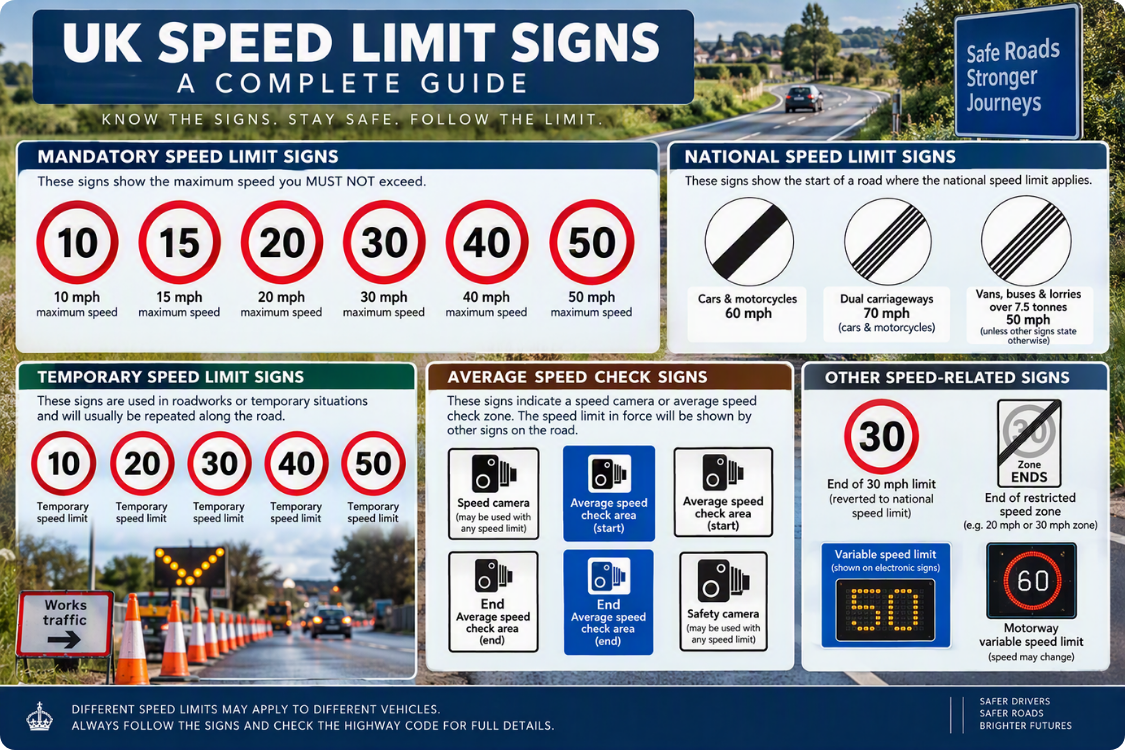
Understanding speed limits is only one part of staying compliant on the road. Our guide to The UK Traffic Signs Manual Explained explains the signs, markings and road information that commercial and fleet drivers need to understand.
What Happens If You Speed Again?
The consequences can become more serious if speeding offences continue.
A speed awareness course is not an unlimited alternative to penalty points.
GOV.UK states that you generally cannot be offered another speed awareness course if you have attended one within the previous three years.
That means drivers should not view completing a course as a way of permanently avoiding penalty points.
It is intended to be an opportunity to address the behaviour that resulted in the offence.
If a driver subsequently commits another speeding offence, they may receive penalty points or face more serious consequences depending on the circumstances.
So, What Are The Real Costs?
Financially, the difference between the two options was actually quite small in my case. I paid £96.20 for the course, compared with the standard £100 fixed penalty. So the course itself was only £3.80 cheaper.
The course can involve:
- several hours of your time
- travelling to a course venue
- fuel or public transport costs
- parking
- annual leave
- lost working time
- disruption to your normal day
On the other hand, accepting three points means you receive an endorsement that remains relevant to your driving record and may be relevant to insurance questions.
There is therefore a trade-off between immediate time and financial costs and the longer-term implications of receiving penalty points.
My Experience Of Choosing The Course
Having now completed the course, would I still have taken it instead of accepting three points?
I’m not sure the answer is as straightforward as I originally thought.
When I was first offered the course, avoiding three points seemed like an easy decision.
After all, I’ve never had any penalty points before.
But when I added up the course fee, the journey to Eastbourne, fuel, half a day’s annual leave and more than three hours sitting in a classroom, I realised that the course had a much greater real-world cost than I initially considered.
At the same time, I now have no speeding points on my licence.
The course also provides an opportunity to think about why relatively small increases in speed can matter, particularly when circumstances change or hazards appear unexpectedly.
So while I went into the course wondering whether accepting three points would have been easier, the experience has at least made me think more carefully about the actual trade-off.
And perhaps that’s part of the point.
Speed Awareness Course Or Three Points: What Should You Consider?
There isn’t one answer that will be right for every driver.
If you are offered a speed awareness course, it is worth considering the complete picture rather than looking only at the course fee.
Think about:
The financial cost: How much is the course compared with the fixed penalty?
Your time: Will you need to take annual leave or lose working hours?
Travel: How far away is the course venue and what will the journey cost?
Your driving record: Do you already have penalty points?
Insurance: What information does your insurer ask you to disclose?
Your work: Could penalty points or attending a course affect your job or ability to drive for work?
Future offences: Are you eligible for another course if you receive another speeding offence?
The educational benefit: Could the course actually help you change your driving behaviour?
Understanding speed limits is only one part of staying compliant on the road. Our guide to The UK Traffic Signs Manual Explained explains the signs, markings and road information that commercial and fleet drivers need to understand.
Ultimately, the decision involves more than simply comparing a course price with the cost of a fine.

 Call our expert team on