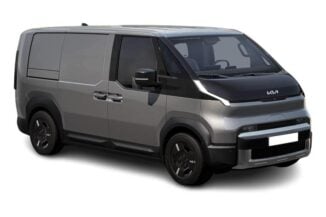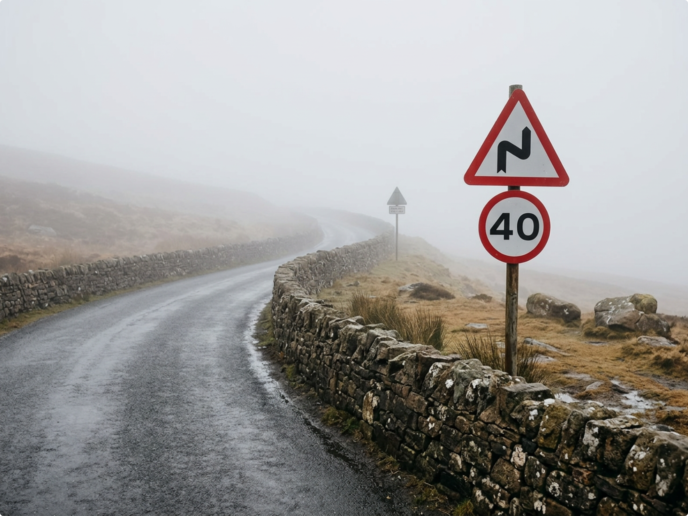
If you drive a van for work, it is important to know that van speed limits are not always the same as the limits for cars.
For many standard vans, the maximum speed is 50mph on a single carriageway and 60mph on a dual carriageway, even where cars are legally allowed to travel at 60mph and 70mph respectively.
However, the rules depend on the type and classification of vehicle you are driving. Car-derived vans and certain dual-purpose vehicles, including some pickup trucks, can have the same speed limits as cars.
This guide explains van speed limits in the UK, including the rules for different types of vans, car-derived vans, pickups, trailers and motorways.
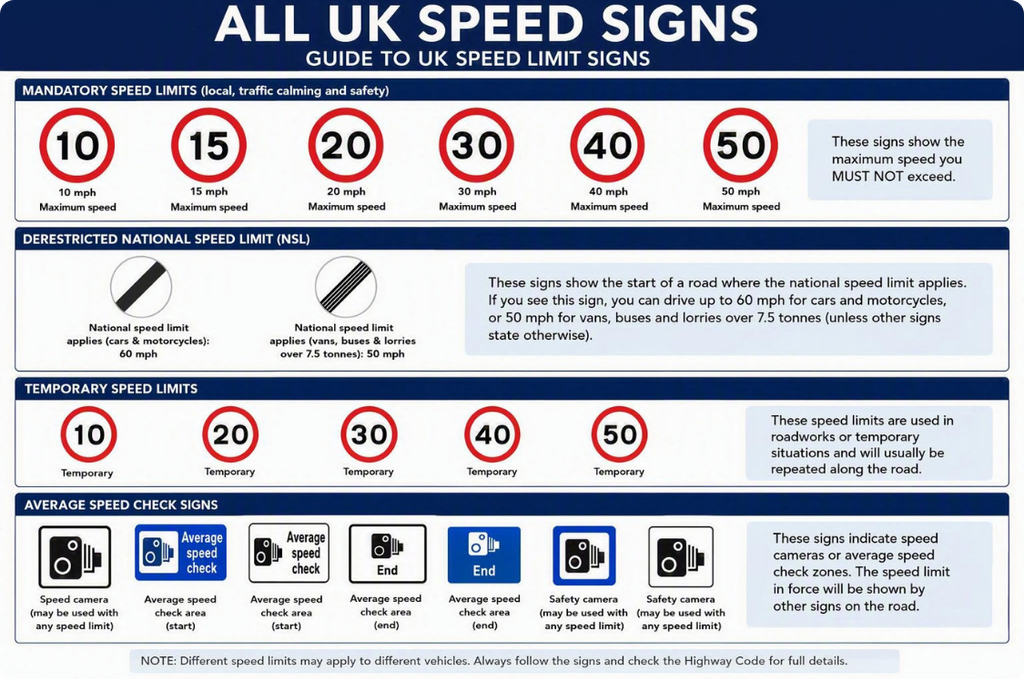
Van Speed Limits UK: At A Glance
For a standard van or light goods vehicle with a maximum laden weight of up to 3.5 tonnes, the national speed limits are:
| Road Type | Van Speed Limit | Car Speed Limit |
|---|---|---|
| Built-up areas | 30mph* | 30mph* |
| Single carriageway | 50mph | 60mph |
| Dual carriageway | 60mph | 70mph |
| Motorway | 70mph | 70mph |
*Local speed limits can be lower. In Wales, the default speed limit on restricted roads is generally 20mph rather than 30mph.
The important point for van drivers is that a national speed limit sign does not necessarily mean 60mph or 70mph for your van.
The limit depends on both the road and the type of vehicle you are driving.
What Is The Speed Limit For A Van?
For most standard vans up to 3.5 tonnes, the national speed limits are:
- 30mph in built-up areas, unless another limit is signed.
- 50mph on single carriageways.
- 60mph on dual carriageways.
- 70mph on motorways.
These limits apply to vans classified as goods vehicles rather than vehicles that qualify for car speed limits.
The rules are set according to the type of vehicle as well as the road. GOV.UK specifically states that vans have lower speed limits than cars and car-type vans.
This means that a van driver cannot simply look at the speed limit that would apply to a car and assume the same limit applies to their vehicle.
Why Are Van Speed Limits Lower?
The lower limits reflect the different characteristics of commercial vehicles.
Even relatively small vans can be heavier, taller and longer than passenger cars. They may also be carrying substantial loads, which can affect braking, handling and stability.
For this reason, many goods vehicles are subject to lower maximum speeds on single and dual carriageways.
The important exception is the motorway, where a standard van up to 3.5 tonnes can generally travel at 70mph, provided there is no lower posted limit and the van is not towing a trailer.
Van Speed Limits On Single Carriageways
The national speed limit for a standard van on a single carriageway is 50mph.
This is 10mph lower than the 60mph limit for cars on a national-speed-limit single carriageway.
For example, if you are driving a standard panel van on an unrestricted rural single carriageway and see the national speed limit sign, you should not assume that you can drive at 60mph.
Your vehicle’s classification means that the maximum speed is generally 50mph.
What Does The National Speed Limit Sign Mean For A Van?
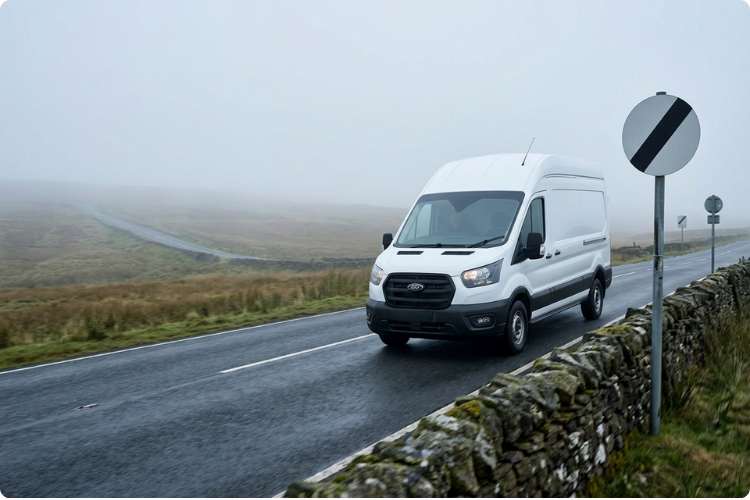
The national speed limit sign is the familiar white circular sign with a black diagonal stripe.
It does not represent one fixed speed.
Instead, the speed it represents depends on:
- The type of road
- The type of vehicle
For a standard van:
- Single carriageway: 50mph
- Dual carriageway: 60mph
- Motorway: 70mph
Always check the road signs and your vehicle classification rather than assuming that the national speed limit is the same as the car limit.
Van Speed Limits On Dual Carriageways
The national speed limit for most standard vans up to 3.5 tonnes on a dual carriageway is 60mph.
For cars, the national speed limit is normally 70mph.
This is one of the most common areas where van drivers can accidentally exceed the legal speed limit.
If you are driving a van on a national-speed-limit dual carriageway, the fact that cars around you are travelling at 70mph does not mean that your van can legally do the same.
Can Vans Do 70mph On A Dual Carriageway?
Generally, no.
A standard goods van is normally limited to 60mph on a dual carriageway.
However, some vehicles that look like vans can legally follow car speed limits because they are classified differently. This includes qualifying car-derived vans and dual-purpose vehicles.
That is why knowing your vehicle’s legal classification is important.
Van Speed Limits On Motorways
The maximum speed limit for a standard van up to 3.5 tonnes on a motorway is generally 70mph.
This is the same maximum national speed limit that applies to cars.
However, you must still follow any lower speed limit displayed on motorway signs or overhead gantries.
Motorways can also use variable speed limits, meaning the maximum permitted speed can change depending on traffic, congestion, incidents or road conditions.
A displayed speed limit in a red circle is legally enforceable and must be followed.
GOV.UK states that drivers must not exceed the maximum speed limit for either the road or their particular type of vehicle.
Can A Van Do 70mph On A Motorway?
Yes, in most cases.
A standard van up to 3.5 tonnes can generally travel at up to 70mph on a motorway where the national speed limit applies.
There is an important exception if the van is towing a trailer, when the maximum motorway speed is reduced to 60mph.
Van Speed Limits In Built-Up Areas
The standard speed limit in built-up areas with street lighting is generally 30mph in England, Scotland and Northern Ireland, unless signs indicate otherwise.
Wales has a different default limit on restricted roads, where the national default is generally 20mph.
Local authorities can also introduce lower or higher signed limits where permitted.
For example, you may encounter:
- 20mph zones
- 30mph limits
- 40mph limits
- 50mph limits
The posted speed limit always takes priority over the default national limit.
The key point is that vans do not automatically have a lower limit than cars in a 20mph or 30mph area simply because they are commercial vehicles.
The difference between cars and standard vans becomes particularly important on roads where the national speed limit applies.
Speed Limits For Different Types Of Vans
Not every vehicle that looks like a van is treated in exactly the same way.
The classification of the vehicle can make a significant difference.
Standard Vans Up To 3.5 Tonnes
Most conventional commercial vans fall into this category.
Examples include many versions of:
- Ford Transit
- Ford Transit Custom
- Mercedes-Benz Sprinter
- Mercedes-Benz Vito
- Volkswagen Transporter
- Volkswagen Crafter
- Peugeot Boxer
- Citroën Relay
- Renault Master
- Nissan Primastar
- Nissan Interstar
For a standard goods vehicle up to 3.5 tonnes, the national speed limits are generally:
30mph → 50mph → 60mph → 70mph
depending on the road.
The important figure to remember is 50mph on single carriageways and 60mph on dual carriageways.
Vans Over 3.5 Tonnes
Goods vehicles with a maximum laden weight of more than 3.5 tonnes are subject to different rules from standard vans. Vehicles in this weight range may be subject to speed limiter requirements, with the limiter restricting the vehicle to 56mph.
For goods vehicles not exceeding 7.5 tonnes, the applicable national speed limits are generally 50mph on single carriageways, 60mph on dual carriageways and 70mph on motorways. However, a vehicle fitted with a 56mph speed limiter may not be able to reach the applicable road speed limit.
Drivers should also make sure they hold the correct driving licence entitlement for the vehicle they are driving.
Do Car-Derived Vans Have The Same Speed Limits As Cars?
Yes, qualifying car-derived vans can have the same speed limits as cars.
GOV.UK identifies car-derived vans as the only light commercial goods vehicles subject to the same speed limits as cars.
For these vehicles, the national limits are generally:
| Road Type | Car-Derived Van Limit |
|---|---|
| Built-up areas | 30mph* |
| Single carriageway | 60mph |
| Dual carriageway | 70mph |
| Motorway | 70mph |
*Subject to local signed limits.
A car-derived van is essentially a goods vehicle derived from a passenger car and must meet the relevant legal definition.
This is why simply looking at a van and deciding which speed limit applies is not always enough.
If you are unsure, check the vehicle documentation and classification.
How Are UK Van Speed Limits Different to Car Speed Limits?
The table below outlines the speed limits for vans in the UK, in comparison to other types of vehicles. All speeds are measured in miles per hour (mph).
| Vehicle type | Built-up areas | Single carriageways | Dual carriageways | Motorways |
| cars, motorcycles, car-derived vans, dual-purpose vehicles, including qualifying pickup trucks | 30 | 60 | 70 | 70 |
| vans and other light goods vehicles up to 3.5 tonnes maximum laden weight | 30 | 50 | 60 | 70 |
| vans and other goods vehicles 3.5-7.5 tonnes maximum laden weight | 30 | 50 | 60 | 70 |
| motorhomes, motor caravans, campervans up to 3.05 tonnes maximum unladen weight | 30 | 60 | 70 | 70 |
| motorhomes, motor caravans, and campervans above 3.05 tonnes maximum unladen weight | 30 | 50 | 60 | 70 |
Goods vehicles between 3.5 and 7.5 tonnes are subject to different rules from standard vans. Vehicles in this weight range generally have a maximum speed limit of 50mph on single carriageways, 60mph on dual carriageways and 70mph on motorways. However, vehicles over 3.5 tonnes that are subject to speed-limiter requirements may be restricted to 56mph by their speed limiter.
Drivers of vehicles between 3,500kg and 7,500kg MAM will generally need a Category C1 driving licence, unless they have another entitlement that covers the vehicle.
What Is A Dual-Purpose Vehicle?
Some vehicles are classified as dual-purpose vehicles because they are designed or adapted to carry both passengers and goods.
This can include certain:
- Pickup trucks
- Double-cab vans
- Crew vans
- Kombi vans
- Commercial 4x4s
Qualifying dual-purpose vehicles can be subject to the same national speed limits as cars.
However, not every pickup or double-cab van automatically qualifies.
The legal definition includes specific requirements relating to factors such as the vehicle’s construction, seating, windows, weight and ability to carry goods and passengers.
This means you should not assume that a vehicle has car speed limits simply because it has five seats or resembles a passenger vehicle.
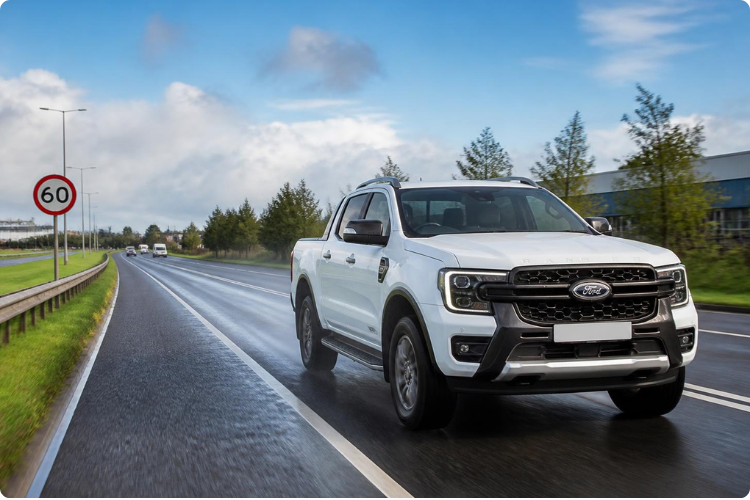
Do Pickup Trucks Have Van Speed Limits?
It depends on the classification of the pickup.
Some pickups qualify as dual-purpose vehicles and can therefore use the same speed limits as cars.
Others are treated as goods vehicles and are subject to the lower van limits.
This is particularly important because pickup trucks can differ considerably in their specification, weight and construction.
A pickup that qualifies as a dual-purpose vehicle may be able to travel at:
- 60mph on a single carriageway
- 70mph on a dual carriageway
- 70mph on a motorway
A pickup that does not qualify may instead be subject to the lower goods-vehicle limits.
Never assume that every pickup has car speed limits.
Do Double-Cab Vans Have The Same Speed Limits As Cars?
Not necessarily.
Double-cab and crew vans can sometimes qualify as dual-purpose vehicles, but they must meet the relevant legal requirements.
Having a second row of seats does not automatically make a van a dual-purpose vehicle.
The vehicle’s construction and specification must be considered.
If you are unsure which limits apply, check the vehicle documentation or seek confirmation from the manufacturer or a qualified professional.
What Is The Speed Limit For A Van Towing A Trailer?
If you are driving a van while towing a trailer, different speed limits apply.
For a van and trailer, the maximum national speed limits are generally:
| Road Type | Van + Trailer |
|---|---|
| Built-up areas | 30mph* |
| Single carriageway | 50mph |
| Dual carriageway | 60mph |
| Motorway | 60mph |
*Subject to local signed limits.
The important difference is the motorway.
A standard van that is not towing can generally travel at 70mph on a motorway, whereas a van towing a trailer is restricted to 60mph.
GOV.UK confirms that vans towing trailers have a 60mph motorway limit.
You must also comply with the relevant towing, loading and trailer requirements.
How Do Variable Speed Limits Work For Vans?
Variable speed limits are increasingly common on motorways and some major roads.
They are normally displayed on overhead gantries or electronic signs.
For example, you may see:
60 → 50 → 40mph
during periods of congestion, roadworks or an incident.
A speed shown inside a red circle is a mandatory speed limit.
The limit applies to your vehicle unless a different rule specifically applies to your vehicle classification.
For example, if your van is normally permitted to travel at 70mph but an overhead sign displays 60mph, your maximum speed is now 60mph.
You must continue following the displayed limit until it changes or the national speed limit resumes.
What Does The National Speed Limit Sign Mean?
The national speed limit sign is a white circle with a black diagonal stripe.
It can be confusing because the same sign can represent different maximum speeds depending on the road and vehicle.
For a standard van:
Single Carriageway
50mph
Dual Carriageway
60mph
Motorway
70mph
For a car, the equivalent limits are normally 60mph on a single carriageway and 70mph on a dual carriageway or motorway.
This is why van drivers need to know their vehicle’s classification.
How Do I Find Out My Van’s Maximum Weight?
One of the most important pieces of information when understanding commercial vehicle regulations is the vehicle’s maximum authorised mass (MAM) or maximum permitted weight.
This is the maximum legal weight of the vehicle when fully loaded.
It includes the vehicle itself together with:
- Driver
- Passengers
- Fuel
- Equipment
- Tools
- Cargo
You can usually find the relevant weight information on the vehicle’s plate and in the manufacturer’s documentation.
Do not confuse the van’s unladen weight with its maximum permitted loaded weight.
The distinction can be important when determining which regulations apply.
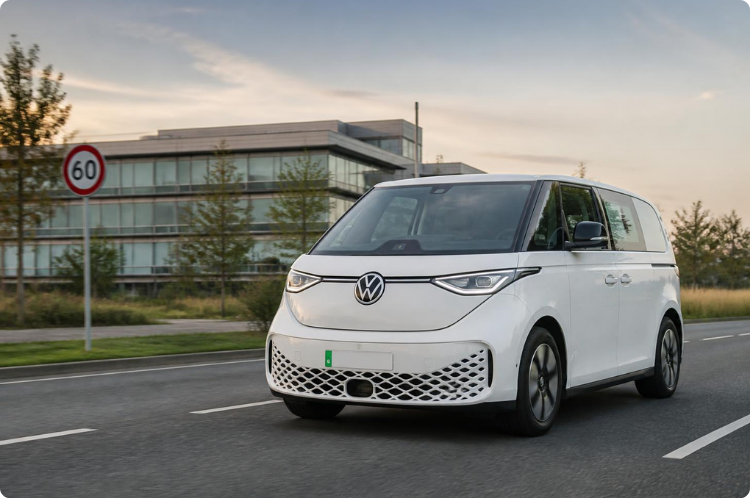
Do Electric Vans Have Different Speed Limits?
Generally, no.
Electric vans are not automatically given higher speed limits simply because they are electric.
The relevant speed limit depends on the vehicle’s classification, weight and the road being used.
For example, a standard electric van that is classified as a goods vehicle up to 3.5 tonnes will generally follow the same national speed limits as an equivalent diesel or petrol van.
This means an electric van can still be limited to 50mph on a single carriageway and 60mph on a dual carriageway.
There are, however, separate rules and regulatory developments affecting certain heavier zero-emission goods vehicles, so operators should check the specific vehicle and its legal classification.
Can A Van Driver Get A Speeding Fine?
Yes.
Van drivers are subject to the same road traffic enforcement system as other motorists, but the applicable speed limit for the vehicle may be lower.
This means a van driver could potentially be speeding even when travelling at a speed that would be legal for a car.
For example:
A car travelling at 60mph on a national-speed-limit single carriageway may be within the normal car limit.
A standard van travelling at 60mph on the same road may be exceeding its 50mph limit.
Speeding offences can result in:
- A Fixed Penalty Notice
- A fine
- Penalty points
- Court proceedings
- Disqualification in serious cases
The severity of the penalty depends on the circumstances and how far the speed exceeded the applicable limit.
How Much Is A Speeding Fine In The UK?
Many speeding offences are dealt with through a Fixed Penalty Notice, although more serious cases can go to court.
If a case reaches court, the potential fine depends on factors including the speed recorded, the applicable speed limit and the driver’s circumstances.
The Sentencing Council’s guidelines divide speeding offences into different bands, with penalties increasing as the seriousness of the offence increases.
A court can also impose penalty points or a period of disqualification.
For this reason, it is important not to rely on the idea that you can simply drive a few miles per hour above the limit without consequences.
The legal limit is the legal limit.
Do Speed Cameras Know That You Are Driving A Van?
Speed enforcement systems can enforce the applicable speed limit.
This is particularly important for vans because the limit may be lower than the one a driver expects based on the road.
Average-speed cameras, fixed cameras and other enforcement systems can all play a role in monitoring vehicle speeds.
Drivers should therefore avoid assuming that a camera will apply the car limit simply because the road has a 60mph or 70mph national limit for cars.
The relevant vehicle classification matters.
How Can Van Drivers Avoid Speeding?
The easiest way to avoid a speeding offence is to know the rules for your particular vehicle before you start driving.
Some useful habits include:
- Know your van’s legal classification.
- Know whether your van is subject to goods-vehicle or car speed limits.
- Pay attention to national speed limit signs.
- Watch overhead gantries for variable speed limits.
- Use cruise control where appropriate.
- Use a speed limiter if your vehicle is equipped with one.
- Do not rely solely on your sat-nav for speed-limit information.
- Take extra care when driving an unfamiliar van.
- Remember that towing a trailer reduces the motorway limit to 60mph.
Modern vans can also feature traffic-sign recognition and adaptive cruise control.
These systems can be useful, but the driver remains responsible for complying with the legal speed limit.
Van Speed Limits UK FAQs
What’s the difference between a motorway and a dual carriageway?
In the UK’s Highway Code, a dual carriageway has a central barrier between the lanes and typically has two lanes in each direction, although this may vary. In addition, dual carriageways have green road signs. While cars can travel at 70mph, the speed limit on a dual carriageway for vans is 60mph.
In addition to a central barrier, motorways also have a hard shoulder (although newer ‘smart motorways’ are replacing this with refuge areas) and numbered entrance and exit junctions. They are designed for fast and safe travel, which is why pedestrians, cyclists, tractors, and slow-moving vehicles are not allowed on them. Motorways also have blue road signs and a maximum speed limit of 70mph for both vans and cars (60mph for vans towing a trailer).
How do variable speed limits work?
Variable speed limits that apply to many motorways (and some dual carriageways) are indicated on overhead gantries featuring digital signs. A white number in a red circle means that the speed limit is legally restricted to that amount at that point in time. Moreover, it remains in effect until a different speed or the national speed limit sign is shown. The national speed limit sign indicates the resumption of the usual maximum speed limit.
What does the national speed limit sign mean?
The national speed limit signifies the highest speed permitted on various types of roads. While speed limit signs in built-up areas are typically numbered (20, 30, 40, or 50 in a red circle), county roads, dual carriageways, and motorways usually display the national speed limit sign instead.
The national speed limit sign is presented as a white circle with a black diagonal line from the top right to the bottom left. However, it can be quite confusing, as it represents different speed limits on different roads. For example, on a country lane, it indicates a maximum speed of 60mph for cars and 50mph for vans. On a dual carriageway, it signifies 70mph for cars and 60mph for vans. Meanwhile, on a motorway, it allows 70mph for both cars and vans.
What is “maximum laden mass”?
Maximum laden mass is a term used interchangeably with maximum authorised mass (MAM), revenue weight, and gross vehicle weight (GVW). It refers to the total allowable weight of a vehicle. Maximum laden mass includes everything on board, such as people and cargo.
How much is the speeding fine?
When it comes to speeding offences, most are typically handled through a Fixed Penalty Notice (FPN). However, if you end up going to court for speeding, you may face a fine of up to 175% of your weekly salary. This applies to both cars and commercial vehicles like vans and pickups.
The maximum fine is capped at £2,500 on motorways and £1,000 on less significant roads. The actual amount of the fine is divided into three bands, determined by how much over the speed limit you were caught.
For Band A offences, the court has the authority to impose a fine ranging from 25% to 75% of your weekly salary. In addition, you will receive three penalty points on your driving record.
For Band B, the penalty range is from 75% to 125% of your weekly salary, along with four to six penalty points or a driving disqualification lasting from seven to 28 days.
For Band C, the penalty range is from 125% to 175% of your weekly salary, in addition to receiving six penalty points or a driving ban lasting from seven to 56 days. However, the guidelines also specify that if an offender is driving significantly over the speed limit, the court should consider a disqualification lasting more than 56 days. This means there’s no specific limit for this scenario.
| Speed limit (mph) | Band A: Recorded Speed (mph) | Band B: Recorded Speed (mph) | Band C: Recorded Speed (mph) |
| 20 | 21-30 | 31-40 | 41+ |
| 30 | 31-40 | 41-50 | 51+ |
| 40 | 41-55 | 56-65 | 66+ |
| 50 | 51-65 | 66-75 | 76+ |
| 60 | 61-80 | 81-90 | 91+ |
| 70 | 71-90 | 91-100 | 101+ |
Why is speeding in a van more serious than speeding in a car?
According to the guidelines unveiled by the UK Sentencing Council, the type of vehicle is explicitly factored in when determining fines and penalties. In this context, speeding in a van or other goods vehicle is deemed more severe due to the increased potential danger resulting from the vehicle’s size and weight.
Other factors that can exacerbate the seriousness of a speeding offence include weather conditions, the presence of passengers, and the location where the offence occurs. Fines for speeding in areas such as near a school, in heavy traffic, or in areas with high pedestrian activity are typically harsher.
 Call our expert team on