A practical guide to company van take-home arrangements, HMRC tax rules, insurance, vehicle security and employer responsibilities.
Can Employees Take Company Vans Home?
Yes. Businesses in the UK can generally allow employees to take company vans home overnight. There is no general rule preventing an employee from keeping an employer-provided van at their home, provided the arrangement is permitted by the employer and complies with the relevant insurance, tax and vehicle-use requirements.
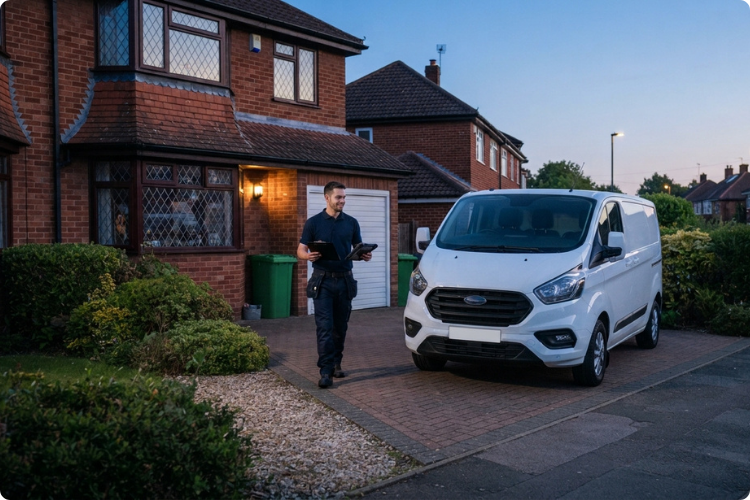
For many businesses, allowing employees to take their vans home is a practical way to organise daily operations. Engineers, tradespeople, maintenance contractors and mobile service teams may need to travel directly to their first appointment rather than report to a central depot each morning.
It can also reduce unnecessary journeys to business premises, particularly when employees are working across different locations or covering large geographical areas.
However, allowing an employee to park a company van at home involves more than simply handing over the keys. Employers should consider how the vehicle will be used, whether the insurance policy covers overnight parking at the employee’s address, how private journeys are controlled and what responsibilities apply to the driver.
The distinction between business use, ordinary commuting and private use is particularly important when considering company van tax.
Why Do Businesses Allow Employees To Take Vans Home?
There are several operational reasons why an employer might allow an employee to keep a company van at home overnight.
Common reasons include:
- Direct travel to appointments: Employees can travel straight from home to their first customer or job location, avoiding an unnecessary journey to the depot.
- Earlier working starts: Engineers and maintenance teams can begin work earlier without first collecting a vehicle from business premises.
- Geographical coverage: Employees working across different towns and regions can keep their vehicles closer to the areas they serve.
- Out-of-hours callouts: Emergency repair and maintenance businesses may need employees to have immediate access to their vehicles.
- Reduced depot requirements: Businesses with limited parking facilities may find it more practical for authorised employees to keep their vans at home.
- Improved operational efficiency: Keeping vehicles with the employees who use them can simplify daily scheduling and vehicle allocation.
For businesses operating several vehicles, these arrangements should form part of a wider fleet management strategy, rather than being left to informal agreements between managers and drivers.
What Does HMRC Say About Taking a Company Van Home?
One of the most important considerations is how HMRC treats company vans that employees take home overnight.
The fact that an employee parks a van at home does not automatically mean that they must pay company van benefit-in-kind (BiK) tax. Equally, describing a vehicle as a work van does not automatically make it exempt.
HMRC distinguishes between business journeys, ordinary commuting and private use when determining whether a taxable van benefit arises.
For most businesses, the key consideration is whether the van is provided mainly for business travel and whether its private use is restricted.
Business Use And Ordinary Commuting
An employee may be able to take a company van home and travel between their home and normal workplace without triggering a van benefit charge, provided the relevant restricted-private-use conditions are satisfied.
HMRC allows a company van to be taken home and used for ordinary commuting without a taxable van benefit arising, provided the van is available mainly for business travel and private use is restricted to home-to-work commuting and insignificant private use. The employer must ensure these conditions are met in practice.
For example, consider a plumbing company that provides an employee with a van containing the tools and equipment required for their work.
The employee takes the van home each evening and drives directly to the company’s customers the following morning. They also use it to travel home after completing their working day.
If the van is used mainly for business and the only private use is ordinary commuting, the arrangement can qualify for the nil van benefit charge.
However, the employer must be able to demonstrate that the conditions are satisfied in practice, not simply state that the vehicle is intended for business use.
HMRC guidance explains the circumstances in which company vans can be exempt from reporting and tax: Company vans and fuel – what’s exempt.
When Does Private Use Become Taxable?
The position changes when an employee uses a company van for private journeys beyond ordinary commuting and insignificant private use.
Examples include:
- Family shopping trips: Regularly using the van to visit supermarkets or shopping centres.
- Social journeys: Driving the vehicle to visit friends, attend social events or make personal trips.
- Holidays: Using the van for personal holidays or leisure activities.
- Weekend use: Regularly using the vehicle for personal journeys unrelated to employment.
These activities can mean that the employee has received a taxable benefit.
HMRC does allow insignificant private use in certain circumstances. This might include making a slight detour to collect a newspaper on the way to work or occasionally taking household rubbish to a recycling centre.
However, insignificant use is subject to strict interpretation. It must be very limited in both frequency and nature. Regular personal journeys should not be treated as insignificant.
Businesses should therefore establish clear rules about permitted use and make sure employees understand the difference between ordinary commuting and private travel.
For further detail, HMRC provides guidance on the benefit charge for company vans available for private use.
What Is The Company Van Benefit Charge For 2026/27?
If an employee uses a company van for private journeys beyond the permitted insignificant use, a taxable benefit may arise.
For the 2026/27 tax year, the standard van benefit charge is £4,170 for a van that is capable of emitting CO₂. This is an annual taxable benefit value, not the amount of tax the employee necessarily pays.
The actual income tax payable depends on the employee’s applicable tax rate.
| Tax position | Annual tax on a £4,170 benefit |
|---|---|
| 20% taxpayer | £834 |
| 40% taxpayer | £1,668 |
| 45% taxpayer | £1,876.50 |
These figures illustrate the potential income tax liability before any applicable adjustments. They assume the employee is provided with the van for the full tax year and that the full standard benefit charge applies.
Where the restricted private-use conditions are met, the van benefit charge is nil.
Zero-emission vans also have a nil van benefit charge under the current rules, although employers should still check the separate treatment of any fuel or electricity benefits.
The 2026/27 standard charge increased from £4,020 in 2025/26. Businesses should use the relevant tax-year figures when reviewing employee benefits and payroll arrangements.
Employees and employers who want to understand the potential tax implications of private use can use CVC’s Van BiK and Van Benefit Charge Calculator to estimate the annual and monthly tax payable. The calculator takes account of the tax year, income tax rate, type of van and whether private fuel is provided.
Can An Employee Take A Pool Van Home Overnight?
Pool vans are treated differently from individually allocated company vans.
A pool van is a vehicle shared between employees for business purposes rather than being provided primarily for the use of one particular individual.
HMRC sets out specific conditions that must be met for a vehicle to qualify as a pool van.
These include:
- Shared availability: The vehicle must be available to, and actually used by, more than one employee.
- Employment requirement: It must be made available to employees because they need it to perform their duties.
- No exclusive allocation: It must not ordinarily be used by one employee to the exclusion of others.
- Overnight arrangements: It must not normally be kept at or near employees’ homes.
- Business use: It must only be used for business journeys, with limited private use permitted where it is merely incidental to business use.
For example, a business might allow an employee to take a shared van home overnight because they need to leave early the following morning for a lengthy business journey.
This does not automatically disqualify the vehicle from pool van treatment. However, the journey home must be incidental to the business journey, rather than becoming a regular arrangement that effectively turns the pool vehicle into an individually allocated van.
A business cannot simply label a vehicle a pool van to avoid benefit-in-kind tax.
If it is regularly kept at an employee’s home or is effectively reserved for their exclusive use, it may no longer satisfy HMRC’s requirements.
For further information, HMRC explains the conditions for using company pooled vans.
Does Company Van Insurance Cover Overnight Parking At An Employee’s Home?
Insurance is another important consideration when allowing employees to take company vans home.
Businesses should not assume that an existing commercial vehicle insurance policy automatically covers every overnight parking arrangement.
The insurer may have specific requirements concerning where vehicles are kept, who is authorised to drive them and the security arrangements in place.
For example, a policy might distinguish between:
- Business premises: Vehicles kept overnight at the company’s registered premises or depot.
- Private residential addresses: Vehicles regularly parked outside an employee’s home.
- Secure parking: Vehicles kept in a locked garage, gated driveway or other secure location.
- Roadside parking: Vehicles left overnight on a public road.
The precise requirements depend on the insurer and the terms of the policy.
What Should Employers Check With Their Insurer?
Before allowing an employee to take a company van home, businesses should check the following:
- Overnight parking: Confirm that the employee’s home address is an acceptable overnight parking location.
- Authorised drivers: Check that the employee is covered to drive the vehicle and whether any additional drivers are permitted.
- Business use: Confirm that the policy covers the actual work being undertaken, including travel between customer appointments.
- Security conditions: Check whether the insurer requires the vehicle to be locked, parked off-road or fitted with particular security equipment.
- Tools and equipment: Establish whether tools and materials stored inside the van are covered, as vehicle insurance does not necessarily provide adequate cover for their contents.
- Changes of address: Make sure the insurer is informed if an employee moves home or their regular overnight parking arrangements change.
Employers should obtain confirmation from their insurer or broker where necessary, rather than relying on assumptions about what their existing policy covers.
Businesses leasing vehicles should also understand the insurance arrangements attached to their agreements. CVC explains some of the key considerations in its guide to insuring a lease van.
What If An Employee Moves House?
An employee moving home can create an additional administrative responsibility.
If a vehicle is regularly kept overnight at a particular address, a change of address may affect the insurer’s assessment of the risk.
Businesses should therefore require employees to notify their manager before changing their regular overnight parking arrangements.
This is particularly important where a vehicle is kept on a driveway at one address but would need to be parked on the public road at another.
A simple update to the company’s vehicle records and confirmation with the insurer can help prevent avoidable problems if a vehicle is stolen or damaged.
How Can Businesses Protect Company Vans Parked At Employees’ Homes?
Company vans frequently contain valuable tools, equipment, materials and technology.
For tradespeople, engineers and maintenance contractors, the contents of a van can represent a considerable financial investment.
Leaving a vehicle parked outside an employee’s home overnight can therefore create additional security risks, particularly if it contains equipment that is visible through the windows or accessible from the rear doors.
Employers should consider the security of both the vehicle and its contents when establishing take-home arrangements.
Practical Van Security Measures
1. Choose Suitable Overnight Parking
Where possible, employees should park their vans on private driveways, in garages or within secure residential parking areas.
If roadside parking is unavoidable, businesses should consider the local security risks and any conditions imposed by their insurer.
2. Remove Valuable Tools Where Possible
Tools and equipment should not be left inside a van overnight unless there is a genuine operational requirement.
Where equipment must remain in the vehicle, employers should consider secure storage systems and suitable insurance cover. Commercial van storage systems can help organise equipment and make better use of the available load space.
3. Install Additional Vehicle Security
Businesses can improve vehicle protection through additional locks, alarms, immobilisers and internal security measures. Where valuable tools and equipment are carried regularly, van security gates can provide an additional physical barrier to protect the load area.
4. Establish Clear Key Management Procedures
Employees should be responsible for keeping vehicle keys secure and should never leave spare keys inside the van or in an easily accessible location.
Businesses should establish procedures for reporting lost or stolen keys and have a contingency plan for lost, damaged or inaccessible vehicle keys. CVC explains the importance of having a van key backup strategy.
5. Consider Vehicle Tracking
Vehicle tracking and telematics can help businesses monitor vehicle locations, identify unusual activity and improve fleet visibility.
However, employers should be transparent about how tracking information is collected and used, including when vehicles are taken home and during periods when employees are not working. Businesses considering these systems can read CVC’s guide to vehicle telematics and fleet tracking for small businesses.
A documented policy should explain the purpose of monitoring and how personal data is handled.
What Are An Employer’s Responsibilities When Employees Take Vans Home?
Allowing employees to take company vehicles home does not remove the employer’s responsibility for managing vehicles used for work.
Employers must consider the safety of employees, other road users and anyone who could be affected by work-related driving activities.
The Health and Safety Executive (HSE) makes clear that employers must manage risks associated with driving for work in the same way that they manage risks in other workplace activities.
This includes company vehicles and employees who use their own vehicles for business purposes.
Businesses should also consider the wider principles of the National Work-Related Road Safety Charter, which encourages employers to take a structured approach to managing work-related road safety and reducing risks for employees who drive as part of their jobs.
Importantly, ordinary commuting between home and a normal workplace is generally outside the scope of work-related driving health and safety duties. The position can differ when an employee travels directly from home to a temporary workplace or customer location as part of their duties.
1. Check Employee Driving Licences
Employers should establish whether employees are legally entitled to drive the vehicles allocated to them.
This includes checking that the appropriate driving licence category is held and identifying any relevant restrictions, endorsements or disqualifications.
Businesses should also establish how frequently licence checks will be carried out and maintain appropriate records.
This is particularly important where employees drive different types of commercial vehicles or where their responsibilities change.
CVC has a dedicated guide explaining company vehicle licence checks and what UK employers need to know.
2. Make Sure Vehicles Are Roadworthy
Company vans must remain roadworthy, properly maintained and suitable for their intended use.
Allowing employees to keep vehicles at home should not make it more difficult for businesses to monitor their condition or arrange necessary maintenance.
Employers should establish procedures for:
- Daily vehicle checks: Employees should understand which checks they need to complete before using their vehicles.
- Defect reporting: Any faults or damage should be reported promptly.
- Servicing: Vehicles should receive maintenance in accordance with manufacturer recommendations and operational requirements. Businesses can also review their approach to fleet vehicle servicing and maintenance to ensure vehicles remain safe, reliable and suitable for business use.
- MOT testing: Where applicable, vehicles must have a valid MOT.
- Tyre condition: Tyres should be checked for damage, tread depth and correct inflation.
- Safety equipment: Lights, mirrors, brakes and other essential components should remain in suitable working condition.
Businesses should also ensure that employees know what to do if they identify a defect that makes the vehicle unsafe to drive.
CVC explains these obligations in its guide to daily van checks and business legal responsibilities.
3. Provide Clear Instructions To Drivers
Employees should understand their responsibilities when using company vehicles, including when taking them home overnight.
This should cover vehicle condition, permitted use, accident reporting, security arrangements and the procedure for dealing with breakdowns.
Employers should also explain whether employees can allow another person to drive the vehicle, as well as whether family members are permitted to travel in it.
A clear set of instructions can reduce misunderstandings and help businesses maintain consistent standards across their fleets.
CVC’s leased vehicle driver responsibilities guide provides further information about the responsibilities associated with company-provided vehicles.
Employers should also consider wider driving risks, including speeding and distracted driving. CVC’s guide to fleet driver safety, speeding and distracted driving provides further information.
4. Carry Out Appropriate Risk Assessments
Employers should consider the risks associated with employees driving for work, including the journey, the driver and the vehicle.
This can include:
- Journey risks: Long distances, unfamiliar routes, congestion and time pressures.
- Driver risks: Fatigue, distraction, training requirements and fitness to drive.
- Vehicle risks: Roadworthiness, suitability, maintenance and safety equipment.
- Parking risks: Whether the vehicle can be parked safely and securely overnight.
The risk assessment should reflect the actual working arrangements rather than simply treating all employees and vehicles in the same way.
For businesses with multiple drivers and vehicles, CVC’s fleet risk assessment guide provides a useful starting point.
5. Establish Accident And Breakdown Procedures
Employees should know exactly what to do if a company van is involved in an accident, whether this happens during working hours or while travelling outside normal working hours.
The procedure should explain:
- Who to contact: The relevant manager, fleet administrator or emergency contact.
- Insurance information: What details need to be collected and reported.
- Vehicle damage: How photographs and other evidence should be recorded.
- Recovery arrangements: Who should organise vehicle recovery if it cannot be driven safely.
- Replacement vehicles: How alternative transport or a temporary replacement van will be arranged.
Businesses should not leave employees uncertain about who to contact if something happens to a company vehicle overnight.
CVC’s guide to what to do when a company vehicle driver has an accident explains the steps businesses should consider.
What Should A Company Van Take-Home Policy Include?
Businesses should avoid relying on informal arrangements when employees are allowed to take company vans home.
A written company vehicle policy can establish what is expected of employees, explain the permitted use of vehicles and provide a consistent approach to managing risks.
It should also make clear that permission to take a van home does not automatically mean permission to use it for personal journeys.
Key Areas To Include In A Company Vehicle Policy
| Policy area | What businesses should establish |
|---|---|
| Vehicle allocation | Which employees are authorised to use each van |
| Overnight parking | Where vehicles can be kept when not in use |
| Private use | Whether personal journeys are permitted |
| Commuting | Whether employees can travel between home and their normal workplace |
| Additional drivers | Whether anyone else is allowed to drive the vehicle |
| Insurance | The required insurance arrangements and any restrictions |
| Vehicle security | Responsibilities for locking vehicles and protecting equipment |
| Daily checks | Driver inspection and defect-reporting procedures |
| Maintenance | Servicing, repairs and MOT arrangements |
| Accidents | Who must be contacted and how incidents are reported |
| Fines and penalties | Responsibility for parking, speeding and other driving offences |
| Vehicle return | What happens when employment ends or a vehicle is reassigned |
Businesses operating larger fleets may also benefit from regular fleet audits to review vehicle allocation, driver records, maintenance arrangements and compliance procedures.
The policy should also explain what happens if an employee repeatedly breaches the agreed conditions.
For example, if an employee regularly uses a company van for unauthorised personal journeys, the business may need to review the arrangement and consider the associated tax and insurance implications.
Importantly, employees should receive a copy of the policy and confirm that they understand and agree to its requirements.
CVC has a dedicated company vehicle policy guide for UK businesses, which covers the wider responsibilities involved in managing company-provided vehicles.
What Happens When An Employee Leaves The Business?
Company vans kept at employees’ homes can create additional complications when someone leaves their employment.
Businesses need to establish how and when the vehicle will be returned, particularly if the employee is no longer required to attend the company’s premises.
This is particularly important when an employee has been using the van for direct travel to customer appointments or has been keeping it at home for an extended period.
A clear vehicle return procedure should cover:
- Return arrangements: Agree where and when the van must be returned.
- Vehicle condition: Inspect the vehicle and record any damage or missing equipment.
- Keys and documentation: Collect all vehicle keys, fuel cards, access devices and relevant paperwork.
- Tools and equipment: Check that company-owned equipment has been returned.
- Insurance and authorisation: Update the insurer and remove the employee’s authorisation where appropriate.
- Fleet records: Update vehicle allocation and driver records.
Businesses should not assume that vehicle arrangements automatically end when an employee leaves. The return of the van and any associated equipment should be formally recorded.
This is particularly important where a vehicle is leased, as it remains subject to the relevant leasing agreement and return conditions.
CVC provides further information about what happens at the end of a van leasing contract.
Should Businesses Allow Employees To Take Company Vans Home?
For many businesses, allowing employees to take their company vans home is a sensible operational decision.
It can reduce unnecessary travel, improve access to vehicles and make it easier for employees to attend appointments directly from home.
However, the arrangement needs to be managed properly.
Businesses should consider the following before introducing a take-home vehicle policy.
Advantages
- Improved operational efficiency: Employees can travel directly to their first appointment without collecting a vehicle from a depot.
- Greater flexibility: Mobile engineers and service teams can respond to customer requirements more easily.
- Reduced unnecessary mileage: Avoiding additional journeys to business premises can reduce vehicle mileage and associated running costs.
- Better vehicle allocation: Businesses can keep vehicles with the employees who regularly need them.
Potential disadvantages
- Insurance considerations: Overnight parking at residential addresses may affect insurance requirements and premiums.
- Vehicle security: Vans containing tools and equipment may be more vulnerable to theft.
- Tax implications: Unrestricted private use can create additional benefit-in-kind liabilities.
- Administrative responsibilities: Businesses need to monitor vehicle allocation, driver permissions and overnight parking arrangements.
- Employee changes: Moving house, changing jobs or leaving the business can require additional fleet administration.
The right approach will depend on the size of the business, the nature of its work, the number of vehicles operated and how frequently employees need access to them.
For companies managing several vehicles, it is also worth reviewing how effectively their existing fleet is being maintained and administered. CVC’s guide to fleet maintenance planning explains how businesses can organise servicing, inspections and vehicle maintenance.
Frequently Asked Questions About Employees Taking Company Vans Home
An employer can make taking a company van home part of an agreed working arrangement, subject to the terms of employment, the company’s vehicle policy and any relevant insurance or operational requirements.
However, employees should understand their responsibilities before accepting a vehicle for regular overnight use.
That depends on the arrangements agreed with your employer.
Some businesses prohibit private use altogether, while others allow limited personal journeys.
For tax purposes, HMRC distinguishes between ordinary commuting, insignificant private use and more substantial private use. Regular shopping trips, holidays and social journeys can create a taxable van benefit.
Employees should check their company’s vehicle policy rather than assume that having permission to take a van home also gives them permission to use it privately.
Not automatically.
Taking a company van on holiday would generally constitute private use, rather than ordinary commuting or an insignificant private journey.
Employees should obtain permission from their employer before using a company vehicle for this purpose.
Where private use is permitted, the business should check the insurance arrangements and consider the relevant tax implications.
Only if the employer permits it and the relevant insurance policy covers the additional driver.
Employees should never assume that a partner or family member can drive a company vehicle simply because they hold a valid driving licence.
The business should confirm the authorised-driver arrangements with its insurer before allowing anyone else to use the vehicle.
Generally, yes, provided the employer permits the arrangement and the insurer’s requirements are satisfied.
Businesses should establish whether the vehicle can be kept at the employee’s residential address and whether any particular security arrangements are required.
Not necessarily.
HMRC permits certain company van arrangements without a van benefit charge, including qualifying business use with ordinary commuting and insignificant private use.
However, where private use goes beyond what is permitted, a taxable benefit may arise.
HMRC’s pool van rules generally require the vehicle not to be normally kept at or near employees’ homes.
There are limited circumstances in which taking a pool vehicle home can be acceptable, such as when it facilitates an early start for a substantial business journey.
Regular overnight parking at an employee’s home could prevent the vehicle from qualifying as a pool van.
Zero-emission vans currently have a nil van benefit charge, including where private use is permitted.
However, employers should still consider the separate rules relating to electricity, charging costs and any other benefits provided alongside the vehicle.
 Call our expert team on