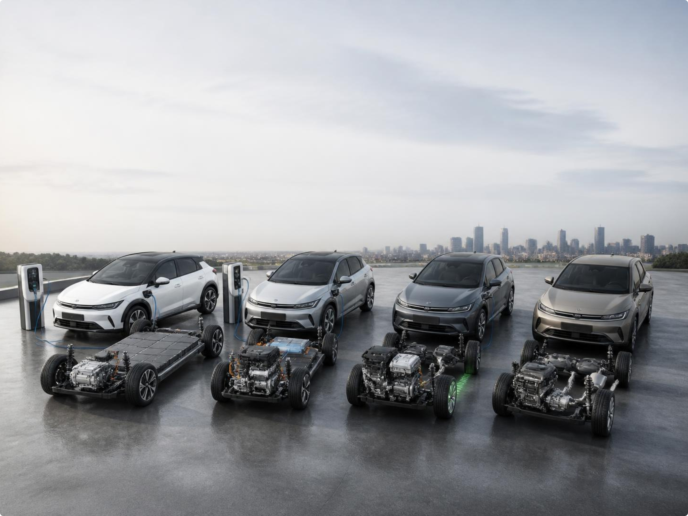
If you’ve started looking into electric cars, you’ve probably come across a confusing collection of abbreviations.
BEV. PHEV. HEV. ICE. ZEV. MHEV.
It can feel like you need to learn a completely new language before you can even work out what type of car you’re looking at.
The good news is that these terms are actually quite straightforward once you know what the letters mean.
The first three – BEV, PHEV and HEV – all contain EV, which stands for Electric Vehicle. However, they describe very different types of electrified vehicles.
Then there’s ICE, which refers to the traditional internal combustion engine found in petrol and diesel vehicles.
In this guide, we’ll explain what each term means, how the different vehicle types work and give you some examples of each.
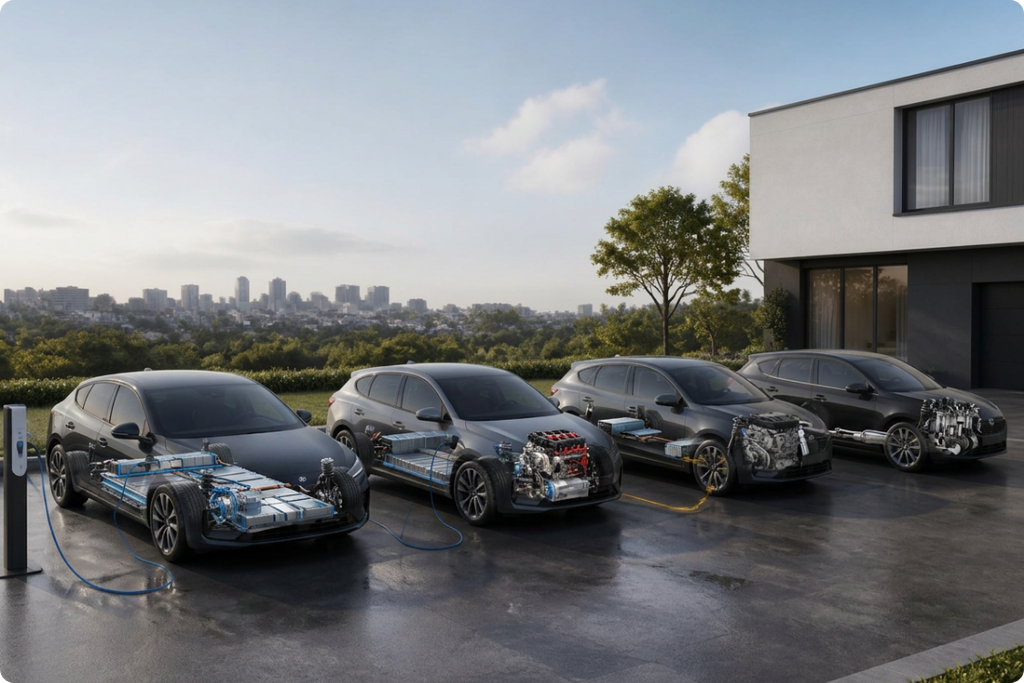
BEV = Battery Electric Vehicle
BEV stands for Battery Electric Vehicle.
This is the simplest of the four terms to understand.
A BEV is a vehicle that uses electricity stored in a battery to power an electric motor. Unlike a hybrid, there is no petrol or diesel engine working alongside the electric motor.
In other words, a BEV is a fully electric vehicle.
The battery is charged by connecting the vehicle to an external power source, such as a home charger, workplace charger or public charging point.
Once charged, the stored electricity powers the vehicle’s electric motor. If you’re new to electric cars, you may also wonder how they actually feel to drive compared with a conventional vehicle. Our guide to automatic vs electric vehicles explains the differences.
What Makes A BEV Different?
The key thing to remember is that a BEV does not have a petrol or diesel engine.
That means:
- Battery = B
- Electric Vehicle = EV
- Battery Electric Vehicle = BEV
If the battery runs low, you need to recharge it. There isn’t an internal combustion engine waiting in reserve to take over.
BEVs are therefore the type of vehicle most people are referring to when they talk about a fully electric car or pure electric car. If you’re considering making the switch, our guide to switching to an electric vehicle can help you understand what to expect.
They also produce no tailpipe emissions while being driven, because there is no exhaust system producing emissions.
Examples Of BEVs
There are now hundreds of fully electric cars available, ranging from small city cars to large SUVs.
Examples include:
- Tesla Model Y
- Polestar 4
- CUPRA Born
- BYD SEAL
- Kia EV4
- Volvo EX30
- Škoda Elroq
- Renault 5 E-Tech
- Audi A6 e-tron
- BMW iX2
- Volkswagen ID.4
- Dacia Spring
- Hyundai IONIQ 9
- XPENG G6
The Tesla Model Y, for example, is a BEV because it is powered entirely by its battery and electric motors.
PHEV = Plug-In Hybrid Electric Vehicle
PHEV stands for Plug-in Hybrid Electric Vehicle.
This is where things become slightly more complicated because a PHEV combines two different power sources.
A plug-in hybrid has:
- A rechargeable battery and electric motor
- A petrol or diesel engine
The battery can be charged by plugging the vehicle into an external charging point. This allows the car to travel using electric power alone for a certain distance.
Once the battery’s available electric range has been used, the petrol or diesel engine can take over.
So What Does PHEV Actually Mean?
The acronym breaks down as follows:
- Plug-in = P
- Hybri d = H
- Electric Vehicle = EV
- Plug-in Hybrid Electric Vehicle = PHEV
The important word here is plug-in.
Unlike a conventional hybrid, you can connect a PHEV to a charger and replenish its battery from the mains.
Many modern PHEVs can cover several tens of miles on electric power alone, although the exact electric range varies considerably between models.
This can make a PHEV particularly useful for someone whose daily commute is relatively short but who still regularly undertakes longer journeys.
For company-car drivers, it’s also worth considering how plug-in hybrids are treated for tax, particularly their Benefit-in-Kind (BIK) rates.
For example, you might be able to complete your daily commute using electric power and then use the petrol or diesel engine when travelling further afield.
However, the benefits of a PHEV depend heavily on how it is used.
If you regularly charge the battery and make good use of its electric range, you can spend a significant proportion of your driving using electric power.
If you rarely charge it, you’re carrying around the additional weight and complexity of the hybrid system without making full use of its electric capability.
Examples Of PHEVs
Examples of plug-in hybrid vehicles available in the UK include:
- Range Rover Evoque P270e
- Audi Q5 TFSI e
- Omoda 9
- Škoda Kodiaq iV
- Volkswagen Touareg eHybrid
- BMW X5 xDrive50e
- Kia Sportage PHEV
- Ford Kuga Plug-in Hybrid
- Hyundai Santa Fe Plug-in Hybrid
- Jaecoo 7 SHS
The Range Rover Evoque PHEV, for example, combines a battery and electric motor with a petrol engine.
HEV = Hybrid Electric Vehicle
HEV stands for Hybrid Electric Vehicle.
An HEV also combines an electric motor and battery with a petrol or diesel engine.
The big difference between an HEV and a PHEV is that a conventional HEV isn’t designed to be plugged into an external charger.
Instead, its relatively small battery is charged automatically while the vehicle is being driven.
This is why you will often hear HEVs described as self-charging hybrids.
How Does A Hybrid Charge Itself?
An HEV can recover energy that would otherwise be lost when the vehicle slows down.
This is known as regenerative braking.
When you slow down or brake, the electric motor can operate as a generator, converting some of the vehicle’s kinetic energy into electrical energy and sending it back to the battery.
The petrol or diesel engine can also help recharge the battery.
The vehicle’s computer then decides when to use the electric motor, the combustion engine or a combination of both.
At lower speeds and under lighter loads, the electric motor may be able to power the vehicle for short periods. Under heavier acceleration or when the battery’s charge is low, the combustion engine will typically become more involved.
The exact way this works varies between hybrid systems.
HEV Vs PHEV
The easiest way to remember the difference is:
PHEV = you plug it in.
HEV = you don’t.
A PHEV has a much larger battery and is designed to provide a meaningful amount of electric-only driving.
A conventional HEV has a much smaller battery and relies on the vehicle itself to manage and replenish the battery.
Examples Of HEVs
Examples of hybrid vehicles include:
- Toyota C-HR Hybrid
- MG HS Hybrid
- Hyundai Tucson Hybrid
- Mazda 2 Hybrid
- Honda Jazz e:HEV
- Lexus NX Hybrid
- Toyota Yaris Cross Hybrid
- Nissan Qashqai e-POWER
- Renault Rafale E-Tech Full Hybrid
The Toyota C-HR Hybrid is an example of an HEV because it combines a petrol engine with an electric motor and battery without requiring the driver to plug it into a charger.
ICE = Internal Combustion Engine
ICE stands for Internal Combustion Engine.
Unlike BEV, PHEV and HEV, ICE doesn’t describe a particular type of electric vehicle.
Instead, it describes the type of engine used to generate power.
An internal combustion engine burns fuel inside the engine itself. In passenger cars, this usually means petrol or diesel.
The combustion of the fuel creates energy that is converted into mechanical power to move the vehicle.
Internal combustion engines have been used in cars for more than a century and remain extremely common on UK roads.
You’ll find an ICE in a conventional petrol or diesel car, but you’ll also find one in many hybrid vehicles.
That’s an important distinction.
A PHEV or HEV can still contain an ICE.
So when you see the term ICE, don’t automatically assume it means a completely non-electrified vehicle. It simply means the vehicle has an internal combustion engine.
BEV Vs PHEV Vs HEV Vs ICE: What’s The Difference?
If you’re struggling to keep all these abbreviations straight, this is the easiest way to think about them:
| Vehicle Type | Battery | Electric Motor | Petrol/Diesel Engine | Plug-In Charging |
|---|---|---|---|---|
| BEV | Large | Yes | No | Yes |
| PHEV | Medium/Large | Yes | Yes | Yes |
| HEV | Small | Yes | Yes | No |
| ICE | Not required for propulsion | No | Yes | No |
The important thing to remember is that BEVs are fully electric, while PHEVs and HEVs combine electric technology with an internal combustion engine.
Other Electric Vehicle Acronyms You May Come Across
Unfortunately, BEV, PHEV, HEV and ICE aren’t the end of the story.
The automotive industry has accumulated plenty of other abbreviations, particularly as electric and alternative-fuel vehicles have become more common.
Here are some of the others you’re likely to encounter.
ZEV = Zero-Emission Vehicle
ZEV stands for Zero-Emission Vehicle.
A ZEV is a vehicle that produces no tailpipe emissions while it is operating.
A battery electric vehicle is the obvious example because it doesn’t have an exhaust and therefore doesn’t produce exhaust emissions while driving. BEVs are also central to the UK’s Zero Emission Vehicle (ZEV) Mandate.
Hydrogen fuel-cell vehicles can also fall into the ZEV category because their only tailpipe emission is water vapour.
It’s worth remembering that PHEVs and HEVs are not generally classed as zero-emission vehicles when their combustion engines are operating.
FCV = Fuel Cell Vehicle
FCV stands for Fuel Cell Vehicle.
A fuel-cell vehicle generates electricity using a fuel cell rather than relying solely on electricity stored in a large battery.
Hydrogen is the fuel most commonly associated with fuel-cell vehicles.
The fuel cell combines hydrogen with oxygen to generate electricity, which can then be used to power an electric motor.
HFCV = Hydrogen Fuel Cell Vehicle
HFCV stands for Hydrogen Fuel Cell Vehicle.
As the name suggests, this is a vehicle that uses hydrogen in a fuel-cell system to generate electricity.
The electricity powers an electric motor in much the same basic way as other electric vehicles.
Hydrogen vehicles can therefore be considered electric vehicles, even though they don’t rely solely on storing electricity in a large rechargeable battery.
AFC = Alternative Fuel Vehicle
AFC stands for Alternative Fuel Vehicle.
The term is used for vehicles that run on fuels other than conventional petrol or diesel.
Depending on the definition being used, this can include vehicles powered by alternatives such as:
- Electricity
- Hydrogen
- Biofuels
- Other alternative fuels
The exact definition can vary depending on the organisation or legislation using the term.
LCV = Low-Carbon Vehicle
LCV stands for Low-Carbon Vehicle.
It generally refers to vehicles designed to produce lower carbon emissions than conventional petrol or diesel vehicles.
This can include fully electric vehicles, hybrids and other vehicles using lower-carbon technologies.
Unlike ZEV, however, low-carbon doesn’t necessarily mean zero-emission.
A hybrid vehicle can therefore be considered a low-carbon vehicle while still producing emissions from its petrol or diesel engine.
NEV = New Energy Vehicle
NEV stands for New Energy Vehicle.
You’ll encounter this term particularly often when reading about the Chinese automotive market.
In that context, New Energy Vehicle is generally used to describe vehicles such as battery electric vehicles and plug-in hybrids, alongside certain other electrified vehicle categories.
There is another meaning of NEV that you may occasionally come across, particularly in the United States:
Neighbourhood Electric Vehicle.
This refers to a type of small, low-speed electric vehicle designed for short journeys and restricted-speed environments.
So, as with many automotive acronyms, the meaning depends on the context.
MHEV = Mild Hybrid Electric Vehicle
MHEV stands for Mild Hybrid Electric Vehicle.
A mild hybrid is different from a full hybrid and a plug-in hybrid.
It still has a conventional internal combustion engine, but it is supported by a relatively small battery and electric system.
The electrical system can assist the engine and help improve efficiency, particularly during functions such as starting, stopping and acceleration.
Unlike a conventional full hybrid, a typical MHEV isn’t designed to drive the vehicle solely using electric power.
The battery is generally charged automatically through energy recovery and the engine rather than by plugging the vehicle into a charger.
Think of an MHEV as a conventional petrol or diesel vehicle with some additional electric assistance, rather than a fully electric car.
So, Which One Is An Electric Car?
This is where all those acronyms can become confusing.
If you’re looking for a fully electric vehicle, the term you need to remember is:
BEV = Battery Electric Vehicle
A BEV runs entirely on electricity stored in its battery.
If you want something that can drive on electric power but also has a petrol or diesel engine for longer journeys:
PHEV = Plug-In Hybrid Electric Vehicle
If you want a hybrid that doesn’t need to be plugged in:
HEV = Hybrid Electric Vehicle
And if you’re talking about a conventional petrol or diesel engine:
ICE = Internal Combustion Engine
Once you know those four, most of the other abbreviations become much easier to understand.
The automotive industry might continue inventing new acronyms, but at least you won’t need to Google every single one when you’re looking at your next vehicle.
 Call our expert team on
  Drop us a message