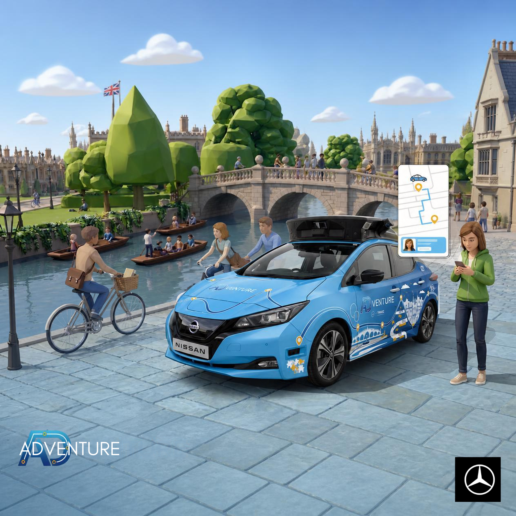
Nissan is set to take its autonomous driving research onto the streets of Cambridge as part of a £3 million UK Government-backed project exploring how self-driving vehicles could eventually become part of everyday transport.
The project, known as ADventure, will investigate what is required to make an autonomous vehicle work as part of an actual mobility service, rather than focusing solely on the technology inside the vehicle.
Nissan is leading the project alongside Warwick Manufacturing Group (WMG) at the University of Warwick and PAVE UK (Partners for Automated Vehicle Education UK).
Cambridge has been selected as the project’s first real-world trial location, with Nissan aiming to use the findings to develop a model that could potentially be adapted for other communities across the UK.
Nissan To Take Autonomous Driving Research Beyond London
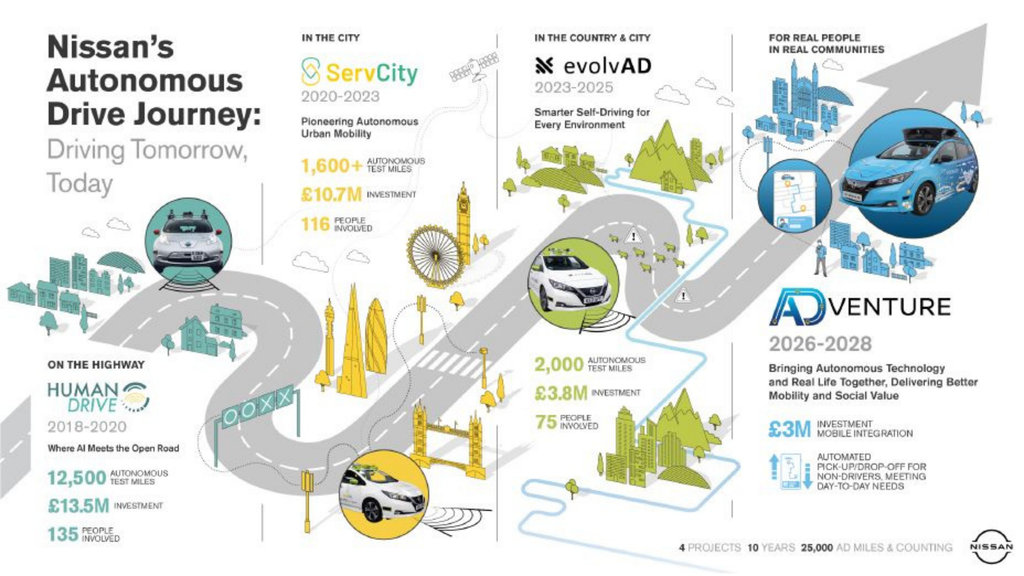
The Cambridge trial represents another stage in Nissan’s autonomous-driving development, building on more than a decade of research and innovation in the field.
Nissan says the project will also allow its autonomous vehicle research to move beyond central London and into another UK city, helping the company understand how self-driving mobility services could work in different communities and for different types of journeys.
Engineers from Nissan Technical Centre Europe (NTCE) will lead the technical work, combining Nissan’s existing autonomous-driving expertise with research from its project partners.
However, ADventure is not simply about seeing whether a vehicle can drive itself.
The project will combine public-road testing with engagement involving local authorities, commuters and residents. This will allow Nissan and its partners to examine how an autonomous service could fit into an existing transport network and whether it could address specific mobility needs within a community.
One potential application identified by Nissan is helping someone who does not drive reach a medical appointment when conventional transport options are unsuitable.
Beyond individual journeys, the research will also consider whether autonomous mobility can create wider social value by improving connectivity, accessibility and access to essential journeys.
What Will The ADventure Project Investigate?
The ADventure programme will focus on three main areas.
The first is understanding how autonomous mobility services could be designed around the needs of individual towns and cities. Rather than introducing self-driving vehicles in isolation, the project will examine how they could complement existing transport networks and respond to local requirements.
The second is passenger confidence.
Nissan and its partners will investigate what people need to feel informed, comfortable and included when using a future autonomous mobility service. This is an important part of the research because the development of the technology itself is only one part of introducing self-driving transport.
The project will also consider accessibility and whether autonomous services could help people who face difficulties accessing existing transport options.
The third area involves testing autonomous driving technology in real-world conditions, allowing the partners to assess how the systems perform on public roads and gather information that would be difficult to replicate in a controlled testing environment.
The overall aim is to develop a better understanding of how autonomous vehicles could operate as part of a wider transport service rather than simply demonstrating that a vehicle is capable of driving itself.
Why Has Cambridge Been Chosen?
Cambridge has already established itself as an important location for transport innovation and autonomous vehicle research.
The city has previously hosted a number of autonomous-driving initiatives, making it a suitable environment for examining how self-driving technology could operate alongside pedestrians, cyclists, public transport and other road users.
Nissan says Cambridge was selected following a detailed assessment of potential locations and because of its established expertise in transport innovation and autonomous mobility research.
The project is being supported by the Greater Cambridge Partnership, which sees the city as a testbed for autonomous transport research.
For Nissan, the intention is not simply to test the technology in Cambridge and stop there. The city will provide an opportunity to understand how an autonomous mobility service could be designed around the requirements of a particular community before considering whether the approach could be replicated elsewhere in the UK.
Passenger Experience Will Be Part Of The Research
A significant part of ADventure will involve understanding how people might actually use an autonomous mobility service.
This means looking beyond the vehicle itself and considering the wider passenger experience, including how people access the service, what information they receive and what would make them feel comfortable using a vehicle without a conventional driver.
Nissan’s imagery for the project illustrates this wider approach, showing a potential digital booking interface alongside the autonomous Nissan LEAF.
The project is therefore considering autonomous driving as part of a mobility service, rather than treating the vehicle as a standalone piece of technology.
WMG at the University of Warwick will contribute expertise in safety and user experience, helping the project co-create the mobility service with members of the public so that it reflects passenger needs as well as the transport priorities of the community.
£3 Million Project Backed By UK Government
The ADventure project has a total value of £3 million and is backed by the UK Government.
The funding is being facilitated through the Advanced Propulsion Centre UK, working in partnership with Innovate UK and inward investment.
The project forms part of the UK’s wider efforts to accelerate the development and deployment of connected and autonomous mobility technologies.
The Government has also highlighted the potential economic opportunities associated with the development and deployment of autonomous vehicle technology in the UK.
For Nissan, the Government backing provides an opportunity to take autonomous driving research beyond controlled environments and into another UK city.
Nissan Builds On Previous Autonomous Driving Research
The ADventure project builds on more than a decade of Nissan’s autonomous-driving research.
The manufacturer has previously been involved in projects including HumanDrive, ServCity and evolvAD, which have investigated different aspects of autonomous technology and how vehicles respond to varying driving environments.
The latest project takes a broader approach.
Rather than concentrating primarily on the capabilities of the vehicle, ADventure is looking at the wider question of how an autonomous vehicle could become part of a functioning mobility service.
That distinction could become increasingly important as autonomous driving technology develops.
A vehicle capable of controlling itself is only one part of the challenge. The wider system also needs to consider passengers, infrastructure, local transport networks, safety, accessibility and the expectations of the communities in which autonomous vehicles operate.
Nissan says the project will help it understand how autonomous services could work for different communities and different types of journeys.
Nissan LEAF To Be Used For Cambridge Trial
The project will use an existing 2022 Nissan LEAF test vehicle that has already been involved in previous UK autonomous-driving research.
The LEAF has been equipped with Nissan-developed advanced autonomous-driving technology, allowing engineers to use the vehicle to assess potential passenger mobility requirements and gather information from real-world conditions.
Rather than building an entirely new vehicle specifically for the project, Nissan is using an existing research vehicle to continue developing its understanding of autonomous mobility.
Local communities will play a central role throughout the programme, with their involvement helping researchers assess how autonomous services could improve connectivity and access to opportunities.
Could Autonomous Vehicles Change The Way Fleets Operate?
Although ADventure is focused on passenger mobility, developments in autonomous driving could eventually have implications for the wider vehicle and fleet industry.
Autonomous technology has already begun moving beyond laboratory and closed-track testing, with trials taking place in real-world environments.
CVC has previously covered the development of autonomous passenger services in London in our article on Wayve and Uber’s autonomous rides in London.
The potential applications extend beyond passenger journeys. If autonomous technology can eventually be adapted successfully for commercial vehicles, there could be implications for areas such as deliveries, logistics, depot movements and fleet utilisation.
Those applications remain an area of future development, however, and the Cambridge project is primarily concerned with understanding how autonomous passenger services could operate safely and effectively within a real community.
Autonomous Vehicles And The Move Towards Electric Transport
There is also an interesting connection between autonomous mobility and the UK’s wider shift towards electrification.
The Nissan LEAF being used for ADventure is an electric vehicle, while the autonomous vehicles involved in other UK mobility trials have also included electric models.
The two technologies are separate, and autonomous vehicles do not necessarily need to be electric. However, electric vehicles are already featuring prominently in a number of early autonomous mobility projects. There are also questions around how much additional electricity autonomous driving technology could require, particularly as vehicles rely on cameras, sensors, computing equipment and communications systems. CVC has previously looked at autonomous vehicle energy consumption and what this could mean for the range and charging requirements of future electric fleets.
For businesses, the continued development of electric vehicles is also changing the way fleets are planned and operated.
The wider transition towards electric vehicles remains an important consideration for UK fleets. While autonomous technology could eventually introduce new opportunities for electric vehicles, businesses are still dealing with the practical challenges of moving away from petrol and diesel. CVC has previously examined why electric vans remain behind ZEV targets and why some fleets are calling for a more realistic approach to the transition.
CVC’s Switching To An Electric Vehicle guide looks at the practical considerations businesses should assess when moving towards electric vehicles, including vehicle suitability, charging requirements, mileage and wider fleet requirements.
For businesses operating multiple vehicles, our Fleet Management Solutions service also covers areas such as fleet audits, vehicle selection and electric fleet transition.
 Call our expert team on