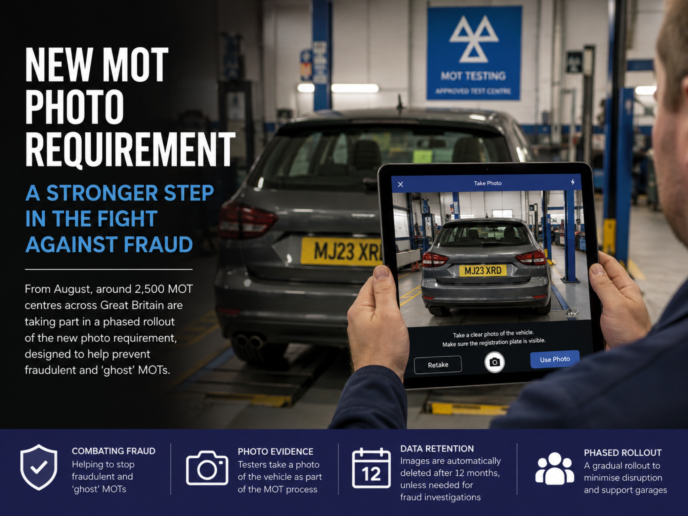
MOT testing is being strengthened with the introduction of a new photo requirement designed to help the Government tackle fraudulent MOT certificates.
From August 2026, around 2,500 MOT garages across Great Britain are being brought into a phased rollout led by the Driver and Vehicle Standards Agency (DVSA). As part of the new system, testers will be required to photograph the vehicle undergoing an MOT test.
The move follows action taken by the DVSA earlier this year against an MOT tester and mechanic who were prosecuted after recording passes for 223 vehicles that had never actually been presented for testing.
This type of fraud is commonly referred to as “ghost” MOT testing, where an MOT result is issued even though the vehicle has not attended the test centre. The DVSA says ghost testing accounts for almost 80% of fraudulent MOT tests.
How Has the New MOT Photo System Been Tested?
The introduction of vehicle photography follows two previous trials involving 311 MOT garages.
According to the DVSA, feedback from testers taking part in the trials was largely positive. Many testers found the process simple to use and said taking and uploading a photograph had little or no noticeable effect on the overall time required to complete an MOT.
The trials also gave the DVSA an opportunity to identify and resolve technical issues before the wider rollout.
Following feedback, improvements were made to the photo-upload system, including changes intended to improve performance, reliability and the overall user experience.
Most participating MOT testers were able to use the feature successfully. However, some garages experienced difficulties linked to device compatibility, browser configurations and internet connectivity.
Why Is The MOT Photo Requirement Being Introduced In Phases?
Rather than introducing the system across every MOT centre at once, the DVSA is gradually expanding the rollout.
The phased approach allows the agency to monitor how the service performs as more testers begin using it, assess how widely the feature is being adopted and identify any problems that could cause disruption for MOT garages.
Further groups of MOT centres will be brought into the system as the rollout progresses, with each stage being monitored and reviewed.
For garages and MOT testers, the gradual introduction should also provide more time to become familiar with the new process before photography becomes a standard part of MOT testing.
What Happens To The MOT Photos?
The photographs are being collected as part of the Government’s vehicle verification and fraud-prevention process.
Drivers and fleet operators will not be able to request copies of the photographs or ask for them to be removed simply because they do not wish them to be retained.
The DVSA says images are designed to be automatically deleted after 12 months, unless a photograph has been identified as potentially relevant to a fraud investigation or is required as evidence.
Are MOT Testers Currently Required To Take A Photo?
At this stage of the rollout, taking and uploading a photograph remains optional.
If a tester is unable to take a photograph, they can continue with the MOT and select the appropriate reason within the MOT testing service. A tester will not be prevented from submitting the MOT result simply because a photograph could not be uploaded.
However, the DVSA is encouraging MOT centres to start using the feature wherever possible.
Doing so will allow testers to familiarise themselves with the process ahead of any future move to make vehicle photography a mandatory part of every MOT test.
What Does The New MOT Process Mean For Drivers And Fleets?
For most motorists and fleet operators, the change should have little impact on the actual MOT experience.
The main difference is that the vehicle may now be photographed during the test, with the image being retained within the Government’s systems for verification and potential fraud prevention.
The introduction of photographic evidence is intended to make it significantly harder for dishonest testers to issue MOT certificates for vehicles that have never attended a test centre.
For businesses operating multiple vehicles, the change also provides an additional layer of confidence that MOT records relate to vehicles that have genuinely been presented for testing.
As the phased rollout continues, the DVSA will continue monitoring the system before deciding how the requirement develops across the wider MOT network.
 Call our expert team on
  Drop us a message