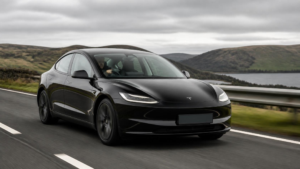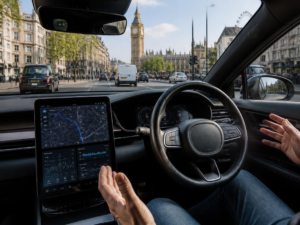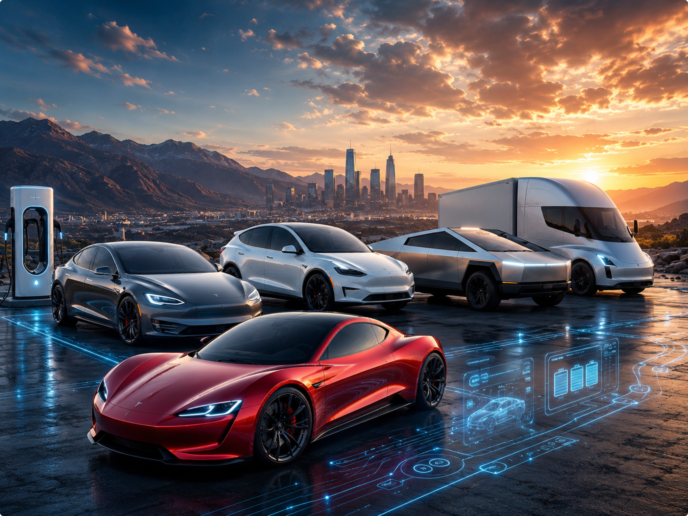
Few companies have had as much influence on the automotive industry in the 21st century as Tesla. What began as a small startup with ambitious goals has grown into one of the most recognisable automotive brands in the world. In less than two decades, Tesla transformed electric vehicles from niche products into mainstream transportation and forced nearly every major automaker to accelerate its own electric vehicle strategy.
Before Tesla entered the market, electric cars were often viewed as slow, limited in range, and impractical for everyday use. Most consumers associated electric vehicles with compromise. Tesla challenged that perception by proving that an EV could be fast, stylish, technologically advanced, and capable of travelling hundreds of miles on a single charge.
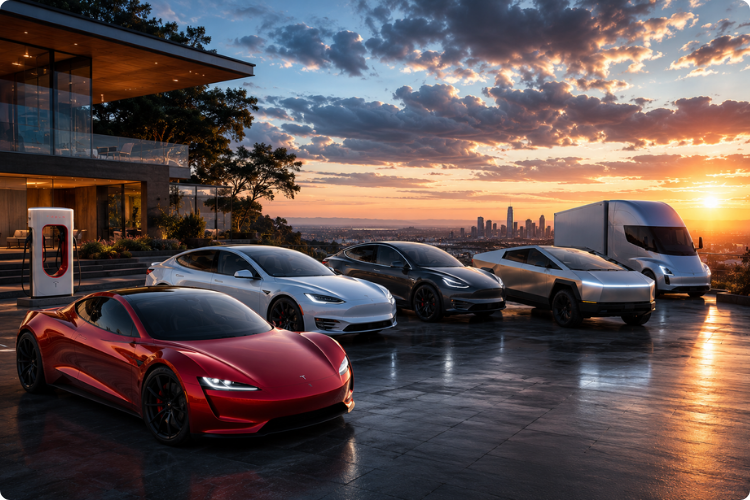
Today, Tesla’s lineup includes luxury sedans, family SUVs, pickup trucks, commercial vehicles, and even plans for future high-performance sports cars. Beyond the vehicles themselves, Tesla has built an ecosystem that includes advanced battery technology, over-the-air software updates, autonomous driving features, and one of the largest fast-charging networks in the world.
The company’s influence extends far beyond vehicle sales. Tesla has changed consumer expectations regarding vehicle technology, software integration, performance, and sustainability. Features that once seemed revolutionary—such as large touchscreen displays, smartphone-style software updates, and electric drivetrains capable of sports-car acceleration—have become increasingly common throughout the industry because of Tesla’s success.
In this comprehensive guide, we’ll explore every major Tesla vehicle, examining its history, design philosophy, strengths, weaknesses, and impact on the automotive market. From the original Roadster that launched the company to the futuristic Cybertruck and Tesla Semi, each vehicle represents a different stage in Tesla’s remarkable journey.
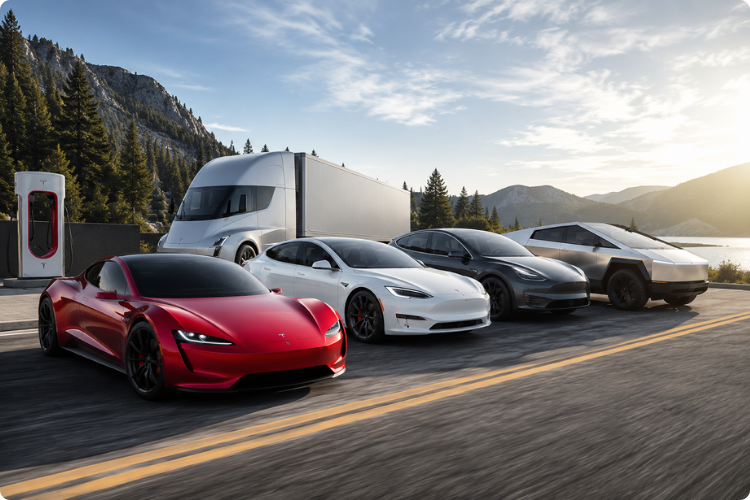
The Origins of Tesla
To understand Tesla’s vehicle lineup, it’s important to understand the company’s mission.
Tesla was founded with a simple but ambitious goal: to accelerate the world’s transition to sustainable energy. Rather than immediately attempting to compete with mass-market automakers, Tesla adopted a strategy that focused first on building premium vehicles that could fund future expansion.
The company believed that electric vehicles could outperform traditional gasoline-powered cars in many important areas. Electric motors deliver instant torque, require fewer moving parts, and eliminate tailpipe emissions. However, significant challenges existed, including battery costs, charging infrastructure, and consumer scepticism.
Tesla’s solution was to create vehicles that people wanted to buy because they were exciting, not simply because they were environmentally friendly.
That strategy led to the company’s first production vehicle: the Tesla Roadster.
Tesla Roadster (2008): The Vehicle That Started Everything
A Bold Beginning
The original Tesla Roadster occupies a special place in automotive history. Released in 2008, it was the first production vehicle from Tesla and served as proof that electric vehicles could compete with traditional sports cars.
At a time when most electric vehicles were designed primarily for efficiency, the Roadster focused on performance. The car offered acceleration figures that rivalled many gasoline-powered sports cars and demonstrated that battery-powered transportation could be thrilling rather than boring.
Built on a modified lightweight sports-car platform, the Roadster featured a compact design that prioritised speed and agility. While production numbers were relatively small compared to later Tesla models, the Roadster achieved something far more important than sales volume—it captured global attention.
| Model | Vehicle Type | Seats | Approx Range* | Key Audience |
|---|---|---|---|---|
| Roadster (2008) | Sports Car | 2 | ~245 miles | Early adopters |
| Model S | Luxury Sedan | 5 | Up to 400+ miles | Luxury buyers |
| Model 3 | Compact Sedan | 5 | Up to 390+ miles | Everyday drivers |
| Model X | Luxury SUV | 5–7 | Up to 350+ miles | Families |
| Model Y | Crossover SUV | 5–7 | Up to 370+ miles | Mainstream buyers |
| Cybertruck | Pickup Truck | Up to 5 | Up to 340+ miles | Truck owners |
| Semi | Commercial Truck | 1–2 | Up to 500 miles | Fleet operators |
| Model | Starting Price Range |
|---|---|
| Model 3 | £35,000–£45,000 |
| Model Y | £45,000–£60,000 |
| Model S | £90,000+ |
| Model X | £95,000+ |
| Cybertruck | Market dependent |
Breaking Industry Assumptions
The Roadster challenged several long-standing assumptions about electric vehicles.
For decades, consumers had been told that electric cars would always suffer from poor performance and limited practicality. The Roadster proved otherwise. It delivered impressive acceleration, a respectable driving range for its era, and a driving experience that surprised automotive journalists around the world.
The vehicle became a symbol of what modern battery technology could achieve when combined with innovative engineering.
Key Features
The original Roadster offered several features that distinguished it from competing vehicles:
- Fully electric powertrain
- Sports-car styling
- Rapid acceleration
- Lightweight construction
- Advanced lithium-ion battery technology
- Zero tailpipe emissions
Although many of these features are now common in modern electric vehicles, they were groundbreaking when the Roadster first appeared.
Why the Roadster Was So Important
The significance of the Roadster extends beyond the vehicle itself.
Without the Roadster, Tesla might never have secured the investment, media attention, and consumer confidence needed to continue developing future models. The success of the Roadster provided proof that Tesla’s vision could work.
More importantly, it demonstrated that consumers could view electric vehicles as desirable products rather than environmental sacrifices.
The Roadster established Tesla’s reputation as an innovator and laid the foundation for every vehicle that followed.
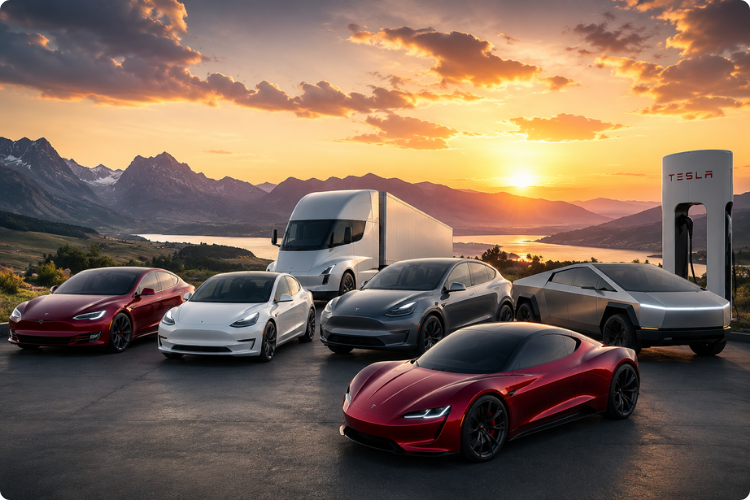
Tesla Model S: The Luxury Sedan That Changed the Industry
Tesla’s First Mainstream Success
While the Roadster proved Tesla could build an electric sports car, the Model S proved Tesla could build a world-class automobile.
Introduced in 2012, the Model S represented a major leap forward for the company. Unlike the limited-production Roadster, the Model S was designed to compete directly with luxury sedans from established manufacturers.
The challenge was enormous. Tesla was entering a market dominated by companies with decades of experience and strong reputations for engineering excellence. Many industry observers doubted whether a relatively young company could successfully compete in the premium sedan segment.
The Model S quickly silenced those doubts.
Revolutionary Design
One of the Model S’s most striking characteristics was its minimalist design philosophy.
The interior featured a large central touchscreen that replaced many traditional buttons and controls. This approach created a clean, modern cabin that felt dramatically different from competing luxury vehicles.
The exterior design balanced elegance and aerodynamics, helping maximise efficiency while maintaining a premium appearance.
Unlike many electric vehicles that emphasised futuristic styling, the Model S looked refined and sophisticated, helping broaden its appeal among luxury car buyers.
Performance That Shocked the Industry
Perhaps the most surprising aspect of the Model S was its performance.
Electric motors deliver maximum torque instantly, allowing the Model S to accelerate with remarkable speed. High-performance variants eventually achieved acceleration figures comparable to some of the world’s most expensive supercars.
This combination of practicality, luxury, and performance challenged traditional assumptions about what a family sedan could be.
For many consumers, the Model S was the first electric vehicle that seemed genuinely superior to its gasoline-powered alternatives.
Technology and Innovation
The Model S wasn’t just a luxury sedan—it was a technology platform on wheels.
Tesla introduced over-the-air software updates that allowed owners to receive new features, performance improvements, bug fixes, and interface upgrades without visiting a dealership. This was a revolutionary concept in the automotive industry, where most vehicles remained largely unchanged after purchase.
The Model S also helped popularise features that have since become standard expectations among EV buyers, including:
- Large touchscreen interfaces
- Smartphone integration
- Remote vehicle monitoring
- Digital key functionality
- Advanced navigation systems
- Real-time charging information
As Tesla refined the vehicle over the years, the Model S continually evolved, often improving long after customers had taken delivery.
Range Leadership
One of the biggest obstacles facing electric vehicles has always been range anxiety—the fear of running out of battery power before reaching a charging station.
Tesla directly addressed this concern with the Model S.
Throughout multiple generations and updates, the vehicle consistently offered some of the longest driving ranges available in the EV market. This achievement helped convince consumers that electric vehicles could serve as practical daily transportation rather than secondary commuter cars.
Combined with Tesla’s growing Supercharger network, the Model S made long-distance electric travel more realistic than ever before.
The Plaid Era
Tesla pushed performance even further with the introduction of the Plaid variant.
The Plaid demonstrated the extraordinary capabilities of electric propulsion by delivering acceleration figures previously associated with exotic supercars. Yet despite its incredible speed, it retained the comfort, practicality, and cargo capacity expected from a luxury sedan.
The success of the Plaid helped redefine expectations for vehicle performance and showcased the advantages of electric powertrains over traditional combustion engines.
Lasting Legacy
More than any other Tesla vehicle, the Model S changed public perception of electric cars.
It proved that EVs could be luxurious, practical, technologically advanced, and incredibly fast. It forced competitors to rethink their strategies and accelerated the automotive industry’s transition toward electrification.
Many of the electric luxury vehicles available today owe a portion of their existence to the success of the Model S.
Tesla Model X: The Futuristic Family SUV
Bringing Tesla Technology to Families
Following the success of the Model S, Tesla turned its attention to one of the fastest-growing segments in the automotive market: SUVs.
The result was the Model X, introduced in 2015.
The Model X combined much of the technology and performance found in the Model S with the practicality and versatility expected from a modern family vehicle.
It quickly became one of the most recognisable electric SUVs on the road.
The Famous Falcon Wing Doors
No discussion of the Model X is complete without mentioning its most distinctive feature: Falcon Wing doors.
Unlike traditional rear doors, the Falcon Wing design opens upward using sophisticated sensors that detect surrounding obstacles. The system allows passengers to enter and exit more easily in tight parking spaces while creating a dramatic visual impression.
The doors immediately became one of the vehicle’s defining characteristics and helped separate the Model X from virtually every other SUV on the market.
While some praised the innovation, others questioned the complexity of the design. Regardless of opinion, the doors ensured that the Model X stood out in a crowded marketplace.
Spacious and Practical
Beyond its unique appearance, the Model X was designed with families in mind.
The vehicle offered:
- Flexible seating configurations
- Large cargo capacity
- Ample passenger space
- Optional third-row seating
- Excellent visibility
- Extensive storage options
Like other Tesla vehicles, the Model X also benefited from a front trunk, or “frunk,” made possible by the absence of a traditional gasoline engine.
The combination of front and rear cargo storage made the vehicle exceptionally practical for family travel.
Performance Meets Utility
Traditionally, large SUVs have been associated with compromises in acceleration and handling.
Tesla challenged this assumption.
The Model X delivered sports-car-like acceleration while maintaining the functionality expected from a family SUV. Instant electric torque allowed the vehicle to launch quickly despite its size and weight.
For many buyers, the Model X represented a unique combination of practicality and performance that was difficult to find elsewhere.
Safety Focus
Tesla placed significant emphasis on safety throughout the Model X’s development.
The vehicle’s low-mounted battery pack helped lower the centre of gravity, reducing rollover risk. The absence of a large engine compartment also allowed for enhanced crash protection in certain collision scenarios.
As a result, the Model X earned a reputation as one of the safest SUVs available during its production run.
The Luxury SUV Alternative
The Model X appealed to buyers who wanted:
- Premium features
- Advanced technology
- Family practicality
- Electric efficiency
- Strong performance
Rather than directly copying existing luxury SUVs, Tesla created something distinctly different.
The Model X demonstrated that electric vehicles could successfully compete in the premium family segment while offering unique advantages over traditional gasoline-powered alternatives.
Tesla Model 3: Bringing Electric Vehicles to the Mass Market
Tesla’s Most Important Vehicle
While the Roadster launched Tesla and the Model S established its credibility, the Model 3 may be the company’s most significant achievement.
Introduced in 2017, the Model 3 represented Tesla’s effort to make electric vehicles accessible to a much larger audience.
The company’s long-term strategy had always been clear:
- Build an expensive sports car.
- Use the profits to develop a luxury sedan.
- Use the success of the luxury sedan to create a more affordable vehicle.
The Model 3 was the realisation of that vision.
Designed for Scale
Unlike previous Tesla models, the Model 3 was engineered for high-volume production.
Tesla sought to create a vehicle that retained the core strengths of its premium offerings while reaching a significantly broader customer base.
The result was a compact sedan that delivered:
- Impressive range
- Strong performance
- Modern technology
- Competitive pricing
- Everyday practicality
The Model 3 quickly became one of the world’s best-selling electric vehicles.
Minimalism Refined
The interior of the Model 3 embraced Tesla’s minimalist philosophy more aggressively than any previous vehicle.
Nearly all controls were integrated into a central touchscreen, creating a clean and uncluttered cabin environment.
The absence of traditional gauges and buttons initially surprised many drivers, but the design soon became one of the vehicle’s most recognisable characteristics.
Tesla’s approach emphasised software-driven functionality and continuous improvement through updates.
Multiple Variants for Different Buyers
Tesla introduced several versions of the Model 3 to appeal to different customers.
Rear-Wheel Drive
The entry-level version focused on affordability and efficiency.
For many first-time EV owners, this model provided an accessible introduction to Tesla ownership.
Long Range
The Long Range variant prioritised driving distance and all-weather capability.
It became especially popular among commuters and drivers who frequently travelled long distances.
Performance
The Performance model offered enhanced acceleration, sportier handling characteristics, and upgraded driving dynamics.
Despite being a practical four-door sedan, it delivered acceleration capable of competing with many traditional sports cars.
Why the Model 3 Succeeded
The success of the Model 3 can be attributed to several factors.
First, it arrived at a time when consumer interest in electric vehicles was rapidly increasing.
Second, it offered a compelling combination of technology, performance, and practicality.
Third, Tesla’s expanding charging infrastructure made ownership increasingly convenient.
Most importantly, the Model 3 helped normalise electric vehicles. It transformed EVs from niche products into mainstream transportation options.
For millions of consumers around the world, the Model 3 became their first experience with electric driving.
Tesla Model Y: The Vehicle That Conquered the Mainstream Market
Tesla’s Best-Selling Success Story
If the Model 3 introduced electric vehicles to the masses, the Model Y perfected the formula.
Built on a platform that shares many components with the Model 3, the Model Y was designed to meet the growing global demand for crossover SUVs. Consumers increasingly preferred vehicles that offered higher seating positions, greater cargo capacity, and increased practicality without sacrificing efficiency.
Tesla recognised this trend and developed what would eventually become its most successful vehicle.
The result was a crossover that combined the efficiency and performance of the Model 3 with the versatility of an SUV.
Why the Model Y Became So Popular
The success of the Model Y wasn’t accidental.
The vehicle arrived at a time when consumers were rapidly shifting away from traditional sedans and toward crossover SUVs. Tesla effectively delivered exactly what many buyers wanted: a practical family vehicle that still offered cutting-edge technology and strong performance.
Key advantages included:
- Increased cargo capacity
- Higher driving position
- Family-friendly design
- Available all-wheel drive
- Strong driving range
- Access to Tesla’s charging network
For many households, the Model Y became the ideal balance between everyday usability and advanced technology.
Interior Space and Practicality
One of the biggest selling points of the Model Y is its practicality.
The vehicle offers significantly more cargo space than the Model 3 while maintaining a relatively compact footprint. Folding rear seats create a large cargo area capable of handling everything from luggage and sports equipment to furniture and home improvement supplies.
Like other Tesla models, the Model Y also includes a front trunk, adding extra storage capacity.
This combination of passenger comfort and cargo flexibility helped make the Model Y appealing to families, commuters, and road-trip enthusiasts alike.
Performance and Efficiency
Despite its SUV-like proportions, the Model Y delivers impressive performance.
Electric motors provide instant torque, allowing the vehicle to accelerate quickly and confidently. Higher-performance variants offer acceleration that rivals many sports sedans while maintaining the practicality expected from a family vehicle.
At the same time, Tesla’s focus on efficiency helps maximise range and reduce charging frequency.
This blend of speed and efficiency remains one of the Model Y’s greatest strengths.
The Future of Tesla’s Consumer Business
Today, the Model Y represents the core of Tesla’s consumer vehicle strategy.
Its widespread appeal, competitive pricing, and practical design have made it one of the company’s most important products and a major driver of global EV adoption.
For many consumers, the Model Y is the vehicle that finally made electric ownership feel completely practical.
Tesla Cybertruck: The Most Radical Pickup Truck Ever Built
A Design Unlike Anything Else
When Tesla unveiled the Cybertruck, reactions ranged from excitement to disbelief.
Unlike traditional pickup trucks that follow familiar design conventions, the Cybertruck embraced a futuristic, angular appearance that immediately separated it from every competitor on the market.
Its sharp lines, stainless steel body panels, and unconventional proportions created one of the most recognisable vehicle designs in modern automotive history.
Whether people loved it or hated it, almost everyone had an opinion.
Rethinking the Pickup Truck
Tesla didn’t simply want to build another truck.
The company sought to rethink what a pickup truck could be in the electric era.
Traditional trucks are often designed around decades-old manufacturing techniques and engineering assumptions. Tesla approached the segment with a clean-sheet design philosophy, emphasising durability, technology, and electric performance.
The result was a vehicle that challenged many industry norms.
Performance Capabilities
Despite its unusual appearance, the Cybertruck was designed as a serious utility vehicle.
Key capabilities include:
- Strong towing capacity
- Large cargo bed
- High-performance acceleration
- Off-road capability
- Advanced traction control systems
Electric power allows the Cybertruck to deliver substantial torque instantly, making it particularly capable when hauling cargo or towing trailers.
Technology and Features
The Cybertruck incorporates many of Tesla’s core technologies, including:
- Large touchscreen controls
- Advanced driver-assistance features
- Over-the-air software updates
- Integrated navigation systems
- Connectivity features
Like other Tesla vehicles, the Cybertruck is designed to improve through software updates over time.
Tesla Driver Assistance Features
Tesla vehicles include a range of driver assistance systems under the broader “Autopilot” umbrella. Despite the names, none of these systems make the vehicle fully autonomous, and driver supervision is always required.
Basic Autopilot
Basic Autopilot is included as standard on most new Tesla vehicles. It provides core driver assistance features designed for highway use, including:
- Traffic-Aware Cruise Control: Maintains a set speed while adjusting for surrounding traffic
- Autosteer: Helps keep the vehicle centred within its lane
These features reduce driving workload but still require constant driver attention and hands on the wheel.
Enhanced Autopilot
Enhanced Autopilot is an optional upgrade (availability varies by region and model) and builds on the basic system with more advanced highway and navigation features, such as:
- Navigate on Autopilot: Assists with motorway driving, including lane changes and junction guidance
- Auto Lane Change: Helps the vehicle change lanes on highways when safe
- Summon / Smart Summon (where supported): Moves the vehicle in and out of parking spaces at low speeds
This package increases automation on highways but still does not enable self-driving capability.
Full Self-Driving (FSD)
Full Self-Driving (FSD) is Tesla’s most advanced driver assistance package and is still under development and regulatory approval in many regions.
Depending on location and software version, it may include:
- Traffic light and stop sign recognition
- Automated city street driving assistance
- Advanced navigation on urban roads
- Parking assistance features
Despite the name, FSD does not make the car fully autonomous in the legal or practical sense. It remains a supervised system requiring active driver oversight at all times.
Current Limitations
Across all Tesla driver assistance systems:
- They are not self-driving systems
- Performance can be affected by weather, road markings, lighting, and complex urban environments
- Sudden interventions by the driver may still be required
- Availability and functionality vary significantly by country due to regulation (including in the UK)
Driver Responsibility
The driver remains legally responsible for the vehicle at all times when using any Tesla assistance feature. This includes:
- Maintaining attention on the road
- Keeping hands ready to take control
- Being prepared to override the system instantly
These systems are best understood as advanced driver aids rather than autonomous driving technology.
A Polarising Success
Few vehicles in modern automotive history have generated as much discussion as the Cybertruck.
Supporters praise its innovation, utility, and willingness to challenge established norms. Critics question its appearance and unconventional design choices.
Regardless of perspective, the Cybertruck has succeeded in attracting attention and reinforcing Tesla’s reputation for doing things differently.
Tesla Semi: Reinventing Commercial Transportation
Moving Beyond Consumer Vehicles
Tesla’s ambitions extend far beyond passenger cars.
The Tesla Semi represents the company’s effort to transform the commercial transportation industry through electrification.
Heavy-duty trucking plays a crucial role in the global economy, but it also contributes significantly to emissions and fuel consumption. Tesla believes electric technology can help solve many of these challenges.
Designed for Freight Efficiency
The Tesla Semi was developed with a focus on operational efficiency.
Potential benefits include:
- Reduced fuel costs
- Lower maintenance requirements
- Improved energy efficiency
- Reduced emissions
- Enhanced driver comfort
Electric motors eliminate many of the mechanical complexities associated with traditional diesel engines, potentially reducing maintenance expenses over time.
Driver-Centric Design
Tesla designed the Semi with drivers in mind.
The vehicle features a unique central seating position that provides improved visibility and a more symmetrical driving experience.
Advanced displays and digital controls help streamline vehicle operation while providing access to important performance and route information.
Potential Industry Impact
If electric commercial vehicles achieve widespread adoption, the effects could be significant.
Fleet operators may benefit from lower operating costs, while governments and businesses pursue sustainability goals through reduced emissions.
Although commercial electrification remains an evolving sector, the Semi demonstrates Tesla’s intention to compete beyond the consumer market.
The Future Roadster: Tesla’s Ultimate Performance Machine
The Return of a Legend
Tesla has announced plans for a next-generation Roadster that aims to push the limits of electric vehicle performance.
Unlike the original Roadster, which served primarily as a proof of concept, the new version is intended to showcase the absolute capabilities of Tesla’s technology.
Performance Goals
Tesla has suggested ambitious targets for the future Roadster, including:
- Extreme acceleration
- Exceptional top speed
- Long driving range
- Advanced battery technology
If these goals are achieved, the vehicle could become one of the most capable production cars ever created.
Why the Roadster Matters
While the Roadster may not generate the sales volume of vehicles like the Model 3 or Model Y, it serves an important purpose.
Halo vehicles create excitement, attract media attention, and demonstrate technological leadership.
The future Roadster represents Tesla’s desire to remain at the forefront of automotive innovation.
Tesla’s Technology Advantage
Battery Technology
Tesla’s success is built largely on battery innovation.
The company has spent years improving battery efficiency, energy density, charging speed, and manufacturing processes.
These advancements help increase driving range while reducing costs and improving overall vehicle performance.
Over-the-Air Updates
One of Tesla’s most significant innovations is its ability to update vehicles remotely.
Software updates can introduce:
- New features
- User-interface improvements
- Performance enhancements
- Safety updates
- Bug fixes
This capability allows Tesla vehicles to evolve throughout their lifespan.
Driver Assistance Systems
Tesla’s advanced driver-assistance technology is another major component of its ecosystem.
Features such as adaptive cruise control, lane-centring assistance, and automated driving functions aim to reduce driver workload and improve safety.
While these systems continue to evolve, they represent an important part of Tesla’s vision for future mobility.
The Supercharger Network
Charging infrastructure remains one of Tesla’s greatest competitive advantages.
The Supercharger network enables drivers to recharge quickly during long-distance travel, helping reduce concerns about range and charging availability.
This network has played a major role in making electric vehicle ownership more practical for millions of drivers.
Charging Times and Charging Options
One of the most common concerns among potential electric vehicle buyers is charging. Unlike traditional petrol or diesel vehicles that can be refuelled in minutes, EV charging times vary depending on the charging method, battery size, and vehicle model. Tesla has addressed many of these concerns by offering multiple charging solutions that allow owners to charge at home, at work, or while travelling.
Home Charging
For most Tesla owners, home charging is the primary and most convenient charging method. Charging overnight allows drivers to start each day with a full battery without needing to visit a public charging station.
Tesla vehicles can be charged using a standard household outlet, although charging speeds are relatively slow. A dedicated home charging installation provides significantly faster charging and is generally recommended for regular use.
Home charging offers several advantages:
- Charge while sleeping
- Lower charging costs compared to many public chargers
- Convenient daily charging routine
- Reduced reliance on public infrastructure
- Ideal for commuters and everyday driving
Because most drivers travel less than their vehicle’s full range each day, overnight home charging is often sufficient to meet daily transportation needs.
Tesla Wall Connector
Tesla’s Wall Connector is the company’s dedicated home charging solution. Installed by a qualified electrician, it provides substantially faster charging speeds than a standard household socket.
The Wall Connector is designed for residential garages, driveways, and private parking spaces. It can automatically communicate with Tesla vehicles, making charging simple and efficient.
Benefits of the Tesla Wall Connector include:
- Faster charging speeds
- Convenient plug-and-charge operation
- Smart charging management features
- Suitable for single or multiple Tesla households
- Designed specifically for Tesla vehicles
For many owners, the Wall Connector represents the most practical long-term charging solution.
Tesla Superchargers
Tesla’s Supercharger network is one of the company’s most significant competitive advantages. These high-speed charging stations are strategically located along major travel routes, allowing drivers to complete long-distance journeys with minimal interruption.
Superchargers are designed for rapid charging and can add substantial driving range in a short period. Depending on the vehicle model, battery condition, and charging station version, many Tesla vehicles can recharge from approximately 10% to 80% battery capacity in around 20 to 40 minutes.
The Supercharger network offers:
- Fast charging speeds
- Convenient motorway and travel-route locations
- Integrated navigation planning
- Automatic billing through the Tesla account
- Reliable charging infrastructure
By combining long vehicle range with an extensive charging network, Tesla has helped reduce concerns about long-distance electric travel.
Destination Charging
In addition to Superchargers, Tesla supports Destination Charging locations. These chargers are commonly found at hotels, restaurants, shopping centres, resorts, and other public destinations where drivers may spend several hours.
Destination Chargers typically provide slower charging than Superchargers, but are ideal for topping up the battery while parked.
Common Destination Charging locations include:
- Hotels and resorts
- Restaurants and cafés
- Business centres
- Shopping centres
- Tourist attractions
- Public parking facilities
This network helps expand charging availability beyond major highways and urban centres.
| Charging Method | Typical Use | Approximate Charging Speed |
|---|---|---|
| Standard Household Outlet | Occasional charging | Slowest option |
| Tesla Wall Connector | Daily home charging | Full overnight charge |
| Destination Charger | Charging while parked | Several hours |
| Tesla Supercharger | Long-distance travel | 10%–80% in roughly 20–40 minutes |
Actual charging times depend on battery size, vehicle model, ambient temperature, charger power output, and current battery level.
Why Tesla’s Charging Ecosystem Matters
Charging convenience remains one of the most important factors influencing electric vehicle adoption. Tesla’s combination of home charging solutions, dedicated Wall Connectors, Destination Chargers, and the extensive Supercharger network creates a charging ecosystem that supports both everyday commuting and long-distance travel.
Tesla’s vehicle lineup tells the story of one of the most significant transformations in automotive history.
From the original Roadster that proved electric vehicles could be exciting, to the Model S that challenged luxury automakers, the Model 3 that brought EVs to the mainstream, and the Model Y that became a global bestseller, each vehicle has played a unique role in Tesla’s growth.
The Cybertruck demonstrates Tesla’s willingness to challenge convention, while the Semi highlights the company’s ambitions beyond passenger transportation. Future products such as the next-generation Roadster suggest that Tesla continues to pursue innovation at every level of the automotive industry.
Regardless of how the market evolves in the coming years, Tesla has already changed the way the world thinks about transportation. Its vehicles have accelerated the adoption of electric mobility, influenced competitors around the globe, and helped shape the future of the automotive industry.
As technology continues to advance and electrification becomes increasingly widespread, Tesla’s impact is likely to be felt for decades to come.
 Call our expert team on