
Stellantis has unveiled an ambitious roadmap for its commercial vehicle division, announcing plans to launch 11 new van models by 2030 as part of a sweeping transformation of its global light commercial vehicle (LCV) portfolio. The move forms part of a broader corporate strategy to modernise its product range, accelerate electrification, and reinforce its position in one of the world’s most competitive and rapidly evolving mobility sectors.
With demand rising for cleaner, smarter, and more connected fleet solutions, Stellantis is investing heavily not only in new vehicles but also in underlying architecture, software systems, and long-term fleet services designed to reshape its role from traditional automaker to integrated mobility provider.
STLA One: The New Global Modular Backbone
Stellantis’ latest plans are underpinned by a broader structural transformation centred on its new STLA One global modular vehicle architecture, which consolidates five existing platforms into a single scalable system. The architecture is designed to streamline engineering across B-, C-, and D-segments, supporting more than 30 future models and forming the backbone of the company’s next-generation vehicle strategy.
At the centre of Stellantis’ transformation is STLA One, a major industrial shift that replaces multiple legacy architectures with one unified system. STLA One is engineered with a modular “by design” approach, allowing dedicated optimisation for different energy types while maintaining shared interfaces across the system. This enables Stellantis to reduce complexity, accelerate development timelines, and achieve approximately 20% cost efficiency across its future vehicle programmes.
STLA One is scheduled to launch in 2027, forming the foundation for Stellantis’ next generation of global vehicle platforms and gradually replacing multiple existing architectures across its brand portfolio.
Scale, Efficiency, and Global Targets
The platform strategy also introduces significant scale and efficiency targets. Stellantis aims for more than 2 million units annually by 2035, with up to 70% component reuse across architectures. By 2030, the company expects 50% of total global production volume to be based on just three core platforms, marking a major shift toward industrial consolidation and simplified manufacturing.
STLA One is also expected to deliver around 20% cost efficiency gains, driven by modular engineering, standardised components, and reduced platform complexity. The strategy is intended to strengthen Stellantis’ competitiveness in global markets by closing the cost gap with leading automotive manufacturers, particularly in Europe.
As Stellantis Chief Engineering and Technology Officer Ned Curic noted:
“STLA One is a clear example of a truly modular strategy, giving us the flexibility of a multi-energy platform without carrying inefficiencies from one propulsion system to another.”
Software-Defined Vehicle Architecture
The STLA One architecture is also the first Stellantis platform designed to fully integrate STLA Brain, STLA SmartCockpit, and steer-by-wire technology, creating a unified software-defined vehicle ecosystem.
This integration is intended to accelerate digital feature deployment, enhance system performance, and enable greater differentiation across Stellantis brands while maintaining a shared technological backbone. The result is a unified digital foundation that supports faster innovation while preserving brand identity across the group.
Electrification and Battery Strategy
STLA One supports a multi-energy strategy across internal combustion, hybrid, and full electric vehicles, reflecting different global market requirements.
The platform includes:
- Lithium iron phosphate (LFP) batteries for affordability and durability
- Nickel manganese cobalt (NMC) batteries for higher energy density and extended range
- 800-volt architecture for faster charging and improved EV performance
- Cell-to-body integration to reduce weight, cost, and complexity while improving energy efficiency
This dual-chemistry approach is designed to balance cost efficiency with performance, improving the commercial viability of electric fleets across diverse operational needs.
Commercial Vehicle Expansion and Van Strategy
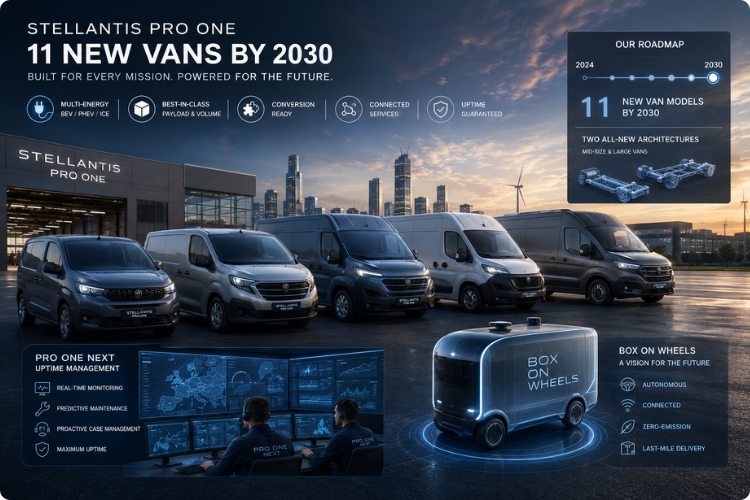
As part of this broader transformation, Stellantis is preparing to launch 11 new van models by 2030, marking one of the most significant upgrades to its commercial vehicle lineup in recent years.
These vans will be built on two next-generation architectures derived from STLA One principles. One will focus on mid-sized vans, while the other will support larger commercial applications. Both architectures will support multiple propulsion types, including electric, hybrid, and internal combustion engines.
The upcoming range will prioritise:
- Payload capacity
- Cargo volume efficiency
- Conversion flexibility for specialist applications
These capabilities are essential for logistics, construction, utilities, emergency services, and last-mile delivery operators.
Fleet Services and Pro One Ecosystem
Beyond vehicle development, Stellantis is expanding its commercial ecosystem through its Pro One strategy, which integrates digital services, connectivity, and lifecycle support.
A key component is Pro One NEXT, an uptime management programme currently being trialled in Europe. It uses real-time vehicle data and dedicated command centres to proactively identify potential issues before they lead to operational downtime.
Key benefits include:
- Predictive maintenance
- Real-time fleet monitoring
- Reduced downtime
- Faster service coordination
- Improved dealer and fleet communication
This approach positions Stellantis as a long-term mobility partner rather than just a vehicle manufacturer.
Compact Van Platform Refresh
Stellantis has also confirmed plans to refresh its global compact van platform before the end of the decade. This update will introduce two new electric powertrain systems based on LFP and NMC battery technologies, reinforcing its dual strategy of affordability and performance across electric commercial vehicles.
“Box on Wheels” Autonomous Concept
A forward-looking element of the strategy is the “Box on Wheels” concept, which explores how autonomous and connected technologies could reshape commercial transport.
The concept is focused on last-mile delivery, one of the fastest-growing logistics segments driven by e-commerce and on-demand services.
Stellantis envisions a zero-emission, driverless delivery system supported by connected logistics services designed to improve efficiency, reduce operating costs, and address challenges such as driver shortages and regulatory pressure.
The concept will be showcased at the IAA Hannover Auto Show on 14 September, where Stellantis Pro One will outline its vision for future professional mobility.

Stellantis is one of the largest van manufacturers in Europe, especially through:
 Call our expert team on