Mercedes-Benz has provided another glimpse of its next-generation Sprinter, revealing more about the design and technology that will underpin its new large van ahead of its planned UK and European arrival in 2027.
The fourth-generation Sprinter is still some way from its full production reveal, but Mercedes is gradually providing more clues about what businesses can expect from its next-generation large van.
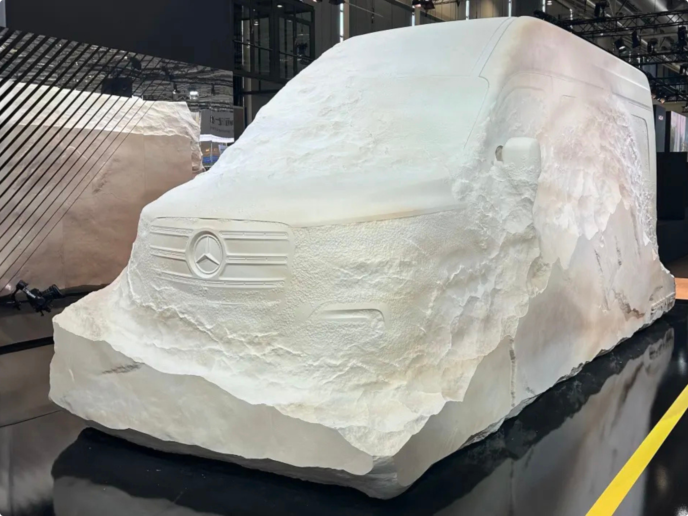
Rather unusually, the latest preview comes in the form of a life-sized stone sculpture.
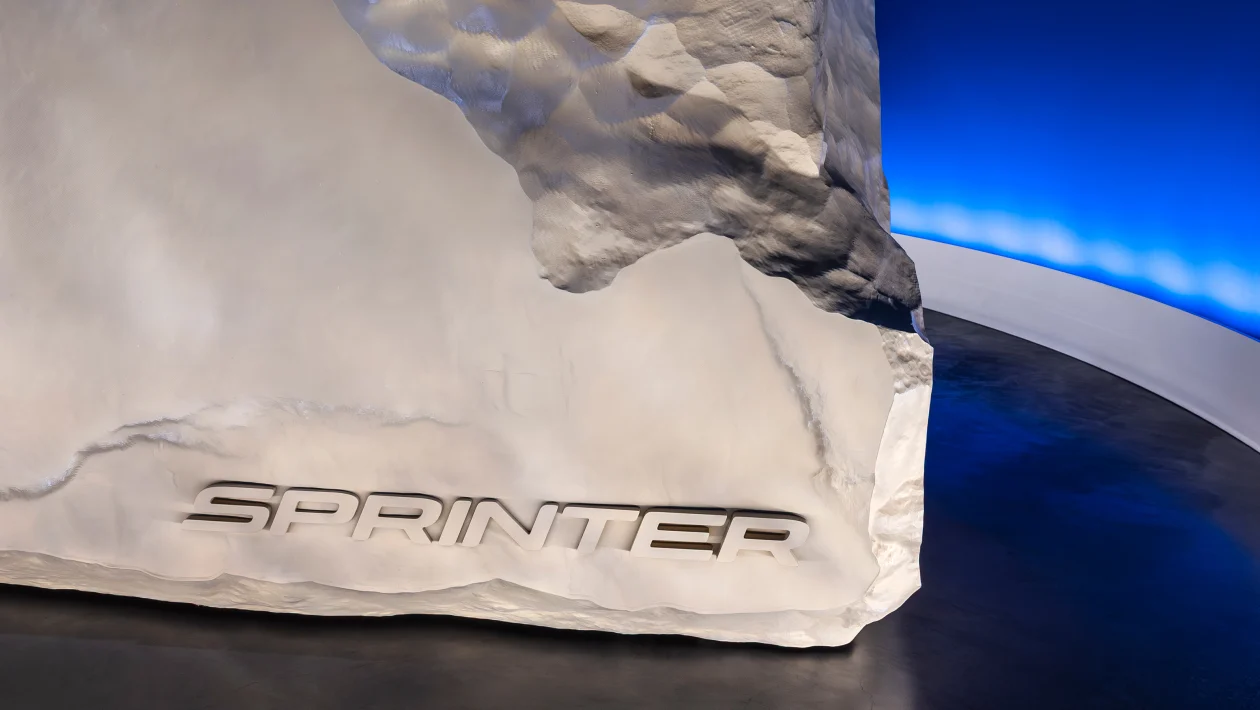
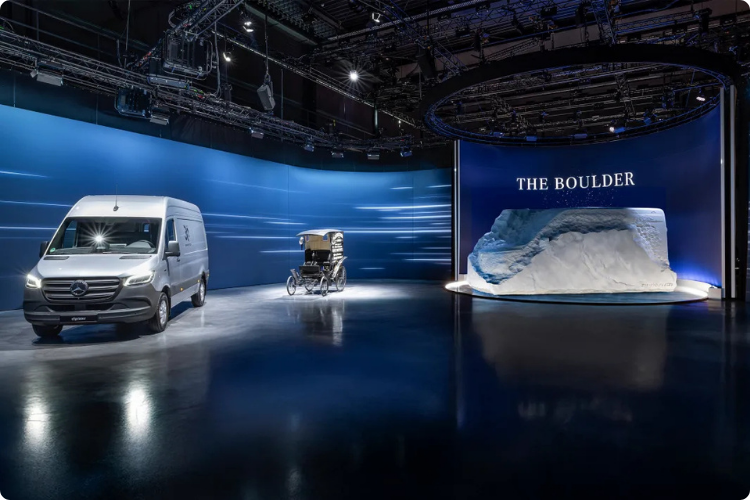
Mercedes first unveiled its so-called ‘Boulder’ concept in 2025, using the unusual design exercise to hint at the shape of the new Sprinter while keeping much of the finished vehicle hidden. The sculpture has now been further developed, exposing additional details of the van’s exterior design.
The new model is expected to continue the Sprinter’s long-standing role as one of the most versatile large commercial vehicles available to businesses, with a wide range of body configurations, drivetrains and specialist conversion possibilities.

A New Look For The Mercedes Sprinter
The latest version of the sculpture gives us a much clearer impression of the fourth-generation Sprinter’s front end.
One of the most obvious changes is the grille, which adopts a taller and more upright design than the unit currently fitted to the existing Sprinter.
This brings the new van visually closer to Mercedes-Benz’s latest passenger and commercial vehicle design language, while the large three-pointed Mercedes star remains prominently positioned at the front.
The bonnet has also been reshaped with smoother surfacing. Mercedes says the revised design has been developed with airflow in mind, helping to improve the aerodynamic performance of the new van.
That could be particularly important for the electric version, where aerodynamic efficiency can have a direct influence on driving range.
The final production design has not yet been fully revealed, so there is still plenty more to come before the new Sprinter reaches showrooms.
Two Platforms For The Next-Generation Sprinter
One of the biggest changes underneath the new Sprinter will be the move to two dedicated platforms.
Electric versions will use Mercedes-Benz’s VAN.EA architecture, while combustion-engined models will be based on the VAN.CA platform.
The VAN.EA architecture is also being used for Mercedes’ next-generation electric people carriers, although the company says the platform has been engineered to allow the Sprinter to retain its own distinct commercial vehicle characteristics.
This means the new Sprinter will not simply be a larger version of Mercedes’ electric passenger vans. Instead, it is being developed around the demanding requirements of commercial operators, including different body lengths, payload requirements and specialist applications.
For businesses considering an electric commercial vehicle, the development of the VAN.EA-based Sprinter will be particularly interesting as electric van technology continues to improve.
Our guide to switching to an electric vehicle looks at some of the wider considerations businesses need to take into account when moving away from conventional petrol and diesel vehicles.

Electric Sprinter Could Offer Around 300 Miles Of Range
Mercedes-Benz has already demonstrated the potential of its VAN.EA technology through early testing of the smaller VLE.
During testing, the VLE reportedly travelled 683 miles while making two 15-minute charging stops, highlighting the potential for rapid charging and improved long-distance usability.
Mercedes has indicated that vehicles based on the platform could potentially achieve around 300 miles of range, although it remains to be seen how that figure will translate to the larger and heavier Sprinter.
The current electric Sprinter already offers a claimed range of up to 279 miles when equipped with its 113kWh battery, meaning the next-generation model could potentially provide a useful improvement.
However, real-world range will depend on factors such as body configuration, payload, weather, driving conditions and the way the vehicle is used.
For commercial operators, charging infrastructure will also remain an important consideration when assessing an electric van. Businesses can read more in our guide to electric vehicle charging for UK businesses.
Built For Different Businesses And Applications
Versatility has always been one of the Sprinter’s biggest strengths, and Mercedes-Benz intends to retain that approach with the new generation.
Both VAN.EA and VAN.CA are modular architectures, allowing Mercedes to produce vehicles in a variety of configurations.
The company has confirmed that the new Sprinter will be available with multiple lengths, wheelbases and weight variants, giving operators greater scope to select a configuration suited to their particular requirements.
This flexibility will also extend beyond conventional panel vans.
Mercedes has highlighted applications including delivery vehicles, refrigerated vans, emergency service vehicles, workshop vehicles and campervans.
That makes the new Sprinter particularly relevant to businesses that require more than a standard load-carrying van.
Specialist conversions can turn a commercial vehicle into a highly tailored working environment, whether that means additional storage, refrigeration, workshop equipment or other business-specific requirements.
Businesses interested in the wider conversion market can read our complete guide to commercial vehicle conversions.
CVC also offers bespoke van leasing, conversions and customisation services for businesses that need a vehicle configured around their individual requirements.
For applications requiring temperature-controlled transport, our guide to refrigerated vans provides further information on the options available to businesses.
Mercedes Sprinter Continues To Target Fleet Operators
The Sprinter has long been established as a major player in the large van market, particularly among businesses operating delivery, logistics, construction, engineering and specialist service fleets.
The arrival of an all-new generation therefore represents an important development for operators looking at their future vehicle requirements.
The availability of both combustion and electric powertrains should also give businesses more flexibility as the UK commercial vehicle market continues to transition towards lower-emission vehicles.
For companies operating mixed fleets, vehicle selection is increasingly influenced by factors beyond purchase price alone, including payload, range, operating costs, charging requirements, taxation and suitability for individual applications.
Businesses looking at their wider fleet requirements can find out more about fleet management solutions for UK businesses, while our fleet van leasing guide looks at how leasing can help companies expand and manage commercial vehicle fleets.
When Will The New Mercedes Sprinter Arrive?
Mercedes-Benz has not yet revealed every detail of the fourth-generation Sprinter, with further information expected as development continues.
The company is expected to reveal more of the production vehicle during the period leading up to its launch, with the new Sprinter currently scheduled to arrive from 2027.
That means there is still considerable time before customers can get behind the wheel, but the latest reveal gives us a clearer indication of the direction Mercedes is taking.
With a new exterior design, dedicated electric and combustion platforms, multiple body configurations and the potential for improved electric range, the next-generation Sprinter looks set to remain a major part of Mercedes-Benz’s commercial vehicle line-up.
For businesses, the most interesting aspect may ultimately be the choice the new model provides. Whether an operator needs a conventional large panel van, an electric delivery vehicle, a refrigerated model, a mobile workshop or another specialist configuration, Mercedes is developing the new Sprinter with flexibility firmly in mind.

 Call our expert team on