Why vehicle safety comparisons have changed in the EV era
As electric vehicles become increasingly common on UK roads, one question continues to generate debate among motorists, fleet operators, and industry experts:
Are electric cars actually safer than petrol cars?
The answer is more nuanced than many headlines suggest.
Modern vehicle safety extends far beyond crash protection. Today’s safety assessments consider a wide range of factors, including:
- Collision protection
- Fire risk
- Occupant injury rates
- Vehicle stability
- Advanced driver assistance systems
- Post-crash safety measures
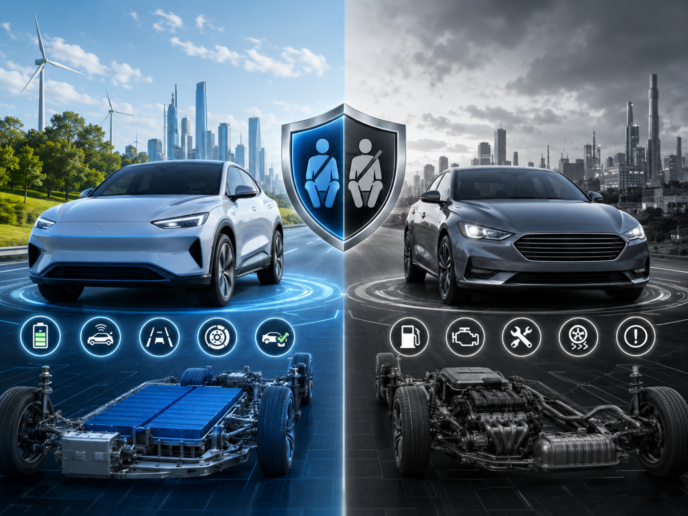
While petrol vehicles have benefited from decades of engineering refinement, electric vehicles have introduced entirely new safety technologies that are changing how manufacturers approach vehicle protection.
As a result, many of the safest vehicles tested in recent years have been electric.
The question is no longer whether EVs can be safe.
The more relevant question is:
How do electric vehicles compare with petrol cars across the full spectrum of vehicle safety in 2026?
Vehicle Safety in 2026: Looking Beyond Crash Tests
Historically, vehicle safety discussions focused primarily on crash survivability.
While crash performance remains critical, modern safety assessments now include:
- Active safety systems
- Accident avoidance technology
- Structural protection
- Fire prevention measures
- Pedestrian protection
- Emergency response systems
Organisations such as Euro NCAP continue to evaluate vehicles using increasingly sophisticated testing procedures.
Many of the highest-scoring vehicles in recent years have been electric models equipped with advanced safety technology as standard.
This reflects a broader industry trend:
Modern vehicle safety is increasingly driven by software, sensors, and electronic monitoring systems rather than mechanical engineering alone.
Why Electric Cars Often Perform Well in Crash Tests
One of the biggest safety advantages of electric vehicles lies in their design.
Unlike petrol cars, EVs do not require:
- Large combustion engines
- Fuel tanks
- Exhaust systems
- Complex transmission tunnels
This creates new opportunities for vehicle engineers.
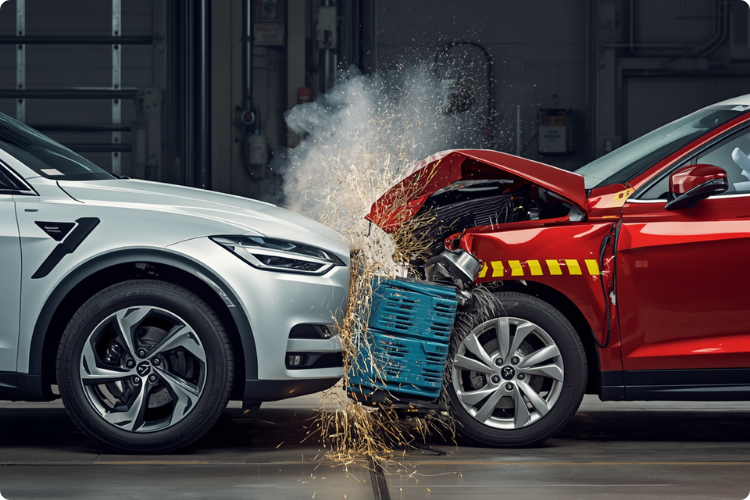
Larger Crumple Zones
Without a traditional engine block occupying the front of the vehicle, manufacturers can design larger impact-absorbing structures.
These crumple zones help dissipate collision energy before it reaches occupants.
Lower Centre of Gravity
The battery pack is typically mounted beneath the floor.
This lowers the vehicle’s centre of gravity and improves stability during:
- Sudden manoeuvres
- Emergency braking
- High-speed cornering
It also reduces rollover risk compared with many conventional vehicles.
Strong Passenger Safety Cell
Because battery packs require protection from impact damage, EV platforms are often built around extremely rigid structural frames.
These reinforced safety cells can provide excellent occupant protection in serious collisions.
Are Electric Cars More Likely to Catch Fire?
Fire risk is often one of the first concerns raised when discussing EV safety.
However, available evidence continues to suggest that electric vehicles are generally less likely to catch fire than petrol or diesel vehicles.
This is partly because petrol vehicles carry highly flammable liquid fuels throughout their operating life.
Common causes of petrol vehicle fires include:
- Fuel leaks
- Engine overheating
- Electrical faults
- Oil leaks
- Collision-related fuel release
Electric vehicles face different risks, primarily involving lithium-ion battery systems.
While EV battery fires can be more technically complex when they occur, they remain comparatively rare relative to the overall size of the EV fleet.
For a detailed breakdown, see our guide to EV fire statistics 2026 and electric vehicle fire risk comparison
For a detailed breakdown, see our guide to EV fire statistics 2026 and electric vehicle fire risk comparison.
Advanced Driver Assistance Systems Give EVs an Edge
Many modern EVs are equipped with advanced safety technologies as standard.
These systems help prevent accidents before they occur.
Examples include:
Automatic Emergency Braking (AEB)
Detects potential collisions and can apply brakes automatically.
Lane Keeping Assistance
Helps prevent unintended lane departures.
Blind Spot Monitoring
Warns drivers of vehicles in adjacent lanes.
Adaptive Cruise Control
Maintains safe distances from other vehicles.
Driver Attention Monitoring
Identifies signs of fatigue or distraction.
Although these technologies are increasingly common across all vehicle types, EV manufacturers have often adopted them more rapidly due to their software-focused vehicle architecture.
Battery Safety Systems Have Improved Dramatically
Early concerns about electric vehicle battery safety largely stemmed from the first generation of mass-market EVs.
Battery technology has advanced significantly since then.
Modern EVs now feature:
- Continuous battery monitoring
- Advanced thermal management systems
- Automatic fault detection
- Crash-triggered isolation systems
- Multiple layers of electrical protection
Battery management systems continuously monitor:
- Temperature
- Voltage
- Charging performance
- Cell health
These safeguards help reduce the likelihood of serious battery failures.
Petrol Cars Still Have Safety Advantages
Despite the rapid advancement of EV technology, petrol vehicles continue to offer several advantages.
Longer Safety Track Record
Petrol vehicles have been refined over more than a century of development.
Manufacturers possess extensive real-world safety data across multiple generations of vehicles.
Faster Emergency Refuelling
Although not a direct safety issue, shorter refuelling times can reduce exposure during roadside breakdown situations.
Familiarity for Emergency Responders
Firefighters, recovery operators, and repair technicians have decades of experience working with conventional vehicles.
However, this gap continues to narrow as EV adoption increases.
Real-World Safety Data: What Do Accident Studies Show?
Several studies examining accident outcomes suggest that electric vehicles perform well in real-world crashes.
Researchers have identified a number of contributing factors:
- Strong structural design
- Lower rollover rates
- Advanced safety technology
- Improved vehicle stability
- Sophisticated collision avoidance systems
However, it is important to recognise that many EVs on the road today are newer vehicles equipped with the latest safety technologies.
This can make direct comparisons with older petrol vehicles more challenging.
Vehicle age remains an important factor when evaluating accident statistics.
Public Perception vs Reality
One reason the safety debate continues is that public perception often focuses on highly visible incidents.
| Public Perception | What the Evidence Shows |
|---|---|
| EV batteries make electric cars dangerous | Modern battery systems include extensive safety protections |
| EVs catch fire more often | Available evidence suggests petrol and diesel vehicles experience more fires overall |
| Electric cars are unsafe in crashes | Many EVs achieve excellent crash-test results |
| Battery damage always leads to fire | Most collision-damaged batteries do not catch fire |
| EV technology is unproven | Modern EVs are now a mainstream global vehicle category |
Understanding these distinctions helps separate isolated incidents from broader safety trends.
Expert Insight: Safety Is About Prevention, Not Just Survival
The safest accident is the one that never happens.
This is why modern vehicle safety increasingly focuses on preventing collisions rather than simply protecting occupants during impact.
Electric vehicles often benefit from:
- Advanced sensor systems
- Continuous software updates
- Integrated driver assistance technologies
- Real-time vehicle monitoring
These systems can help reduce accident risk before a collision occurs.
As a result, vehicle safety discussions are increasingly shifting away from purely mechanical considerations toward technology-driven prevention.
Are Electric Cars Safer Than Petrol Cars in 2026?
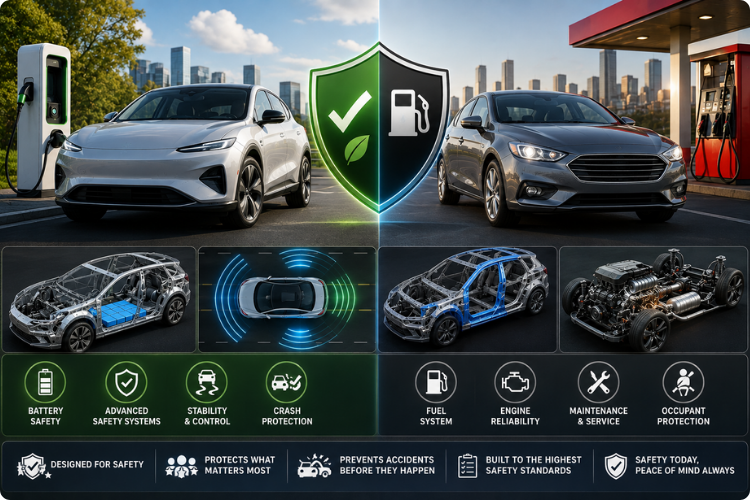
The evidence available in 2026 suggests that modern electric vehicles compare extremely well with petrol cars across most major safety measures.
Electric vehicles benefit from:
- Strong crash-test performance
- Advanced driver assistance systems
- Improved vehicle stability
- Sophisticated battery safety technology
- Lower overall vehicle fire incidence rates
Petrol vehicles remain highly safe and continue to benefit from decades of engineering development.
However, the assumption that electric vehicles are inherently less safe is not supported by current evidence.
For many drivers, the reality may be the opposite.
As vehicle technology continues to evolve, electric vehicles are increasingly setting the benchmark for modern automotive safety.
Continue Reading: EV Fire Safety & Electric Vehicle Research
Want to learn more about electric vehicle safety, battery technology, and vehicle fire risks? Explore our latest guides below:
- EV Fire Risk vs Petrol & Diesel (2026 Update): What the Data Really Shows – Discover how EV fire rates compare with petrol and diesel vehicles and what the latest evidence reveals.
- EV vs Hybrid vs Petrol Fire Risk Comparison – Compare fire risks across different vehicle types and understand how modern safety systems influence outcomes.
- EV Battery Safety Improvements (2020–2026): How Modern EVs Became Safer – Explore the technological advances that have helped improve battery protection and thermal management.
- Why EV Fires Go Viral Online: Media Bias, Social Media and Risk Perception – Learn why electric vehicle fires often attract disproportionate attention despite their relatively low frequency.
- What Actually Causes Lithium-Ion Battery Fires? The Real Risks Explained – This guide explains thermal runaway, battery damage, charging failures, manufacturing defects, and the safety systems designed to reduce fire risk
- Do Electric Cars Catch Fire While Charging? – The Truth About EV Charging Safety – This guide explores how EV charging systems work, what can cause rare charging-related incidents, the safety protections built into modern electric vehicles, and why charging an EV is generally considered one of the safest aspects of EV ownership.
- Are EV Fires Harder to Extinguish Than Petrol Vehicle Fires? (2026 Guide) – This guide explains why lithium-ion battery fires behave differently from conventional vehicle fires, how thermal runaway can affect firefighting efforts, the specialist techniques used by fire services, and what the latest evidence reveals about EV fire risk and emergency response.
Whether you’re researching electric vehicle safety, battery technology, or the facts behind EV fire statistics, these guides provide evidence-based insights into one of the most discussed topics in modern motoring.
Are Electric Cars Safer Than Petrol Cars in 2026 – Frequently Asked Questions
Many modern electric vehicles achieve excellent crash-test ratings due to their strong structural design, large crumple zones, and low centre of gravity. However, safety ultimately depends on the specific vehicle model and its safety features.
No. Current evidence suggests that petrol and diesel vehicles experience more fire incidents overall than electric vehicles when measured across entire vehicle fleets.
Electric vehicles often benefit from reinforced battery structures, rigid passenger compartments, advanced safety technology, and improved weight distribution, all of which can contribute to strong crash-test performance.
Modern EV batteries are protected by crash-resistant enclosures, thermal management systems, and automatic isolation mechanisms designed to reduce the risk of electrical faults or battery damage following a collision.
Many electric vehicles include advanced driver assistance systems as standard, such as automatic emergency braking, lane-keeping assistance, adaptive cruise control, and driver monitoring systems.
Generally, no. The battery pack is usually positioned low in the vehicle, creating a lower centre of gravity that can improve stability and reduce rollover risk.
Many electric vehicles achieve top safety ratings and offer advanced occupant protection systems, making them a popular choice for family transport.
While no vehicle is completely risk-free, current evidence suggests that many modern electric vehicles compare favourably with petrol cars across crash safety, fire risk, stability, and accident prevention technologies.
Current evidence suggests petrol and diesel vehicles experience more fire incidents overall than electric vehicles.
 Call our expert team on