Lease Purchase can provide a practical way for businesses to finance a van while keeping monthly payments lower than traditional Hire Purchase.
Instead of paying off the entire cost of the vehicle through the regular monthly instalments, Lease Purchase defers part of the balance until the end of the agreement. This final amount is known as a balloon payment.
Once the agreement has been completed and the final balloon payment and any applicable fees have been paid, ownership can transfer to the customer, subject to the terms of the finance agreement.
This can make Lease Purchase an attractive option for businesses that want to own their van but would prefer lower monthly payments during the agreement.
However, Lease Purchase is not right for every business.
The final balloon payment needs to be considered carefully, as you remain responsible for settling it at the end of the agreement.
In this guide, we explain how Lease Purchase works, what it costs, the advantages and disadvantages, and how it compares with other popular van finance options.
What Is Lease Purchase?
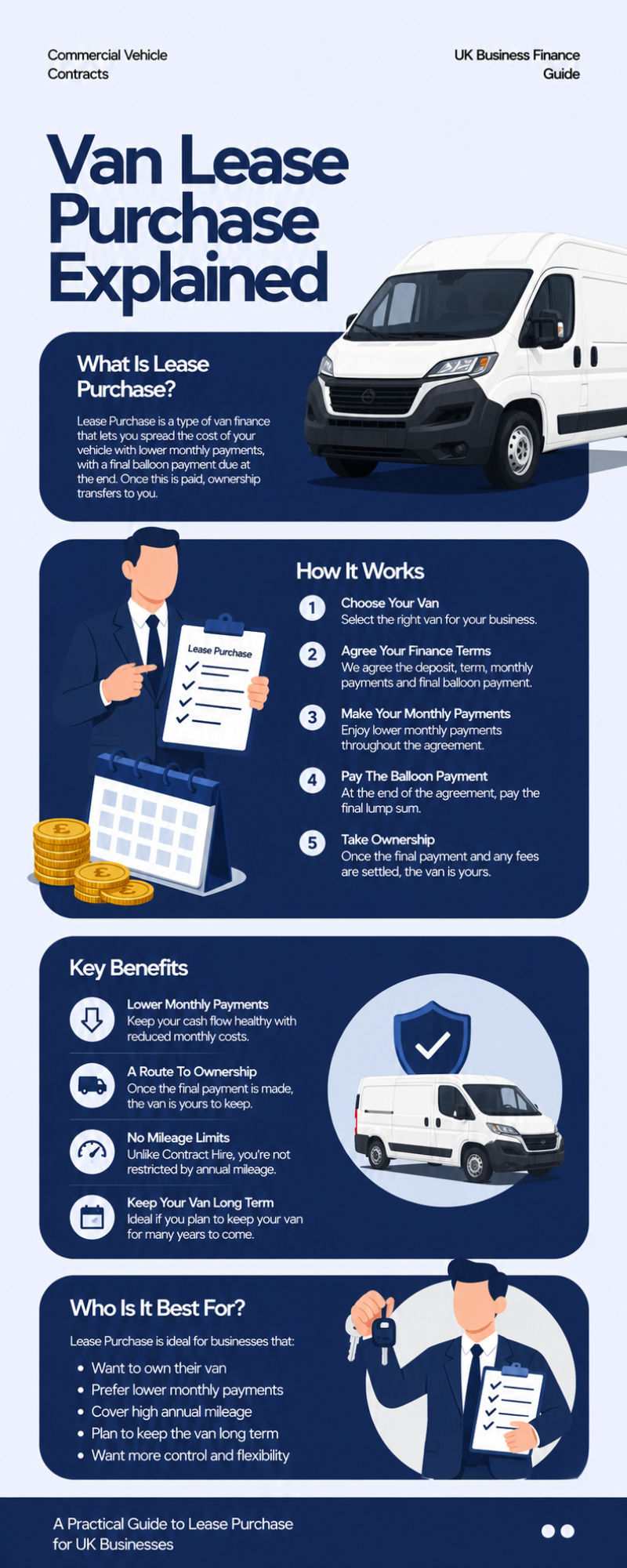
Lease Purchase is a form of vehicle finance that allows you to spread the cost of a van over an agreed period while deferring part of the balance until the end of the agreement.
A Lease Purchase agreement will typically involve:
- An initial deposit
- Fixed monthly payments
- A final balloon payment
The monthly payments are lower than they would be if the entire cost of the vehicle were spread evenly across the agreement because a proportion of the balance is deferred until the end.
Once the agreement has been completed and the final payment has been made, ownership of the vehicle can transfer to you, subject to the terms of the finance agreement.
Lease Purchase is therefore particularly suited to businesses that intend to keep their van long-term but want to reduce their monthly finance commitment.
How Does Lease Purchase Work?
Lease Purchase is relatively straightforward.
The process normally works like this:
1. Choose Your Van
You select the commercial vehicle that meets your business requirements.
This could be a:
- Small vans
- Medium vans
- Large vans
- Electric vans
- Pick-up trucks
- Crew vans
- Dropside vans
- Tippers
- Luton vans
- Minibuses
- Specialist commercial vehicles
- Converted commercial vehicles
2. Agree Your Finance Terms
You then agree the:
- Initial deposit
- Contract length
- Monthly payment
- Final balloon payment
- Applicable interest rate and fees
The exact figures will depend on the vehicle, finance provider and your circumstances.
3. Make Your Monthly Payments
You make the agreed monthly payments throughout the contract.
Because part of the balance is deferred until the end, the monthly payments can be lower than a comparable Hire Purchase agreement.
4. Pay The Balloon Payment
At the end of the agreement, the remaining balance becomes payable.
This is known as the balloon payment or final payment.
5. Take Ownership
Once all contractual payments and applicable fees have been paid, ownership of the vehicle can transfer to you.
This is one of the key differences between Lease Purchase and Finance Lease.
What Is A Balloon Payment?
A balloon payment is a larger final payment that is deferred until the end of a finance agreement.
With Lease Purchase, the balloon is agreed at the beginning of the contract.
For illustration purposes, a simplified agreement could look like this:
| Finance Element | Example |
|---|---|
| Vehicle price | £35,000 |
| Initial deposit | £5,000 |
| Monthly payments | £450 |
| Contract length | 48 months |
| Final balloon payment | £12,000 |
This example does not represent a quotation and does not show the interest or fees that could apply to an actual finance agreement.
The balloon payment allows you to reduce the amount being paid through the regular monthly instalments.
However, it also means you need to plan for a significant payment at the end of the agreement.
Why Are Lease Purchase Monthly Payments Lower?
With traditional Hire Purchase, the financed balance is generally paid down through the monthly instalments, alongside interest and any applicable fees.
Lease Purchase can have lower monthly payments than Hire Purchase because part of the balance is deferred until the end of the agreement as a balloon payment.
This means less of the vehicle’s cost needs to be covered by the regular monthly instalments. However, the deferred amount still has to be paid, and interest and applicable fees can affect the overall cost.
Businesses should therefore compare the total amount payable rather than looking only at the monthly payment.
Lease Purchase Example
Imagine a business wants to finance a £35,000 van.
With a standard Hire Purchase agreement, more of the vehicle’s cost could be spread across the monthly payments.
With Lease Purchase, the business could instead agree to defer £12,000 until the end of the agreement.
This could produce lower monthly payments.
However, after making the regular monthly payments, the business would still need to settle the £12,000 balloon payment to complete the purchase.
The example demonstrates the main principle behind Lease Purchase:
Lower monthly payments in exchange for a larger final payment.
The actual balloon payment, monthly rental and total cost will vary according to the vehicle, finance provider, term, deposit, interest rate and customer circumstances.
What Are The Benefits Of Lease Purchase?
Lease Purchase can offer several advantages for businesses.
Lower Monthly Payments
The biggest attraction is often the potential for lower monthly payments compared with traditional Hire Purchase.
This can help businesses manage monthly cash flow.
A Route Towards Ownership
Unlike Contract Hire, Lease Purchase is designed around eventual ownership.
Once the agreement has been completed and the final payment and any applicable fees have been paid, ownership can transfer to you, subject to the terms of the finance agreement.
No Agreed Mileage Limit
Lease Purchase is a purchase finance product rather than a traditional contract hire agreement.
As a result, it does not normally operate with the same annual mileage restrictions associated with Contract Hire.
CVC’s own finance documentation states that Hire Purchase and Lease Purchase do not come with mileage restrictions.
Useful For High-Mileage Businesses
Because mileage is not normally restricted in the same way as Contract Hire, Lease Purchase can be suitable for businesses that cover significant annual mileage.
This could include:
- Couriers
- Builders
- Electricians
- Plumbers
- Landscapers
- Delivery businesses
- Construction companies
- Agricultural businesses
Keep The Vehicle Long Term
If you expect to keep the van for many years, Lease Purchase can provide a structured route towards ownership.
You are not relying on the vehicle being returned to the finance company at the end of a Contract Hire agreement.
What Are The Disadvantages Of Lease Purchase?
Lease Purchase also has some important disadvantages.
You Need To Plan For The Balloon Payment
The biggest consideration is the final payment.
A lower monthly payment can look attractive, but you need to be confident that you can afford the balloon payment when it becomes due.
The Vehicle Is Not Yours Until The Agreement Is Completed
Although Lease Purchase is designed to lead to ownership, the vehicle does not simply become yours because you have made the monthly payments.
The contractual requirements, including the final payment, need to be completed before ownership transfers.
You Take The Depreciation Risk
Because you are working towards ownership, you ultimately take responsibility for the vehicle’s future value.
If the van is worth less than expected at the end of the agreement, that does not normally remove your obligation to settle the agreed balloon payment.
It May Cost More Overall
Lower monthly payments do not automatically mean a cheaper finance agreement.
The total cost of finance should always be compared, including interest, deposit, monthly payments, balloon payment and any applicable fees.
The Vehicle Cannot Simply Be Returned
Lease Purchase should not be confused with Business Contract Purchase.
Lease Purchase is designed as a purchase-based finance agreement. It should not be chosen with the expectation that you can simply hand the vehicle back at the end of the agreement if you no longer want it.
Is There A Mileage Limit With Lease Purchase?
Generally, Lease Purchase does not have the annual mileage restrictions associated with Contract Hire.
This can make it attractive to businesses that cover high mileage.
For example, a courier company covering 30,000 or 40,000 miles a year may prefer a purchase-based finance agreement because it does not have to work within a Contract Hire mileage allowance.
Although Lease Purchase does not normally impose an annual mileage allowance in the same way as Contract Hire, expected mileage can still be relevant when determining the vehicle’s anticipated future value and therefore the structure of the agreement.
The vehicle’s anticipated usage should therefore be discussed when arranging finance, particularly where the vehicle is expected to cover significant mileage.
What Happens At The End Of A Lease Purchase Agreement?
At the end of the agreement, you need to settle the final balloon payment and any applicable fees.
Once the contractual requirements have been met, ownership can transfer to you.
This means you can continue using the van without entering into another finance agreement.
This is different from Business Contract Hire, where the vehicle is normally returned to the finance provider at the end of the contract.
It is also different from Finance Lease, where ownership does not transfer directly to the customer.
Lease Purchase vs Hire Purchase
Lease Purchase and Hire Purchase are similar because both are designed to provide a route towards vehicle ownership.
The main difference is how much you pay during the agreement and how much is deferred until the end.
| Feature | Lease Purchase | Hire Purchase |
|---|---|---|
| Initial Deposit | Usually required | Usually required |
| Monthly Payments | Lower due to balloon | Generally higher |
| Balloon / Final Payment | Yes | Normally no large balloon |
| Mileage Restriction | No standard annual mileage allowance | No standard mileage allowance |
| Ownership | After final payment | After completion and applicable purchase fee |
| Best Suited To | Lower monthly payments + planned ownership | Straightforward ownership |
Which Is Better?
Neither is automatically better.
Lease Purchase may suit a business that wants to reduce its monthly payments and is comfortable planning for a large final payment.
Hire Purchase may be better for a business that wants to spread more of the vehicle’s cost across the regular monthly payments and avoid a large balloon payment.
If you can afford higher monthly payments, Hire Purchase can provide a simpler repayment structure.
If keeping monthly costs lower is more important, Lease Purchase may be worth considering.
Lease Purchase vs Finance Lease
These two products are often confused because they both involve a final payment.
However, they have fundamentally different outcomes.
| Feature | Lease Purchase | Finance Lease |
|---|---|---|
| Designed for ownership | Yes | No direct ownership |
| Balloon/final payment | Yes | May be available depending on structure |
| Mileage restrictions | No standard annual allowance | Depends on agreement |
| Depreciation risk | Customer | Customer |
| End of agreement | Complete purchase | End-of-term options depend on agreement |
Under a Finance Lease, the customer does not simply become the owner by making the final payment. Finance Lease has different end-of-term arrangements and does not normally result in direct ownership of the vehicle. See our Finance Lease guide for a full explanation.
If your primary goal is to own the van, Lease Purchase is the more direct finance structure to investigate.
Lease Purchase vs Business Contract Purchase
Lease Purchase and Business Contract Purchase can look very similar because both can use a final balloon payment.
However, the key difference is the flexibility available at the end.
Business Contract Purchase can provide greater flexibility at the end of the agreement, depending on the contract. You may have the option to pay the final amount and take ownership of the vehicle, or return the vehicle instead.
Lease Purchase is intended for businesses that know they want to own the vehicle and are prepared to settle the final payment.
If you are undecided about whether you want to keep the van, a different finance product may be more appropriate.
Who Is Lease Purchase Suitable For?
Lease Purchase may be suitable for businesses that:
- Want to own their van eventually
- Want lower monthly payments
- Expect to keep the vehicle beyond the finance term
- Want to avoid mileage-based excess charges associated with some leasing products
- Are comfortable with a final balloon payment
- Cover high annual mileage
- Want to keep the vehicle for several years
- Want greater control over the vehicle
- Do not want Contract Hire mileage restrictions
- Are comfortable taking responsibility for depreciation
It could be particularly relevant to tradespeople, contractors, delivery businesses, construction companies and fleet operators.
Can You Use Lease Purchase For Pickups And Commercial Vehicles?
Yes.
Lease Purchase is not limited to conventional panel vans.
Depending on the finance provider and vehicle, businesses can potentially use Lease Purchase for a wide range of commercial vehicles, including:
- Pickups
- Crew vans
- Dropside vans
- Tippers
- Luton vans
- Specialist commercial vehicles
- Converted vehicles
The suitability of Lease Purchase will depend on the vehicle, finance provider and individual finance application.
This makes Lease Purchase particularly interesting for businesses purchasing a vehicle that they expect to keep for the long term.
Can You Finance An Electric Van With Lease Purchase?
Electric vans can potentially be financed through Lease Purchase in the same way as other commercial vehicles, subject to the finance provider and vehicle. Availability will depend on the vehicle and finance provider.
This can provide businesses with a way to spread the cost of an electric commercial vehicle while working towards ownership.
However, electric vans can experience different depreciation patterns from diesel vehicles.
For this reason, businesses should pay particular attention to the agreed balloon payment and the total amount payable before entering into an agreement.
If you are considering an electric van, it is worth comparing Lease Purchase with other options such as Finance Lease and Contract Hire.
VAT And Lease Purchase
VAT treatment can vary depending on the type of finance agreement, the vehicle and how it is used by your business.
For a VAT-registered business, VAT may be recoverable where the relevant HMRC rules and conditions are met. The amount that can be reclaimed can depend on the vehicle and how it is used, including whether there is any private use.
It is important not to assume that all vehicle finance agreements have the same VAT treatment. Lease Purchase, Hire Purchase, Finance Lease and Contract Hire can be treated differently for VAT purposes.
If VAT recovery is an important factor in your finance decision, you should speak to your accountant or tax adviser to confirm how the rules apply to your business.
Lease Purchase And Business Cash Flow
One of the main reasons businesses consider Lease Purchase is cash flow.
Buying a van outright requires a substantial amount of capital immediately.
Hire Purchase spreads the cost over time but can result in higher monthly payments.
Lease Purchase provides another option by deferring part of the cost until the end.
This can leave a business with more working capital available for:
- Stock
- Wages
- Marketing
- Equipment
- Business expansion
- Fuel and charging costs
- Unexpected expenses
However, the balloon payment should always be included in your cash-flow planning.
A lower monthly payment is only useful if the business has a realistic strategy for meeting the final payment.
Why Choose Commercial Vehicle Contracts?
At Commercial Vehicle Contracts, we understand that choosing a commercial vehicle is only part of the decision.
The finance agreement needs to work for your business as well as the vehicle itself.
With more than 25 years of experience helping UK businesses source commercial vehicles and finance solutions, we can help you compare different finance options and find a vehicle that meets your requirements
As an independent vehicle leasing broker, we can explain the key differences between Business Contract Hire, Finance Lease, Hire Purchase, Lease Purchase and Outright Purchase, helping you choose the option that best suits your business.
Commercial Vehicle Contracts is FCA authorised and regulated and a British Vehicle Rental and Leasing Association (BVRLA) member.
If you’re still deciding which type of finance is right for your business, our business van leasing options cover a wide range of vehicles and finance solutions.
Lease Purchase FAQs
Lease Purchase does not normally have the annual mileage allowances associated with Contract Hire. However, expected mileage can still be relevant when determining the vehicle’s anticipated future value and the structure of the finance agreement.
Yes. Lease Purchase is designed to provide a route towards ownership. Once the agreement has been completed and the final balloon payment and any applicable fees have been paid, ownership can transfer to you, subject to the terms of the finance agreement.
A balloon payment is a larger final payment that is deferred until the end of the Lease Purchase agreement. It reduces the amount that needs to be paid through the regular monthly payments, but the balloon payment must be settled to complete the purchase of the vehicle.
Lease Purchase can provide lower monthly payments than Hire Purchase because part of the balance is deferred until the end of the agreement. However, lower monthly payments do not necessarily mean a lower overall cost. Businesses should compare the total amount payable, including interest, the deposit, monthly payments, balloon payment and any applicable fees.
Yes, electric vans can potentially be financed through Lease Purchase, subject to the vehicle, finance provider and individual finance application. Businesses should consider the vehicle’s expected future value when agreeing the balloon payment, particularly because electric van depreciation can vary between models.
Yes. Depending on the finance provider and vehicle, Lease Purchase can potentially be used for pickup trucks and other commercial vehicles, including crew vans, dropsides, tippers, Luton vans and specialist or converted vehicles.
You remain responsible for settling the agreed balloon payment under the finance agreement. If the vehicle is worth less than the outstanding balloon payment, the difference does not normally remove your obligation to make the final payment. This is why the agreed balloon payment and expected future value should be considered carefully before entering into the agreement.
Neither option is automatically better. Lease Purchase may suit a business that wants lower monthly payments and is comfortable planning for a larger final balloon payment. Hire Purchase may suit a business that wants to spread more of the vehicle’s cost across the regular monthly payments and avoid a large balloon payment.
Lease Purchase is designed as a purchase-based finance agreement rather than a vehicle-return product. You should not choose Lease Purchase expecting to simply hand the van back at the end of the agreement. The final payment and other contractual requirements normally need to be settled to complete the purchase.
It can be. Lease Purchase does not normally have the annual mileage allowances associated with Contract Hire, which can make it attractive to businesses covering significant mileage. However, expected mileage can still be relevant when determining the vehicle’s anticipated future value and the structure of the finance agreement.
 Call our expert team on